Measure blood pressure properly, choose a target when guidelines disagree, and treat resistant hypertension.
PublishedNailathalaGipatikPepalwal:ReferencesMga SanggunianMga TinubdanReng Reperensya:13Audience: Adult and pediatric nephrology fellows · internal medicine and pediatric residents · medical interns on medicine, pediatrics, ICU and dialysis rotations, and residents who work shifts as dialysis physicians on dutyRead timeOras ng pagbasaOras sa pagbasaOras ning pamamasa:
Training track for nephrology fellows, residents and medical interns
Study material for medical interns, residents and fellows. It explains the reasoning behind common decisions; it is not a protocol and gives no drug doses. Doses, rates and order sets come from current guidelines, product labels, your institution’s approved protocols and your supervising physician. Benefit rules change: confirm them on the date of service. Every case is fictional.
Learning objectives
After this module you should be able to
Intern: Measure blood pressure the standardized way, record it with the cuff size and the conditions, and recognize the readings that need a physician now.
Resident: Choose a blood pressure target and drug classes for a patient with chronic kidney disease (CKD), starting with renin-angiotensin system inhibitors (RASi) where albuminuria calls for them, and monitor potassium and creatinine safely.
Fellow: Reconcile the Kidney Disease: Improving Global Outcomes (KDIGO) 2021 target, the 2025 American Heart Association/American College of Cardiology (American Heart Association (AHA)/ACC) target and the Systolic Blood Pressure Intervention Trial (SPRINT) evidence, and work up and treat resistant hypertension and cardiovascular risk.
Pre-testBefore you read, answer the 5 self-assessment questions and note your score. After the module, select New set of questions and compare. The difference is what you learned; the questions you still miss are what to reread.
Start here
The big picture, in plain words
Your role · the pressure in CKD, from cuff to planAs an intern, you own the number: a reading taken badly will mislead every decision after it. As a resident, you own the plan for the day: the target your attending sets, the drug that protects the kidney, and the potassium and creatinine checked at the right time. As a fellow, you own the hard cases: the patient whose pressure will not come down, the guideline disagreement a resident asks you about at 2 a.m., and the cardiovascular risk that kills more patients with CKD than kidney failure does.
In plain wordsThink of the glomerulus as a coffee filter attached to a garden hose. The water pressure in the street (systemic blood pressure) is passed through a tap (the afferent arteriole) to the filter. In a healthy kidney the tap adjusts itself so that the filter sees roughly the same pressure whatever the street does.
The picture has a limit. In CKD the tap stops adjusting. Fewer nephrons, scarred arterioles and the dilation that comes with hyperfiltration mean that more of the street pressure reaches each remaining glomerulus. High systemic pressure then becomes high glomerular pressure, more albumin leaks, and scarring speeds up. At the same time, a stiff, calcified arterial tree and sodium retention keep the systemic pressure high. That is why pressure control in CKD protects both the heart and the kidney, and why drugs that relax the efferent arteriole (the outflow side of the filter) lower glomerular pressure more than their effect on the arm cuff suggests.
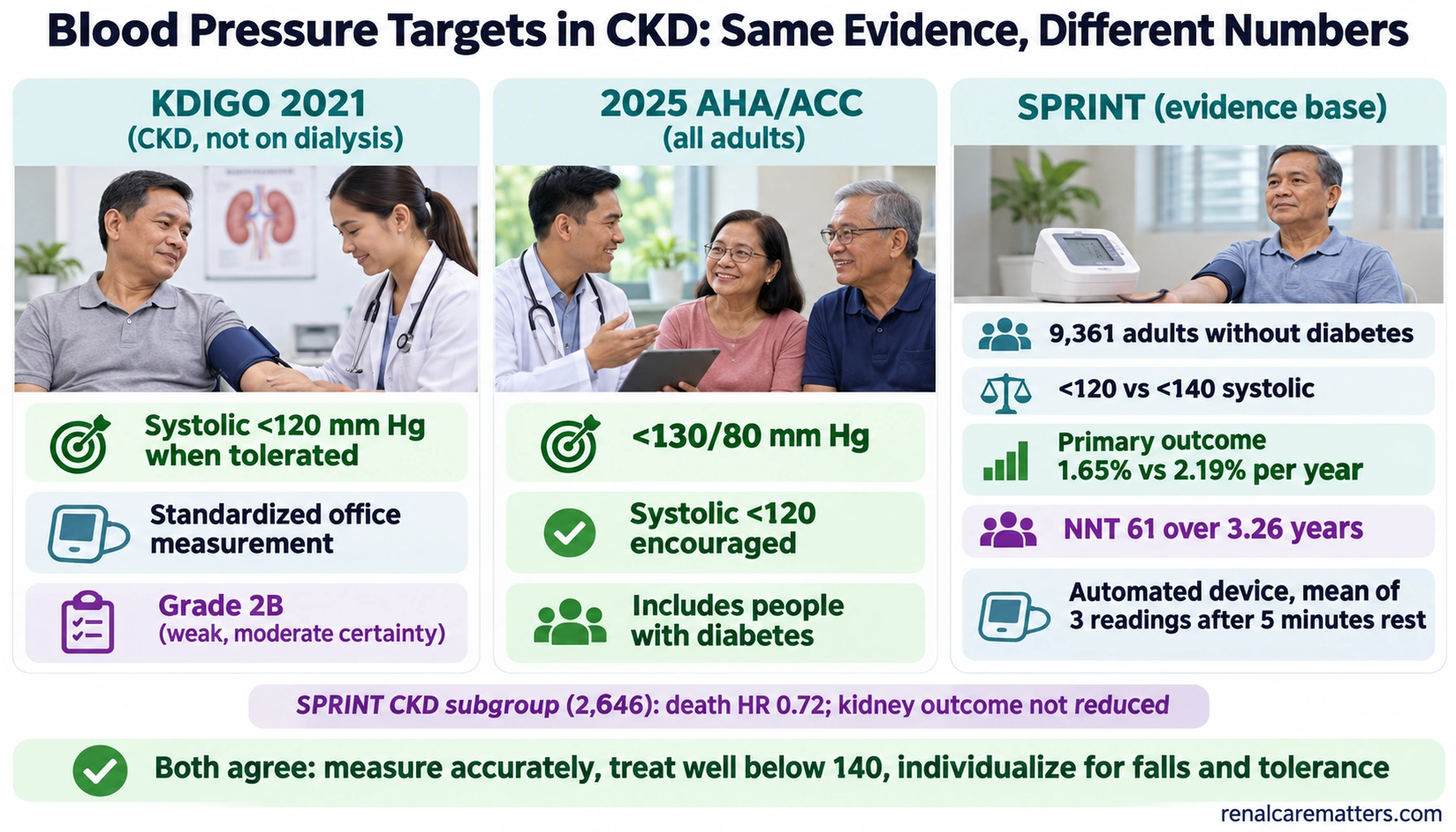
Target (KDIGO 2021)Systolic below 120 mm Hg when tolerated, by standardized office measurement (2B)
Target (2025 AHA/ACC)Below 130/80 mm Hg for all adults, with encouragement to reach a systolic below 120 mm Hg
SPRINT, 9,361 adults without diabetesPrimary outcome 1.65% vs 2.19% per year; number needed to treat 61 over a median 3.26 years
Sodium (KDIGO 2021)Below 2 g of sodium a day (2C)
RASi (KDIGO 2021)Recommended for CKD with severely increased albuminuria without diabetes (1B) and for CKD with moderately to severely increased albuminuria with diabetes (1B)
Most patients with CKD and high blood pressure can be controlled with an accurate measurement, less salt, a RASi where albuminuria calls for it, and two or three other drugs taken every day. A few have resistant hypertension with a cause you can find, such as primary aldosteronism, and a few have a hypertensive emergency. Your work is to get the number right, to pick a target and say why, to choose drugs that protect the kidney, and to remember the heart.
Opening case · fictional
Case: The tricycle driver with the pounding headache
Thursday, 3 p.m., the internal medicine clinic of a provincial hospital in Tarlac City. Mr. Danilo Ramos, 59, drives a tricycle near the public market. He came because of a headache that started this morning. He has had high blood pressure for 10 years and takes amlodipine “when the head is heavy.” He does not have diabetes. Lunch today was instant noodles and dried fish with rice, eaten with patis; at home his wife cooks with bagoong and soy sauce most days.
The triage nurse took his pressure on arrival, with the cuff over his sleeve, right after he climbed two flights of stairs: 168/100 mm Hg. His creatinine is 2.0 mg/dL, estimated glomerular filtration rate (eGFR) 36 mL/min/1.73 m² (it was 44 a year ago), urine albumin-to-creatinine ratio (ACR) 120 mg/g, potassium 4.8 mmol/L. He has no chest pain, breathlessness, confusion or visual change. His 10-year-old daughter sells kakanin outside the clinic; he cannot afford to lose a day’s driving.
The intern asks you whether to give “something to bring it down now” and which target to write: 140, 130 or 120.
Before reading on, decide:
Is this reading reliable, and is it an emergency?
Which target will you set for him, and how will you defend it?
Which drugs will you suggest to the attending, and what will you monitor?
Keep your answers in mind. The lesson gives you what you need, and the case review near the end shows one sound response.
Lesson · part 1
Measurement: the number every decision rests on
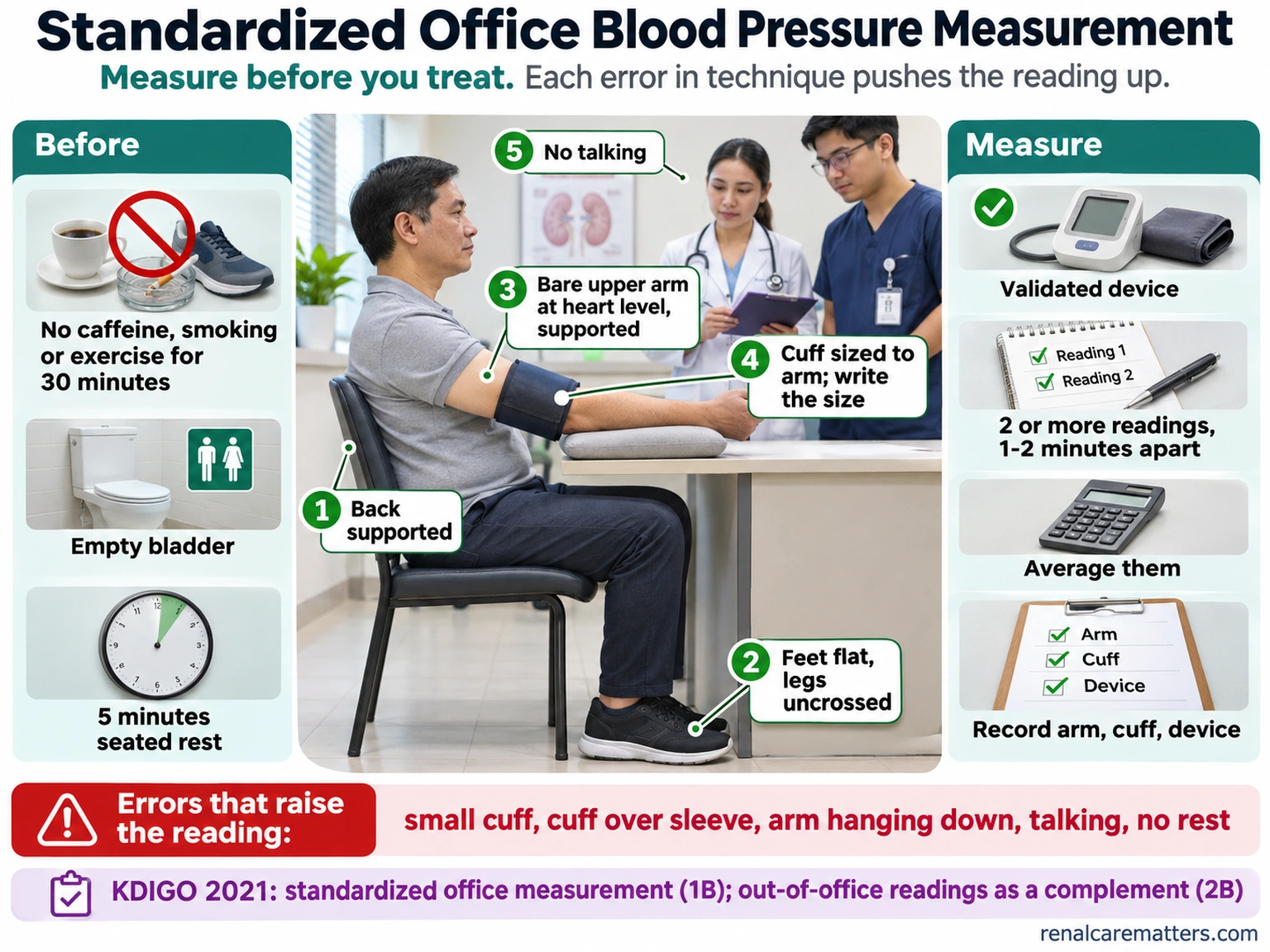
A blood pressure reading is a physical measurement with known sources of error, and almost all of them push the number up. A cuff that is too small, an unsupported arm, legs crossed, a full bladder, talking, a cigarette or coffee within the half hour, and no rest after walking in can each add several mm Hg. Together they can add enough to move a patient from controlled to uncontrolled, or from one drug to three.
The Kidney Disease: Improving Global Outcomes (KDIGO) 2021 blood pressure guideline made measurement its first chapter because every large outcome trial behind its targets used a standardized protocol. It recommends standardized office blood pressure measurement in preference to routine office measurement (1B), and suggests out-of-office measurement, by ambulatory or home monitoring, as a complement (2B).1,2 The National Kidney Foundation’s Kidney Disease Outcomes Quality Initiative (KDOQI) commentary on the 2025 guideline repeats the same point: decisions made on wrong numbers are wrong decisions.3
Figure 2 · Standardized office measurement
PrepareNo caffeine, smoking or exercise in the 30 minutes before; empty bladder; seated in a quiet room.
PositionBack supported, feet flat, legs uncrossed, bare upper arm supported at heart level.
CuffBladder sized to the arm; write the size used.
RestFive minutes without talking, by the patient or by you.
MeasureUse a validated device; take two or more readings a minute or two apart and average them.
RecordAverage, arm, cuff size, device, and time since the last medicine dose.
Source of error
Why it raises the reading
What you do
Cuff too small for a large arm
More pressure is needed to compress the artery
Measure arm circumference; use the larger cuff
Cuff over clothing
Fabric adds compression and slips
Bare the arm
No rest after walking or stairs
Sympathetic activation
Five minutes seated first
Talking during the reading
Raises pressure for the duration
Silence, by both of you
Arm hanging below the heart
Hydrostatic pressure adds to the reading
Support the arm at heart level
White-coat effect
Anxiety in the clinic
Home or ambulatory readings to compare
Home readings in the Philippines. Many families own an automatic upper-arm device bought at a drugstore. Ask them to bring it to clinic once, check it against your reading, and teach the same preparation at home. A phone photo of each morning and evening reading for a week is a practical substitute for ambulatory monitoring, which few provinces can offer. Wrist devices and devices of unknown validation give less reliable readings.
When it is an emergency. Very high pressure alone is hypertensive urgency at most. It becomes an emergency when an organ is being injured: encephalopathy, acute coronary syndrome, acute heart failure with pulmonary edema, aortic dissection, eclampsia, or acute kidney injury with a rising creatinine. That patient needs a monitored bed and a titratable intravenous agent. The patient without organ injury needs an accurate repeat measurement and oral treatment, not a rapid drop that can starve a brain whose autoregulation has shifted upward.
RememberNever treat a blood pressure you did not measure properly. Repeat it the standardized way before you change a single drug.
Figure 3. Measure before you treat. Each error in technique pushes the reading up; KDIGO 2021 recommends standardized office measurement (1B).
Lesson · part 2
The target: why KDIGO and AHA/ACC say different numbers
What SPRINT showed. The Systolic Blood Pressure Intervention Trial (SPRINT) randomized 9,361 adults at high cardiovascular risk but without diabetes to a systolic target below 120 mm Hg or below 140 mm Hg. Mean systolic pressure at 1 year was 121.4 versus 136.2 mm Hg. The trial stopped early at a median 3.26 years because the primary outcome (myocardial infarction, other acute coronary syndromes, stroke, heart failure or cardiovascular death) occurred at 1.65% versus 2.19% per year (hazard ratio [heart rate (HR)] 0.75), and all-cause death was also lower (HR 0.73).4 The authors gave numbers needed to treat of 61 to prevent one primary outcome event and 90 to prevent one death over the trial period.4 Hypotension, syncope, electrolyte abnormalities and acute kidney injury were more frequent with intensive treatment; injurious falls were not.4 Participants needed on average 2.8 drugs in the intensive arm and 1.8 in the standard arm.4
The CKD subgroup. In the 2,646 participants with an eGFR of 20 to 59 mL/min/1.73 m², the primary cardiovascular outcome hazard ratio was 0.81 (95% confidence interval 0.63 to 1.05), not statistically significant on its own, while all-cause death was lower (HR 0.72, 0.53 to 0.99); the treatment effect did not differ from participants without CKD. The main kidney outcome (50% eGFR fall or kidney failure) was not reduced (15 versus 16 events), and after the first 6 months eGFR declined slightly faster with intensive control (−0.47 versus −0.32 mL/min/1.73 m² per year).5 The benefit, in other words, was for the heart and for survival, not for the kidney. The eGFR slope is a surrogate; the early dip reflects lower glomerular pressure, not necessarily injury.
Who SPRINT did not enroll. People with diabetes, heavy proteinuria, polycystic kidney disease, an eGFR below 20 and people in nursing homes were excluded. That matters for the Philippine CKD clinic, where diabetes causes most CKD.
Source
Target in adults with CKD
Grade or class
How BP is to be measured
KDIGO 2021
Systolic <120 mm Hg when tolerated
2B (weak recommendation, moderate certainty)
Standardized office measurement
2025 AHA/ACC
<130/80 mm Hg for all adults, systolic <120 encouraged
See guideline for class and level of evidence
Proper office technique plus out-of-office readings
KDOQI commentary on AHA/ACC 2025 (October 2026)
Supports <130/80; individualize, weighing tolerance and limited evidence in advanced CKD
Commentary, not a graded guideline
Stresses accurate technique
SPRINT
<120 vs <140 systolic
randomized controlled trial (RCT): 1.65% vs 2.19% per year, number needed to treat (NNT) 61
Automated device, mean of three readings after 5 minutes’ rest
Why the numbers differ, honestly. First, measurement. SPRINT measured with an automated device, averaging three readings after 5 minutes of quiet rest.4 Routine clinic readings taken the way Mr. Ramos’s was are usually higher. A systolic of 120 by the SPRINT method is not the same as 120 by a rushed triage reading, and treating a routine reading to 120 risks overtreatment. KDIGO tied its target to standardized measurement for exactly that reason, and calls its own recommendation weak (2B).1,2 Second, population. KDIGO wrote for CKD and leaned on the SPRINT CKD subgroup and related trials; the AHA/ACC guideline writes for all adults, including people with diabetes, for whom the evidence below 130 is less consistent, and chose one target that most clinics can measure and reach.6 Third, philosophy. KDIGO gives a number to aim at when tolerated; the AHA/ACC gives a number to reach and encourages going lower. The two agree on far more than they disagree: measure accurately, treat most adults with CKD to well below 140, and lower further when the patient tolerates it.6,3
What you do at your stage. The intern measures properly. The resident writes the target the attending chooses, with its source, and checks for orthostatic symptoms, falls and a rising creatinine. The fellow individualizes: a 59-year-old without diabetes who tolerates it well may be treated toward below 120 by standardized measurement; an 82-year-old with orthostatic dizziness and falls, or a patient whose only readings are routine clinic readings, is better served by below 130 and careful review.
RememberA target means nothing without its measurement method. Write the number and how it was measured: “below 120 systolic by standardized office reading” is a plan; “below 120” alone is a risk.
Figure 4. Same evidence, different numbers. The targets differ mainly in measurement method and population; both say measure accurately and treat well below 140.
Lesson · part 3
Drug classes in CKD: protect the glomerulus, then add what works
Renin-angiotensin system inhibitors (RASi). Angiotensin II constricts the efferent arteriole more than the afferent. Blocking it with an angiotensin-converting enzyme (ACE) inhibitor or an angiotensin receptor blocker (ARB) lowers glomerular pressure, lowers albuminuria, and slows progression in albuminuric CKD. KDIGO 2021, and KDIGO 2024 in the same words, recommends starting a RASi for people with high blood pressure, CKD and severely increased albuminuria (A3) without diabetes (1B); suggests it for moderately increased albuminuria (A2) without diabetes (2C); and recommends it for moderately to severely increased albuminuria (A2 and A3) with diabetes (1B).1,7 Both recommend avoiding any combination of an ACE inhibitor, an ARB and a direct renin inhibitor (1B).1,7 Use the highest approved dose the patient tolerates, from the label and the attending.
The expected creatinine rise. Because the RASi lowers glomerular pressure, eGFR often falls a little in the first weeks. KDIGO 2024 advises continuing the ACE inhibitor or ARB unless creatinine rises by more than 30% within 4 weeks of starting or increasing the dose (practice point).7 Check creatinine and potassium within that window. A rise beyond 30% asks for a cause: volume depletion, a nonsteroidal anti-inflammatory drug (NSAID), renal artery stenosis, or worsening heart failure.
Class
Mechanism in CKD
What you watch
ACE inhibitor or ARB
Efferent dilation lowers glomerular pressure and albuminuria
Potassium and creatinine within 2 to 4 weeks; cough with ACE inhibitors; fetal risk
Dihydropyridine calcium channel blocker
Arterial vasodilation; no albuminuria benefit alone
Ankle edema
Thiazide-like diuretic
Sodium loss lowers volume-driven pressure
Sodium, potassium, uric acid, glucose
Loop diuretic
Sodium loss when GFR is low or edema is present
Volume, potassium
Mineralocorticoid receptor antagonist
Blocks aldosterone-driven sodium retention
Potassium closely
Beta-blocker
For coronary disease, heart failure, rate control
Heart rate; not first-line for pressure alone
Thiazides in advanced CKD. The old teaching that thiazides stop working below an eGFR of 30 was tested. The Chlorthalidone in Chronic Kidney Disease (CLICK) trial randomized 160 patients with stage 4 CKD (mean eGFR 23) and uncontrolled hypertension confirmed by 24-hour ambulatory monitoring, most already on loop diuretics and a mean of 3.4 drugs. At 12 weeks, ambulatory systolic pressure fell by 11.0 mm Hg with chlorthalidone and 0.5 mm Hg with placebo, a difference of 10.5 mm Hg; albuminuria fell by 50 percentage points more. Hypokalemia, reversible creatinine rises, hyperglycemia, dizziness and hyperuricemia were more common.8 The outcome was blood pressure, a surrogate, over 12 weeks; CLICK did not test kidney failure or cardiovascular events.
Salt. KDIGO suggests a sodium intake below 2 g a day in people with high blood pressure and CKD (2C), with care in salt-wasting conditions and with potassium-based salt substitutes in patients at risk of hyperkalemia.1 Sodium restriction potentiates every class above, especially the RASi. The Filipino table is a hard place to start: patis, bagoong, toyo, daing, tuyo, instant noodles with their seasoning packets, canned meat and chips. Ask what the family actually eats in a day, then change one thing at a time: less sawsawan, half the noodle seasoning, dried fish once a week instead of daily.
In childrenBlood pressure is classified by percentiles for age, sex and height until age 13. In children with CKD, KDIGO 2021 suggests lowering 24-hour mean arterial pressure by ambulatory monitoring to the 50th percentile or below (2C), based largely on the Effect of Strict Blood Pressure Control and ACE Inhibition on the Progression of CRF in Pediatric Patients (ESCAPE) trial, in which 29.9% of children with intensified control and 41.7% with conventional control reached a 50% fall in glomerular filtration rate (GFR) or kidney failure over 5 years.1,9 See Attending Pediatric Nephrologist, Module 5.
RememberIn albuminuric CKD, the RASi comes first and goes to the highest tolerated dose; check potassium and creatinine within 4 weeks, and keep going unless creatinine rises more than 30%.
Resistant hypertension is usually defined as pressure above target despite three drugs of different classes, including a diuretic, at maximally tolerated doses, or pressure controlled only with four or more. Before you accept the label, rule out the common impostors. Most “resistant” patients in a Philippine clinic are not taking all their tablets every day, often because of cost, or were measured badly, or are eating a great deal of salt.
Step
What you look for
Why
1. Confirm the reading
Standardized office and home readings
White-coat effect and poor technique mimic resistance
2. Confirm the tablets
Pill count, pharmacy receipts, “which ones did you skip this week?”
Primary aldosteronism. Autonomous aldosterone production retains sodium, wastes potassium and drives pressure up and fibrosis forward. It is under-diagnosed because clinicians wait for hypokalemia, which many patients do not have. The 2025 AHA/ACC guideline recommends screening every adult with resistant hypertension for primary aldosteronism, whether or not potassium is low (Class of Recommendation 1), and advises continuing most antihypertensive drugs other than mineralocorticoid receptor antagonists while screening, so that testing is not delayed.6 The screen is the aldosterone-to-renin ratio; confirmation and subtype testing belong to endocrinology and nephrology. In CKD, interpret the ratio with care, because reduced GFR and medicines change both numbers.
The fourth drug. The PATHWAY-2 crossover trial randomized 335 patients with resistant hypertension on three drugs to rotate through spironolactone, bisoprolol, doxazosin and placebo. Spironolactone lowered home systolic pressure by 8.70 mm Hg more than placebo and by 4.26 mm Hg more than the average of the other two drugs; its advantage was largest in patients with low renin. Serum potassium exceeded 6.0 mmol/L on one occasion in 6 of 285 patients given spironolactone.10 The outcome was blood pressure over 12-week periods, and PATHWAY-2 was not a trial in advanced CKD, where hyperkalemia is more likely; in CKD the fourth drug is chosen with the attending and with a potassium plan.
Renal denervation. Catheter-based ablation of the renal sympathetic nerves lowers pressure modestly in sham-controlled trials, and the 2025 AHA/ACC guideline addresses it for selected adults with resistant hypertension.6 Evidence in advanced CKD and evidence on hard outcomes are limited, and the procedure is a specialist referral that few Philippine patients can reach or afford. Treat it as a question for the attending, not a routine step.
Stop and callStop and call the attending nephrologist (per unit protocol, but always ask the attending nephrologist for guidance) when you find:
Very high pressure with headache and confusion, chest pain, breathlessness, visual loss, seizure or a rising creatinine
Creatinine rising more than 30% within 4 weeks of starting or increasing a RASi
Potassium of 6.0 mmol/L or higher on any antihypertensive
Symptomatic hypotension, syncope or a fall after intensifying treatment
Pressure uncontrolled on four drugs taken correctly
RememberCall hypertension resistant only after you have confirmed the reading, the tablets and the salt; then screen for primary aldosteronism even when potassium is normal.
Lesson · part 5
Beyond pressure: statins and cardiovascular risk in CKD
A patient with CKD G3b is, in most cohorts, more likely to have a cardiovascular event than to reach dialysis. The mechanisms add up: hypertension, diabetes, dyslipidemia, vascular calcification from mineral disorders, anemia, inflammation and left ventricular hypertrophy. Blood pressure is one lever. Lipids are the next.
Statins. The Study of Heart and Renal Protection (SHARP) randomized 9,270 patients with CKD (3,023 on dialysis) and no known coronary disease to simvastatin plus ezetimibe, which lowers low-density lipoprotein (LDL) cholesterol, or to placebo; high-density lipoprotein (HDL) cholesterol was not the target. Over a median 4.9 years, major atherosclerotic events occurred in 11.3% versus 13.4% (rate ratio 0.83), a difference of about 2 per 100 patients; myopathy was rare.11 KDIGO 2024 recommends a statin or statin/ezetimibe combination for adults aged 50 or older with an eGFR below 60 (1A), a statin for adults aged 50 or older with an eGFR of 60 or more (1B), and suggests a statin for adults aged 18 to 49 with coronary disease, diabetes, prior ischemic stroke or a 10-year risk above 10% (2A).7 Statin dose selection in CKD comes from the label and the attending.
Risk estimation. The AHA Predicting Risk of cardiovascular disease EVENTs (PREVENT) equations include eGFR and can add ACR; they were derived and validated in US adults aged 30 to 79.12 The 2025 AHA/ACC guideline uses PREVENT to decide when stage 1 hypertension needs medicine, but recommends starting medicine at 130/80 or above in adults with CKD, diabetes or cardiovascular disease regardless of the score (Class of Recommendation 1).6 It also recommends a urine ACR for every adult with hypertension, a test that, the National Kidney Foundation notes, fewer than 1 in 10 patients with hypertension alone receive.3 In the Philippines the ACR is often an out-of-pocket test; it is still the cheapest way to find the patients who need a RASi most.
Lever
Evidence
What you do
Blood pressure
SPRINT: lower events and death; CKD subgroup consistent for death
Standardized measurement, target with its method
Statin
SHARP: 11.3% vs 13.4% major atherosclerotic events
Statin per KDIGO 2024 by age and eGFR
Albuminuria
Marker and driver of risk
ACR in every hypertensive patient; RASi when indicated
Smoking
Major modifiable risk
Ask, advise, refer to cessation support
RememberIn CKD, a blood pressure plan without a statin decision and a urine ACR is half a plan.
On the floor
Real situations: problems and solutions
These are fictional but typical. For each one, cover the answer, decide what you would do, then compare. Where a step depends on local rules, your unit’s procedure and your supervisor’s direction come first.
The pressure that came down in five minutes
What you see
A 66-year-old woman in a Cebu City clinic has 172/96 mm Hg at triage. After 5 minutes of silent rest with a correct cuff, the average of two readings is 142/84.
What is likely going on
Technique and the white-coat effect inflated the first reading.
What to do
Record the standardized average, review home readings, and adjust treatment on those numbers, not the triage value.
Why it matters
Treating the triage number would have added a drug she may not need and risked dizziness and falls.
The potassium after the ARB
What you see
A 58-year-old man with diabetes and CKD G3b A3 started losartan 3 weeks ago. Creatinine rose from 1.9 to 2.3 mg/dL (21%), potassium is 5.4 mmol/L, and he eats several bananas a day.
What is likely going on
An expected hemodynamic creatinine rise under 30%, with dietary potassium adding to a RASi effect.
What to do
Continue the ARB if the attending agrees, review diet and other potassium-raising drugs, consider a diuretic, and recheck in a short interval.
Why it matters
Stopping a RASi at the first creatinine rise throws away the best-proven kidney protection in albuminuric CKD.
The pain reliever behind the resistance
What you see
A 52-year-old construction foreman in Davao has pressure above target on three drugs. He buys an NSAID for back pain almost every day.
What is likely going on
Pseudo-resistance from NSAID-induced sodium retention and blunted antihypertensive effect.
What to do
Stop the NSAID, offer a safer pain plan, and recheck before adding a fourth drug.
Why it matters
NSAIDs also add kidney injury risk when combined with a RASi and a diuretic (Module 16).
The elderly patient who fell
What you see
An 84-year-old widow in Iloilo on four antihypertensives has a standardized clinic pressure of 118/64 and fell twice this month; she feels dizzy on standing.
What is likely going on
Overtreatment with orthostatic hypotension.
What to do
Measure seated and standing, reduce the regimen with the attending, and set an individualized, higher target.
Why it matters
Targets are for patients who tolerate them; a hip fracture costs more years than a few mm Hg save.
Field notes
Write the cuff size and whether the reading was standardized beside every blood pressure you record.
Ask families to send phone photos of a week of home readings before the next visit.
Check potassium and creatinine 2 to 4 weeks after starting or increasing a RASi, and write the date on the prescription.
Ask which tablets the patient skipped this week before you call any hypertension resistant.
Order a urine ACR for every patient with hypertension; it decides who needs a RASi most.
Case review
Back to the case: The tricycle driver with the pounding headache
Reliable, and an emergency? No to both, for now. The reading was taken over a sleeve, right after stairs, without rest: every error pushed it up. Repeat it the standardized way: bare arm, correct cuff, 5 minutes seated in silence, two or more readings averaged. He has no sign of organ injury: no confusion, chest pain, breathlessness or visual change, and his creatinine change is over a year, not a day. This is not a hypertensive emergency, and a rapid drop could harm him. Start or adjust oral treatment and see him again soon.
The target. He is 59, without diabetes, with CKD G3b A2: close to the SPRINT CKD population. If his attending chooses the KDIGO 2021 target, write “systolic below 120 mm Hg by standardized office measurement, when tolerated (KDIGO 2021, 2B)”; if the AHA/ACC 2025 target, “below 130/80, lower if tolerated.” Either is defensible; what is not defensible is treating triage readings to 120. Ask his family to measure at home with a validated device and send phone photos for a week. Check for dizziness and falls at every visit.
Drugs and monitoring. His ACR of 120 mg/g without diabetes makes a RASi a suggested first step (KDIGO 2C), titrated to the highest tolerated dose, with potassium and creatinine checked within 2 to 4 weeks and continued unless creatinine rises more than 30%. Amlodipine should be taken daily, not “when the head is heavy.” Cut sodium below 2 g a day starting with the patis, noodle seasoning and dried fish. Add a thiazide-like diuretic if needed. He is over 50 with an eGFR below 60, so a statin is recommended (KDIGO 2024, 1A). Ask about cost early: generic amlodipine and losartan are on the Philippine Health Insurance Corporation (PhilHealth) Guaranteed and Accessible Medications for Outpatient Treatment (GAMOT) list, within its annual limit, and a regimen he can buy every month beats a better one he buys twice a year.13
Interactive case · fictional
Interactive case: 174/104 over a sleeve
Work through a shift one decision at a time. The panel at the top changes with what you choose. After each choice you see why it is, or is not, the best move; after a weaker one you can try again or carry on and see where it leads. Your first choice at each step is scored. The score stays on this device and nothing is sent anywhere. In real practice, your unit’s protocol and the people responsible for each decision come first.
Skills lab · with your preceptor
Skills checklist: Blood pressure and cardiovascular kidney care
Complete with a preceptor, in clinic or on the ward. Sign-off is local. Your preceptor rates each step as satisfactory, needs practice, or not observed. Steps marked Critical must all be satisfactory before sign-off. This checklist supports supervised learning; your unit’s own procedure and competency form are the authority. A printable version of every checklist is on the trainer page.
Measures blood pressure by the standardized protocol and records cuff size, arm and conditions
Distinguishes hypertensive emergency from severe hypertension without organ injury
States the KDIGO 2021 and 2025 AHA/ACC targets with their grades and explains why they differ
Starts a RASi plan with the timing of potassium and creatinine checks and the 30% rule
Works through pseudo-resistance and screens resistant hypertension for primary aldosteronism
Makes a statin decision by age and eGFR using KDIGO 2024
Placement activity. Outpatient clinic, CKD clinic or ward
Self-assessment
Check your understanding
Each visit draws 5 questions at random from this module’s 5-question bank. Choose the single best answer for each, then select Check answers; an explanation appears under the best answer. Select New set of questions for a different mix. A good target is 4 of 5 on two different sets. Nothing you select is sent anywhere; scoring happens in your browser.
Kidney Disease: Improving Global Outcomes (KDIGO) Blood Pressure Work Group. (2021). KDIGO 2021 clinical practice guideline for the management of blood pressure in chronic kidney disease. Kidney International, 99(3S), S1–S87. https://doi.org/10.1016/j.kint.2020.11.003
Cheung, A. K., Chang, T. I., Cushman, W. C., Furth, S. L., Hou, F. F., Ix, J. H., Knoll, G. A., Muntner, P., Pecoits-Filho, R., Sarnak, M. J., Tobe, S. W., Tomson, C. R. V., Lytvyn, L., Craig, J. C., Tunnicliffe, D. J., Howell, M., Tonelli, M., Cheung, M., Earley, A., & Mann, J. F. E. (2021). Executive summary of the KDIGO 2021 clinical practice guideline for the management of blood pressure in chronic kidney disease. Kidney International, 99(3), 559–569. https://doi.org/10.1016/j.kint.2020.10.026
National Kidney Foundation. (2026, October 22). National Kidney Foundation highlights new blood pressure guidance putting kidney health at the forefront [Press release on the KDOQI commentary on the 2025 AHA/ACC guideline]. https://www.kidney.org/node/154383
SPRINT Research Group, Wright, J. T., Jr., Williamson, J. D., Whelton, P. K., Snyder, J. K., Sink, K. M., Rocco, M. V., Reboussin, D. M., Rahman, M., Oparil, S., Lewis, C. E., Kimmel, P. L., Johnson, K. C., Goff, D. C., Jr., Fine, L. J., Cutler, J. A., Cushman, W. C., Cheung, A. K., & Ambrosius, W. T. (2015). A randomized trial of intensive versus standard blood-pressure control. The New England Journal of Medicine, 373(22), 2103–2116. https://doi.org/10.1056/NEJMoa1511939
Cheung, A. K., Rahman, M., Reboussin, D. M., Craven, T. E., Greene, T., Kimmel, P. L., Cushman, W. C., Hawfield, A. T., Johnson, K. C., Lewis, C. E., Oparil, S., Rocco, M. V., Sink, K. M., Whelton, P. K., Wright, J. T., Jr., Basile, J., Beddhu, S., Bhatt, U., Chang, T. I., ... SPRINT Research Group. (2017). Effects of intensive BP control in CKD. Journal of the American Society of Nephrology, 28(9), 2812–2823. https://doi.org/10.1681/ASN.2017020148
Jones, D. W., Ferdinand, K. C., Taler, S. J., Johnson, H. M., Shimbo, D., Abdalla, M., Altieri, M. M., Bansal, N., Bello, N. A., Bress, A. P., Carter, J., Cohen, J. B., Collins, K. J., Commodore-Mensah, Y., Davis, L. L., Egan, B., Khan, S. S., Lloyd-Jones, D. M., Melnyk, B. M., ... Williamson, J. D. (2025). 2025 AHA/ACC/AANP/AAPA/ABC/ACCP/ACPM/AGS/AMA/ASPC/NMA/PCNA/SGIM guideline for the prevention, detection, evaluation and management of high blood pressure in adults: A report of the American College of Cardiology/American Heart Association Joint Committee on Clinical Practice Guidelines. Circulation, 152(11), e114–e218. https://doi.org/10.1161/CIR.0000000000001356
Kidney Disease: Improving Global Outcomes (KDIGO) CKD Work Group. (2024). KDIGO 2024 clinical practice guideline for the evaluation and management of chronic kidney disease. Kidney International, 105(4S), S117–S314. https://doi.org/10.1016/j.kint.2023.10.018
Agarwal, R., Sinha, A. D., Cramer, A. E., Balmes-Fenwick, M., Dickinson, J. H., Ouyang, F., & Tu, W. (2021). Chlorthalidone for hypertension in advanced chronic kidney disease. The New England Journal of Medicine, 385(27), 2507–2519. https://doi.org/10.1056/NEJMoa2110730
ESCAPE Trial Group, Wühl, E., Trivelli, A., Picca, S., Litwin, M., Peco-Antic, A., Zurowska, A., Testa, S., Jankauskiene, A., Emre, S., Caldas-Afonso, A., Anarat, A., Niaudet, P., Mir, S., Bakkaloglu, A., Enke, B., Montini, G., Wingen, A. M., Sallay, P., ... Schaefer, F. (2009). Strict blood-pressure control and progression of renal failure in children. The New England Journal of Medicine, 361(17), 1639–1650. https://doi.org/10.1056/NEJMoa0902066
Williams, B., MacDonald, T. M., Morant, S., Webb, D. J., Sever, P., McInnes, G., Ford, I., Cruickshank, J. K., Caulfield, M. J., Salsbury, J., Mackenzie, I., Padmanabhan, S., Brown, M. J., & British Hypertension Society’s PATHWAY Studies Group. (2015). Spironolactone versus placebo, bisoprolol, and doxazosin to determine the optimal treatment for drug-resistant hypertension (PATHWAY-2): A randomised, double-blind, crossover trial. The Lancet, 386(10008), 2059–2068. https://doi.org/10.1016/S0140-6736(15)00257-3
Baigent, C., Landray, M. J., Reith, C., Emberson, J., Wheeler, D. C., Tomson, C., Wanner, C., Krane, V., Cass, A., Craig, J., Neal, B., Jiang, L., Hooi, L. S., Levin, A., Agodoa, L., Gaziano, M., Kasiske, B., Walker, R., Massy, Z. A., ... SHARP Investigators. (2011). The effects of lowering LDL cholesterol with simvastatin plus ezetimibe in patients with chronic kidney disease (Study of Heart and Renal Protection): A randomised placebo-controlled trial. The Lancet, 377(9784), 2181–2192. https://doi.org/10.1016/S0140-6736(11)60739-3
Khan, S. S., Matsushita, K., Sang, Y., Ballew, S. H., Grams, M. E., Surapaneni, A., Blaha, M. J., Carson, A. P., Chang, A. R., Ciemins, E., Go, A. S., Gutierrez, O. M., Hwang, S. J., Jassal, S. K., Kovesdy, C. P., Lloyd-Jones, D. M., Shlipak, M. G., Palaniappan, L. P., Sperling, L., ... Chronic Kidney Disease Prognosis Consortium and the American Heart Association Cardiovascular-Kidney-Metabolic Science Advisory Group. (2024). Development and validation of the American Heart Association’s PREVENT equations. Circulation, 149(6), 430–449. https://doi.org/10.1161/CIRCULATIONAHA.123.067626
Philippine Health Insurance Corporation. (2025). Nationwide implementation of PhilHealth Guaranteed and Accessible Medications for Outpatient Treatment (PhilHealth GAMOT) (PhilHealth Circular No. 2025-0013). https://www.philhealth.gov.ph/circulars/2025/PC2025-0013.pdf
Educational self-study for physicians in training. Clinical tasks need your institution’s authorization and supervision. Completing this track is an Academy learning record only. It does not confer licensure, specialist status, PSN or PNSP membership or board eligibility, procedural privileges, CPD units, or completion of an institutional training program, and it does not replace current guidelines, regulations, your institution’s protocols and formulary, or your supervisor.