Answer the referral question with a timeline, a problem representation, a prioritized differential and a named owner.
PublishedNailathalaGipatikPepalwal:ReferencesMga SanggunianMga TinubdanReng Reperensya:9Audience: Adult and pediatric nephrology fellows · internal medicine and pediatric residents · medical interns on medicine, pediatrics, ICU and dialysis rotations, and residents who work shifts as dialysis physicians on dutyRead timeOras ng pagbasaOras sa pagbasaOras ning pamamasa:
Training track for nephrology fellows, residents and medical interns
Study material for medical interns, residents and fellows. It explains the reasoning behind common decisions; it is not a protocol and gives no drug doses. Doses, rates and order sets come from current guidelines, product labels, your institution’s approved protocols and your supervising physician. Benefit rules change: confirm them on the date of service. Every case is fictional.
Learning objectives
After this module you should be able to
Intern: Present a focused renal history, examination and timeline of creatinine, urine output and exposures, including herbal and over-the-counter products, in under three minutes.
Resident: Write a one-sentence problem representation and a prioritized differential with an investigation plan in which each test would change the next decision.
Fellow: Deliver a consultation that answers the referring team’s question, states urgency and uncertainty, gives contingency plans and names who follows up, by direct conversation as well as in the note.
Pre-testBefore you read, answer the 5 self-assessment questions and note your score. After the module, select New set of questions and compare. The difference is what you learned; the questions you still miss are what to reread.
Start here
The big picture, in plain words
Your role · turning a referral into a planAn intern owns the data: the old creatinines, the urine output, every medicine and remedy, the examination, laid out on a timeline. A resident owns the synthesis: what the problem is, what it could be, and which test will decide between the possibilities. A fellow owns the answer to the referring team: what to do now, what to watch, when to call, and who comes back tomorrow.
In plain wordsThink of a barangay health worker called to a house because “Lola is not well.” Before she does anything, she asks who called and why, checks whether Lola is breathing and talking, asks when this started and what changed, and looks at the medicine bag on the table. Only then does she decide whether to give advice, return tomorrow, or send for the ambulance.
The picture has a limit. The health worker sees one person in one room. A renal consultation pulls data from several places and times: another hospital’s laboratory, a clinic slip on a daughter’s phone, a nurse’s urine chart, a pharmacy record, a market remedy. Kidney problems are told in time. A creatinine of 3.4 mg/dL means something different if it was 1.0 mg/dL yesterday, 3.2 mg/dL a year ago, or never measured. The consultant’s first job is to rebuild that time course, because the time course is most of the diagnosis.
Diagnostic error in medicine is common and has a recognizable shape. In a review of 100 diagnostic errors involving internists, cognitive factors contributed in 74% and system factors in 65%, and the single most common cognitive cause was premature closure: stopping at the first explanation without considering the rest.1 A structured consultation is a defense against both.
Figure 1 · Key numbers
AKI (KDIGO 2012)Creatinine rise ≥0.3 mg/dL within 48 hours, or ≥1.5 times baseline within 7 days, or urine output <0.5 mL/kg/h for 6 hours (ungraded definition)
Chronic kidney disease (KDIGO 2024)Abnormal kidney structure or function for at least 3 months; do not assume chronicity from a single abnormal value (practice points)
Best baseline creatinine (Siew 2012)Mean outpatient value 7 to 365 days before admission agreed best with nephrologists (intraclass correlation 0.91)
Diagnostic error (Graber 2005, 100 cases)Cognitive factors in 74%; premature closure the most common
Most renal referrals are for a rising creatinine in a patient who is otherwise stable. A few hide an emergency: potassium high enough to stop the heart, fluid in the lungs, a uremic patient who is drowsy, an obstructed kidney. Your work is to find the emergency first, then to build the timeline, name the problem in one sentence, and leave the referring team with a plan they can act on at 3 a.m. without you.
Opening case · fictional
Case: Creatinine high, pls see
Tuesday, 2:05 a.m., a tertiary hospital in Manila. The medicine resident on call, Dr. Kevin Ocampo, receives a referral through the hospital’s messaging system: “Bed 22, 59M, CAP, crea 3.4, pls see. Thanks Doc.” Nothing else.
At the bedside he finds Mr. Danilo Ramos, a jeepney operator with type 2 diabetes, admitted 30 hours ago for community-acquired pneumonia (CAP). He is awake, breathing 22 times a minute, blood pressure 104/62 mm Hg, pulse 108. The chart has no earlier creatinine. The nurse has not recorded urine output since admission; the urinal holds about 150 mL. His wife, Mrs. Elena Ramos, says he took “two or three” pain tablets a day for fever for five days before admission, and that he has taken herbal capsules “for the kidneys” bought online since last year. He had a contrast computed tomography (CT) scan of the chest at a clinic in Caloocan four days ago. Tonight’s potassium is 5.9 mmol/L. Her phone has a photo of a laboratory slip from a company physical in March: creatinine 1.1 mg/dL.
Before reading on, decide:
What is the real question, and how urgent is it tonight?
What is the timeline, and what is your one-sentence problem representation and differential?
What do you write, whom do you call, and who follows up?
Keep your answers in mind. The lesson gives you what you need, and the case review near the end shows one sound response.
Lesson · part 1
Establish the question and the patient’s stability
Every consultation answers a question, and the first error is to answer the wrong one. Goldman and colleagues set out ten principles for effective consultation in 1983: determine the question being asked, establish the urgency, gather primary data yourself, communicate briefly, make specific recommendations, provide contingency plans, understand your own role, teach, talk directly to the requesting physician, and follow up.2 These are expert opinion, not trial results, but four decades of consultation practice still rest on them.
“Creatinine high, pls see” is not a question. Behind it may be “is this dangerous tonight?”, “can we give contrast?”, “how do we dose the antibiotic?”, or “does he need dialysis?” Call the referring physician, or ask the first person you meet on the ward, and get the real question before you write anything.
Stability first
Before history, before timeline, decide whether anything will kill the patient in the next hours. The kidney fails in four ways that can: potassium, fluid, acid and uremic toxins.
Threat
What you check in the first minutes
What makes it urgent
Potassium
Latest value and time, an electrocardiogram (ECG), drugs that raise it
A high value with ECG changes, or a rising value with poor urine output
Bladder size, catheter, history of prostate disease or pelvic tumor
A palpable bladder or anuria: obstruction is quick to fix and easy to miss
Circulation
Blood pressure, pulse, perfusion, lactate if sepsis
Shock: the kidney will not recover until perfusion does
For Mr. Ramos, the potassium of 5.9 mmol/L needs an ECG now and a repeat value, the tachycardia and soft pressure need attention to his sepsis and volume, and the urinal needs emptying and a bladder scan or catheter question answered. None of this waits for the timeline.
Stop and callStop and call the attending nephrologist, per unit protocol, but always ask the attending nephrologist for guidance, when you find:
a high potassium with ECG changes, or one that keeps rising;
pulmonary edema or rising oxygen need in a patient with poor urine output;
severe acidemia, a suspected toxic ingestion, or uremic encephalopathy or pericarditis;
anuria, or a patient for whom the referring team is asking about urgent dialysis.
Start the hospital’s emergency protocols while you call.
RememberFind the real question and rule out the four killers (potassium, fluid, acid, uremia) and obstruction before you take the history.
Lesson · part 2
Build the creatinine, urine and exposure timeline
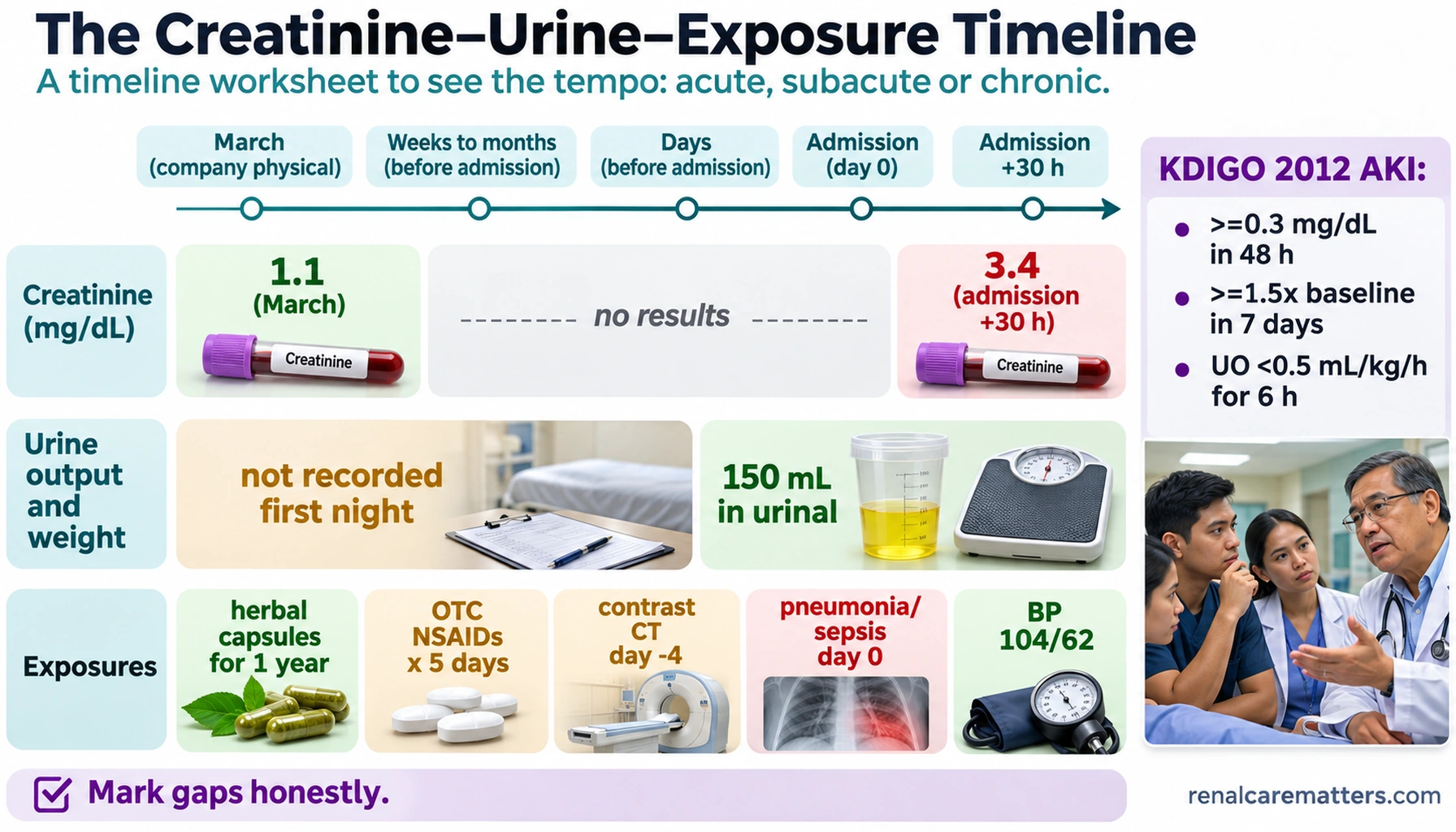
Kidney diseases are distinguished mostly by their tempo. The same creatinine can belong to AKI over hours, acute kidney disease over weeks, or chronic kidney disease (CKD) over years, and the plan differs in each. A timeline lays the evidence side by side so the tempo shows itself.
Figure 2. The creatinine–urine–exposure timeline. Lay the three lines side by side and the tempo, acute, subacute or chronic, shows itself.
Find the baseline
The baseline creatinine defines AKI. Kidney Disease: Improving Global Outcomes (KDIGO) 2012 defines AKI as a rise of at least 0.3 mg/dL within 48 hours, a rise to at least 1.5 times baseline known or presumed to have occurred within the prior 7 days, or urine output below 0.5 mL/kg per hour for 6 hours; these definitions are not graded.3 Pick the wrong baseline and you miss AKI or invent it. Siew and colleagues compared common ways of choosing a baseline with a reference adjudicated by nephrologists in 379 hospitalized patients. The mean of outpatient creatinines measured 7 to 365 days before admission agreed best (intraclass correlation 0.91), better than the most recent or the lowest value; adding older values or values from the week before admission did not help.4 This was a single-center study, but it supports a practical rule: use the average of the last year’s stable outpatient values when you have them.
In the Philippines the baseline is often outside the chart: a company physical, a clinic slip, a photo on a relative’s phone, a laboratory in another city. Ask for it every time. When there is none, say so, and do not assume CKD from a single high value. KDIGO 2024 states that chronicity needs at least three months of evidence and should not be assumed from one abnormal estimated glomerular filtration rate (eGFR) or albuminuria result; small kidneys on ultrasound, a past result or a long history can supply that proof.5
Lay out the three lines
Line
What to collect
Common gap
Creatinine and other laboratory values
Every creatinine with its date and place; potassium, bicarbonate, urinalysis, hemoglobin
Results from another facility not in the chart
Urine output and weight
Hourly or shift totals, catheter status, daily weight, fluid in and out
Output “not recorded” on the first night
Exposures and events
Hypotension, sepsis, surgery, contrast, every drug started or stopped, over-the-counter painkillers, herbal and “kidney cleanse” products, vomiting, diarrhea, poor intake
Products the family does not think of as medicines
Ask about every product
Ask the question in a way that gets an answer: “What tablets, capsules, teas or powders has he taken, even ones from the market, online or a friend?” Bring the bags if possible. Nonsteroidal anti-inflammatory drugs (NSAIDs) sold without prescription for fever and pain are common. Herbal products sold for the kidneys can harm them: aristolochic acid nephropathy, a progressive interstitial fibrosis often followed by urothelial cancer, was first described after slimming pills containing a Chinese herb and has been reported worldwide, with Asian traditional medicine a recognized risk because of substitution of herbs.6 Most remedies you meet will be unknown mixtures; record the name, the seller and a photo of the label, and include them in the differential.
Fill in what you can, then mark the gaps. A timeline with honest gaps (“no creatinine between March and admission”) is more useful than one that pretends.
RememberPut every creatinine, every urine output and every exposure on one dated line. The tempo tells you whether this is acute, subacute or chronic.
Lesson · part 3
Problem representation and the prioritized differential
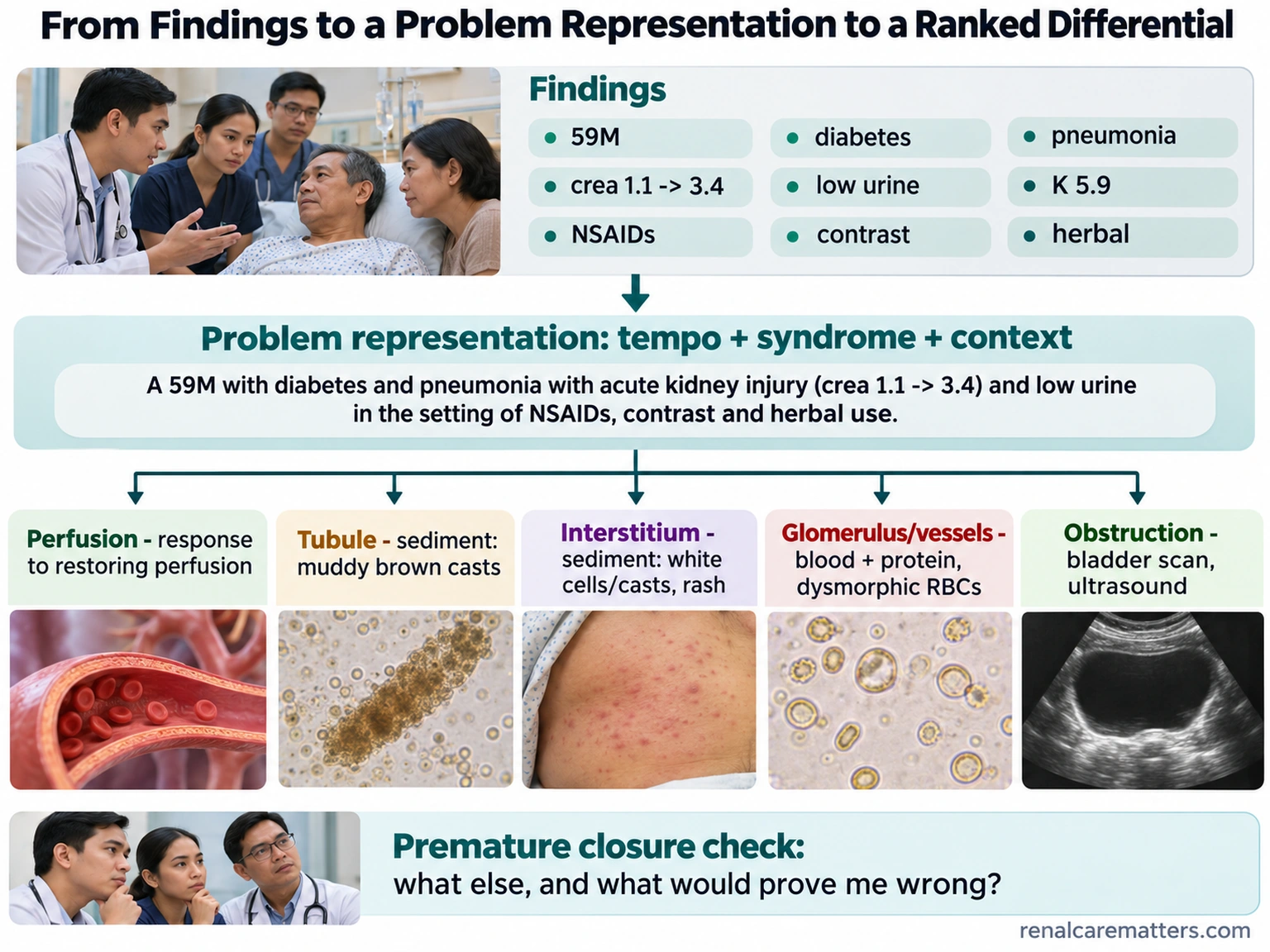
A problem representation is a one-sentence summary that names the time course, the key features and the syndrome in abstract terms. Bowen described it as the step that turns a list of findings into something you can match against illness scripts, the patterns of disease that experienced clinicians carry in memory.7 It is the hinge of diagnostic reasoning: a vague representation leads to a vague differential, and a sharp one narrows the search.
Figure 3. From findings to a problem representation to a ranked differential, with the one test per branch that would change the next decision.
Weak version
Problem representation
What it changes
“59M, CAP, crea 3.4.”
“A 59-year-old man with diabetes and sepsis from pneumonia has AKI over days, from a baseline of 1.1 mg/dL to 3.4 mg/dL, with low urine output and potassium 5.9 mmol/L, after NSAIDs, a contrast scan and an unidentified herbal product.”
Names the tempo (days), the syndrome (oliguric AKI with hyperkalemia), the context (sepsis, diabetes) and the exposures
“Renal failure, for hemodialysis (HD)?”
“A woman with long-standing hypertension has creatinine 6.0 mg/dL with small echogenic kidneys and no acute symptoms.”
Points toward advanced CKD and planning, not an emergency
From representation to differential
Sort the causes by where the problem sits, then rank them by probability and by danger. The classic split into perfusion (prerenal), intrinsic kidney disease and obstruction still works, as long as you remember that sepsis can act through all three and that more than one cause is common.
Compartment
Causes that fit Mr. Ramos
The test that would change the next decision
Perfusion
Sepsis with low effective volume, NSAIDs blocking afferent vasodilation
Response of urine output and creatinine to restoring perfusion; urine sodium if no diuretic
Tubule
Acute tubular injury from sepsis, NSAIDs or contrast; pigment if rhabdomyolysis
Urine sediment for muddy brown casts and tubular cells (Module 4); creatine kinase if muscle pain
Interstitium
Drug-induced interstitial nephritis from NSAIDs, antibiotics or herbal products
Sediment for white cells and white cell casts; history of rash or fever
Glomerulus or vessels
Rapidly progressive glomerulonephritis is less likely but dangerous
Blood and protein on urinalysis, dysmorphic red cells
Obstruction
Prostate enlargement, clot
Bladder scan or catheter; kidney ultrasound
Rank each test by whether it changes the next decision. A urinalysis, a sediment, a bladder scan and a kidney ultrasound change decisions tonight or tomorrow. A long panel of serologies sent at 2 a.m. for every patient rarely does, costs the family money, and delays the tests that matter.
Guard against premature closure
In Graber’s series, premature closure was the most common cognitive error, and faulty knowledge was uncommon.1 The fix is a habit, not more reading: once you have a leading diagnosis, ask “what else could this be, and what finding would prove me wrong?” For Mr. Ramos, “septic AKI” is likely, but the herbal product, the NSAIDs and a possible obstruction each need a deliberate check.
In childrenThe renal consult in a child starts from height, weight and age-specific norms, not adult numbers: creatinine is lower, eGFR uses height-based equations, and urine output is judged per kilogram. Dehydration from gastroenteritis, congenital anomalies of the kidney and urinary tract, and post-infectious glomerulonephritis dominate the differential, and the parents are both the historians and the decision-makers. See Attending Pediatric Nephrologist, Module 1.
RememberSay the problem in one sentence with tempo, syndrome and context, then rank causes by probability and danger, and order only tests that will change the next decision.
Lesson · part 4
The note, the call and the handoff
A consultation that is correct but not received is a failure. The plan must reach the person who will act on it, in a form they can act on, with clear signals for when to call back.
The note
Lead with the answer. The referring team should find the recommendations in the first lines, not after a page of history. Then give the reasoning briefly, the uncertainties, and the contingency plan: what to do if the potassium rises, if the urine output stays low, if the patient becomes breathless.
Part of the note
What it contains
Example line for Mr. Ramos
Question and answer
The question asked and your short answer
“Asked: cause and management of raised creatinine. Answer: oliguric AKI stage 2 to 3 on a baseline of 1.1 mg/dL, likely septic and drug-related; not dialysis tonight if potassium responds.”
Problem representation
One sentence
As in the previous section
Recommendations
Numbered, specific, few
“1. ECG now and repeat potassium; treat per hospital hyperkalemia protocol. 2. Stop NSAIDs and the herbal product. 3. Hourly urine output; bladder scan. 4. Urinalysis and sediment; kidney ultrasound in the morning. 5. Review all drugs for kidney dosing with pharmacy.”
Contingencies
If-then triggers with a number to call
“Call the renal fellow if potassium is not falling on repeat, if ECG changes appear, if urine output stays below the agreed threshold for six hours, or if oxygen need rises.”
Owner and follow-up
Who sees the patient next and when
“Renal fellow will review at 8 a.m. rounds; attending informed at 2:40 a.m.”
The call
Talk to the requesting physician directly when anything is time-sensitive, which Goldman counted among the ten principles.2 A note in a chart that nobody reads until morning rounds does not protect a patient with a potassium of 5.9 mmol/L. Use SBAR (situation, background, assessment, recommendation), read back the critical numbers, and write that the call happened.
The handoff
At the end of your duty, hand the patient over in a structure that the next person expects. I-PASS (illness severity, patient summary, action list, situation awareness and contingency planning, synthesis by receiver) was introduced with training and faculty observation in nine hospitals, and medical errors fell from 24.5 to 18.8 per 100 admissions and preventable adverse events from 4.7 to 3.3 per 100 admissions; handoffs took no longer.8 The study compared periods before and after the program, so it shows association, not proof. The “synthesis by receiver” step, in which the next doctor repeats the plan back, catches misunderstandings before they reach the patient.
Why the follow-up matters
AKI is not a one-night problem. In the multinational AKI-EPI study of 1,802 intensive care unit (ICU) patients in 97 centers, 57.3% had AKI in the first ICU week, and at hospital discharge 47.7% of those with AKI had an eGFR below 60 mL/min/1.73 m², compared with 14.8% of those without.9 The study was cross-sectional and observational, so it does not show that AKI caused the lower eGFR, but it shows why someone must own the follow-up after discharge. Name that person and that date in the note. Use a tool such as the CKD progression slope calculator later, when you have serial values over months, to judge the long-term trajectory; the slope of eGFR is a surrogate, not an outcome the patient feels.
In the Philippines the follow-up plan must fit the family’s reality: where they live, whether the patient can come back to this hospital, whether laboratory tests can be done near home, and who will pay. A plan to “repeat creatinine in one week at the renal clinic” fails if the family lives in Bulacan and the clinic is in Manila. Write the nearest workable option.
RememberLead with the answer, give specific recommendations and if-then triggers, talk to the team directly when it is urgent, and name the person and date for follow-up.
On the floor
Real situations: problems and solutions
These are fictional but typical. For each one, cover the answer, decide what you would do, then compare. Where a step depends on local rules, your unit’s procedure and your supervisor’s direction come first.
The surgical referral before contrast
What you see
A surgery resident in Cagayan de Oro asks, “Can we give contrast for the CT? Crea is 1.6.” The patient is stable and the scan is for suspected abdominal abscess.
What is likely going on
The real question is risk versus benefit of a diagnostic contrast scan, not a general renal workup.
What to do
Find the baseline and eGFR trend, check volume and nephrotoxins, and answer the question directly with any risk-reduction steps the hospital protocol allows; do not delay a needed diagnosis.
Why it matters
Answering a different question than the one asked wastes time and can delay care.
The baseline on a relative’s phone
What you see
A daughter in Tarlac shows a photo of a 2025 laboratory slip with creatinine 2.9 mg/dL for her father, whose creatinine today is 3.1 mg/dL.
What is likely going on
Likely chronic kidney disease with little acute change, if the old value was stable and the method comparable.
What to do
Record the date, laboratory and value, ask about earlier results and symptoms, examine the urine and kidneys, and frame the consult as CKD with a possible small acute change.
Why it matters
The baseline changes the diagnosis from an emergency to a long-term plan.
The “kidney cleanse” tea
What you see
A 50-year-old woman in Batangas with new CKD has been drinking a boxed herbal tea marketed for kidney cleansing for two years.
What is likely going on
An unknown herbal exposure that may contribute to kidney injury.
What to do
Photograph the box and label, record the seller, advise stopping, include interstitial injury in the differential, and report the product through the hospital’s channel if one exists.
Why it matters
Herbal products sold for the kidneys can harm them, and the label rarely lists every ingredient.
The handoff at 7 a.m.
What you see
A resident leaving after a night with three new renal consults is tired and wants to give a quick list.
What is likely going on
A high-risk handoff where unresolved tasks can be lost.
What to do
Use I-PASS, flag illness severity, give the action list with times, state contingencies, and have the receiver repeat back the plan.
Why it matters
Structured handoff is associated with fewer medical errors and preventable adverse events.
Field notes
Ask the referring doctor “What question do you want answered?” before you open the chart.
Draw the timeline on paper first; it is faster than scrolling through results.
Put recommendations in the first five lines of your note.
End every call with “Call me if …” and three numbers or signs.
Case review
Back to the case: Creatinine high, pls see
The real question and its urgency. Dr. Ocampo calls the referring intern and learns the team wants to know whether Mr. Ramos needs dialysis and how to dose his antibiotic. Before answering, he checks stability: the ECG shows peaked T waves, so the hospital’s hyperkalemia protocol starts now with the resident on the medical team; he is tachycardic with a soft pressure, so his sepsis and volume need reassessment; his bladder is not distended on scan. He calls the renal fellow because of the ECG changes. The urgent question tonight is the potassium and perfusion, not dialysis.
Timeline and representation. March: creatinine 1.1 mg/dL. Five days of over-the-counter NSAIDs before admission, herbal capsules for a year, contrast CT four days ago, 30 hours of sepsis from pneumonia with a soft pressure, creatinine 3.4 mg/dL now (about 3.1 times baseline, KDIGO stage 3 by creatinine if the rise is within 7 days, which the recent normal-range history and acute illness suggest), and little urine. The representation: “A 59-year-old man with diabetes and pneumonia-related sepsis has oliguric AKI over days with hyperkalemia, after NSAIDs, contrast and an unidentified herbal product.” Differential: septic and nonsteroidal anti-inflammatory drug (NSAID)-related perfusion injury and acute tubular injury first; drug-induced interstitial nephritis second; obstruction excluded by scan; glomerulonephritis unlikely but checked by urinalysis.
Note, call and owner. The note leads with the answer: oliguric AKI stage 3 by creatinine, no dialysis tonight if the potassium responds, with numbered recommendations (potassium protocol and repeat, stop NSAIDs and the herbal capsules, hourly urine output, urinalysis and sediment, morning ultrasound, kidney dosing of the antibiotic with pharmacy) and if-then triggers. He calls the medical resident to read back the plan and the triggers, the fellow informs the attending nephrologist, and the note names the renal fellow at 8 a.m. rounds as the owner. At discharge, the plan will include a creatinine check near the family’s home in Caloocan and a renal clinic visit.
Work through a shift one decision at a time. The panel at the top changes with what you choose. After each choice you see why it is, or is not, the best move; after a weaker one you can try again or carry on and see where it leads. Your first choice at each step is scored. The score stays on this device and nothing is sent anywhere. In real practice, your unit’s protocol and the people responsible for each decision come first.
Skills lab · with your preceptor
Skills checklist: Renal consultation
Complete with a preceptor on the renal consult service. Sign-off is local. Your preceptor rates each step as satisfactory, needs practice, or not observed. Steps marked Critical must all be satisfactory before sign-off. This checklist supports supervised learning; your unit’s own procedure and competency form are the authority. A printable version of every checklist is on the trainer page.
Clarifies the referring team’s question directly before writing
Checks potassium, fluid, acid, uremia, obstruction and circulation in the first minutes
Builds a dated timeline of creatinine, urine output and exposures, including herbal and over-the-counter products
States a one-sentence problem representation with tempo, syndrome and context
Writes a consult note that leads with the answer, numbered recommendations, contingencies and a named owner
Calls the requesting physician for a time-sensitive plan and hands over using I-PASS with read-back
Placement activity. Renal consult service, medical wards or emergency department
Self-assessment
Check your understanding
Each visit draws 5 questions at random from this module’s 5-question bank. Choose the single best answer for each, then select Check answers; an explanation appears under the best answer. Select New set of questions for a different mix. A good target is 4 of 5 on two different sets. Nothing you select is sent anywhere; scoring happens in your browser.
Graber, M. L., Franklin, N., & Gordon, R. (2005). Diagnostic error in internal medicine. Archives of Internal Medicine, 165(13), 1493–1499. https://doi.org/10.1001/archinte.165.13.1493
Goldman, L., Lee, T., & Rudd, P. (1983). Ten commandments for effective consultations. Archives of Internal Medicine, 143(9), 1753–1755. https://pubmed.ncbi.nlm.nih.gov/6615097/
Kidney Disease: Improving Global Outcomes (KDIGO) Acute Kidney Injury Work Group. (2012). KDIGO clinical practice guideline for acute kidney injury. Kidney International Supplements, 2(1), 1–138. https://doi.org/10.1038/kisup.2012.1
Siew, E. D., Ikizler, T. A., Matheny, M. E., Shi, Y., Schildcrout, J. S., Danciu, I., Dwyer, J. P., Srichai, M., Hung, A. M., Smith, J. P., & Peterson, J. F. (2012). Estimating baseline kidney function in hospitalized patients with impaired kidney function. Clinical Journal of the American Society of Nephrology, 7(5), 712–719. https://doi.org/10.2215/CJN.10821011
Kidney Disease: Improving Global Outcomes (KDIGO) CKD Work Group. (2024). KDIGO 2024 clinical practice guideline for the evaluation and management of chronic kidney disease. Kidney International, 105(4S), S117–S314. https://doi.org/10.1016/j.kint.2023.10.018
Debelle, F. D., Vanherweghem, J.-L., & Nortier, J. L. (2008). Aristolochic acid nephropathy: A worldwide problem. Kidney International, 74(2), 158–169. https://doi.org/10.1038/ki.2008.129
Bowen, J. L. (2006). Educational strategies to promote clinical diagnostic reasoning. The New England Journal of Medicine, 355(21), 2217–2225. https://doi.org/10.1056/NEJMra054782
Starmer, A. J., Spector, N. D., Srivastava, R., West, D. C., Rosenbluth, G., Allen, A. D., Noble, E. L., Tse, L. L., Dalal, A. K., Keohane, C. A., Lipsitz, S. R., Rothschild, J. M., Wien, M. F., Yoon, C. S., Zigmont, K. R., Wilson, K. M., O'Toole, J. K., Solan, L. G., Aylor, M., ... I-PASS Study Group (2014). Changes in medical errors after implementation of a handoff program. The New England Journal of Medicine, 371(19), 1803–1812. https://doi.org/10.1056/NEJMsa1405556
Hoste, E. A. J., Bagshaw, S. M., Bellomo, R., Cely, C. M., Colman, R., Cruz, D. N., Edipidis, K., Forni, L. G., Gomersall, C. D., Govil, D., Honoré, P. M., Joannes-Boyau, O., Joannidis, M., Korhonen, A.-M., Lavrentieva, A., Mehta, R. L., Palevsky, P., Roessler, E., Ronco, C., ... Kellum, J. A. (2015). Epidemiology of acute kidney injury in critically ill patients: The multinational AKI-EPI study. Intensive Care Medicine, 41(8), 1411–1423. https://doi.org/10.1007/s00134-015-3934-7
Educational self-study for physicians in training. Clinical tasks need your institution’s authorization and supervision. Completing this track is an Academy learning record only. It does not confer licensure, specialist status, PSN or PNSP membership or board eligibility, procedural privileges, CPD units, or completion of an institutional training program, and it does not replace current guidelines, regulations, your institution’s protocols and formulary, or your supervisor.