Build a problem representation from creatinine trajectory, urine output and examination.
PublishedNailathalaGipatikPepalwal:ReferencesMga SanggunianMga TinubdanReng Reperensya:5Audience: Practicing nephrologists · senior nephrology fellows · internists who share longitudinal kidney care in the clinic, ward, ICU, dialysis unit, and homeRead timeOras ng pagbasaOras sa pagbasaOras ning pamamasa:
Training track for attending nephrologists in adult practice
This module is study material for attending nephrologists and senior fellows in adult practice. It explains the reasoning behind common decisions; it is not a protocol. Doses and thresholds must be checked against current product labels, guidelines, and your institution’s approved protocols. Regulatory and benefit rules change: confirm them on the date of service. Every case is fictional.
Learning objectives
After this module you should be able to
Build a problem representation from creatinine trajectory, urine output and examination.
Choose targeted urine, serologic and imaging studies by syndrome.
Write a consult note that states urgency, the working diagnosis, alternatives and the owner of pending results.
Pre-testBefore you read, answer the 5 self-assessment questions and note your score. After the module, select New set of questions and compare. The difference is what you learned; the questions you still miss are what to reread.
Start here
The big picture, in plain words
Your duty · Section 1.2, 2024 hemodialysis guidelinesUnder the Philippine Society of Nephrology (PSN) guidelines: Perform a complete clinical assessment before hemodialysis is started (b2).
In plain wordsCreatinine is a lagging, indirect signal, like reading yesterday’s bank balance to judge today’s spending. The consultant’s first job is to rebuild the timeline: what was kidney function before this illness, how fast is it moving, and what does the urine say about where the injury lives?
Figure 1 · Key numbers
AKI (Kidney Disease: Improving Global Outcomes (KDIGO) 2012)Creatinine rise ≥0.3 mg/dL in 48 h, or ≥1.5x baseline within 7 days, or urine output <0.5 mL/kg/h for 6 h
acute kidney disease (AKD) windowKidney dysfunction lasting 7–90 days
fractional excretion of sodium (FENa) suggesting avid sodium retention<1% (off diuretics); fractional excretion of urea <35% if on diuretics
On Tuesday afternoon you are in your clinic when Nurse Cabral, head nurse at the dialysis center where several of your patients dialyze, calls. A general practitioner has sent Mr. Reyes, 59, to the unit with a text: “Pls accept for hemodialysis (HD), creatinine 2.5, edematous.” You ask her to send him and his wife to your clinic instead.
His creatinine was 1.1 mg/dL ten days ago. He has new ankle swelling, cola-colored urine, and back pain for which he has been taking ibuprofen. His blood pressure is 158/96 mm Hg. A urine sample taken in the clinic shows red cells, and when you look under the microscope yourself you find dysmorphic red cells and one red-cell cast. While he is with you, Nurse Cabral texts: “Doctor, should we keep the 4 p.m. chair for him?”
Before reading on, decide:
Does he need dialysis today?
What does the urine tell you that the creatinine does not?
What will you write in your consult note, and who owns each pending result?
Keep your answers in mind. The lesson gives you what you need, and the case review near the end shows one sound response.
Lesson · part 1
How it works
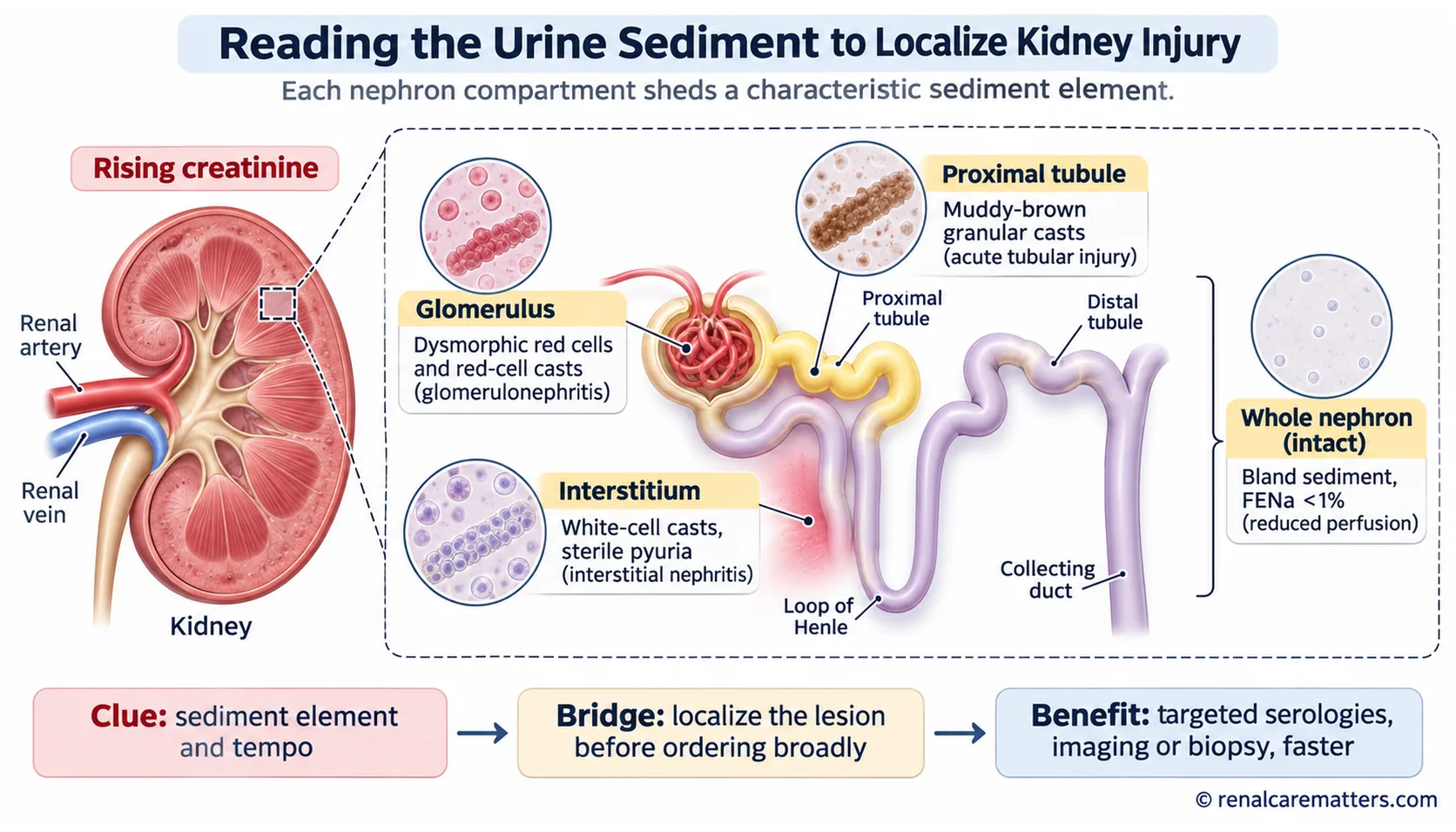
Serum creatinine reflects the balance between production (muscle mass, meat intake) and filtration. After an abrupt fall in glomerular filtration rate (GFR), creatinine rises over 24–72 hours to a new steady state, so a single value underestimates acute injury and overestimates recovery. Location is read from the urine. Dysmorphic red cells and red-cell casts mean blood crossed a damaged glomerular capillary wall. Muddy-brown granular casts mean shed tubular epithelium. White-cell casts point to interstitial inflammation or pyelonephritis. A bland sediment with high specific gravity and a fractional excretion of sodium (FENa) below 1% says the tubules are working hard to conserve salt. That suggests reduced effective perfusion, although contrast, early obstruction and some glomerular diseases can do the same. Cystatin C is produced by all nucleated cells and is less dependent on muscle mass. It is the better marker in sarcopenia, amputation or very high muscle mass.
In your clinic · fictional
Two referrals arrive on the same afternoon, both “creatinine 4.0.” Mrs. Lim, 70, has small, bright kidneys on ultrasound and a creatinine of 3.6 a year ago. Mr. Javier, 31, has normal-sized kidneys, a creatinine of 1.0 two months ago, and red-cell casts in his urine.
The same number describes two different diseases. For Mrs. Lim it is the next step on a long slope; for Mr. Javier it is an emergency that a biopsy may still reverse.
What this shows. Creatinine tells you how much filtration is lost. The timeline, the kidney size, and the sediment tell you why.
Figure 2. A kidney and an enlarged nephron showing which urine sediment finding points to which part of the nephron.
Lesson · part 2
What the evidence shows
KDIGO 2024 recommends the race-free chronic kidney disease (CKD)-EPI 2021 creatinine equation for initial assessment and cystatin C (eGFRcr-cys) when creatinine-based estimated glomerular filtration rate (eGFR) is likely to be inaccurate and decisions depend on it. The KDIGO 2026 AKI and acute kidney disease (AKD) public-review draft proposes suggesting cystatin C to identify AKI when creatinine is less accurate (draft grade 2B). It also expands definitions to include structural biomarkers. Treat these as draft until the final edition is published. Urine microscopy by a trained nephrologist outperforms automated analyzers for casts and dysmorphism in diagnostic-accuracy studies.
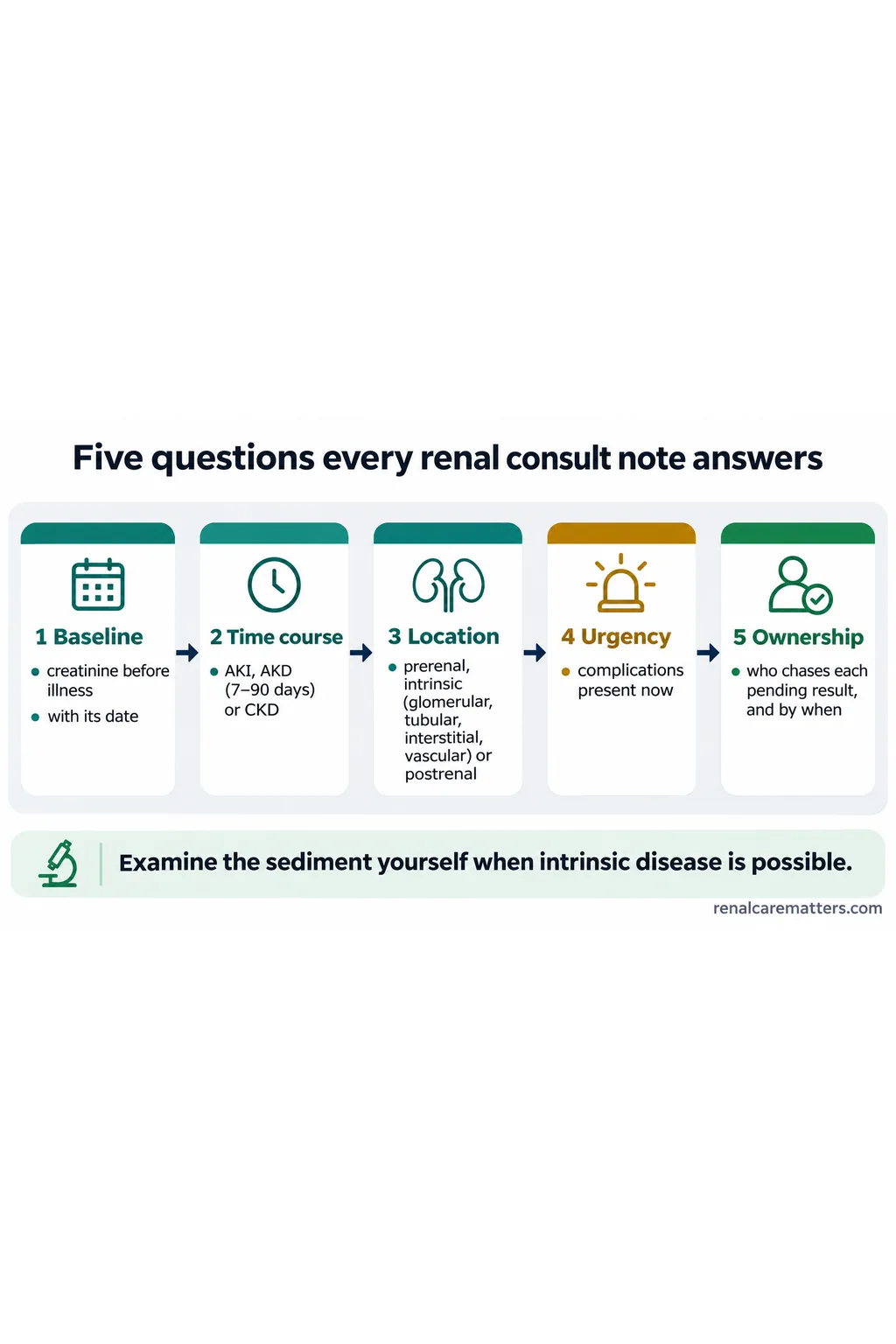
Every consult note should answer five questions. What was the baseline creatinine, and from what date? Is this AKI, AKD (7–90 days) or CKD? Where is the lesion: prerenal, intrinsic (glomerular, tubular, interstitial, vascular) or postrenal? How urgent is it, and which life-threatening complications are present now? Who owns each pending result, and by when? Examine the sediment yourself when intrinsic disease is possible. Quantify protein with the urine albumin-to-creatinine ratio (UACR) or protein-to-creatinine ratio (UPCR). Image the kidneys early: size, echogenicity and hydronephrosis change the differential within minutes.
Figure 3. Five questions every renal consult note answers. Five steps for a kidney consult note: baseline, time course, location of injury, urgency, and who owns each pending result.
In the consult room · fictional
You write Mr. Javier’s note in five lines. Baseline: 1.0 mg/dL two months ago. Category: AKI. Lesion: glomerular, active sediment. Urgency: biopsy this week, admit if breathless or creatinine rises again. Owners: you follow the serologies by Friday; the general practitioner rechecks creatinine in 48 hours.
The next physician who opens his chart understands the plan in thirty seconds.
What this shows. A consult note that answers the five questions is a handoff, not a diary.
Stop and call
Red-cell casts or dysmorphic red cells with rising creatinine
Hemoptysis, rash or purpura with AKI
Anuria (consider obstruction or a vascular event)
Bilateral small echogenic kidneys reframing ’AKI’ as advanced CKD
On the floor
Real situations: problems and solutions
These are fictional but typical. For each one, cover the answer, decide what you would do, then compare. Where a step depends on local rules, your unit’s procedure and your supervisor’s direction come first.
“For HD, creatinine 6”
What you see
A referral asks you to start dialysis for a new patient whose only result is a creatinine of 6.0 mg/dL.
What is likely going on
Nobody knows whether this is acute, chronic, or acute on chronic.
What to do
Ask for old results, an ultrasound, and a urinalysis before the first session unless an emergency indication is present. Small, bright kidneys point to longstanding disease; normal-sized kidneys and an active sediment point elsewhere.
Why it matters
Dialysis can treat the consequences of kidney failure but not its cause, and some causes can still be reversed.
The urine nobody looked at
What you see
A patient referred for “CKD, for dialysis” has a dipstick showing 3+ blood and 3+ protein, but no microscopy was done.
What is likely going on
An active glomerular disease may be hiding behind the label of CKD.
What to do
Look at the sediment yourself and quantify protein with a protein-to-creatinine ratio.
Why it matters
Red-cell casts or dysmorphic red cells change the diagnosis, the urgency, and sometimes the outcome.
The muscular young man with a high creatinine
What you see
A 28-year-old bodybuilder is sent with a creatinine of 1.6 mg/dL and an eGFR in the 50s.
What is likely going on
Creatinine reflects muscle mass as well as filtration.
What to do
Measure cystatin C and use the combined equation before you label him with CKD.
Why it matters
A wrong diagnosis follows a patient into insurance, employment, and drug dosing.
Field notes
Write the baseline creatinine and its date at the top of every consult note.
Keep a microscope in the clinic and use it.
An ultrasound before the first session often changes the plan.
Name who follows each pending result, and by when.
Case review
Back to the case: The referral that arrived by text
Does he need dialysis today? Not on what you have so far. A creatinine of 2.5 mg/dL is not an indication. Look for the things that would make it one: potassium, bicarbonate, breathlessness, and urine output. If none is present, the free chair is not the right next step. The right next step is a diagnosis.
What does the urine say? Ibuprofen can cause injury through blood flow or through interstitial nephritis, but it does not make red-cell casts. Dysmorphic red cells and a cast mean blood crossed an inflamed glomerulus, and a creatinine that more than doubled in ten days makes this a rapidly progressive glomerulonephritis until proven otherwise. Stop the ibuprofen. Send antineutrophil cytoplasmic antibodies, anti-glomerular basement membrane antibodies, C3 and C4, and hepatitis B, hepatitis C, and human immunodeficiency virus (HIV) serologies. Quantify protein with a protein-to-creatinine ratio and order a kidney ultrasound.
The note. Answer the five questions: baseline and its date, AKI rather than CKD, a glomerular lesion, the urgency (biopsy within days, and admission if he becomes breathless or the creatinine keeps climbing), and who follows each result by when. Tell Nurse Cabral why you are not booking the chair, and that you are not turning him away. A text message that says “for HD” is a request, not a diagnosis.
Skills lab · with your preceptor
Skills checklist: Skills checklist
Complete with a preceptor, in simulation or at your own unit. Sign-off is local. Your preceptor rates each step as satisfactory, needs practice, or not observed. Steps marked Critical must all be satisfactory before sign-off. This checklist supports supervised learning; your unit’s own procedure and competency form are the authority. A printable version of every checklist is on the trainer page.
Reconstructs the baseline with dates
Personally interprets the urine sediment
Classifies AKI, AKD or CKD and localizes the lesion
Writes urgency, plan and result ownership
Placement activity. Simulation or supervised practice
Self-assessment
Check your understanding
Each visit draws 5 questions at random from this module’s 5-question bank. Choose the single best answer for each, then select Check answers; an explanation appears under the best answer. Select New set of questions for a different mix. A good target is 4 of 5 on two different sets. Nothing you select is sent anywhere; scoring happens in your browser.
Kidney Disease: Improving Global Outcomes (KDIGO) CKD Work Group (2024). KDIGO 2024 clinical practice guideline for the evaluation and management of chronic kidney disease. Kidney International, 105(4S), S117–S314. https://doi.org/10.1016/j.kint.2023.10.018
Kidney Disease: Improving Global Outcomes (KDIGO) Acute Kidney Injury Work Group. (2012). KDIGO clinical practice guideline for acute kidney injury. Kidney International Supplements, 2(1), 1–138. https://doi.org/10.1038/kisup.2012.1
Inker, L. A., Eneanya, N. D., Coresh, J., Tighiouart, H., Wang, D., Sang, Y., Crews, D. C., Doria, A., Estrella, M. M., Froissart, M., Grams, M. E., Greene, T., Grubb, A., Gudnason, V., Gutiérrez, O. M., Kalil, R., Karger, A. B., Mauer, M., Navis, G., ... Chronic Kidney Disease Epidemiology Collaboration (2021). New creatinine- and cystatin C-based equations to estimate GFR without race. The New England Journal of Medicine, 385(19), 1737–1749. https://doi.org/10.1056/NEJMoa2102953
Kidney Disease: Improving Global Outcomes (KDIGO) Glomerular Diseases Work Group. (2021). KDIGO 2021 clinical practice guideline for the management of glomerular diseases. Kidney International, 100(4S), S1–S276. https://doi.org/10.1016/j.kint.2021.05.021
Educational material for physicians. Completing it is an Academy learning record only. It does not confer CPD units, PSN certification, privileges, or PhilHealth accreditation, and it does not replace current guidelines, regulations, your institution’s protocols, or clinical judgment.