- Work through the four questions below. Tick every box that applies — you can leave a whole group blank if none fit.
- Press Show my recommendation. The helper reads your answers in priority order (acute illness first) and names the most appropriate test.
- Bring the recommendation to your clinician — it is a starting point for the conversation, not an order or a diagnosis.
Everything runs in your browser. No answers are stored or transmitted.
What this helper does — and does not — do
What it does
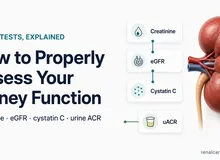
It maps your situation onto the KDIGO-aligned kidney-test ladder: serum creatinine + estimated GFR (eGFR) for routine assessment; adding cystatin C for a combined estimate (eGFRcr-cys) when creatinine may mislead or a decision is close to a threshold; a measured GFR (mGFR) for high-stakes decisions; and it flags acute situations where a steady-state eGFR should not be trusted at all. It also reminds you that a urine albumin-to-creatinine ratio (uACR) belongs alongside filtration testing.
What it does not do
It does not calculate a GFR, does not diagnose chronic kidney disease, does not assign a "percent kidney function," and never advises starting or stopping any medicine. Special situations — pregnancy, childhood, kidney-donor evaluation, or dosing a narrowly toxic drug — are routed to a clinician pathway rather than answered by a web tool.
Answer four questions.
Tick everything that applies. The most urgent or highest-precision answer wins — and the helper always reminds you to pair filtration testing with a urine albumin check.
The kidney-test ladder, in one screen.
Every recommendation this helper gives is a rung on the same ladder. You climb it only when a lower rung might mislead, or when a decision is important enough to justify more accuracy.
Read the full guide → for the physiology, the equations, the uncertainty behind every eGFR, and the two-axis (filtration + damage) model.