Read creatinine, eGFR and urine through filtration, tubular handling and water balance, and know when an estimate fails.
PublishedNailathalaGipatikPepalwal:ReferencesMga SanggunianMga TinubdanReng Reperensya:10Audience: Adult and pediatric nephrology fellows · internal medicine and pediatric residents · medical interns on medicine, pediatrics, ICU and dialysis rotations, and residents who work shifts as dialysis physicians on dutyRead timeOras ng pagbasaOras sa pagbasaOras ning pamamasa:
Training track for nephrology fellows, residents and medical interns
Study material for medical interns, residents and fellows. It explains the reasoning behind common decisions; it is not a protocol and gives no drug doses. Doses, rates and order sets come from current guidelines, product labels, your institution’s approved protocols and your supervising physician. Benefit rules change: confirm them on the date of service. Every case is fictional.
Learning objectives
After this module you should be able to
Intern: Explain at the bedside, in plain words, how the kidney filters blood, adjusts what it keeps along the tubule, and balances water separately from salt.
Resident: Use filtration, tubular handling and water balance to read common laboratory patterns, including a creatinine that looks normal but is not, and a creatinine that rises without any change in filtration.
Fellow: Connect clearance, tubular transport and renal hemodynamics to competing treatment choices, and choose the right estimate of glomerular filtration rate (GFR) for the decision at hand, stating its assumptions.
Pre-testBefore you read, answer the 5 self-assessment questions and note your score. After the module, select New set of questions and compare. The difference is what you learned; the questions you still miss are what to reread.
Start here
The big picture, in plain words
Your role · reading the kidney’s numbersAn intern owns the baseline: finding the old creatinine, the weight, the urine output and the medicine list, and noticing when a “normal” value has doubled. A resident owns the interpretation: which estimate applies, whether the patient is in steady state, and what the pattern means. A fellow owns the choice: when to measure cystatin C or a timed clearance, which estimate to use for a drug decision, and how a change in hemodynamics will move the number.
In plain wordsThink of a rice mill with a sieve and a sorting line. The sieve lets fine grains and husk dust through by the sackful. Workers along the line pick back the good grains and toss the stones. What leaves the mill at the end is a small sack of what the owner did not want to keep.
The picture has a limit. A mill sorts at a fixed speed. The kidney’s sieve, the glomerulus, filters about 125 mL of plasma a minute in a healthy young adult, which is roughly 180 liters a day, and the tubule then returns almost all of the water and salt. But the tubule does not work at a fixed rate. Hormones, blood pressure and the medicines you prescribe change what each segment keeps, minute by minute. And the number you use to judge the sieve, the serum creatinine, depends on how much creatinine the muscles make and how much the tubule secretes, not only on filtration.
That is the physiology behind most mistakes with kidney numbers. A small, frail patient makes little creatinine, so a filtration rate that is truly low can sit behind a creatinine inside the laboratory’s normal range. A drug that blocks creatinine secretion can raise the creatinine with no change in filtration. And in acute kidney injury (AKI), the creatinine lags behind the filtration rate by a day or more.
Figure 1 · Key numbers
Initial GFR assessment (KDIGO 2024)Creatinine-based estimated GFR (eGFRcr) for adults at risk of chronic kidney disease (CKD); use creatinine plus cystatin C if available (1B)
When eGFRcr is less accurate (KDIGO 2024)Use eGFRcr-cys when GFR affects a clinical decision (1C)
Use an equation, not creatinine alone (KDIGO 2024)Validated estimating equation recommended (1D)
CKD-EPI 2021 race-free equations85% or more of estimates within 30% of measured GFR in validation
AKI stage 2 (KDIGO 2012)Creatinine 2.0 to 2.9 times baseline (ungraded definition)
Most of the time a stable creatinine and an estimating equation are good enough. A few patients break the equation’s assumptions: the very thin, the very muscular, the acutely ill, the patient on a drug that blocks secretion. Your work is to know which patient is in front of you, to say aloud which assumption fails, and to choose a better measure when the decision depends on it.
Opening case · fictional
Case: The normal creatinine
Thursday, 3 p.m., the medical ward of a provincial hospital in San Fernando, Pampanga. Mrs. Teresita Mallari, 78, is admitted for a fall at home. She is frail, weighs 38 kg, and has eaten little for a week. She takes a thiazide for blood pressure and, her daughter says, a “pain reliever for her knees” bought at the market.
Her serum creatinine today is 1.1 mg/dL. The laboratory’s reference range is 0.6 to 1.2 mg/dL, and the result is not flagged. The intern, Dr. Paolo Lansang, finds a clinic slip on the daughter’s phone: six months ago her creatinine was 0.5 mg/dL. Her urine output since admission is about 120 mL over eight hours. The admitting note reads “renal function normal.”
Before reading on, decide:
Is her kidney function normal? What does the change from 0.5 to 1.1 mg/dL mean physiologically?
What do the estimating equations say, and why may each be wrong for her today?
What would you measure or do next, and what would change your plan?
Keep your answers in mind. The lesson gives you what you need, and the case review near the end shows one sound response.
Lesson · part 1
Glomerular filtration and what creatinine really measures
Filtration is pressure working against a barrier. The heart drives blood into the glomerular capillaries; the afferent arteriole sets how much pressure arrives and the efferent arteriole sets how much stays. The pressure pushes plasma water and small solutes across the capillary wall into Bowman’s space, and the GFR is the total volume filtered per minute by all nephrons. Large proteins and cells stay behind.
The kidney defends its GFR. When pressure falls, the afferent arteriole relaxes and angiotensin II tightens the efferent arteriole, which keeps pressure in the capillary. This is why a patient who depends on angiotensin II, through volume depletion, heart failure or renal artery stenosis, can lose GFR quickly when started on an angiotensin-converting enzyme (ACE) inhibitor or angiotensin receptor blocker (ARB), and why a nonsteroidal anti-inflammatory drug (NSAID), which removes the prostaglandins that relax the afferent arteriole, does harm in the same patient. It is also why a modest early fall in estimated glomerular filtration rate (eGFR) with these drugs, or with a sodium-glucose cotransporter 2 (SGLT2) inhibitor, is expected: lowering glomerular pressure is part of how they protect the kidney over years.
Creatinine is a waste product, not a ruler
Creatinine comes from creatine in muscle, at a rate roughly proportional to muscle mass, with a smaller amount from cooked meat. It is filtered freely, and a part is also secreted by the proximal tubule. Its serum level therefore depends on four things: how much is made, how much is filtered, how much is secreted, and, in some laboratory methods, substances that interfere with the assay.1 Only one of the four is the GFR.
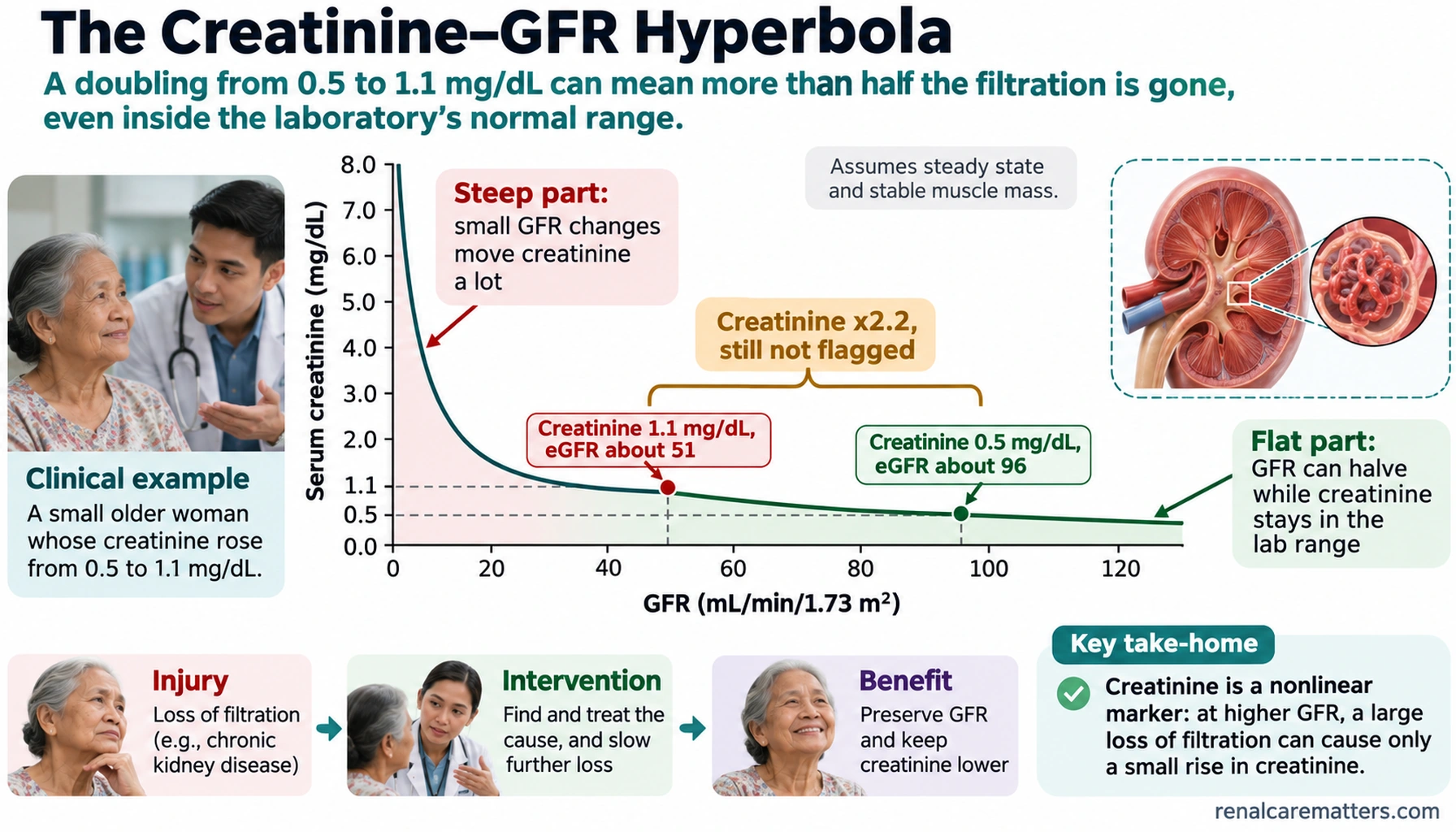
At steady state, creatinine production equals creatinine excretion. Production is roughly fixed for a given person, so if the GFR halves, the serum creatinine must double before excretion again matches production. The relationship is a hyperbola: serum creatinine is roughly proportional to 1 divided by GFR.
Figure 2. The creatinine–GFR hyperbola. A doubling from 0.5 to 1.1 mg/dL can mean more than half the filtration is gone, even inside the laboratory’s normal range.
Where the creatinine comes from or goes
What changes it
What you see
Production by muscle
Low muscle mass (frailty, old age, small body size, amputation, malnutrition, liver disease); high muscle mass; a large cooked-meat meal
A low-normal creatinine that hides a low GFR; a high creatinine in a muscular young man with normal GFR
Filtration
True change in GFR
The change you are trying to detect
Tubular secretion
Drugs that block secretion, such as trimethoprim and cimetidine; secretion rises as GFR falls
A creatinine rise without a fall in GFR; a creatinine clearance that overestimates GFR in CKD
Assay
Interference in some methods, for example from ketones or bilirubin
A value that does not fit the patient
The flat part and the steep part
The hyperbola explains two bedside errors. On the flat part, at high GFR, a large fall in GFR moves the creatinine only a little: from 0.5 to 1.1 mg/dL in a small woman is a reading the laboratory may not flag, yet it may mean she has lost more than half her filtration. On the steep part, at low GFR, a small change in GFR moves the creatinine a lot, so a rise from 4.0 to 4.6 mg/dL may mean only a small further loss.
Many Filipino patients, especially older women, are small and carry little muscle. Their creatinine runs low when they are well. Judge every creatinine against that person’s own baseline and body, not against the laboratory’s range.
RememberCompare every creatinine with the patient’s own baseline and muscle mass. A doubling inside the normal range is still a doubling.
Lesson · part 2
The tubule segment by segment, with the drugs that act there
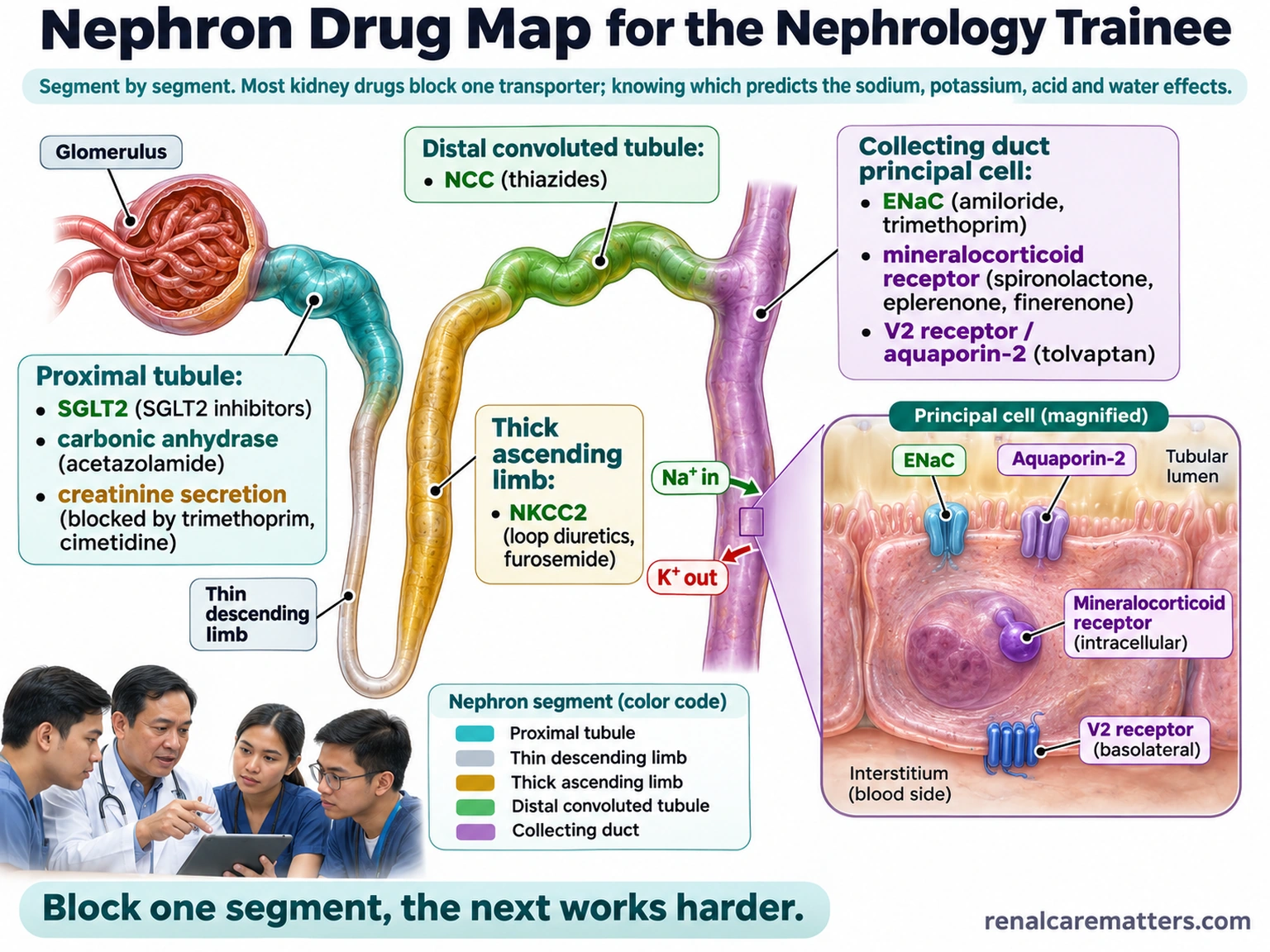
The filtrate leaving Bowman’s space is plasma without its proteins. The tubule decides, segment by segment, what to keep. Each segment has a main transporter, and most kidney drugs act by blocking one of them. Knowing the map lets you predict what a drug does to sodium, potassium, acid and water, and why two diuretics together do more than one.2
Figure 3. Segment by segment. Most kidney drugs block one transporter; knowing which predicts the sodium, potassium, acid and water effects.
Segment
Main job and transporter
Drugs acting there
What you may see
Proximal tubule
Reclaims most filtered sodium, glucose, bicarbonate, phosphate and amino acids; sodium-glucose cotransport (SGLT2), sodium-hydrogen exchange; secretes creatinine and many drugs
Block one segment and the next one works harder. A loop diuretic sends more sodium to the distal tubule, which grows and reclaims more over weeks; adding a thiazide blocks that adaptation. More sodium delivered to the collecting duct means more potassium secreted, which is why loop and thiazide diuretics cause hypokalemia, and why blocking aldosterone or ENaC raises potassium.2 The same logic explains why a patient on a thiazide who drinks tea and eats little salt becomes hyponatremic: the thiazide impairs dilution in the distal tubule, and the low solute intake leaves too little to excrete water with. Module 6 builds on this.
Reading a pattern instead of a number
The tubule writes its work into the blood and the urine. A low bicarbonate with a normal anion gap points to the proximal or distal tubule or to the gut. Glucose in the urine with a normal blood sugar points to the proximal tubule or an SGLT2 inhibitor. A high potassium in a patient with modest CKD on spironolactone and trimethoprim points to two blocks in the collecting duct, not to a sudden loss of GFR. Ask which segment could produce the pattern, then which drug or disease acts there.
RememberFor every electrolyte surprise, ask which tubular segment could produce it and which drug on the list acts there.
Lesson · part 3
Water balance is not salt balance
The kidney runs two separate control systems, and confusing them causes many errors.
Salt controls volume. Sodium is the main solute outside cells, so the total body sodium sets the size of the extracellular fluid. When the circulation senses low effective volume, through the baroreceptors and the afferent arteriole, renin, angiotensin II, aldosterone and sympathetic nerves make the tubule keep sodium. Edema means too much total sodium; dryness means too little. The urine sodium tells you what the kidney thinks of the volume, unless a diuretic is speaking for it.
Water controls concentration. The plasma sodium concentration reflects the ratio of sodium to water, and it is set mostly by water balance. When plasma tonicity rises by a small amount, the hypothalamus releases ADH and makes you thirsty. ADH inserts aquaporin-2 channels in the collecting duct, and water flows back into the concentrated medulla built by the loop of Henle. When tonicity falls, ADH switches off and the kidney makes dilute urine.
Question
What answers it
Bedside clue
Is total body salt high, low or normal?
Volume examination; urine sodium off diuretics
Edema, crackles and raised neck veins versus dry mucosa, postural drop
Concentrated urine with a low plasma sodium means ADH is on when it should be off
Can the kidney make dilute urine?
Solute intake, distal delivery, diuretics, GFR
Tea and toast, beer potomania, thiazides, advanced CKD
The two systems collide in hypovolemia. When effective volume falls far enough, the body releases ADH even at a low tonicity, because keeping circulating volume matters more than keeping concentration. That is why a volume-depleted patient, or one with heart failure or cirrhosis, can be both edematous or dry and hyponatremic. A patient can have too much salt and still too much water for that salt.
Two practical rules follow. A low plasma sodium is a water problem until proven otherwise, and its treatment is about water. A swollen patient has a salt problem, and fluid restriction alone will not fix the edema. Module 5 covers volume assessment and Module 6 covers sodium disorders and the house limits for correcting them.
RememberAsk two separate questions every time: what is the total body salt (volume), and what is the water relative to that salt (sodium concentration)?
Lesson · part 4
Estimating equations and their assumptions
Every estimating equation turns a blood marker into a GFR by assuming things about the patient. The equation is reliable only when those assumptions hold. Stating the assumption before quoting the number is the most useful habit in this module.
Frailty, very low or high muscle mass, AKI, drugs blocking secretion
CKD-EPI 2021, creatinine plus cystatin C (eGFRcr-cys)
Both markers
Errors in the two markers partly cancel
High-dose corticosteroids, thyroid disease and inflammation affect cystatin C; still assumes steady state
European Kidney Function Consortium (EKFC)
Creatinine, age, sex, scaled to a population’s normal creatinine
A continuous equation from childhood to old age
Same steady-state and muscle assumptions
Cockcroft–Gault
Creatinine, age, weight, sex
Estimates creatinine clearance, not GFR; derived in 249 patients in 1976, for men with a correction for women
Obesity, edema, modern standardized creatinine
Kinetic eGFR
Two or more creatinines over time, an estimate of production and volume
Creatinine is changing
Fluid shifts, uncertain production; it is an estimate of an estimate
Measured creatinine clearance
Timed urine collection and a blood creatinine
Complete collection
Missed voids; overestimates GFR because of secretion
The Kidney Disease: Improving Global Outcomes (KDIGO) 2024 CKD guideline recommends using a validated estimating equation rather than the serum marker alone (1D), creatinine-based eGFR for initial assessment in adults at risk of CKD, with the combination of creatinine and cystatin C to estimate the GFR category when cystatin C is available (1B), and eGFRcr-cys in clinical situations when eGFRcr is less accurate and GFR affects decisions (1C). Its practice points add that GFR should be measured where more accurate ascertainment will change treatment, that a timed urine collection for creatinine clearance can be considered when measured GFR is unavailable, and that race should not be used in computing eGFR.3
What the evidence shows
Inker and colleagues developed the 2021 CKD-EPI equations without race in 8,254 participants (creatinine) and 5,352 participants (creatinine and cystatin C), and validated them in 4,050 participants with measured GFR. For all equations, 85% or more of estimates were within 30% of measured GFR, and the combined creatinine-cystatin C equations were more accurate than creatinine alone.4 Read that number the other way too: even in research cohorts, up to about one estimate in seven was more than 30% away from the measured value. The EKFC equation, built and validated in about 19,600 people with measured GFR from 13 studies, showed low bias across ages 2 to 90 years; no Black participants were included.5 Neither cohort was drawn from Filipino patients, and no Philippine validation study is cited here, so treat any equation as an approximation in a small, older Filipino patient.
Cockcroft and Gault derived their formula from 24-hour creatinine excretion in 249 patients, and it predicted measured creatinine clearance with a correlation of 0.83.6 Its weight term makes it sensitive to edema and obesity, and it was developed before creatinine assays were standardized. Many drug labels still state kidney dosing in Cockcroft–Gault creatinine clearance, which is why you will still use it; keep the label’s measure when you follow the label.
Steady state and the kinetic estimate
All standard equations assume steady state. After a sudden loss of filtration, creatinine rises over days toward a new plateau; during that rise, an eGFR calculated from today’s value overestimates the true GFR. When filtration recovers, creatinine falls slowly and the eGFR underestimates. Chen proposed a kinetic eGFR built from the change between consecutive creatinines, the volume of distribution and the production rate, to estimate GFR while creatinine is changing.7 It is a derived estimate from first principles, not a validated measurement, and fluid shifts in the critically ill can mislead it. Use it to sense direction and size, not to dose a narrow-margin drug.
Arithmetic illustration, not a target. Mrs. Mallari, 78, female, 38 kg. CKD-EPI 2021 eGFRcr at creatinine 0.5 mg/dL = about 96; at 1.1 mg/dL = about 51 mL/min/1.73 m² (if she were in steady state). Cockcroft–Gault creatinine clearance at 1.1 mg/dL = (140 − 78) × 38 ÷ (72 × 1.1) × 0.85 = about 25 mL/min. The two answers differ twofold because one ignores her weight and the other uses it; neither is valid while her creatinine is still rising.
Cystatin C in the Philippines
Cystatin C is produced by all nucleated cells and depends much less on muscle, which is why it helps in the frail, the amputee and the malnourished. In many Philippine provinces it is unavailable or must be sent out, and the family usually pays. Order it when the answer will change a decision, such as whether to start, stop or dose a drug, whether a patient has CKD at all, or whether to list for a procedure, and say so in the request. When it is not available, a timed urine creatinine clearance is the practice-point fallback, with its own errors.
In childrenChildren are not small adults: GFR rises through infancy and reaches adult values, scaled to body surface area, by about two years, and muscle mass changes with growth and puberty. Use pediatric equations built on height, such as the Chronic Kidney Disease in Children (CKiD) under-25 (U25) equations, which use age- and sex-specific constants from childhood into young adulthood.8 A neonate’s first creatinine reflects the mother’s. See Attending Pediatric Nephrologist, Module 2.
Stevens and colleagues’ review remains a clear account of why measured and estimated GFR differ and when each is worth the trouble.9
RememberBefore you quote an eGFR, say which equation, whether the patient is in steady state, and whether muscle mass is average. If any answer is no and the decision matters, use cystatin C, a timed clearance or the trend.
On the floor
Real situations: problems and solutions
These are fictional but typical. For each one, cover the answer, decide what you would do, then compare. Where a step depends on local rules, your unit’s procedure and your supervisor’s direction come first.
The bodybuilder’s creatinine
What you see
A 28-year-old gym instructor in Quezon City who takes creatine powder has a creatinine of 1.5 mg/dL at a company physical, with a normal urinalysis.
What is likely going on
High muscle mass and creatine supplementation raise creatinine production; GFR may be normal.
What to do
Ask about supplements and meat intake, repeat after stopping creatine, check urine albumin, and use cystatin C if the result will decide a label of CKD.
Why it matters
A false CKD label affects insurance, employment and medicines for years.
The heart failure patient on a new SGLT2 inhibitor
What you see
Two weeks after starting an SGLT2 inhibitor, a patient’s eGFR falls from 52 to 46 mL/min/1.73 m²; he feels well and his potassium is normal.
What is likely going on
An expected hemodynamic dip from lower glomerular pressure.
What to do
Check volume status and other causes, repeat the test, and discuss continuing with the attending rather than stopping by reflex.
Why it matters
The early dip reflects the protective mechanism; stopping the drug forfeits its long-term benefit.
The amputee who needs a contrast scan
What you see
A man in Bacolod with diabetes and a below-knee amputation has an eGFRcr of 62 before a contrast Computed tomography (CT).
What is likely going on
Low muscle mass makes eGFRcr overestimate GFR.
What to do
Interpret the eGFR cautiously; if contrast or drug decisions depend on it, ask for cystatin C or rely on the trend and clinical risk.
Why it matters
Equations assume average muscle; an amputation removes part of the creatinine source.
The rising creatinine on day two of sepsis
What you see
In an intensive care unit (ICU) in General Santos, creatinine goes from 0.9 to 1.4 mg/dL overnight while the antibiotic is dosed by today’s eGFR of 55.
What is likely going on
Creatinine has not reached steady state; the true GFR is likely lower and still changing.
What to do
Use the trend, urine output and a kinetic estimate, review dosing daily with pharmacy, and reassess as values change.
Why it matters
Dosing by a lagging estimate can overdose renally cleared drugs or underdose them during recovery.
Field notes
Write the baseline creatinine, its date and the patient’s weight at the top of every renal note.
When you quote an eGFR, name the equation; CKD-EPI and Cockcroft–Gault answers can differ twofold.
Ask families to photograph old laboratory slips; the baseline is often on a phone.
Keep the nephron map from this module in your pocket notebook for the first month on the renal service.
Case review
Back to the case: The normal creatinine
Is it normal? No. Her creatinine has risen 2.2-fold from her baseline, inside the laboratory’s range. In a 38-kg woman with little muscle, creatinine production is low, so her baseline of 0.5 mg/dL reflected good filtration, and the rise means she has lost more than half of it. If the rise happened within the last seven days, it meets KDIGO 2012 stage 2 AKI (2.0 to 2.9 times baseline);10 if over six months, it is a large fall that needs explaining. Her urine output of about 120 mL in eight hours, about 0.4 mL/kg per hour for a 38-kg woman, has stayed below 0.5 mL/kg per hour for more than six hours, which on its own meets the KDIGO urine output criterion for stage 1. The admitting note should be corrected.
What the equations say. CKD-EPI 2021 gives about 51 mL/min/1.73 m² at 1.1 mg/dL, and Cockcroft–Gault about 25 mL/min. Both assume steady state, and her creatinine is probably still rising after poor intake, a thiazide and a market “pain reliever” that is likely an NSAID, so both overestimate her current GFR. CKD-EPI also assumes average muscle mass for her age and sex, which she does not have. Cockcroft–Gault uses her low weight, which is why it is lower, but it was built for a different era and population. The honest statement is that her GFR is markedly reduced and still uncertain.
What next. Repeat the creatinine in 12 to 24 hours to see the direction, and use the change to judge severity (a kinetic estimate helps with the direction). Examine her volume, chart intake, output and weight daily, stop the NSAID and hold the thiazide with the attending’s agreement, review every drug for kidney dosing at the lower estimate, and send a urinalysis. Cystatin C would help once she is stable if a decision about chronic kidney function or drug dosing depends on it and the family can manage the cost. A further rise, falling urine output, potassium above the hospital’s threshold or a worsening acid-base picture changes the plan to an urgent call.
Skills lab · with your preceptor
Skills checklist: Physiology at the bedside
Complete with a preceptor during ward rounds or teaching. Sign-off is local. Your preceptor rates each step as satisfactory, needs practice, or not observed. Steps marked Critical must all be satisfactory before sign-off. This checklist supports supervised learning; your unit’s own procedure and competency form are the authority. A printable version of every checklist is on the trainer page.
Draws a nephron and labels the transporter and drug class for each of four segments
Explains the creatinine–GFR hyperbola using a real patient’s baseline and current values
Calculates CKD-EPI 2021 eGFR and Cockcroft–Gault clearance for a patient and states which assumption each violates
Separates a salt (volume) problem from a water (concentration) problem in one patient with hyponatremia or edema
States when to request cystatin C or a timed clearance, and how the result would change the decision
Placement activity. Medical ward, renal service or teaching session
Self-assessment
Check your understanding
Each visit draws 5 questions at random from this module’s 5-question bank. Choose the single best answer for each, then select Check answers; an explanation appears under the best answer. Select New set of questions for a different mix. A good target is 4 of 5 on two different sets. Nothing you select is sent anywhere; scoring happens in your browser.
Perrone, R. D., Madias, N. E., & Levey, A. S. (1992). Serum creatinine as an index of renal function: New insights into old concepts. Clinical Chemistry, 38(10), 1933–1953. https://pubmed.ncbi.nlm.nih.gov/1394976/
Ellison, D. H., & Felker, G. M. (2017). Diuretic treatment in heart failure. The New England Journal of Medicine, 377(20), 1964–1975. https://doi.org/10.1056/NEJMra1703100
Kidney Disease: Improving Global Outcomes (KDIGO) CKD Work Group. (2024). KDIGO 2024 clinical practice guideline for the evaluation and management of chronic kidney disease. Kidney International, 105(4S), S117–S314. https://doi.org/10.1016/j.kint.2023.10.018
Inker, L. A., Eneanya, N. D., Coresh, J., Tighiouart, H., Wang, D., Sang, Y., Crews, D. C., Doria, A., Estrella, M. M., Froissart, M., Grams, M. E., Greene, T., Grubb, A., Gudnason, V., Gutiérrez, O. M., Kalil, R., Karger, A. B., Mauer, M., Navis, G., ... Chronic Kidney Disease Epidemiology Collaboration (2021). New creatinine- and cystatin C-based equations to estimate GFR without race. The New England Journal of Medicine, 385(19), 1737–1749. https://doi.org/10.1056/NEJMoa2102953
Pottel, H., Björk, J., Courbebaisse, M., Couzi, L., Ebert, N., Eriksen, B. O., Dalton, R. N., Dubourg, L., Gaillard, F., Garrouste, C., Grubb, A., Jacquemont, L., Hansson, M., Kamar, N., Lamb, E. J., Legendre, C., Littmann, K., Mariat, C., Melsom, T., ... Delanaye, P. (2021). Development and validation of a modified full age spectrum creatinine-based equation to estimate glomerular filtration rate: A cross-sectional analysis of pooled data. Annals of Internal Medicine, 174(2), 183–191. https://doi.org/10.7326/M20-4366
Cockcroft, D. W., & Gault, M. H. (1976). Prediction of creatinine clearance from serum creatinine. Nephron, 16(1), 31–41. https://doi.org/10.1159/000180580
Chen, S. (2013). Retooling the creatinine clearance equation to estimate kinetic GFR when the plasma creatinine is changing acutely. Journal of the American Society of Nephrology, 24(6), 877–888. https://doi.org/10.1681/ASN.2012070653
Pierce, C. B., Muñoz, A., Ng, D. K., Warady, B. A., Furth, S. L., & Schwartz, G. J. (2021). Age- and sex-dependent clinical equations to estimate glomerular filtration rates in children and young adults with chronic kidney disease. Kidney International, 99(4), 948–956. https://doi.org/10.1016/j.kint.2020.10.047
Stevens, L. A., Coresh, J., Greene, T., & Levey, A. S. (2006). Assessing kidney function—Measured and estimated glomerular filtration rate. The New England Journal of Medicine, 354(23), 2473–2483. https://doi.org/10.1056/NEJMra054415
Kidney Disease: Improving Global Outcomes (KDIGO) Acute Kidney Injury Work Group. (2012). KDIGO clinical practice guideline for acute kidney injury. Kidney International Supplements, 2(1), 1–138. https://doi.org/10.1038/kisup.2012.1
Educational self-study for physicians in training. Clinical tasks need your institution’s authorization and supervision. Completing this track is an Academy learning record only. It does not confer licensure, specialist status, PSN or PNSP membership or board eligibility, procedural privileges, CPD units, or completion of an institutional training program, and it does not replace current guidelines, regulations, your institution’s protocols and formulary, or your supervisor.