After this module you should be able to
- Explain what a complete processing record must prove, and audit a record against the acceptance gates.
- Calculate and interpret average uses per dialyzer, discard rates by reason and pyrogenic reactions per 1,000 treatments.
- Explain why a rising average use number is not a quality target, and how such targets can make reuse unsafe.
- Dispose of discarded dialyzers and chemical waste as the waste procedure and the safety data sheet direct.
- Integrate every module in a full capstone case, from receiving to handoff to incident.
The big picture, in plain words
The picture has a limit. A false report card misleads parents. A processing record is often the only evidence a patient will ever have that the dialyzer connected to their blood was the right one, cleaned, tested and rinsed. A record that is filled in afterward, or copied, looks exactly like a true one. So records are made at the time, by the person who did the step, and checked by someone else regularly.
Figure 1 · Key terms for this module
Your role in quality is to make honest records, to read the numbers of your own room, and to help the unit improve without ever trading safety for a better-looking number.
Case: A good-looking month
At a unit in Cebu, the October reuse report shows the average number of uses per dialyzer rising from 3.6 to 4.4. The operations manager praises the reuse room and suggests a bonus if the number reaches 4.8. The same report shows that discards for failed volume fell to almost zero, while two patients had chills during treatment, compared with none in September.
The head nurse, Ms. Rowena Del Rosario, asks the reprocessing technician, Mr. Mark Gonzales, to help her look at the records before the meeting.
Before reading on, decide:
- What could explain more uses, fewer volume failures and new reactions at the same time?
- What should Mr. Gonzales look for in the records?
- What would a safer target look like?
Keep your answers in mind. The lesson gives you what you need, and the case review near the end shows one sound response.
What a complete record proves
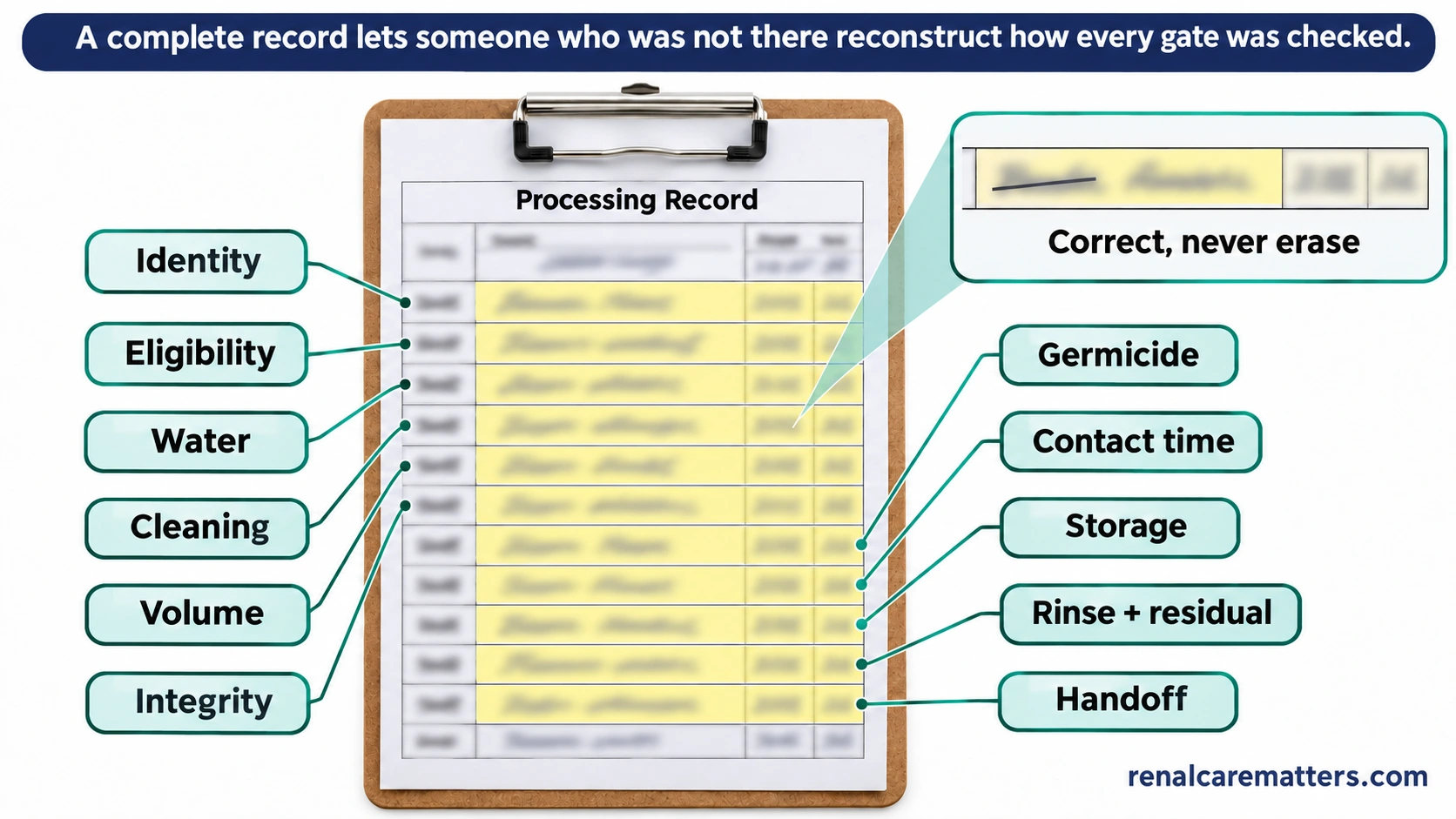
A complete record lets someone who was not there prove that every gate passed for this dialyzer, this cycle. It links the dialyzer to its patient, to the water, germicide and reprocessor checks of that run, and to the people who did each step.
| The record must show | Gate it proves |
|---|---|
| Patient identity, second identifier, dialyzer identifier, use number | Identity, uses left |
| Eligibility confirmed for the current period | Eligibility |
| Time received and time processed | Time to processing |
| Run linked to the water log, germicide batch and reprocessor daily check | Water, germicide, equipment |
| Baseline and measured total cell volume (TCV); integrity result; inspection | Performance |
| Fill time, presence result, storage position | Disinfection, window |
| Rinse, residual result and read time, two-person verification | Safe to connect |
| Disposition and the person who decided | Accountability |
Correct an error by a single line through it, with the correction, date and initials, under the procedure. Never erase, overwrite or recopy a record. Electronic records follow the same rule through an audit trail.
Reading the room’s numbers
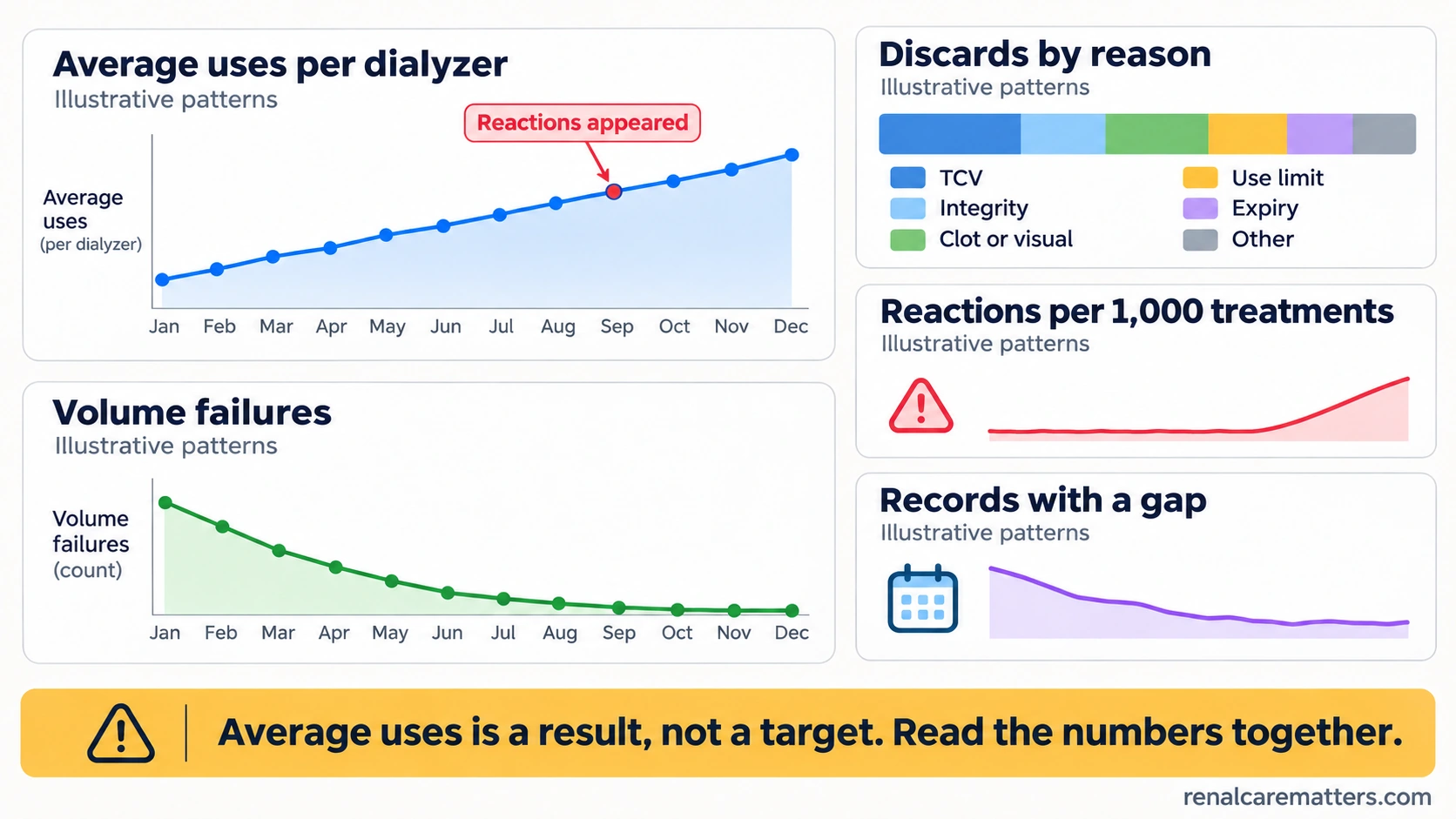
| Measure | How to calculate | What it can tell you |
|---|---|---|
| Average uses per dialyzer | Treatments with reprocessed or new dialyzers ÷ dialyzers used, over the month | How long dialyzers last; affected by heparin, rinsing, patient factors and the use limit |
| Discard rate by reason | Discards for each reason (volume, integrity, clot, visual, expiry, other) ÷ dialyzers processed | Where failures come from: the floor, the room, or the machine |
| Pyrogenic reactions per 1,000 treatments | Reactions ÷ treatments × 1,000 | A warning signal; any rise is investigated1 |
| Records audited with a gap | Records with any missing gate ÷ records audited | Whether the evidence can be trusted |
Malaysia’s 2026 standards require reuse audits as part of quality management.2 One United States unit raised its average uses substantially after standardizing heparin and end-of-treatment rinsing on the floor, with no fall in dialysis adequacy;3 the improvement came from upstream care, not from relaxing tests.
Targets that make reuse unsafe
The average number of uses is a result of good care, not a goal in itself. When staff are rewarded for raising it, the easiest way to raise it is to pass dialyzers that should fail: repeating volume tests until they pass, accepting doubtful integrity results, or stretching storage. The research gives a reason for caution even when tests are honest. In the Hemodialysis (HEMO) Study (HEMO) analysis, the survival advantage of high-flux dialyzers seen with little reuse reversed with extensive reuse;4 the finding is an association, but it means more uses is not automatically harmless.
Figure 4 · Safer measures to praise
Waste and disposal
A discarded dialyzer contains blood residue and, often, germicide. It is infectious waste and, for some germicides, chemical waste. Follow the unit’s waste procedure, which follows Philippine health-care waste rules and the safety data sheet (SDS). Drain germicide as the SDS and procedure direct before disposal, never into a hand-washing sink. Cut or defaced labels protect privacy.
Reuse reduces plastic waste; one large provider estimated about 10,000 metric tons avoided over its study period.5 Dialysis is among the most resource-intensive treatments in medicine, and the reuse room uses water and chemicals too.6 A program that cares about the environment measures both sides.
Capstone: one dialyzer, every gate
Illustrative scenario. Names and details are invented.
| Step | What you should decide |
|---|---|
| Receiving | Identity, eligibility, use count (next would be the fifth), time to receiving 15 minutes: accept |
| Volume | 77 ÷ 96 × 100 = 80.2%: meets the 80% floor only |
| Integrity and inspection | Passed; all other gates recorded |
| Monday handoff | Contact time passed, within expiry; residual read at the correct time; two-person verification |
| The fault report | A low-reading volume sensor makes TCV results look worse, not better, but every result from the window is uncertain. Trace back all dialyzers processed since the last good check; quarantine stored ones; the medical director decides |
| The chills | Keep that patient’s dialyzer and lines; check run, water and germicide records; report a possible cluster |
| After Monday | RU-1104 has had five uses. It is discarded at its next return, however good its tests look |
Back to the case: A good-looking month
What could explain the pattern? More uses and almost no volume failures can come from genuinely better care on the floor. It can also come from tests being repeated until they pass, a volume sensor drifting, or the use limit being stretched. Two new reactions in the same month make the second set of explanations worth checking before anyone celebrates.
What should Mr. Gonzales look for? Repeated volume tests on the same dialyzer with only the pass recorded; dialyzers beyond the use limit; gaps in integrity results; reprocessor calibration dates; germicide batch and water results for the days of the reactions; and the processing records of the two dialyzers involved, if they were kept.
A safer target? Praise complete records, honest failures, fewer clot discards after floor improvements, zero sixth uses and no unexplained reactions. Drop the bonus tied to average uses; Mr. Gonzales and Ms. Del Rosario should say so in the meeting.
Skills checklist: Record audit and capstone
Audit twenty synthetic records, then work through the capstone case aloud with your assessor. Your preceptor rates each step as satisfactory, needs practice, or not observed. Steps marked Critical must all be satisfactory before sign-off. This checklist supports supervised learning; your unit’s own procedure and competency form are the authority. A printable version of every checklist is on the trainer page.
- CriticalIdentifies every record with a missing or inconsistent gate.
- CriticalCorrects a sample record error by the single-line method, without erasing.
- Calculates average uses, discard rate by reason and reactions per 1,000 treatments from a monthly summary.
- CriticalExplains why a rising average use number is not a quality target.
- CriticalDisposes of a discarded training dialyzer and germicide as the procedure and SDS direct.
- CriticalWorks the capstone from receiving to handoff, naming each gate and its proof.
- CriticalRecognizes the use limit in the capstone and the trace-back window after the fault.
- States who decides each unproven question in the capstone.
Check your understanding
Each visit draws 5 questions at random from this module’s 12-question bank. Choose the single best answer for each, then select Check answers; an explanation appears under the best answer. Select New set of questions for a different mix. A good target is 4 of 5 on two different sets. Nothing you select is sent anywhere; scoring happens in your browser.
Read next on this site
- Green Nephrology 2026 — How Sustainable Kidney Care Begins Before DialysisThe environmental footprint of dialysis and ways to reduce it.
- Dialyzer Reprocessing and ReuseThe reference guide to reuse.