After this module you should be able to
- Explain how hepatitis B, hepatitis C and HIV spread in dialysis units, and why the reuse room is a high-risk place for indirect spread.
- Describe one-way clean and dirty flow and why the reuse room must be separate from medicine preparation.
- Choose and use protective equipment for splash, vapor and sharps risks.
- Apply the academy eligibility default and the unit program to infection status.
- Respond correctly to a splash, a cut, or a spill, and report it.
The big picture, in plain words
The picture has a limit. Chicken juice can be seen and smelled. A drop of blood carrying hepatitis B virus may be invisible, and the virus can survive on surfaces at room temperature for at least seven days.1 A reuse room handles blood-soiled devices from many patients every day. So the habits must be stricter than a kitchen’s, and they must not depend on whether the contamination is visible.
Figure 1 · Key terms for this module
Most of the time nothing goes wrong, because the habits hold. Your work is to keep the habits even when the room is busy and no one is watching.
Case: A splash at the header
Ms. Lorna Castillo, a reprocessing technician, is cleaning the blood-side header of a used dialyzer at 10:20 on a Saturday. She has her gown and gloves on. Her face shield is fogged, so she has pushed it up on her head for a moment. As she flushes the header, a jet of pink rinse water hits the side of her face and her left eye.
The dialyzer belongs to a patient whose program record shows him as eligible for reuse; his latest hepatitis results are filed in the nurses’ station. The reuse room is behind by eight dialyzers.
Before reading on, decide:
- What should Ms. Castillo do in the first minute?
- What should happen in the next hour?
- What should the unit change so it does not happen again?
Keep your answers in mind. The lesson gives you what you need, and the case review near the end shows one sound response.
How bloodborne viruses spread in a dialysis unit
Dialysis patients are exposed to blood every treatment, and many share stations, machines and staff. Outbreak investigations repeatedly find indirect contact: gloves not changed, surfaces not cleaned, clean supplies kept near dirty ones. The Centers for Disease Control and Prevention (CDC) recommendations for dialysis units rest on these findings.1,2
Two investigations show how the reuse room can be part of the chain. In a low-resourced unit in Vietnam, 11 patients acquired hepatitis C virus (HCV) over two months. All reused dialyzers on shared machines; the area for preparing injected medicines sat next to the area for handling blood samples and storing reused dialyzers. Investigators judged indirect contact through the environment as the likely route for 10 of the 11 cases and called for dedicated reprocessing systems and strict separation.3 In the Netherlands, gene sequencing linked two new HCV infections to one patient, through a contaminated pressure port or lapses during two incidents in a single session.4 Both were investigations, not trials, but the mechanism is consistent: virus travels on hands, surfaces and equipment.
| Virus | Why it matters in the reuse room |
|---|---|
| Hepatitis B virus (HBV) | Very high amounts in blood; survives on surfaces for days; vaccination protects staff |
| Hepatitis C virus (HCV) | The most common bloodborne infection acquired in dialysis units; no vaccine |
| Human immunodeficiency virus (HIV) | Lower risk per exposure than HBV; Philippine Society of Nephrology (PSN) guidance excludes dialyzer reuse5 |
Clean and dirty flow
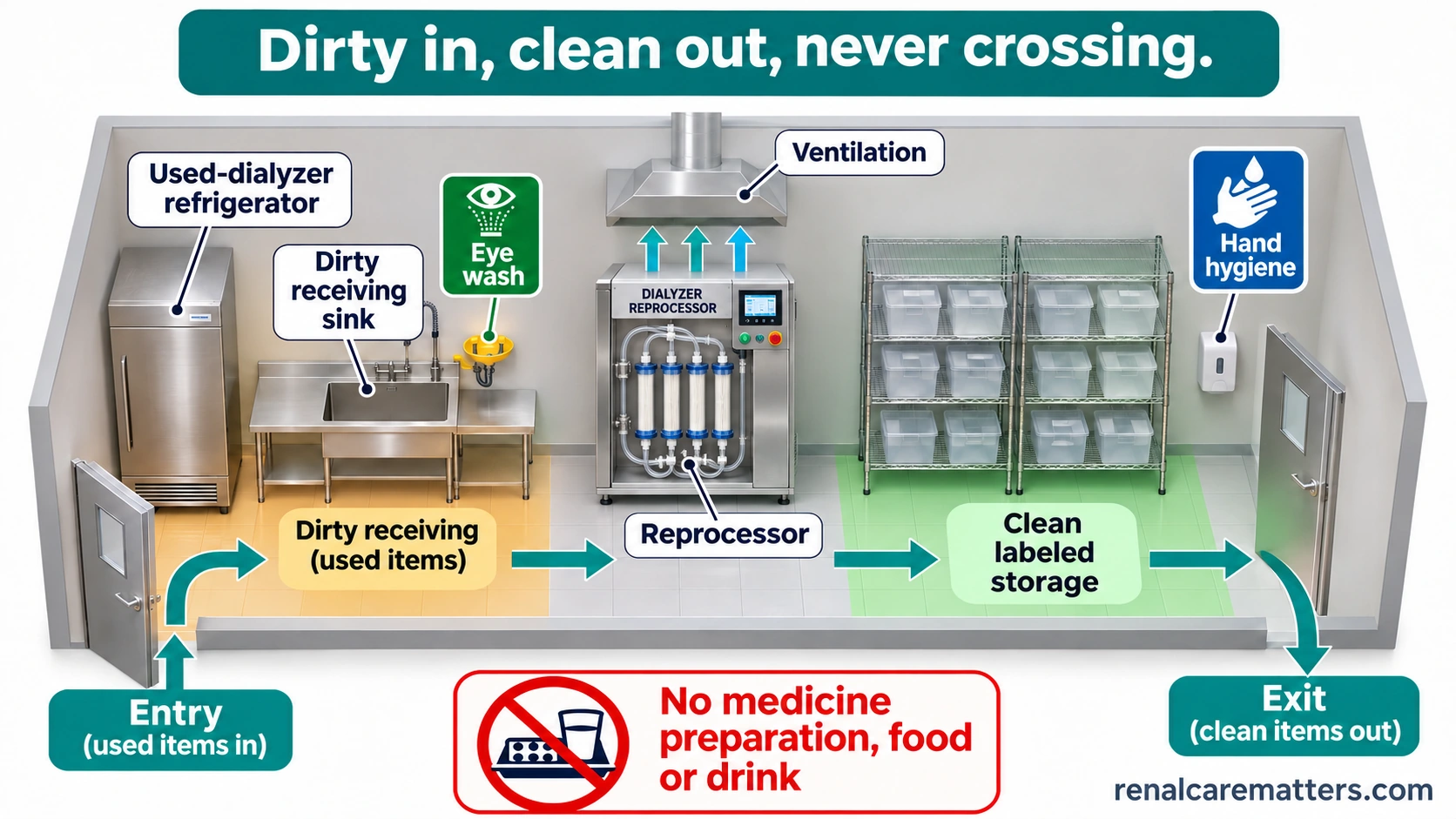
A reuse room protects patients best when its layout makes mistakes hard. Used dialyzers enter at one end, move through rinsing and processing, and leave as clean, labeled dialyzers at the other end. Nothing travels backward. Malaysia’s 2026 standards, a current regional comparison, require a dedicated reprocessing space with ventilation and labeled storage.6
| Feature | Why it matters |
|---|---|
| Separate dirty receiving sink and clean storage | Prevents splash and drip from reaching processed dialyzers |
| No medicine preparation, food or drink in the room | The Vietnam outbreak placed medicine preparation next to reused dialyzers3 |
| Hand hygiene station at the exit | Hands leaving the room are clean |
| Eye wash within reach | Splashes need water within seconds |
| Ventilation | Germicide vapor is removed (Module 6) |
| Dedicated area and reprocessor for any approved hepatitis program | Keeps one patient group’s devices away from others’5 |
Protective equipment and how it fails
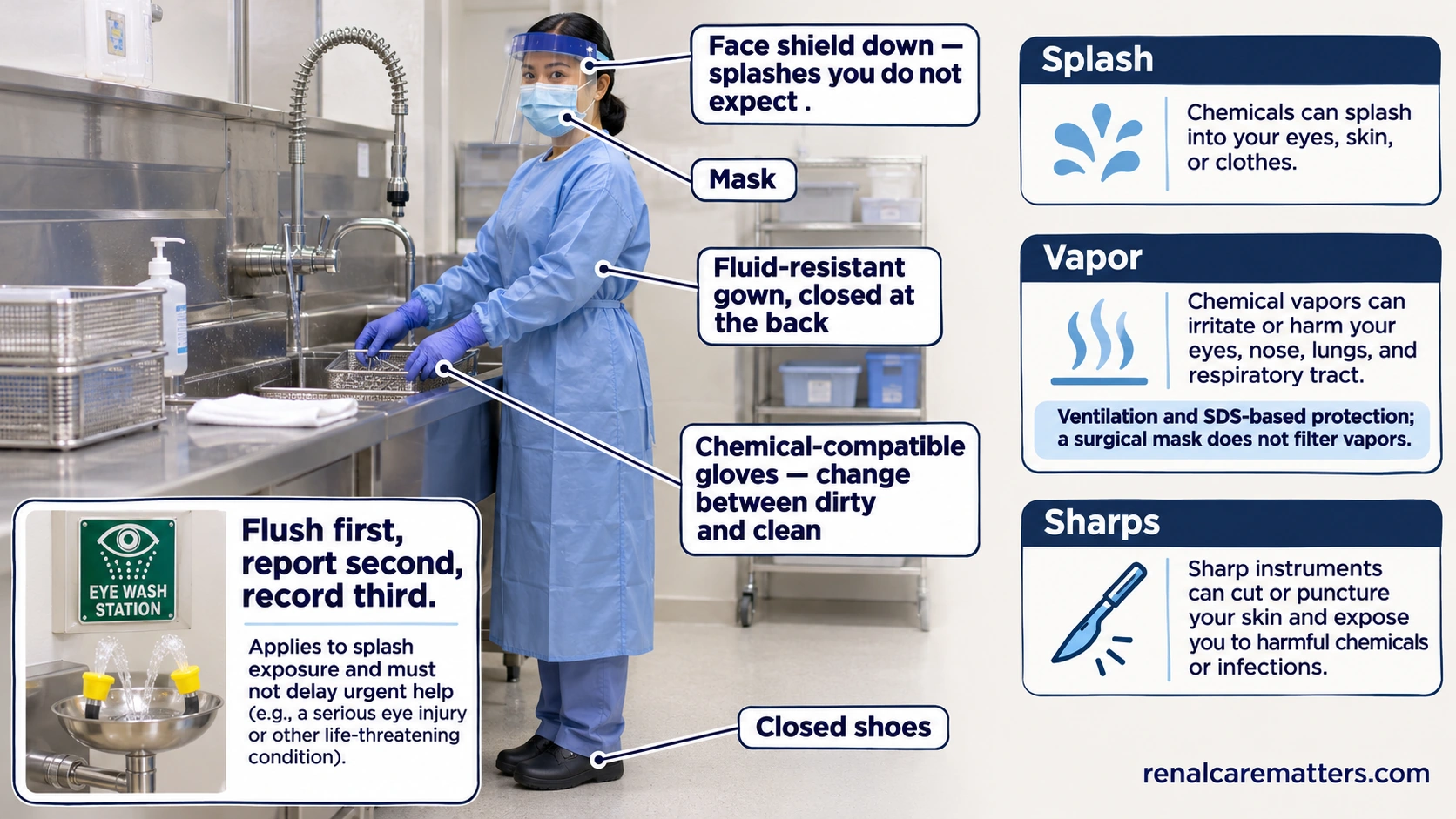
Header cleaning and rinsing produce splashes. Germicides give off vapor and can burn skin and eyes. Protective equipment works only when it is worn the whole time the risk exists.
| Item | Protects against | How it fails |
|---|---|---|
| Fluid-resistant gown | Splash to body and arms | Worn open at the back; worn outside the room |
| Gloves (chemical-compatible type) | Blood and germicide on hands | Not changed between dirty and clean tasks; torn; wrong material for the germicide |
| Face shield over a mask | Splash to eyes, nose and mouth | Pushed up because it fogs |
| Eye protection | Splash to eyes | Ordinary glasses with open sides |
| Closed, fluid-resistant shoes | Spills and dropped sharps | Sandals or cloth shoes |
Hepatitis B vaccination for staff is part of protection; the CDC recommends it for all susceptible dialysis staff, with a check of response.1 Ask occupational health for your own status.
Infection status and eligibility
The medical director’s program decides which patients may reuse. The technician’s job is to know the list and hold when it is unclear. Module 3 compared countries; the practical rules for the room are these.
Figure 4 · Academy default for Philippine units (your program decides)
A label on a dialyzer is not where infection status lives. It lives in the clinical record, and the nurse confirms it. Never write a diagnosis on a label that other patients can see unless your program requires a coded marker.
When an exposure happens
Figure 5 · Splash, cut or needle injury
- First secondsStop. Flush eyes at the eye wash for the time your procedure sets, holding the lids open; wash skin with soap and water; let a cut bleed freely, then wash. Do not scrub or apply bleach to skin.
- First minutesTell the person in charge. Secure the dialyzer and the work area so no one else is exposed.
- Within the hourReport to occupational health or the designated physician, who assesses the need for testing and preventive treatment. Time matters for some preventive treatments.
- RecordDate, time, what happened, which dialyzer, which patient (in the confidential report only), and what you did.
- ReviewThe unit looks for the cause without blame: a fogged shield, a sink at the wrong height, a rushed schedule.
Chemical splashes follow the same first steps: flush with water and follow the safety data sheet (SDS) for the product. Module 6 covers chemical exposure in detail.
Back to the case: A splash at the header
In the first minute: Ms. Castillo stops work, goes to the eye wash and flushes her eye and face for the time the procedure sets, holding the lids open, then washes her face with water. She calls out so a colleague can secure the dialyzer and the sink.
In the next hour: She reports to the person in charge and to occupational health or the designated physician. The source patient’s infection results are retrieved through the nurse, confidentially, to guide her assessment. Her own hepatitis B vaccination status is checked. The incident is recorded. The backlog of eight dialyzers waits, or is processed by another authorized operator; patients receive new dialyzers if needed.
What should change: The real cause was a fogging shield. The fix is anti-fog shields or a different model, a sink and spray height that point splashes away from the face, and a schedule that does not push staff to skip steps. The review asks why it happened, not who failed.
Skills checklist: Protective equipment and exposure drill
Practice in the reuse room with your preceptor, using water in place of blood and germicide. Your preceptor rates each step as satisfactory, needs practice, or not observed. Steps marked Critical must all be satisfactory before sign-off. This checklist supports supervised learning; your unit’s own procedure and competency form are the authority. A printable version of every checklist is on the trainer page.
- CriticalPuts on gown, gloves, mask and face shield in the order the procedure sets, and removes them without contaminating hands or face.
- CriticalKeeps the face shield down for the whole splash-risk task.
- CriticalChanges gloves and performs hand hygiene between dirty and clean tasks.
- Identifies the clean and dirty areas and the one-way path in the room.
- CriticalLocates the eye wash, the spill kit and the SDS binder, and checks the eye wash flow.
- CriticalDemonstrates eye flushing with lids held open.
- CriticalStates who to report an exposure to and how quickly.
- CriticalStates what to do with a dialyzer when a patient’s infection status changes.
Check your understanding
Each visit draws 5 questions at random from this module’s 12-question bank. Choose the single best answer for each, then select Check answers; an explanation appears under the best answer. Select New set of questions for a different mix. A good target is 4 of 5 on two different sets. Nothing you select is sent anywhere; scoring happens in your browser.
Read next on this site
- Viral Infections & Vaccinations in CKDViral infections and vaccines in kidney disease.
- Dialysis Access InfectionHow infections start at the dialysis access.