After this module you should be able to
- Describe reprocessing as one competency shared by the reprocessing operator, the dialysis technician and the biomedical technician, and what each may do with it.
- Name who decides patient eligibility, who decides use on the patient, who proves processing, and who restores equipment.
- State the tasks outside your scope, even when a lesson mentions them.
- Act correctly when two people disagree about a dialyzer: quarantine, then a written decision.
- Explain why a knowledge pass, an observed practical, and a facility authorization are three different things.
The big picture, in plain words
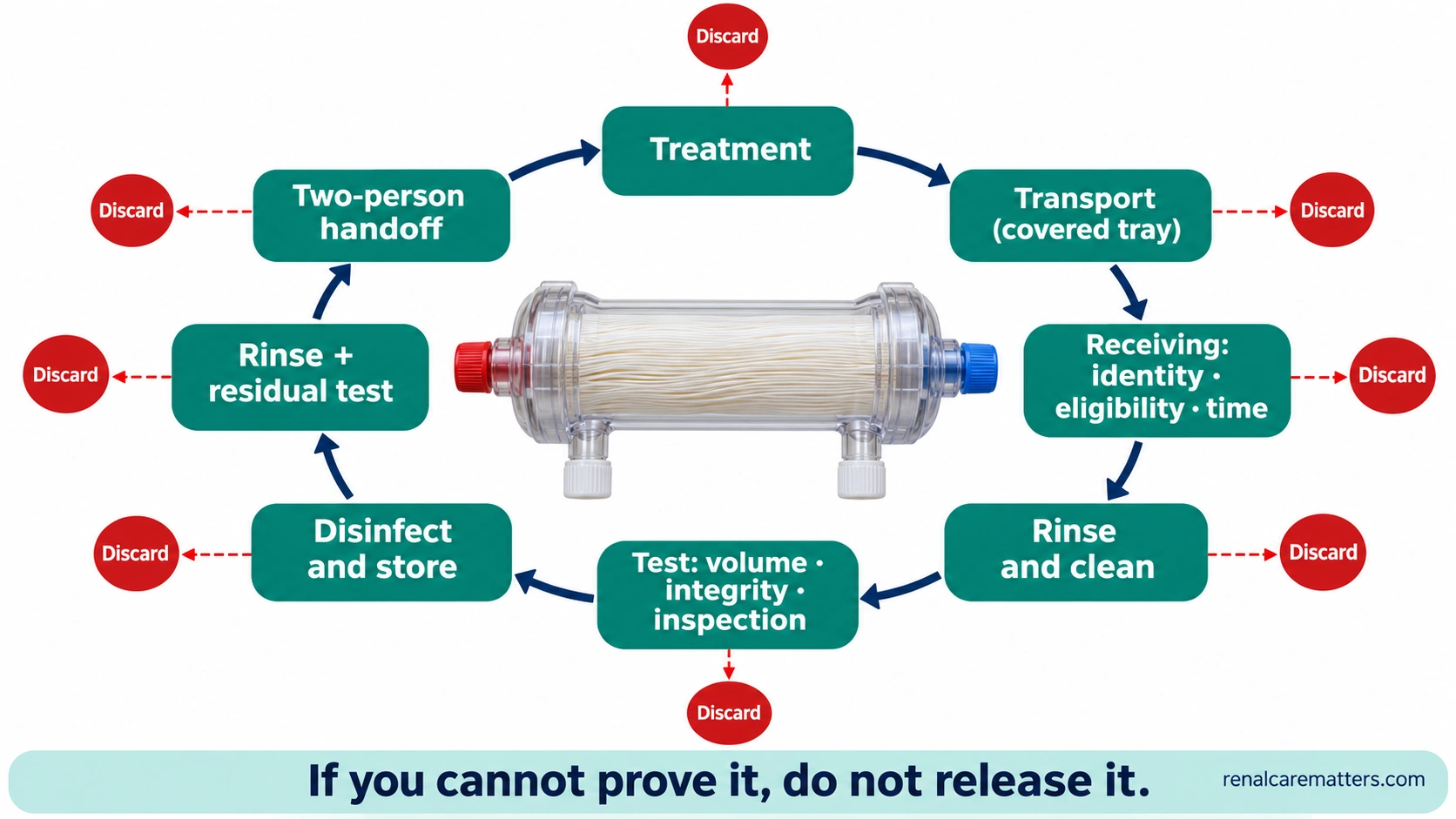
The picture has a limit. A baby bottle is simple, and a mistake is usually small. A dialyzer holds about ten thousand hollow fibers, each thinner than a hair, and the next patient’s blood flows through all of them. A mix-up can give a patient someone else’s blood residue, a clotted filter that cleans poorly, or a dose of disinfectant. So reuse is safe only when every step is done, checked and written down.
Figure 1 · Key terms for this module
Most dialyzers in a well-run program pass through the room without incident. A few fail a test or arrive with a problem. Your work is to prove the first kind safe, step by step, and to stop the second kind before it reaches a patient.
Case: A quiz is not a key
It is 6:10 on a Tuesday morning at a sixteen-station unit in Bulacan. Mr. Jun Soriano, a biomedical technician, has just finished the common knowledge module of the reprocessing track with a score of 5 of 5. The reuse room is behind schedule because the regular operator, Ms. Liza Dimaculangan, is on leave.
The charge nurse, Ms. Tess Lagman, asks Mr. Soriano to “release the 6:30 dialyzers, since you passed the course.” Three dialyzers have been processed overnight by a relief operator. One of them, labeled RU-0412, has a blank space where the integrity test result should be. The first patient is already on the weighing scale.
Before reading on, decide:
- Can Mr. Soriano release the dialyzers because he passed the quiz?
- What should happen to dialyzer RU-0412?
- Who should Ms. Lagman call, and what does the patient receive in the meantime?
Keep your answers in mind. The lesson gives you what you need, and the case review near the end shows one sound response.
One competency, three jobs
Reprocessing is a technical patient-safety competency. It belongs to several jobs at once. The Department of Health (DOH) licensing order lists daily reprocessor calibration, collection, reprocessing, acceptance testing, labeling, records and storage among the duties of the dialysis technician.1 The Philippine Society of Nephrology (PSN) expects technicians to finish a structured training program of three months or longer.2 Some units hire a person only for the reuse room; others give the work to dialysis technicians; biomedical technicians service the reprocessor itself.
| Job | What they do in the reuse room | What the job does not include |
|---|---|---|
| Reprocessing operator | Receives, processes, tests, stores and documents each dialyzer under the approved program | Deciding who is eligible for reuse; using the dialyzer on a patient |
| Dialysis technician | The operator’s work, plus machine preparation and other duties the facility assigns | Cannulation, medicines, or changing a prescription unless separately authorized by law and the facility |
| Biomedical technician | Installs, calibrates, maintains and repairs the reprocessor and water system within service authorization | Releasing a patient’s dialyzer |
Being enrolled under Nephrology Nursing does not make anyone a nurse. The track sits there because the reuse room is part of the nursing service that the head nurse and medical director supervise.
Who decides what
Every safe decision in the reuse room has an owner. When ownership is clear, a technician can stop a dialyzer without arguing about who is in charge.
| Decision | Owner | Your part |
|---|---|---|
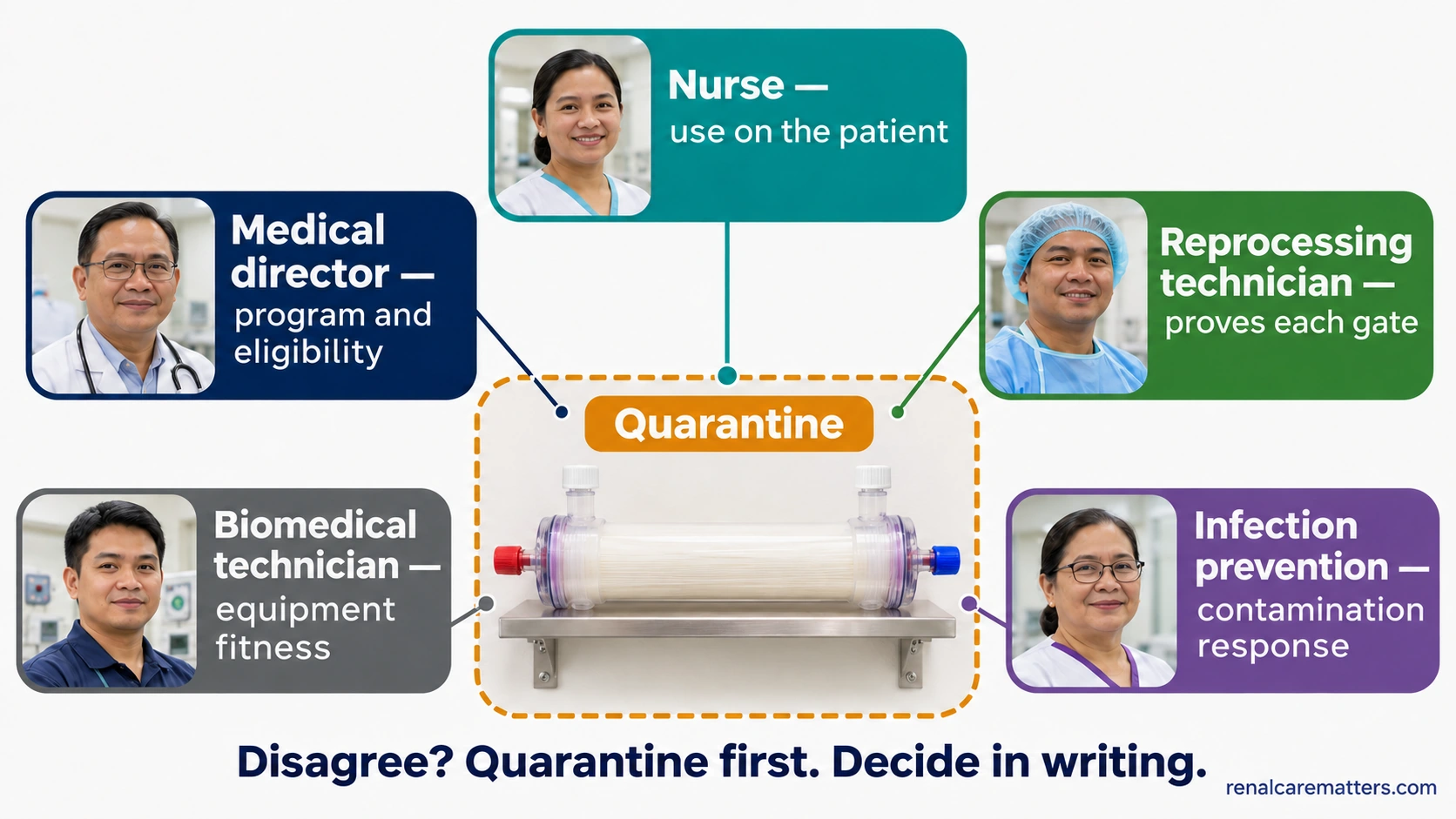
| Whether the unit reuses at all, which method and germicide, and who is eligible | Medical director | Know the program and the eligibility list. Hold any dialyzer whose eligibility is unknown. |
| Whether a dialyzer is used on the patient today | Dialysis nurse | Give the nurse a dialyzer with complete evidence, and verify identity with the nurse. |
| Whether processing passed | Authorized operator | Prove each gate in the record. Report every failure. |
| Whether a reprocessor is fit for use after service | Biomedical technician, per the service procedure | Report faults and odd readings. Do not use equipment tagged out. |
| How to respond to contamination or a cluster of reactions | Infection prevention lead with the medical director | Quarantine, preserve evidence, and report. |
Disagreement happens. A nurse wants a dialyzer now; a technician sees a gap in its record. Production pressure is real, but it cannot settle a safety question. The rule is simple: the dialyzer goes to quarantine, the patient receives a new dialyzer, and the question is answered in writing by the person who owns it.
The edges of your scope
This track mentions many tasks that belong to other people: setting up a dialysis machine, connecting a patient, giving heparin, repairing an electrical board. A lesson that describes a task does not authorize you to do it.
Figure 4 · Outside the reprocessing operator’s scope unless separately authorized
Before you accept a new duty, ask two questions: which written scope covers this, and who has watched me do it? If either answer is “no one,” the answer to the task is “not yet.”
Respect belongs to scope as well. The dialyzers you handle carry patients’ names and infection status. Speak about them only to the people who need to know, and never photograph a label on a personal phone.
Knowledge, practice, authorization: three different things
The Academy can teach principles and record what you have learned. It cannot watch your hands. The track keeps five states apart, and they must never be merged.
Figure 5 · From first lesson to facility authorization
- LearningReading the modules and working through the cases.
- Knowledge assessedSelf-assessments and the end-of-track examination.
- Supervised practiceWorkplace hours on the unit’s own reprocessor, with an assessor.
- Practical assessedObserved full cycles with every critical item met.
- Facility authorizedA written decision by the facility on what you may do. This happens outside the Academy.
Each state proves something different. A quiz shows that you know the steps. An observed practical shows that you can do them on that equipment. A facility authorization says that the unit accepts responsibility for letting you do them. A person who passes a quiz has moved one step, not five.
The same logic applies to people moving between countries. A United States patient-care technician must be certified within 18 months of hire under federal rules, and the water-system technician role is addressed separately;3 a Philippine certificate does not transfer automatically, and neither does a foreign one. Job titles vary as well: one 2025 Philippine job posting for reprocessing work used the title “adding machine technician.” Read the duties, not the title.
Working with the team
The reuse room depends on the people upstream and downstream. A nurse who rinses the dialyzer well at the end of treatment and gives enough heparin during it sends you a cleaner dialyzer. In one United States unit, a team project that standardized heparin and end-of-treatment rinsing raised the average number of uses per dialyzer substantially without any fall in dialysis adequacy.4 It was a single-unit improvement report, not a trial, but the lesson holds: most failed dialyzers are made on the floor, not in the room.
Report what you see in a way the floor can use. “Three dialyzers from station 5 failed volume this week, all with clotted headers” is a fact a head nurse can act on. “Station 5 is careless” is not.
Figure 6 · Good reports from the reuse room
Back to the case: A quiz is not a key
Can Mr. Soriano release the dialyzers? No. He has passed a knowledge check. He has not been observed releasing dialyzers on this unit’s reprocessor, and the facility has not authorized him as an operator. His biomedical role covers the reprocessor, not patient dialyzers. He can help in the room within his scope, for example by checking whether the reprocessor printout shows the integrity result.
What happens to RU-0412? A blank integrity result means the gate is unproven. The dialyzer goes to quarantine with a hold label. It is not released on the assumption that the test was done. If the reprocessor memory shows a recorded pass, an authorized operator can complete the record later under the standard operating procedure (SOP); if not, the dialyzer is reprocessed or discarded as the program directs.
Who does Ms. Lagman call? The head nurse or the person the unit designates for reuse-room questions, and, if no authorized operator is available, the medical director’s designate. The patient receives a new dialyzer for today. That costs one dialyzer. Using an unproven one could cost far more.
Skills checklist: Responsibility map and escalation drill
Complete this with your preceptor, using a training dialyzer with a deliberately incomplete record. Your preceptor rates each step as satisfactory, needs practice, or not observed. Steps marked Critical must all be satisfactory before sign-off. This checklist supports supervised learning; your unit’s own procedure and competency form are the authority. A printable version of every checklist is on the trainer page.
- CriticalNames the owner of each decision: eligibility, use on the patient, processing, equipment fitness, contamination response.
- CriticalIdentifies the missing gate in the record and states that the dialyzer is unproven.
- CriticalApplies a quarantine label and moves the dialyzer to the quarantine shelf.
- CriticalStates that the patient receives a new dialyzer while the question is answered.
- CriticalRefuses, politely and clearly, a request to release outside authorization.
- Names the person to call when no authorized operator is present.
- Writes a short factual report: what, when, where it may come from, what was done.
- States two tasks outside the operator’s scope.
Check your understanding
Each visit draws 5 questions at random from this module’s 12-question bank. Choose the single best answer for each, then select Check answers; an explanation appears under the best answer. Select New set of questions for a different mix. A good target is 4 of 5 on two different sets. Nothing you select is sent anywhere; scoring happens in your browser.
Read next on this site
- Dialyzer Reprocessing and ReuseThe site’s reference guide to dialyzer reuse, its history and its risks.