After this module you should be able to
- Reconcile sessions delivered to claims, receivables, remittances and bank deposits.
- Build a receivables aging report and calculate days sales outstanding (DSO).
- Apply segregation of duties and compensating controls in a small team.
- Run a month-end close checklist with the accountant.
The big picture, in plain words
The picture has a limit. Footprints in mud are obvious; footprints in a spreadsheet are not. A missing claim looks exactly like a claim that was never needed, until someone counts. And most gaps are not theft. They are late submissions, returned claims, unapplied payments, and supplies issued without a record. Internal controls exist to catch the honest mistakes early, and to make the dishonest ones hard.
You do not need to be an accountant for this module. You need to know what to reconcile, who should not do two jobs at once, and how to investigate a gap without accusing anyone before the facts are in.
Figure 1 · Key terms for this module
Case: The missing ESA vials
At the October month-end count in a 16-station unit in Tuguegarao City, the storekeeper, Ms. Lovely Mabbayad, finds 40 fewer vials of erythropoietin, an erythropoiesis-stimulating agent (ESA), than the stock ledger predicts. At about 1,200 pesos a vial, that is 48,000 pesos.
By lunchtime, the rumor has reached the nurses' station that "someone is stealing." Two nurses who worked nights that month feel they are being watched.
Before reading on, decide:
- What records would you compare first?
- What would you say to the staff today, before the facts are known?
- If the cause turns out to be a system gap, how would you prove the fix works?
Keep your answers in mind. The lesson gives you what you need, and the case review near the end shows one sound response.
The model: follow the session
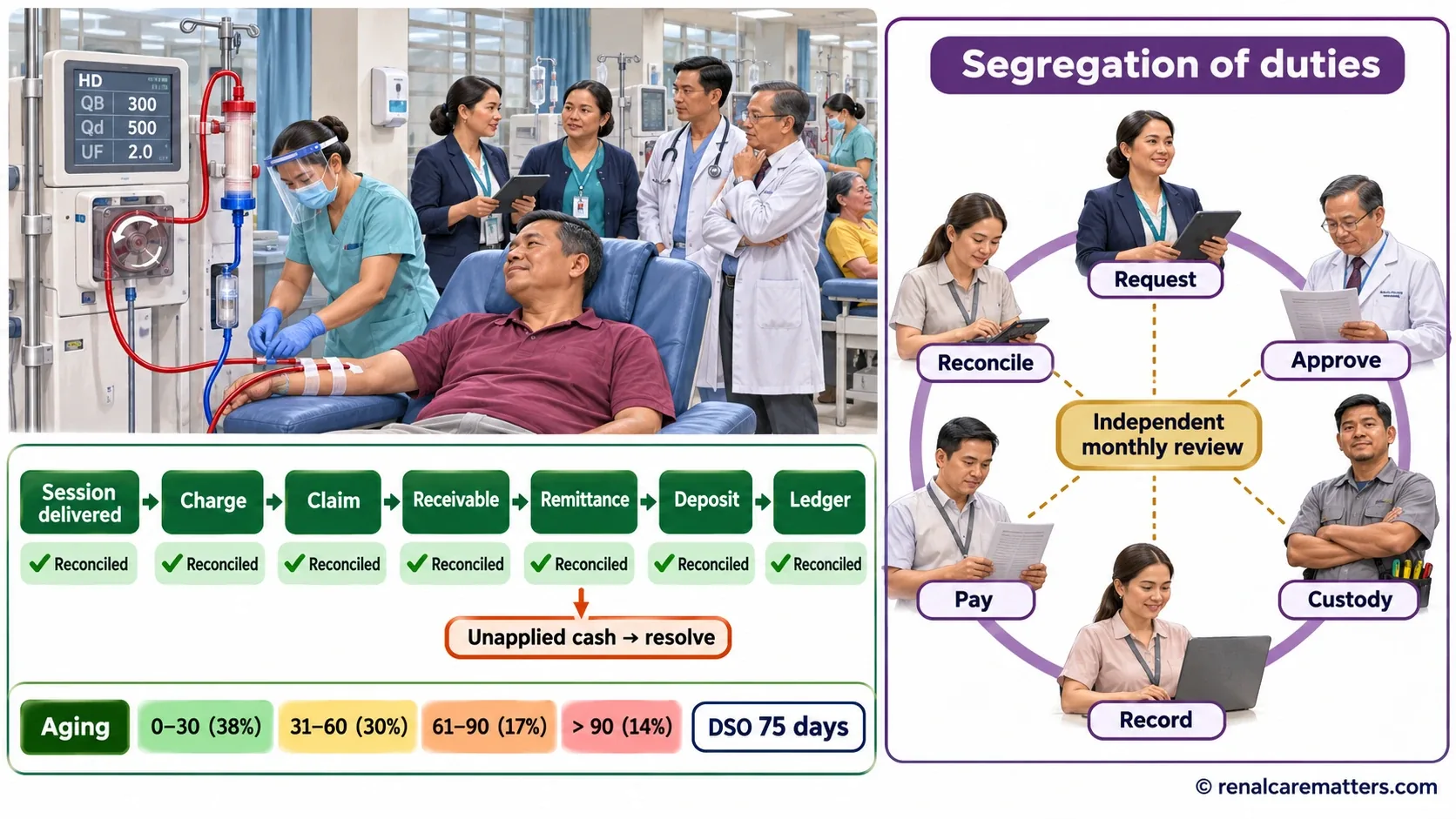
Figure 3 · From the chair to the bank
- Session deliveredThe signed treatment record.
- ChargeThe billing entry for that session.
- ClaimSubmitted to Philippine Health Insurance Corporation (PhilHealth) or another payer1; any patient share billed if it applies.
- ReceivableThe amount expected.
- RemittanceThe payer's payment advice.
- DepositThe bank statement.
- LedgerThe general ledger entries.
At month-end, the counts and amounts at each step must agree, or the differences must be explained: claims not yet submitted, denials, partial payments, adjustments. Unexplained differences are where errors and fraud hide.
Example. A unit in Cotabato City delivers 1,312 sessions in August. Billing shows 1,298 claims. The 14-session gap is explained in an hour: 9 patients were still awaiting PhilHealth Dialysis Database registration, 3 were self-pay, and 2 sessions were charted but never billed because the encoder was on leave. Those 2 are filed the next day. Without the reconciliation, they would have been lost.
Purchasing and payment
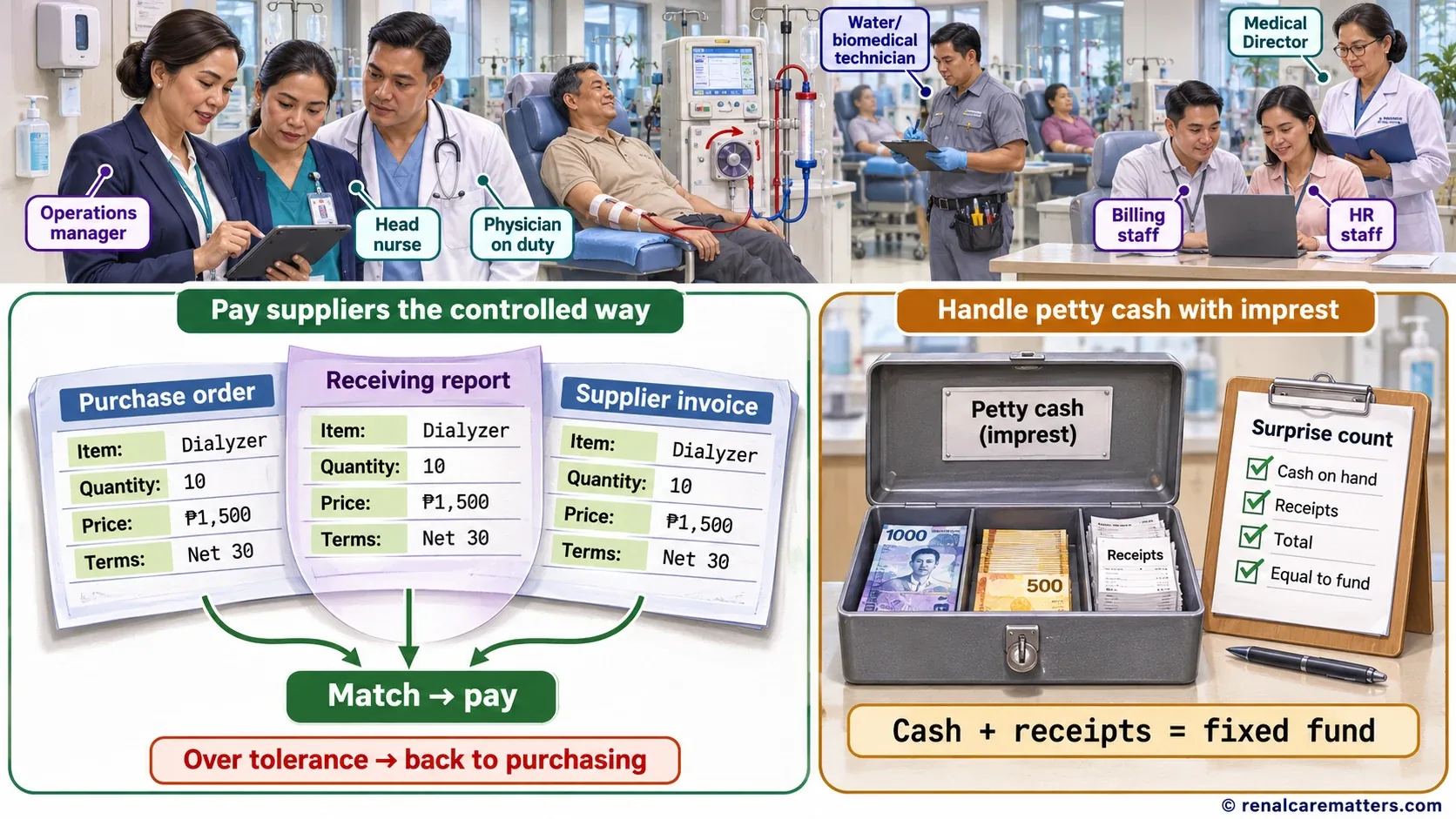
The three-way match pays a supplier only when three documents agree on the item, quantity, price, and terms: the approved purchase order, the signed receiving report, and the supplier's invoice. Differences beyond a set tolerance go back to purchasing.
Petty cash uses an imprest system: a fixed fund, refilled only against receipts that bring it back to its original amount. Count it without warning at least once a month.
Tax documents. The Ease of Paying Taxes Act (Republic Act (RA) 11976, 2024) made the invoice the primary document for sales of goods and services.2 Your accountant confirms the current requirements for receipts, invoices, and withholding.
Segregation of duties
| Function | Example |
|---|---|
| Requesting | The head nurse requests supplies |
| Approving | The administrator approves the purchase |
| Custody | The storekeeper receives and holds stock |
| Recording | The bookkeeper posts entries |
| Paying | Finance releases payment |
| Reconciling | The accountant or manager reconciles the bank and subledgers |
In a small unit, one person may have to hold two roles. Then add a compensating control: an independent monthly review by the owner or an outside accountant, surprise cash counts, or bank statements sent directly to the reviewer.
Example. In a 10-station unit in Iligan, the administrator both approves purchases and releases payments, because there is no one else. The owner, a nephrologist who visits weekly, now receives the bank statement directly from the bank, and every month picks five payments at random and asks to see the purchase order, receiving report, and invoice for each. It takes her 20 minutes. It also makes a fake supplier much harder to hide.
What the evidence shows
Internal control frameworks are professional standards, not trial-tested interventions. Fraud surveys by professional associations consistently find that small organizations lose proportionally more, that missing controls and overridden controls are the most common weaknesses, and that most frauds are detected by tips or management review rather than by external audit. This is descriptive evidence. It supports a simple principle: a check that is actually performed beats a policy that is not.
Calculator CALC-09: receivables aging and DSO
You need: outstanding receivables, by service month or by days outstanding, and net revenue for the last 90 days.
Average daily revenue = net revenue for the last 90 days ÷ 90.
DSO = total receivables ÷ average daily revenue.
Worked example. Receivables are 2.4 million pesos at 0 to 30 days, 1.9 million at 31 to 60, 1.1 million at 61 to 90, and 0.9 million over 90: 6.3 million in total. Revenue for the last 90 days was 7.56 million pesos, or 84,000 pesos a day. DSO = 6,300,000 ÷ 84,000 = 75 days. The over-90 share is 0.9 ÷ 6.3 = 14%.
Reading it. Watch the over-90 share and the DSO trend month by month. A growing over-90 bucket usually means claims that were never submitted, were returned, or are unresolved (Module 10). Work the list claim by claim.
Month-end close checklist
- Lock the session count for the month from the treatment records.
- Reconcile sessions to claims submitted, pending, and not billable, with reasons.
- Reconcile remittances to claims. Post unapplied cash to a holding account and resolve it.
- Reconcile the bank account to the ledger.
- Count high-value stock, such as ESAs and dialyzers, and compare with the stock ledger.
- Count petty cash.
- Review open purchase orders, unmatched receipts, and accruals with the accountant.
- Prepare the variance report: actual against budget, with explanations for material differences.
- Send the management report (Module 13 format) with exceptions, owners, and due dates.
Common failure modes
- Two systems, no bridge. Billing and clinical session counts never reconciled.
- Unapplied cash. Payments sitting in a holding account for months.
- One person, every job. The same person requests, receives, and pays, with no review.
- Year-end counting. High-value stock counted once a year.
- The rumor investigation. Looking for a culprit before looking at the records.
Back to the case: The missing ESA vials
Today. The manager, Mr. Jerome Agustin, tells the staff plainly: "We have a count difference. We do not know why yet. No one is being accused. We will look at the records and I will tell you what we find." Then he asks for the records, not for names.
The records. He compares three sources: the stock issued to the floor, the doses ordered for each patient, and the doses recorded as given. The doses recorded as given match the orders exactly. The gap traces to one week when vials were issued to the floor in boxes of 20 rather than by patient dose, and the night nurse recorded usage at the end of each shift from memory. Some given doses were never subtracted from the floor stock. Some vials were likely dropped, cracked, or used and not recorded.
The fix. ESA is now issued by patient dose and recorded at the moment of administration. The floor stock is counted daily for one month, then weekly. The difference falls to zero in November and stays there. Mr. Agustin tells the staff what he found. The night nurses, who had done nothing wrong, are relieved. The system change protects them as much as it protects the stock.
Skills checklist: Supervised practice
Complete these with your preceptor at your own unit, using fictional or de-identified data. Your preceptor rates each step as satisfactory, needs practice, or not observed. Steps marked Critical must all be satisfactory before sign-off. This checklist supports supervised learning; your unit’s own procedure and competency form are the authority. A printable version of every checklist is on the trainer page.
- CriticalReconcile one month of synthetic sessions through all seven steps.
- Build the aging report and DSO with CALC-09 and list the ten oldest items.
- Map segregation of duties in your unit and propose compensating controls for any overlaps.
- Complete the month-end checklist with the accountant.
Check your understanding
Each visit draws 5 questions at random from this module’s 15-question bank. Choose the single best answer for each, then select Check answers; an explanation appears under the best answer. Select New set of questions for a different mix. A good target is 4 of 5 on two different sets. Nothing you select is sent anywhere; scoring happens in your browser.
Read next on this site
- "Zero Balance" Doesn't Mean Zero WorriesBilling rules behind the receivables.