After this module you should be able to
- List the external services a freestanding unit depends on and the agreement that secures each.
- Maintain the permits a freestanding unit needs beyond the Department of Health (DOH) license.
- Manage the owner relationship with regular, factual reporting.
- Design emergency transfer and patient transport arrangements.
The big picture, in plain words
The picture has a limit. A small house is also more nimble. A freestanding unit can choose its suppliers, change its schedule without a hospital committee, and know every patient by name. Many of the best-run units in the country are freestanding. Structure matters less than the systems behind it. But those systems do not come with the building; you have to build them.
This module is for managers of freestanding units. If you run a hospital unit, Module 14 is yours, though the two overlap.
Figure 1 · Key terms for this module
Case: The transfer that took two hours
It is 10:40 on a Tuesday at a 12-station freestanding unit in Dasmariñas, Cavite. Mr. Eduardo Ramos, 64, develops crushing chest pain and a blood pressure of 80/50 midway through his session. The physician on duty, Dr. Clarissa Uy, stops ultrafiltration, gives oxygen, gets an electrocardiogram, and calls for transfer.
The manager, Mr. Ferdinand Sison, calls the hospital named in the unit's only transfer agreement. Its emergency department says it is full and is diverting ambulances. He calls the ambulance provider on the contract. Its one vehicle is on another call, 40 minutes away. Mr. Ramos leaves the unit at 12:45, in a private car driven by his son, to a hospital 25 minutes away.
Before reading on, decide:
- What made this transfer take two hours?
- What should be in place so the next one takes 20 minutes?
- How would you know it works before the next real emergency?
Keep your answers in mind. The lesson gives you what you need, and the case review near the end shows one sound response.
The model: a small facility with outside lifelines
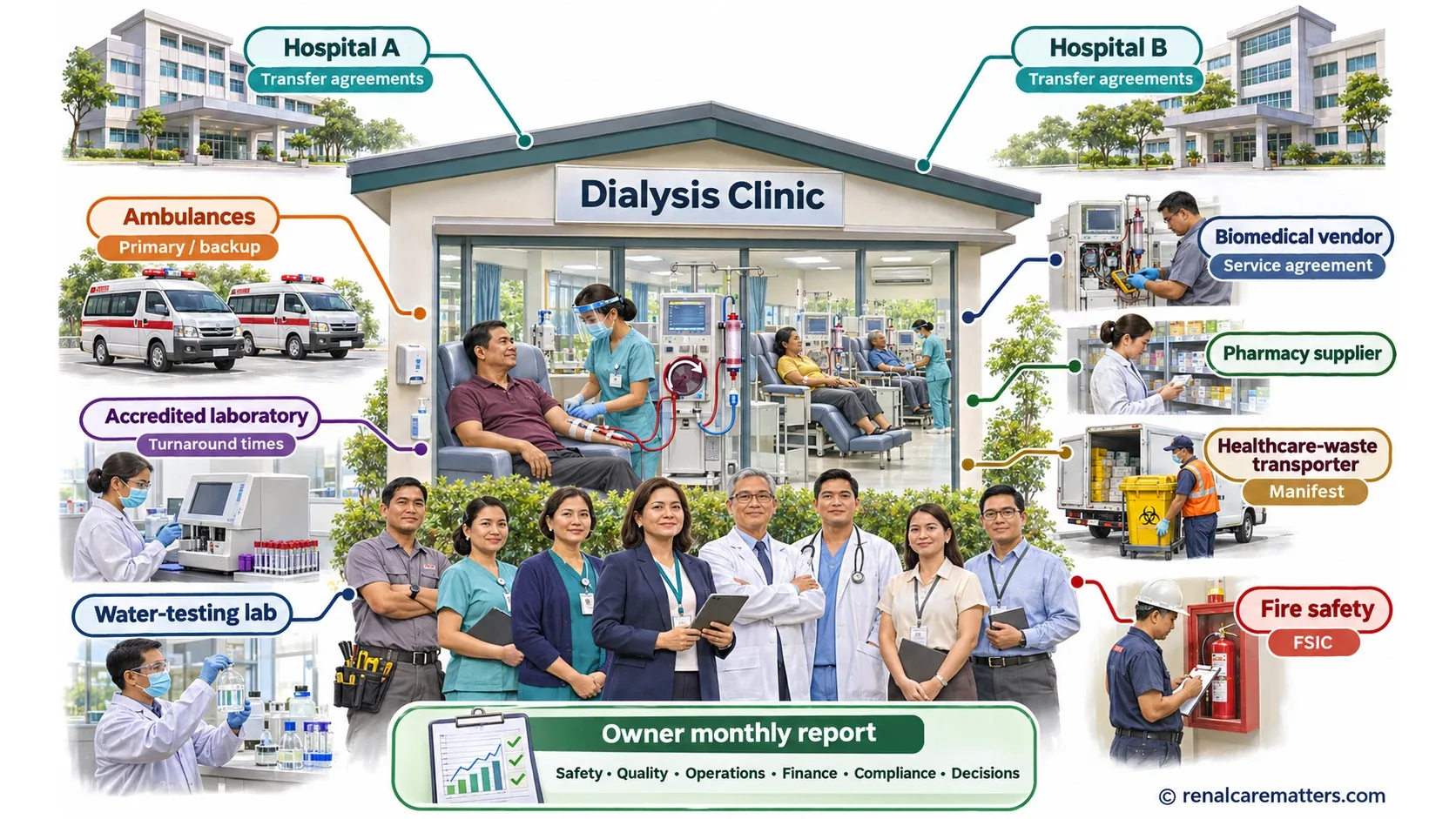
| Need | A hospital unit gets it from | A freestanding unit secures it by |
|---|---|---|
| Emergency transfer | The emergency department next door | Written transfer agreements with at least two hospitals; ambulance contracts |
| Laboratory | The hospital laboratory | A contract with an accredited laboratory with defined turnaround times |
| Water testing | Hospital engineering and laboratory | A contract laboratory for cultures, endotoxin, and chemical analysis |
| Biomedical service | The hospital biomedical department | A vendor service agreement and an in-house technician |
| Pharmacy | The hospital pharmacy | A licensed supplier; drug storage according to regulation |
| Waste management | The hospital waste contract | An accredited transporter and treatment facility; manifest records |
| Infection control committee | The hospital committee | A unit infection prevention program led by the Medical Director |
| Security and fire safety | Hospital systems | Its own fire safety inspection, alarms, extinguishers, and drills |
Example. A unit in Tagum City has a laboratory contract that says nothing about turnaround time. Monthly hepatitis B results take 10 to 14 days. After the manager adds "results within 72 hours; critical values phoned within one hour" to the renewal and tracks it for three months, the median falls to two days. The laboratory had always been able to do it. No one had asked.
Permits beyond the DOH license
Confirm the list with your local government and administrator. It typically includes the business permit, the Bureau of Fire Protection fire safety inspection certificate, the sanitary permit, registration as a generator of hazardous healthcare waste with the environmental regulator, and building and occupancy permits for renovations. Each goes in the evidence index (Module 2) with its expiry date.
Healthcare waste
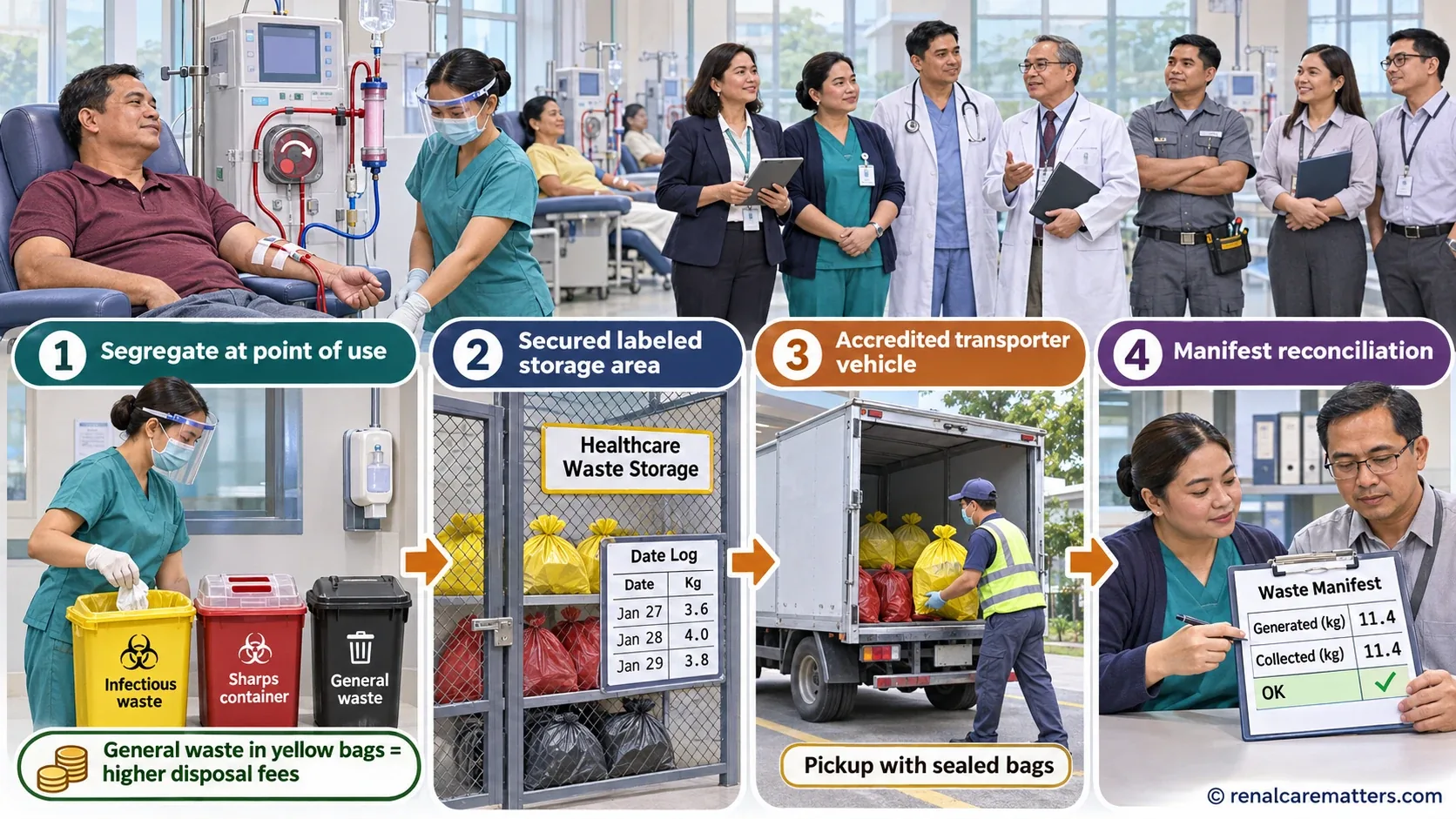
Figure 4 · Healthcare waste in four steps
- SegregateAt the point of generation, using the national color code: yellow for infectious waste, sharps in puncture-proof containers, black for general waste. Confirm against current DOH healthcare waste guidance.
- StoreIn a secured, labeled area, for a limited time.
- TransportOnly through an accredited transporter.
- DocumentA manifest for each pickup; reconcile volumes every month.
Waste is also a cost. General waste put in yellow bags multiplies disposal fees.
Example. A unit in Cabuyao pays for 320 kilograms of infectious waste a month. A one-week audit of the yellow bins finds food wrappers, paper towels from hand-washing, and empty saline bags. After a black bin is placed beside every hand-washing sink and the staff are shown the audit, infectious waste falls to 210 kilograms. The savings pay for the new bins in two months.
Owner and governance reporting
Owners of freestanding units are often physicians, families, or investors who are not on the floor every day. Give them a predictable monthly report, in the same format every time:
- Safety: incidents, infections, water exceptions, and their status.
- Quality: the quality dashboard (Module 9).
- Operations: sessions delivered against capacity, missed sessions, staffing gaps.
- Finance: revenue, cost per treatment, receivables aging, and cash (Modules 11 and 16).
- Compliance: the amber and red rows of the evidence index.
- Decisions needed: each with options, cost, and risk.
Networks and multisite operations
When one operator runs several units, standardize what must be the same: policies, forms, indicator definitions, and supplier contracts. Allow local variation only where it is justified, such as staffing patterns and transport routes. Shared float pools and central purchasing give scale. Rotating managers spreads good practice, but no site should ever be left without a named accountable manager on any day.
What the evidence shows
No trial has compared freestanding and hospital-based dialysis governance in the Philippines. International observational data show wide variation in staffing and outcomes by facility ownership and chain affiliation.1,2 The defensible conclusion: structure matters less than the systems behind it. A freestanding unit with strong agreements, staffing, and audits can match or exceed a hospital unit with weak ones.
Common failure modes
- One of everything. A single transfer hospital and a single ambulance.
- Contracts without clocks. Laboratory agreements with no turnaround time.
- Renew after the notice. Permits renewed only when the expiry letter arrives.
- The shape-shifting report. Owner reports in a new format every month.
- Yellow bags for everything. Paying infectious-waste rates for paper towels.
Back to the case: The transfer that took two hours
The cause. Not the physician, not the manager. One hospital, one ambulance, no backup. The plan had no second option for either.
The fix. Mr. Sison negotiates transfer agreements with two more hospitals in different directions: one in Imus and one in Silang. He adds a second ambulance provider and the city's emergency response number. All three hospitals and both ambulances, with phone numbers and expected travel times, go on the emergency contact board by the nurses' station.
The test. He runs a transfer drill every quarter, timing the interval from the decision to transfer to the ambulance leaving. The first drill takes 31 minutes, because the second ambulance company's number had changed. The second takes 18. Mr. Ramos, who had a heart attack and recovered, returns to the unit six weeks later. His son asks what has changed. Mr. Sison shows him the board.
Skills checklist: Supervised practice
Complete these with your preceptor at your own unit, using fictional or de-identified data. Your preceptor rates each step as satisfactory, needs practice, or not observed. Steps marked Critical must all be satisfactory before sign-off. This checklist supports supervised learning; your unit’s own procedure and competency form are the authority. A printable version of every checklist is on the trainer page.
- List every external service and its agreement, contact and expiry.
- Audit one month of healthcare waste manifests against volumes generated.
- Prepare one monthly owner report using the six headings.
- CriticalTime a transfer drill from call to ambulance departure.
Check your understanding
Each visit draws 5 questions at random from this module’s 15-question bank. Choose the single best answer for each, then select Check answers; an explanation appears under the best answer. Select New set of questions for a different mix. A good target is 4 of 5 on two different sets. Nothing you select is sent anywhere; scoring happens in your browser.
Read next on this site
- Hemodialysis Transfer Guide: How to Change Dialysis Centers or Nephrologists SafelyTransfers between units and hospitals.