Nephrology Nursing Track · By Role · Module 12 of 13
Keeping Dialysis Running Through a Disaster
Why dialysis patients have a deadline in days, preparing before the season, prioritizing with the physician, and a signed restart.
PublishedNailathalaGipatikPepalwal:ReferencesMga SanggunianMga TinubdanReng Reperensya:6Audience: Head nurses and charge nurses in hemodialysis units · senior dialysis nurses preparing to lead · medical directors and nursing administrators who orient themRead timeOras ng pagbasaOras sa pagbasaOras ning pamamasa:
This module is study material for head nurses in hemodialysis units. It explains the reasoning behind common decisions; it is not a protocol. On the floor, follow your unit’s protocol and ask the attending nephrologist for guidance. Doses, limits, and cut-off values are set by your unit. Every case is fictional.
Learning objectives
After this module you should be able to
Explain why a dialysis patient’s deadline in a disaster is counted in days.
Summarize what the evidence from hurricanes and tropical storms shows, and what it does not.
Prepare before the typhoon season: call lists, emergency cards, receiving agreements, and a disaster diet.
Give the physician the facts needed to prioritize the roster, and close every transfer.
Restart only through five signed gates, then reconcile who was missed.
Turn a drill into a 90-day plan.
Pre-testBefore you read, answer the 8 self-assessment questions and note your score. After the module, select New set of questions and compare. The difference is what you learned; the questions you still miss are what to reread.
Start here
The big picture, in plain words
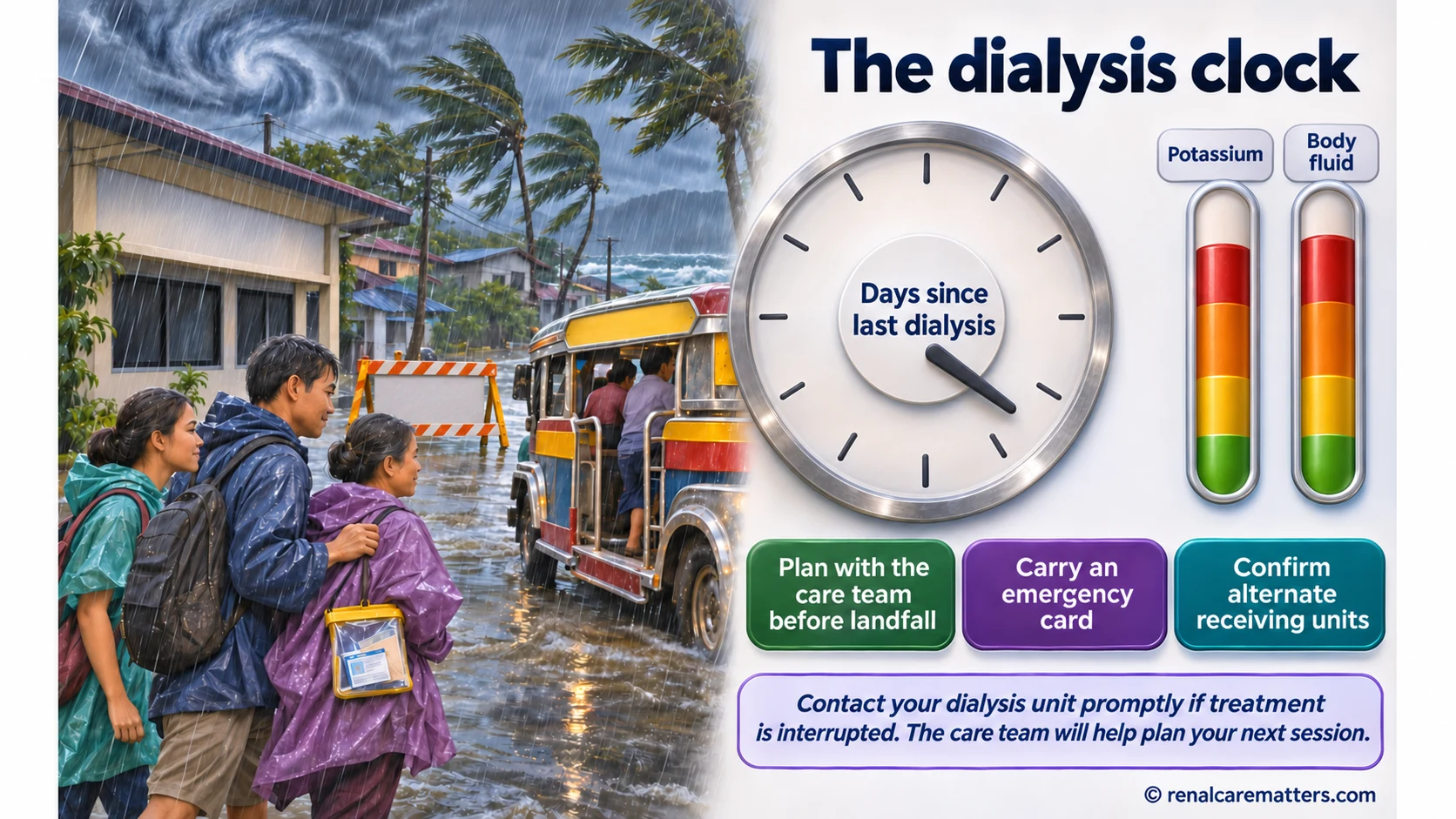
In plain wordsMost people can go a week without their usual medical care during a storm. A patient on hemodialysis has a deadline counted in days. Every day without treatment adds potassium and fluid, and the risk climbs fastest after the third day. Your plan is a race between that clock and the time it takes to find a working chair, a working road, and a working phone line.
The picture has a limit. The clock does not run at the same speed for everyone. A patient who ate canned relief food and drank freely runs faster. The physician decides who goes first. You make sure the physician has the facts.
Figure 1. The dialysis clock. Every day without treatment adds potassium and fluid, and risk rises fastest after day three.
Figure 2 · Key terms for this module
Receiving unitAnother dialysis unit that agrees to treat your patients when yours cannot.
Emergency cardA wallet card with the facts a strange unit needs to dialyze the patient safely.
Disaster dietA short-term plan that limits potassium, salt, and fluid more tightly than usual, to buy time.
Incident commandA simple structure that names who leads, who communicates, and who handles logistics during a disaster.
Call-down drillA test of the call list, done before it is needed.
Restart gatesFive signed checks before the unit treats patients again.
Opening case · fictional
Case: Signal No. 3
A strong typhoon makes landfall in the afternoon. At 2:10, the clinic loses power. The generator runs, but at 2:40 the water supply stops. Two patients, Mrs. Corazon Lim and Mr. Edgar Pineda, are on the machines. Fifteen more are scheduled for the evening and next morning.
Your planned receiving unit, in the next town, says it can take six patients tomorrow. The highway to it is flooded at one point. Three of the fifteen patients do not answer their phones.
Before reading on, decide:
What happens to the two patients on the machines?
How are the fifteen prioritized, and by whom?
When can the unit restart, and what do you check afterward?
Keep your answers in mind. The lesson gives you what you need, and the case review near the end shows one sound response.
Lesson · part 1
What the clock is measuring
Potassium rises roughly with intake and time. Fluid builds up with every glass of water. Both are worse after a long gap.1 In a disaster, intake changes too. Relief food is often canned, salty, and high in potassium, while bottled water may be the only safe drink. The result is overload and high potassium arriving together, often in a patient who cannot reach a phone. Earthquakes add a second wave: crush injuries cause sudden kidney injury and high potassium in people who were never on dialysis.2
A disaster diet buys time. It is a bridge measured in days, not a substitute for dialysis. Patients should have it in writing from the dietitian and nephrologist before the season, not on the day.
On the floor · Relief goods and two missed sessions
After a typhoon, Mr. Andres Marquez, 62, cannot reach the unit for four days because the bridge to his barangay is closed. The relief packs his family receives contain rice, canned sardines, and instant noodles, and neighbors share bananas from their yard. He drinks bottled water whenever he is thirsty.
When he arrives on the fifth day, he is 5 kilograms above his dry weight, breathless, and weak, and his potassium is dangerously high. His relief food, which kept his family fed, was close to the worst diet for him: salt that drove thirst and fluid gain, and potassium from the canned fish and bananas. A written disaster diet given to him in June, telling him which relief foods to avoid and how much to drink, could have stretched those four days more safely. It would not have replaced dialysis, but it might have bought him time.
Illustrative scenario. Names and details are invented.
Lesson · part 2
What hurricanes and storms have taught
Finding
Data
Strength
Storms cause missed sessions
Tropical storm exposure was associated with 55% higher risk of a missed session over the following week (rate ratio 1.55; 95% confidence interval 1.22 to 1.98)3
Cohort
Even prepared systems miss
After Hurricane Sandy, 26.3% of 357 surveyed patients missed dialysis, a median of two sessions. 66.1% dialyzed somewhere other than their own unit. Only 44.3% carried a detailed medication list4
Survey
Preparation helps
Dialysis-specific preparedness was associated with fewer missed sessions (rate ratio 0.91)4
Survey
A coordinated network can hold
In 94 clinics affected by Hurricane Katrina, the storm was not associated with excess mortality in adjusted models5
Cohort
What works
A review of tropical cyclones grouped the lessons into mitigation, preparedness, response, and recovery6
Scoping review
The Katrina finding is reassuring only because providers moved patients quickly. It is evidence that planning works, not that disasters are harmless. No trial has tested any disaster intervention.
Lesson · part 3
What to do before the typhoon season
Figure 3 · Before the season
Call listTwo numbers for each patient, a named family contact, the barangay, and the usual route to the unit. Test it with a call-down drill.
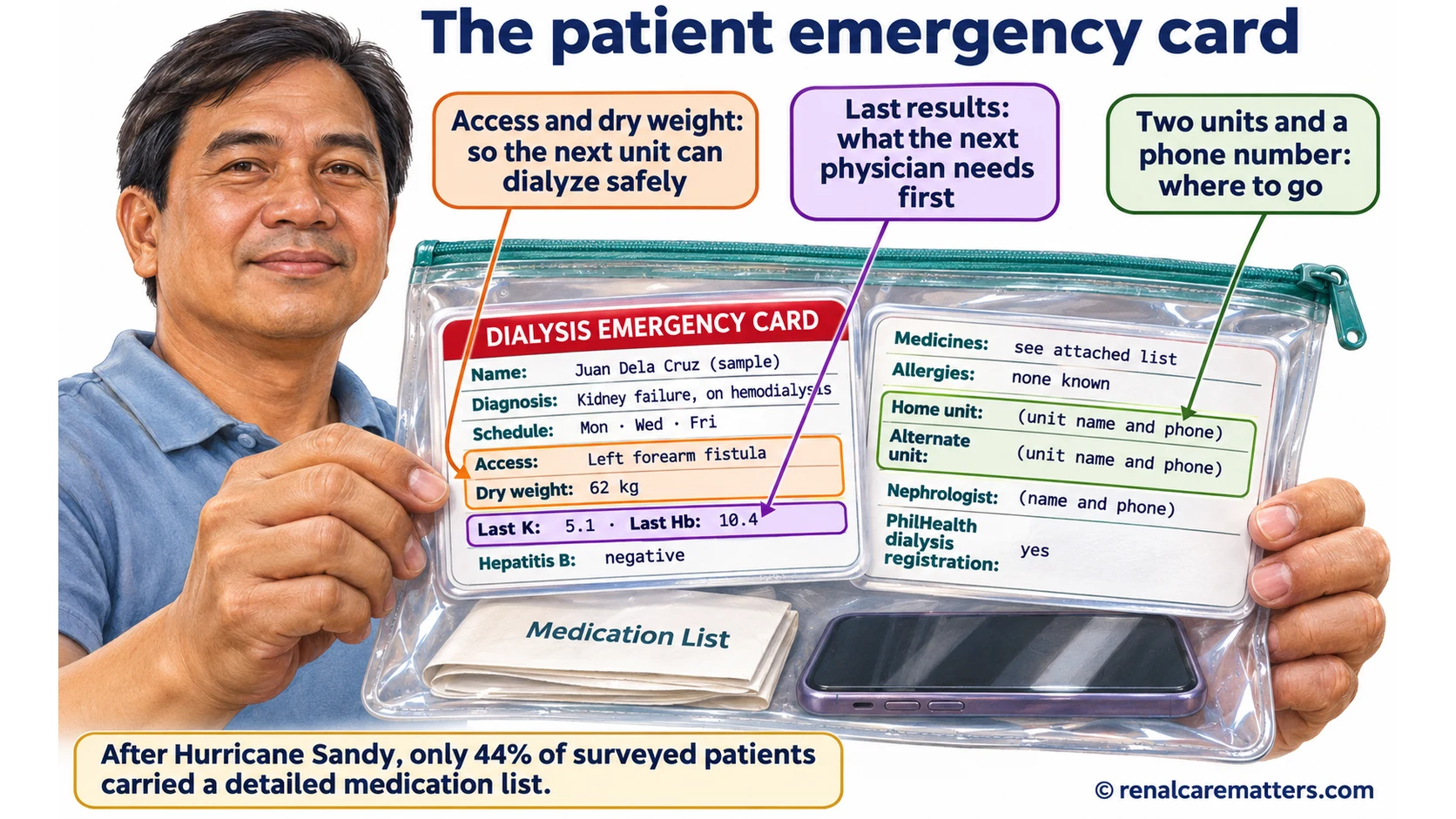
Emergency cardCarried at all times. Name, diagnosis, access, dry weight, last potassium and hemoglobin, medicines, Philippine Health Insurance Corporation (PhilHealth) status, unit contacts, and the alternate unit.
Disaster dietWritten by the dietitian, with a three-day medicine supply where the physician agrees.
Receiving agreementsAt least two units in different directions, each with a named contact and a backup number.
Downtime kitPaper forms, a printed patient list kept off-site, generator and water storage checks with facilities staff.
Figure 4. The patient emergency card. When a patient arrives at a strange unit, this card is the handoff.
When a warning is issued, ask the nephrologist about moving sessions earlier so patients dialyze before landfall. Call every patient. Find out who will not be able to reach the unit.
On the floor · Twenty-three wrong numbers
In May, the unit runs a call-down drill. Each nurse calls her assigned patients and asks one question: “If the unit closed tomorrow, where would you go?”
Of 95 patients, 23 numbers are wrong or out of service, mostly because patients changed SIM cards. Eleven patients cannot name the alternate unit. The drill takes one afternoon. The fixes take two weeks: a second number and a family contact for each patient, emergency cards issued with the alternate unit printed on them, and a rule that phone numbers are confirmed at every monthly review. When the real typhoon comes in August, every patient is reached within three hours.
Illustrative scenario. Names and details are invented.
Lesson · part 4
Prioritizing and placing patients
Activate incident command. For patients on the machines, follow the shutdown procedure. Whether blood is returned follows the protocol and the physician’s direction (Module 7).
Give the physician, for each scheduled patient: the date of the last session, the last potassium, fluid status and symptoms, and any recent missed session. The physician decides the order. Patients furthest from their last session, and those with symptoms or a high potassium, usually go first.
Capacity gap = patients needing a session in the next 48 hours − confirmed receiving slots. 15 − 6 = 9. A gap above zero means calling the next receiving unit now.
Figure 5 · Closing each transfer
AcceptedA named person at the receiving unit accepts this patient.
HandoffThe emergency card and a summary are sent.
TransportA route that is open, and a ride confirmed.
ToldThe patient and family know where, when, and how.
LoggedPlacement, time, and the accepting person’s name in a secure log.
Keep a fallback for patients who cannot be reached: barangay officials, local emergency services, and a second attempt by a named person at a set time.
Stop and callStop and call the attending nephrologist and the clinical head as soon as the unit cannot treat scheduled patients. The physician prioritizes the roster. Follow your unit’s disaster protocol while you call.
Lesson · part 5
Restart through five signed gates
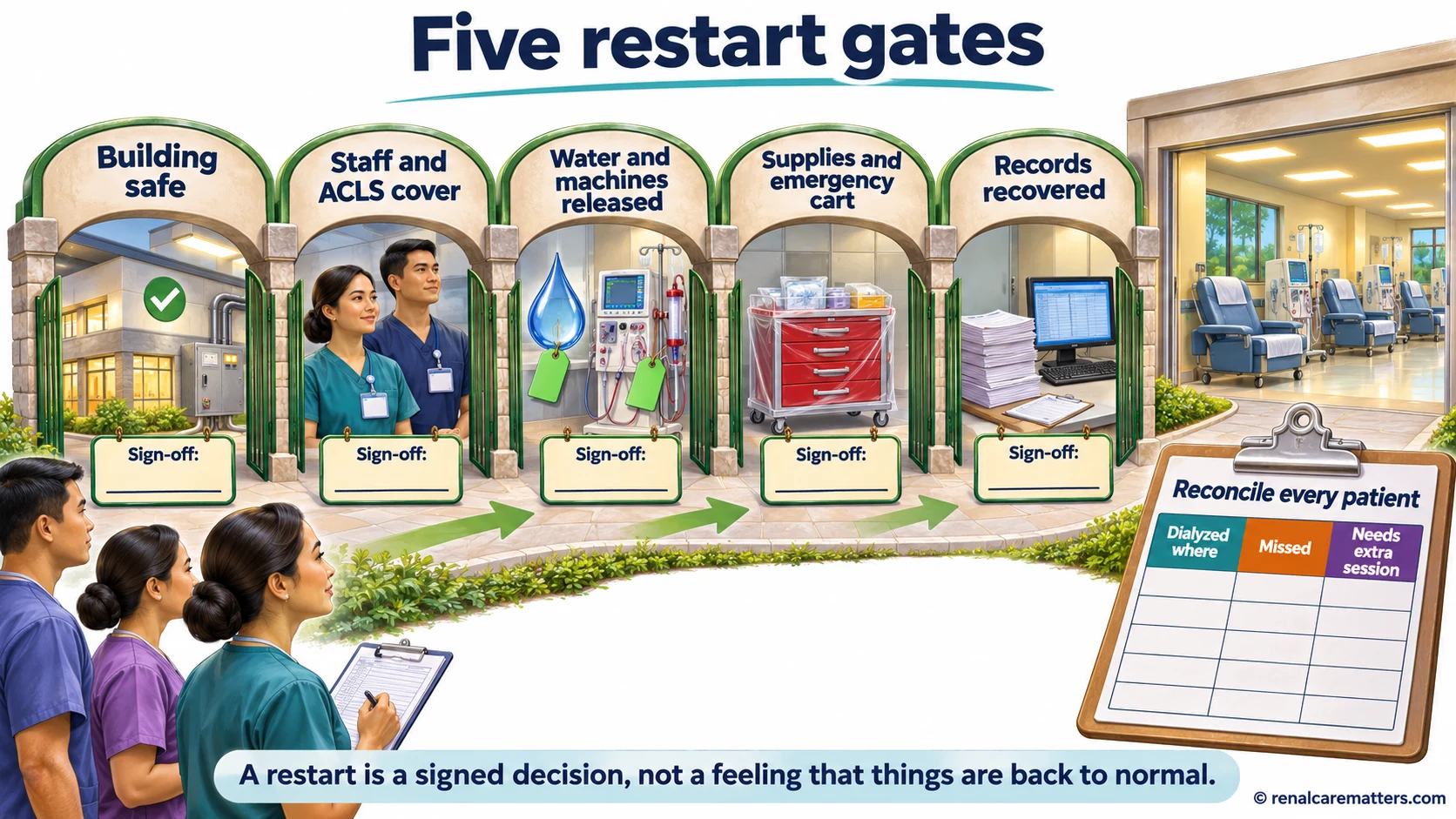
Figure 6. Restart after an outage is a signed decision, not a feeling that things are back to normal.
Figure 7 · Five restart gates
BuildingSafe to occupy, power stable.
StaffQualified nurses and Advanced Cardiovascular Life Support (ACLS) cover (Module 8).
Water and machinesTested and released after the outage (Module 6).
Supplies and cartStock and emergency cart checked.
RecordsRecovered, and paper downtime records entered.
Then reconcile. Who was dialyzed where? Who was missed? Who needs an extra session or a laboratory test? Close the incident only when every patient on the roster has been accounted for.
On the floor · Two names not yet accounted for
Two days after the typhoon, the unit restarts. The reconciliation list shows that 93 of 95 patients were dialyzed somewhere or are confirmed safe. Two names have no entry.
The incident stays open. A named nurse calls both families. The first patient was dialyzed at a hospital emergency room and is well. The second has not been dialyzed for five days and is too weak to travel. The barangay officials help arrange transport, and she is dialyzed that afternoon. If the unit had closed the incident on the day it restarted, she would have been missed. The roster is the list of people, and it is finished only when every name is accounted for.
Illustrative scenario. Names and details are invented.
RememberA restart is a signed decision, not a feeling that things are back to normal.
The next 90 days. By day 30, list the gaps from the event or drill with owners, test the call list, and secure two written receiving agreements. By day 60, test one improvement with a Plan-Do-Study-Act (PDSA) cycle (Module 11) and issue emergency cards to at least half the patients. By day 90, review the measures with the clinical head, finish the cards, and schedule the next drill.
On the floor
Real situations: problems and solutions
These are fictional but typical. For each one, cover the answer, decide what you would do, then compare. Where a step depends on local rules, your unit’s procedure and your supervisor’s direction come first.
The phone list from last year
What you see
During a storm warning, a third of the numbers on the call list do not connect.
What is likely going on
The list was never tested.
What to do
Use barangay contacts as a fallback now. Run a call-down drill before the next season.
Why it matters
Wrong numbers are found in calm weather or not at all.
The receiving unit says yes
What you see
The receiving unit accepts six patients by phone.
What is likely going on
Acceptance of a number, not of named people.
What to do
Confirm each patient by name, send each handoff, and log the accepting person.
Why it matters
A transfer is closed person by person.
The generator is running
What you see
Power returns by generator and staff want to restart at once.
What is likely going on
Water and machines have not been tested since the outage.
What to do
Restart only through the five gates.
Why it matters
A restart is a signed decision, not a feeling.
Field notes
Every patient should carry an emergency card.
Keep receiving agreements with two units in different directions.
Ask the nephrologist about dialyzing early when a storm warning is issued.
Case review
Back to the case: Signal No. 3
The two on the machines. With water gone, the machines cannot continue safely for long. Follow the shutdown procedure for Mrs. Lim and Mr. Pineda. Ask the physician on duty whether to return their blood. If the circuits are intact and nothing suggests the fluid caused harm, return is usually part of the procedure. Record how much treatment each received, because they may need another session sooner.
Prioritizing the fifteen. Call the attending nephrologist and the clinical head. Give them, for each patient, the last session date, last potassium, fluid and symptoms, and any recent missed session. The physician decides the order. Six go to the planned unit tomorrow by an open route. Call the second receiving unit for the other nine now, not tomorrow. For the three who do not answer, ask a named person to try again at a set time and contact their barangay. Log every placement with the name of the person who accepted the patient.
Restart and afterward. The unit restarts only when the five gates are signed: building, staff, water and machines released, supplies and cart, records. Then reconcile all seventeen patients. Who dialyzed, where, when? Who needs an extra session? Who still has not been reached? Turn what you learned into the 90-day plan.
Skills lab · with your preceptor
Skills checklist: Typhoon tabletop
Lead a tabletop exercise with a mock roster, a power and water outage, and a receiving unit that becomes unavailable halfway through. Your preceptor rates each step as satisfactory, needs practice, or not observed. Steps marked Critical must all be satisfactory before sign-off. This checklist supports supervised learning; your unit’s own procedure and competency form are the authority. A printable version of every checklist is on the trainer page.
CriticalFollows the shutdown procedure for connected patients and asks the physician about blood return.
CriticalCalls the attending nephrologist and the clinical head promptly.
CriticalGives the physician the facts needed to prioritize, without deciding the order herself.
CriticalCalculates the capacity gap and calls a second receiving unit.
CriticalCloses each transfer with a named accepting person, handoff, transport, and patient notice.
Sets a fallback for patients who cannot be reached.
Keeps a secure placement log.
CriticalNames the five restart gates and does not restart without them.
Describes how every patient will be reconciled afterward.
Outlines a 30, 60, and 90-day plan from the exercise.
Placement activity. Before the next typhoon season, run a call-down drill of your full patient list. Record how many were reached within two hours, and fix every wrong number.
Self-assessment
Check your understanding
Each visit draws 8 questions at random from this module’s 15-question bank. Choose the single best answer for each, then select Check answers; an explanation appears under the best answer. Select New set of questions for a different mix. A good target is 7 of 8 on two different sets. Nothing you select is sent anywhere; scoring happens in your browser.
Foley, R. N., Gilbertson, D. T., Murray, T., & Collins, A. J. (2011). Long interdialytic interval and mortality among patients receiving hemodialysis. New England Journal of Medicine, 365(12), 1099–1107. https://doi.org/10.1056/NEJMoa1103313
Yoo, K. D., Hatim, H., Abu-Alfa, A. K., & Sever, M. S. (2025). Rising from the storm: Applying lessons from disasters. Advances in Kidney Disease and Health, 32(6), 522–528. https://doi.org/10.1053/j.akdh.2026.02.002
Remigio, R. V., Song, H., Raimann, J. G., Kotanko, P., Maddux, F. W., Lasky, R. A., He, X., & Sapkota, A. (2023). Inclement weather and risk of missing scheduled hemodialysis appointments among patients with kidney failure. Clinical Journal of the American Society of Nephrology, 18(7), 904–912. https://doi.org/10.2215/CJN.0000000000000174
Murakami, N., Siktel, H. B., Lucido, D., Winchester, J. F., & Harbord, N. B. (2015). Disaster preparedness and awareness of patients on hemodialysis after Hurricane Sandy. Clinical Journal of the American Society of Nephrology, 10(8), 1389–1396. https://doi.org/10.2215/CJN.10181014
Kutner, N. G., Muntner, P., Huang, Y., Zhang, R., Cohen, A. J., Anderson, A. H., & Eggers, P. W. (2009). Effect of Hurricane Katrina on the mortality of dialysis patients. Kidney International, 76(7), 760–766. https://doi.org/10.1038/ki.2009.268
Yang, F., Zhu, L., & Li, S. (2024). Treatment-related problems and countermeasures for patients undergoing maintenance hemodialysis following tropical cyclones: A scoping review. Disaster Medicine and Public Health Preparedness, 18, e117. https://doi.org/10.1017/dmp.2024.70
Educational study material for nurses. Does not replace the attending nephrologist’s orders, the unit’s protocols, required training and certification, or supervised practice.