Nephrology Nursing Track · By Role · Module 13 of 13
The Schedule, Absences, and Replacements
How many nurses the roster needs, rest between shifts, fair swaps, same-day absences, lateness and due process, and replacing a nurse who leaves.
PublishedNailathalaGipatikPepalwal:ReferencesMga SanggunianMga TinubdanReng Reperensya:9Audience: Head nurses and charge nurses in hemodialysis units · senior dialysis nurses preparing to lead · medical directors and nursing administrators who orient themRead timeOras ng pagbasaOras sa pagbasaOras ning pamamasa:
This module is study material for head nurses in hemodialysis units. It explains the reasoning behind common decisions; it is not a protocol. On the floor, follow your unit’s protocol and ask the attending nephrologist for guidance. Doses, limits, and cut-off values are set by your unit. Every case is fictional.
Learning objectives
After this module you should be able to
Calculate how many nurses a unit must employ from its stations, shifts, staffing rule, and relief factor.
Build a roster that keeps at least 11 hours between shifts and avoids long runs and long weeks.
Approve or decline a shift swap with a written rule that protects skills on the floor and rest between shifts.
Fill a same-day absence in a fixed order, and escalate instead of opening below the minimum.
Handle absenteeism and tardiness fairly: log every event, talk first, and follow due process with Hazard ratio (HR).
Plan the bridge between a resignation and a new nurse who is cleared to work alone.
Pre-testBefore you read, answer the 8 self-assessment questions and note your score. After the module, select New set of questions and compare. The difference is what you learned; the questions you still miss are what to reread.
Start here
The big picture, in plain words
In plain wordsA roster is like a bridge built for a load. The engineer does not design it for the weight of an average day; she adds a safety margin for the heavy truck, the storm, and the bolt that rusts early. A roster built with no margin works on paper until the first nurse calls in sick.
The picture has a limit. A bridge fails all at once. A roster with no margin fails a little every week: an extra shift here, a quick return there, a tired nurse who skips the check without an alarm. Module 8 showed how thin staffing reaches the patient. This module is about the schedule that decides how thin it gets.
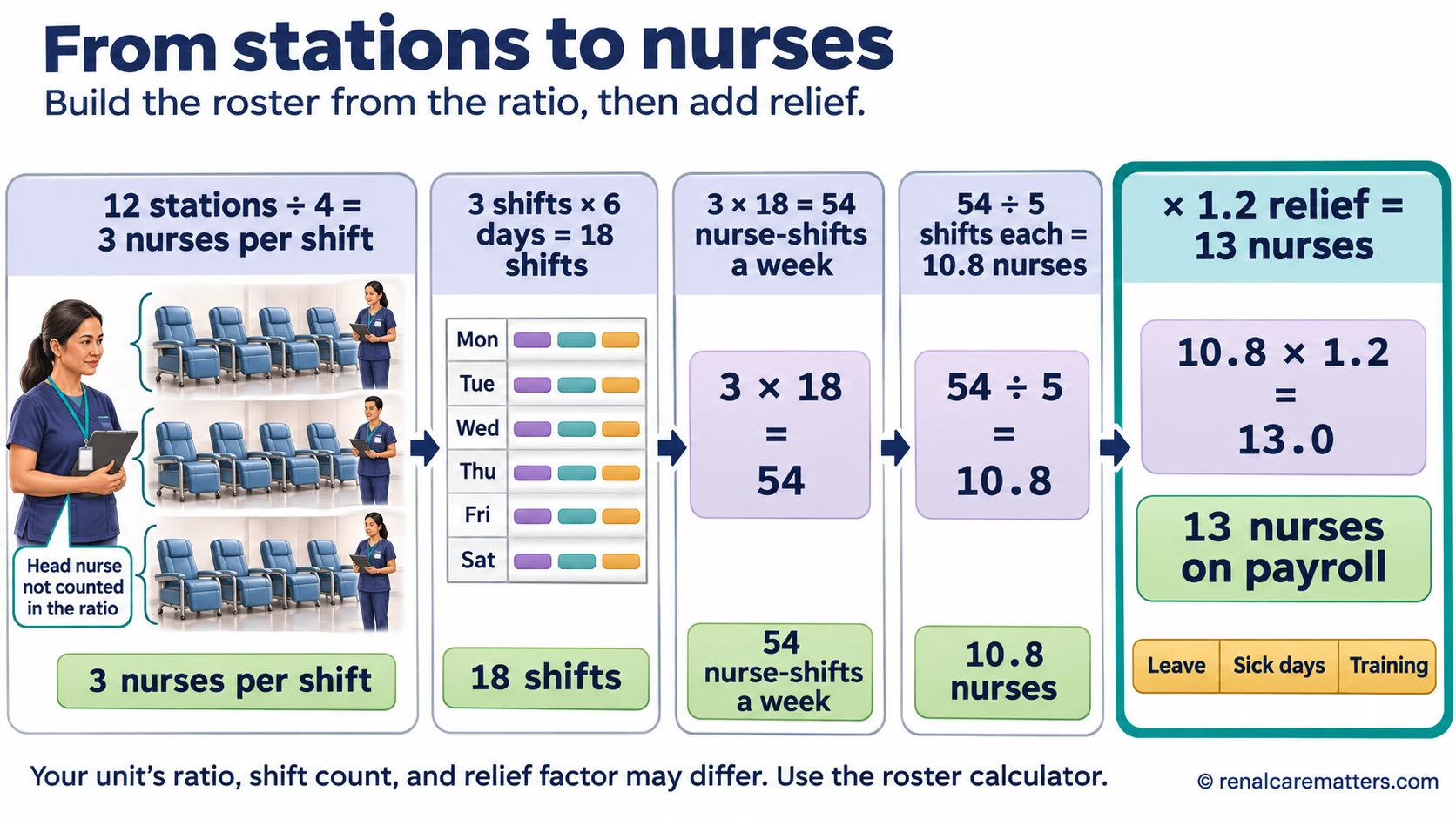
Figure 1. From stations to nurses. Build the roster from the ratio, then add relief for leave, sick days, and training.
Figure 2 · Key terms for this module
Full-time equivalent (FTE)One nurse working a full regular week. Two half-time nurses are one FTE.
Relief factorThe multiplier that adds staff to cover leave, sick days, and training. A factor of 1.2 adds one nurse for every five on the roster.
Quick returnLess than 11 hours of rest between the end of one shift and the start of the next.
Change requestA written request to change an assigned shift, including a swap with another nurse.
Reliever poolQualified nurses who have agreed in advance to be called for open shifts.
TardinessArriving after the scheduled start of a shift.
HabitualThe point at which a pattern of absence or lateness becomes a formal matter under your employer’s rules.
Opening case · fictional
Case: The 5:20 text
At 5:20 on Monday, Ms. Rica Santos texts that she has a fever and cannot come in. It is her third Monday absence this month. Twelve stations open at 6:00. With her out, two signed-off nurses are on the morning roster; one of them, Mr. Jun Reyes, holds the only current Advanced Cardiovascular Life Support (ACLS) certificate.
Mr. Reyes replies in the group chat that he can “just stay for the afternoon too.” He worked the late shift on Sunday until 9:00 preventive maintenance (PM) and started at 5:30 this morning. On the roster board you also find a note: Ms. Ana Lim and Mr. Paolo Cruz have agreed between themselves to swap Wednesday shifts. Nobody asked you.
Before reading on, decide:
How do you fill the gap for this morning, and in what order?
Should you accept Mr. Reyes’s offer to stay for the afternoon?
What do you do about Ms. Santos’s Monday absences, and about the private swap?
Keep your answers in mind. The lesson gives you what you need, and the case review near the end shows one sound response.
Lesson · part 1
Why the roster is a safety tool
Tired nurses make more errors, and the roster decides how tired they are. In a logbook study of 393 hospital staff nurses, the risk of an error rose when shifts ran past twelve hours, when nurses worked overtime, and when they worked more than forty hours a week.1 Rest between shifts matters as much as shift length. Among 1,538 Norwegian nurses, a month with more quick returns was followed by more sick leave the next month, and 83% of the nurses had at least one quick return in a year.2
Finnish payroll records from more than 12,000 shift workers tell the same story from another angle: weeks over 40 hours, several night shifts in a row, and five or more quick returns in 28 days were each followed by more short sickness absence.3 In Danish and Finnish nurses, long runs of night shifts were associated with more long-term sickness absence.4
These are observational studies from hospitals in other countries, and none was done in a dialysis unit. They show associations, not a proven limit. They still point the same way, and the mechanism is plain: short rest means short sleep, short sleep means slower attention and more illness, and illness means more absences that someone else must cover. That is a loop, like the overload loop in Module 8, and the roster is where you can break it.
RememberA roster that causes quick returns and long weeks creates the very absences it then has to fill.
Lesson · part 2
How many nurses the schedule really needs
Staffing starts with the stations, not with the people you happen to have. Build the number in five steps and write each one down, so that anyone can check it.
Figure 3 · From stations to nurses
Nurses per shiftStations ÷ 4, rounded up. The Department of Health (DOH) provision is one nurse for every four hemodialysis stations.5 The head nurse is not counted when she is not assigned patients.
Shifts per weekTreatment shifts per day × operating days per week.
Nurse-shiftsNurses per shift × shifts per week.
Full-time nursesNurse-shifts ÷ shifts one nurse works per week.
ReliefMultiply by the relief factor and round up. This is the number on payroll.
Worked example. 12 stations ÷ 4 = 3 nurses per shift. 3 shifts × 6 days = 18 shifts. 3 × 18 = 54 nurse-shifts a week. 54 ÷ 5 = 10.8 full-time nurses. 10.8 × 1.2 = 13.0, so 13 nurses on payroll.
Where the relief factor comes from. Every nurse is away for some scheduled days: leave, sick days, training, and the days she spends orienting someone else. If a nurse is scheduled for 260 days a year and is away for 40, the unit needs 260 ÷ 220 = 1.18 nurses to fill each position. Calculate your own factor from last year’s attendance records rather than borrowing a number. A unit staffed at exactly 10.8 nurses has a relief factor of 1.0, which means the first sick day breaks the ratio.
Count ACLS cover separately. A roster can have enough nurses and still leave a shift with no one who holds a current ACLS certificate. Mark it as a column on the roster, not as a hope.
On the floor · Eleven nurses on payroll
A twelve-station unit running three shifts six days a week has 11 nurses on payroll. On paper, 11 is more than the 10.8 the arithmetic asks for. In practice, one nurse is on maternity leave from July, another takes her vacation in May, and two are booked for an ACLS course in March.
From April to September, the unit is short almost every week, and the gaps are filled with overtime and quick returns. Sick leave rises, which makes the gaps worse. The head nurse calculates the unit’s own relief factor from last year’s attendance: 1.21. At 10.8 × 1.21 = 13.1, the unit needs 13 nurses. She brings the calculation, the overtime hours, and the quick-return count to nursing administration. The request is easier to approve because every step can be checked.
Illustrative scenario. Names and details are invented.
Lesson · part 3
Building a roster that protects sleep
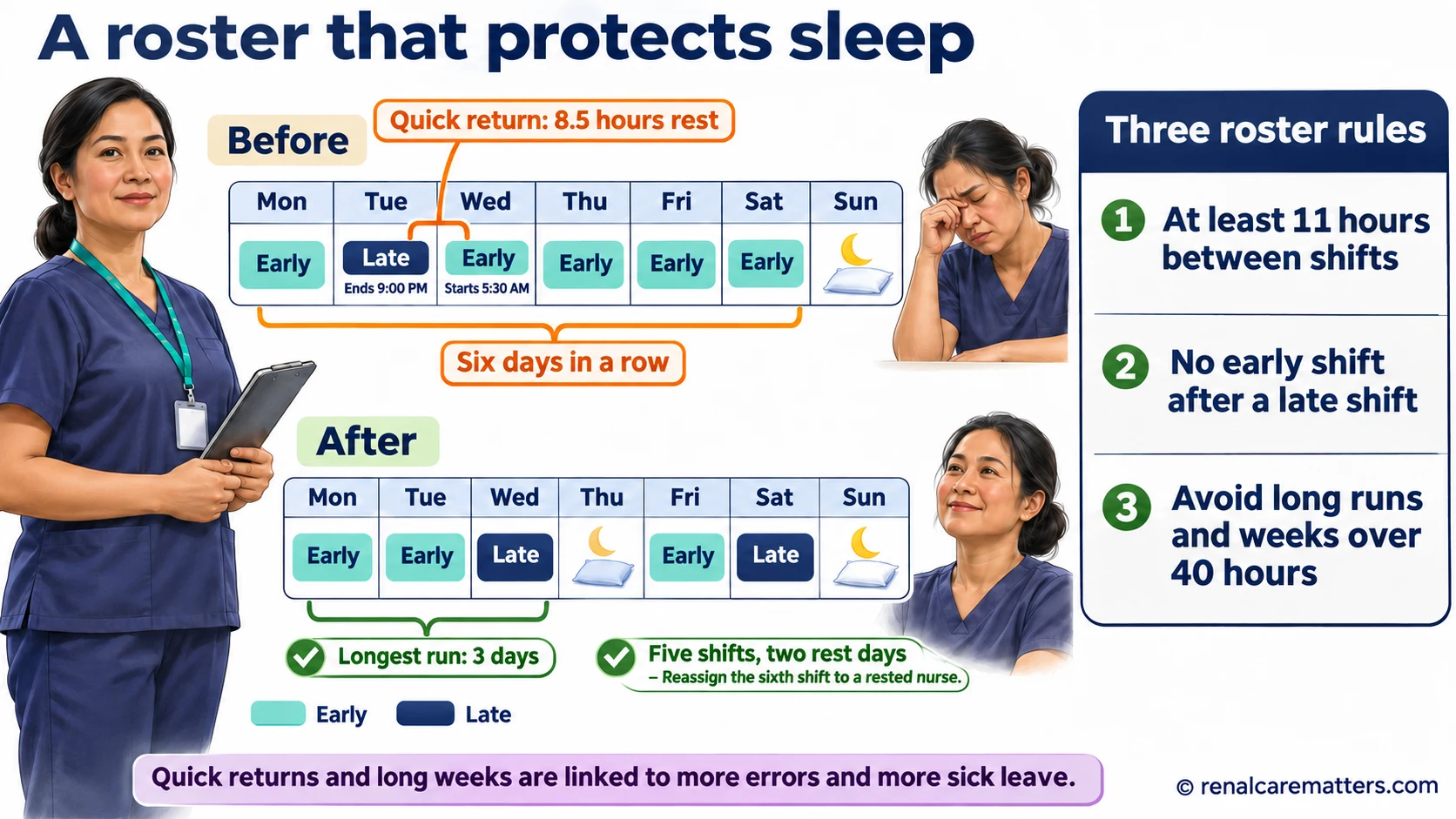
Figure 4. A roster that protects sleep. The same number of shifts can be safe or unsafe depending on where they fall.
Figure 5 · Three roster rules
At least 11 hours between shiftsNo quick returns. An early shift after a late shift is the most common one.
No early after lateRotate forward: early, then late, then rest.
Avoid long runs and long weeksWatch runs of five or more days and weeks over 40 hours.
The 11-hour line comes from the research on quick returns, not from a Philippine regulation. Use it as your unit’s rule unless your employer sets a stricter one. Philippine law sets the normal hours of work, overtime pay, night-shift pay, and the weekly rest day; your HR office applies them to your unit.6
Fairness is part of safety. When the same nurses always get the hard shifts, they leave. Publish the roster at least two weeks ahead, rotate Saturdays and holidays by a visible rule, and keep a running count of who worked them. Collect leave requests by a fixed date and approve them in the order received, within a cap per week. A nurse who can predict her schedule can arrange childcare and transport; a nurse who cannot is the one who calls in at 5:20.
Stop and callStop and raise it with nursing administration when the only way to fill the roster is to schedule quick returns or regular weeks over 40 hours. That is a staffing shortage, and it needs a staffing decision, not a tired nurse.
Lesson · part 4
Change requests and shift swaps
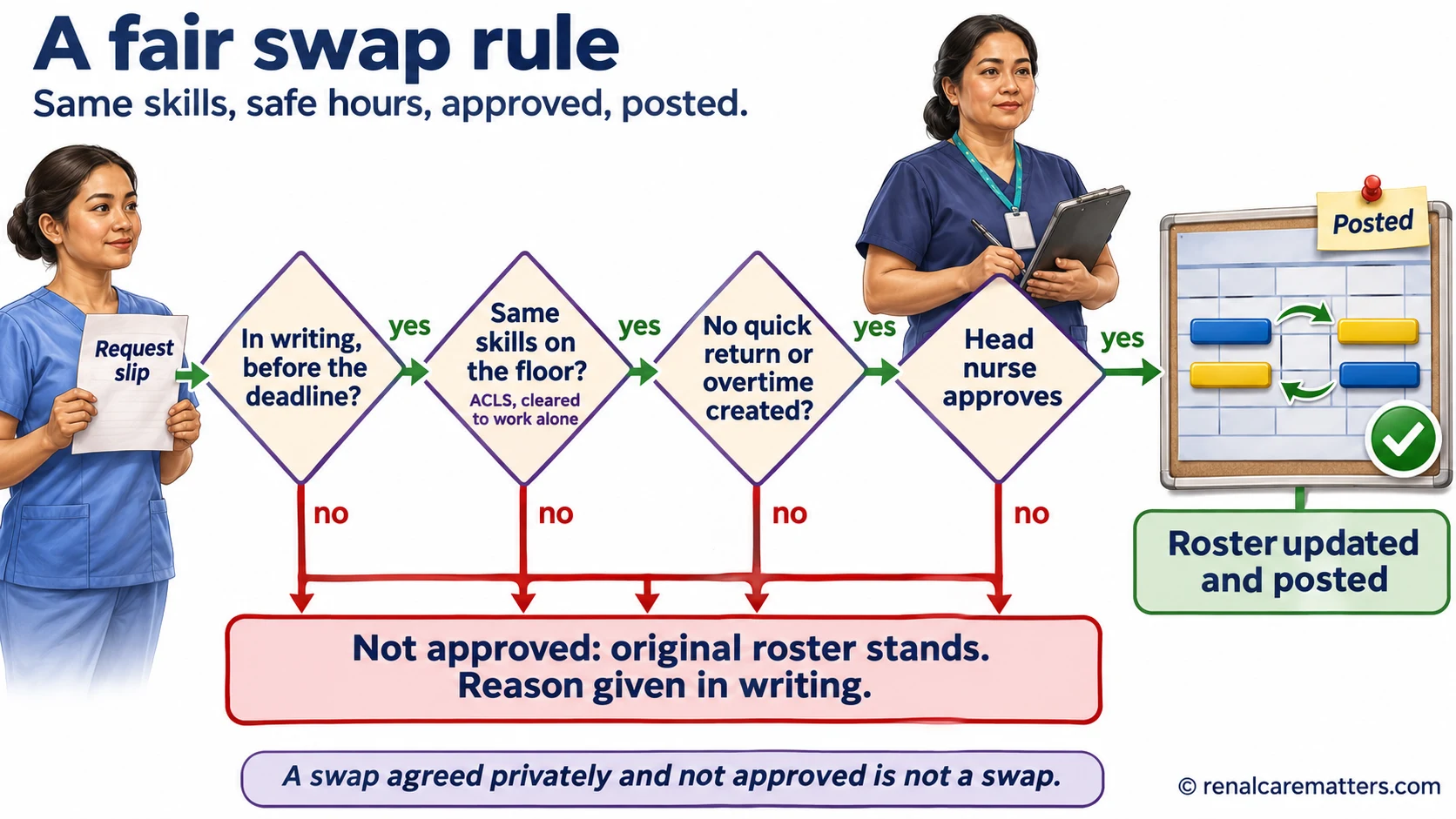
Figure 6. A fair swap rule. A swap agreed privately and not approved is not a swap.
Swaps keep nurses’ lives workable, and a good unit allows them. The risk is a swap that quietly removes the only ACLS nurse from a shift, or that gives one nurse a late shift followed by an early one. A written rule prevents both, and it also makes your decisions look fair, because they are the same for everyone.
Figure 7 · The swap rule
In writing, before the deadlineFor example, 48 hours before the earlier of the two shifts, using the unit form. Emergencies go to the head nurse directly.
Same skills on the floorThe incoming nurse holds the same sign-offs needed on that shift, including ACLS if she replaces the ACLS nurse.
No quick return or overtime createdCheck both nurses’ weeks, not just the swapped days.
Head nurse approvesApprove or decline, and give the reason in writing when you decline.
Roster updated and postedThe posted roster is the only roster. A swap that is not on it did not happen.
A swap agreed privately and not approved is not a swap. If both nurses come, the unit pays twice; if neither comes, a station closes. Explain the rule at a staff meeting before you enforce it, then enforce it the same way every time.
On the floor · The swap that removed the only ACLS nurse
Mr. Carlo Reyes and Ms. Bea Santos agree to swap: he takes her Thursday afternoon shift, and she takes his Saturday morning. They submit the form on time. Both nurses are signed off to work alone, and neither swap creates a quick return.
When you check the Saturday roster, though, Mr. Reyes is the only nurse on that shift with a current ACLS certificate, and Ms. Santos does not hold one. The swap passes every rule except the one about skills on the floor. You decline it in writing, give the reason, and suggest a different Saturday nurse who holds ACLS and is willing to trade. The rule did not stop the nurses from swapping. It stopped the Saturday shift from opening without ACLS cover.
Illustrative scenario. Names and details are invented.
Lesson · part 5
When someone calls in sick
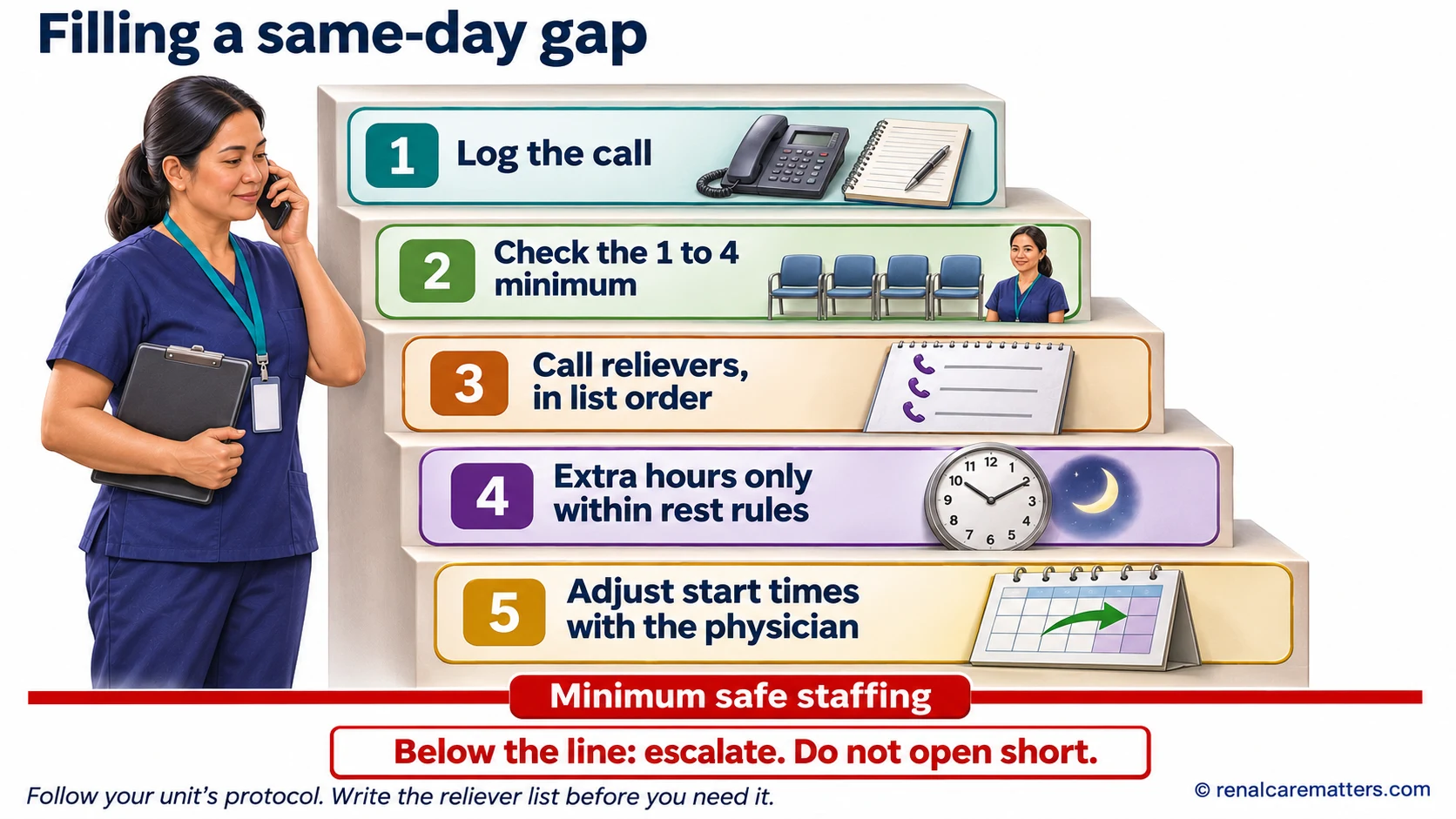
Figure 8. Filling a same-day gap. Below the minimum, escalate; do not open short.
Figure 9 · Filling a same-day gap
Log the callTime, name, and the reason given. Do not interrogate a sick nurse on the phone; you only need enough to plan.
Check against the minimumStations planned ÷ 4, and ACLS cover. Use calculator 4.
Call relievers in list orderThe reliever list names qualified nurses, their sign-offs, and how to reach them. Calling in a fixed order is fair and avoids favorites.
Extra hours only within rest rulesA nurse who offers to stay may do so only if it keeps 11 hours of rest before her next shift and does not create a very long day.
Adjust the day with the physicianStagger start times, or move patients to another shift, only with the nephrologist’s agreement.
Stop and callStop and call nursing administration, the clinical head, and the physician on duty if relief has not arrived by the scheduled start and you are below the minimum or without ACLS cover. Do not open short. Follow your unit’s protocol while you call.
Write the reliever list before you need it, and test it. A list with outdated numbers, or names that have not worked in your unit for a year, is not a plan. Keep relievers current: orientation to your machines, sign-offs on file, and at least one shift every few months.
Lesson · part 6
Absenteeism and tardiness: fair, documented, consistent
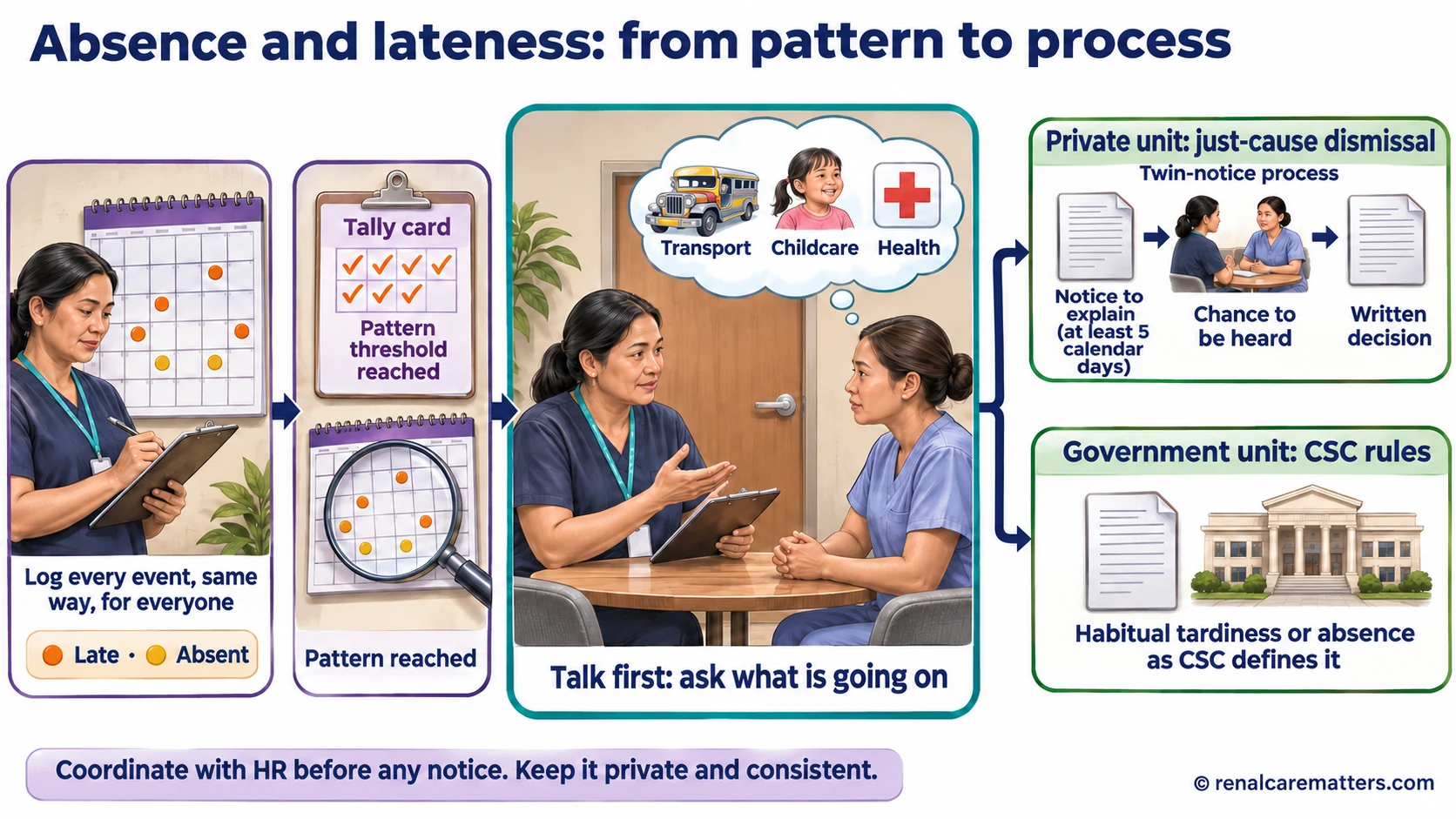
Figure 10. Absence and lateness: from pattern to process. Log the same way for everyone, talk first, and let HR run the process.
Absence and lateness are both safety issues and people issues. A late nurse at 6:00 delays four patients and pushes every session later; a pattern of absences tells you something is wrong in that nurse’s life or in the job. Your role is to notice the pattern early, respond the same way for everyone, and leave the formal decisions to the process your employer has set.
Figure 11 · From pattern to process
Log every eventSame fields for everyone: date, minutes late or shift missed, notice given, reason offered. A log kept only for nurses you are worried about is not fair and will not stand up.
Notice the patternYour employer’s code of conduct defines when lateness or absence becomes a disciplinary matter. Review the log monthly.
Talk firstIn private, describe the pattern, then ask what is going on. Transport, childcare, a sick parent, and the nurse’s own health are common answers. Many can be solved with a different shift or an earlier jeepney.
Agree and recordWhat will change, what support you will give, and when you will review it.
Due processIf the pattern continues, refer it to HR. Do not issue sanctions on your own.
Where you work
What governs discipline
What it means for you
Private unit
The Labor Code and DOLE Department Order 147-15: a first written notice stating the specific facts and giving at least five calendar days to explain, a chance to be heard, then a written decision.7
Your log and your notes from the talk are the facts HR will use. Keep them specific: dates and minutes, not “always late.”
Government unit
Civil Service Commission rules. Habitual tardiness is lateness ten times a month for at least two months in a semester, or two consecutive months. Habitual absenteeism is unauthorized absence beyond the 2.5 days of monthly leave credit for at least three months in a semester, or three consecutive months.8,9
Your attendance records feed the semestral report. Make sure leave is filed and approved so that authorized absences are not counted as unauthorized.
This is not legal advice. Check the current rules with your HR office before any notice is written. What you control is the quality of the record and the fairness of the first conversation.
On the floor · Twelve minutes late, three times a week
The log shows that Ms. Andrea Flores has been 10 to 15 minutes late for the 6:00 shift eleven times in five weeks, always on Mondays, Wednesdays, and Fridays. Her work at the chair is excellent.
In a private conversation, you describe the pattern and ask what is happening. Her mother started dialysis at another unit on those same days, and Ms. Flores drops her off at 5:30 on the way. The first jeepney after that gets her to work just after 6:00. With nursing administration, you move her to the 7:00 start on those days, where a nurse is also needed. The lateness stops. Had the first step been a written warning, the unit might have lost a good nurse over a problem the schedule could fix. Had the talk not helped, the log would already hold a fair, consistent record for the formal process.
Illustrative scenario. Names and details are invented.
RememberLog every event the same way for everyone, talk before you write, and let HR run the process.
Lesson · part 7
Replacing a nurse who leaves
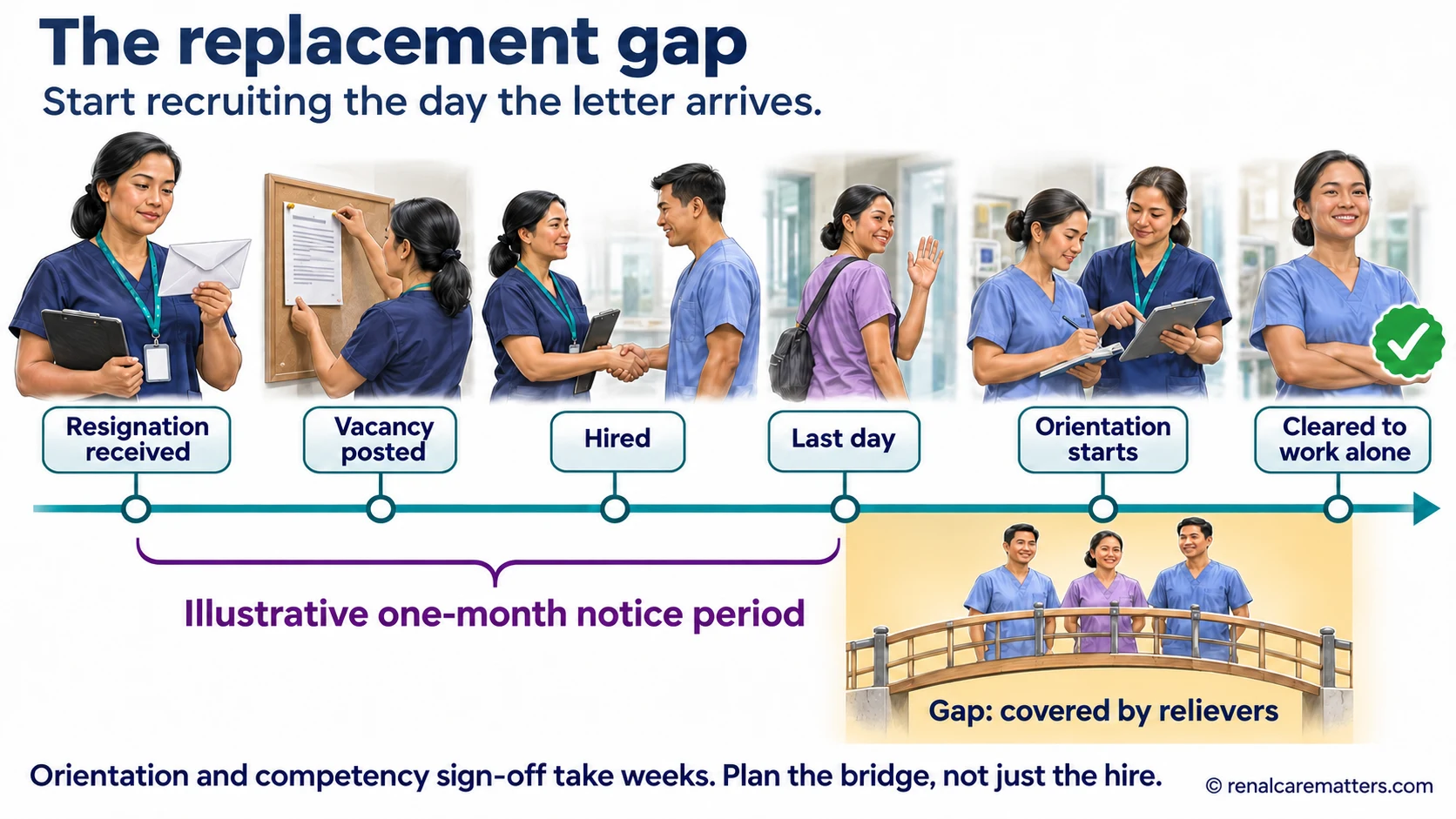
Figure 12. The replacement gap. It ends when the new nurse is cleared to work alone, not on the departing nurse's last day.
A resignation opens a gap longer than the notice period. Under the Labor Code, a nurse who resigns without just cause gives at least one month’s written notice.6 A new nurse is not on the roster on her first day, though. She needs orientation to your machines, your water system, and your emergency roles, and each skill must be signed off before she counts toward the ratio. That usually takes weeks. The real gap runs from the departing nurse’s last day to the day the new nurse is cleared to work alone.
Figure 13 · Closing the replacement gap
The day the letter arrivesTell nursing administration and start recruiting at once. Do not wait for the last day.
During the notice periodAsk the departing nurse to hand over her preceptees, her duties, and her knowledge of individual patients.
Plan the bridgeBook relievers for the gap by name and date. Check rest rules for anyone taking extra shifts.
Orient on a scheduleA named preceptor, a dated checklist, and sign-offs recorded in the competency matrix.
Learn from the exitAsk why she is leaving. If it is workload, schedule, or support, it will happen again.
The Philippines has a well-documented nurse shortage, driven in large part by migration overseas, and dialysis units compete with hospitals and with each other for experienced nurses. Retention is cheaper than recruitment. The schedule is one of the few things that matter to nurses that a head nurse fully controls.
On the floor · Seven weeks, not four
Ms. Joy Mercado hands in her resignation on October 1. Her last day is October 31. The administrator says, “We have a month. That’s plenty of time.”
You count the real gap. Recruiting takes two weeks, and the new nurse starts on November 15. She needs about five weeks of orientation and sign-offs before she can work alone, so she counts toward the ratio around December 20. The real gap runs from November 1 to December 20, about seven weeks, not four. You book relievers by name for those seven weeks on October 2, check that no one taking extra shifts will have a quick return, and ask Ms. Mercado to spend her last week handing over her two preceptees. The gap still exists, but now it is planned.
Illustrative scenario. Names and details are invented.
On the floor
Real situations: problems and solutions
These are fictional but typical. For each one, cover the answer, decide what you would do, then compare. Where a step depends on local rules, your unit’s procedure and your supervisor’s direction come first.
The favorite reliever
What you see
The same reliever is called for every open shift, and two others on the list say they are never asked.
What is likely going on
Calling whoever answers fastest has turned into a habit.
What to do
Call in list order and log each call. Rotate the top of the list monthly.
Why it matters
Relievers who are never called stop answering, and the list fails when you need it.
“I can do a double”
What you see
A willing nurse offers to stay for a second shift after a late shift the night before.
What is likely going on
Goodwill is covering a staffing gap with fatigue.
What to do
Thank her and check rest first. If it creates a quick return or a very long day, decline and call the reliever list.
Why it matters
The most willing nurses are the ones a roster burns out first.
Late every Friday
What you see
A nurse is 10 to 20 minutes late every Friday morning.
What is likely going on
Something specific to Fridays, such as school runs, a second job, or a transport route.
What to do
Log it, then ask. Offer a later Friday start or a different Friday shift if the schedule allows.
Why it matters
A pattern with a fixed day usually has a fixable cause.
Field notes
Publish the roster at least two weeks ahead and freeze it except through the swap rule.
Keep a running count of weekend and holiday shifts per nurse, visible to everyone.
Recalculate your relief factor every year from last year's attendance.
Case review
Back to the case: The 5:20 text
Filling this morning. Log Ms. Santos’s message. Two signed-off nurses are present for twelve stations, so at most eight can open on nursing grounds. ACLS cover is met, because Mr. Reyes holds it. Call the reliever list in order now. If a reliever arrives before 6:00, open all twelve. If not, tell the physician on duty which four patients are waiting and ask which can start later or move to another shift. Inform nursing administration.
Mr. Reyes’s offer. Decline it, kindly. He finished at 9:00 PM and started at 5:30 AM, so he has already had a quick return of 8.5 hours. Adding the afternoon would make a very long day on short sleep, and he is your only ACLS nurse. Thank him, and solve the afternoon from the reliever list.
The Monday absences. Three Mondays is a pattern worth a conversation, not yet a disciplinary matter. Log today the same way you log everyone. This week, talk with Ms. Santos in private: describe the dates, then ask what is going on. If it is illness, suggest she see a physician and file her leave properly. If it is something else, such as childcare on Mondays, a different shift may solve it. Record what you agreed and when you will review it.
The private swap. It is not approved, so the posted roster stands. Ask Ms. Lim and Mr. Cruz to submit it on the form today. Then check it: same sign-offs, ACLS cover on Wednesday, and no quick return or overtime for either of them. If it passes, approve and post it. Use it as the example when you explain the swap rule at the next staff meeting.
Skills lab · with your preceptor
Skills checklist: Roster and attendance
Build a two-week roster for a synthetic unit, process two change requests and a same-day absence, and hold a practice attendance conversation while your facilitator observes. Your preceptor rates each step as satisfactory, needs practice, or not observed. Steps marked Critical must all be satisfactory before sign-off. This checklist supports supervised learning; your unit’s own procedure and competency form are the authority. A printable version of every checklist is on the trainer page.
CriticalCalculates nurses per shift, nurse-shifts, full-time nurses, and payroll nurses with the relief factor shown.
CriticalMarks ACLS cover on every shift of the roster.
CriticalBuilds the roster with no quick returns and no regular weeks over 40 hours.
Rotates weekend and holiday shifts by a written rule.
Applies the swap rule and states the reason for any decline in writing.
CriticalFills a same-day absence in list order and checks rest before accepting extra hours.
CriticalEscalates instead of opening below the minimum or without ACLS cover.
CriticalLogs attendance events with the same fields for every nurse.
Opens the attendance conversation with specific dates and an open question.
CriticalRefers continuing patterns to HR without issuing sanctions alone.
Placement activity. Pull last quarter’s roster. Count quick returns, weeks over 40 hours, and same-day absences per nurse, and bring the three numbers to your next meeting with nursing administration.
Self-assessment
Check your understanding
Each visit draws 8 questions at random from this module’s 15-question bank. Choose the single best answer for each, then select Check answers; an explanation appears under the best answer. Select New set of questions for a different mix. A good target is 7 of 8 on two different sets. Nothing you select is sent anywhere; scoring happens in your browser.
Rogers, A. E., Hwang, W.-T., Scott, L. D., Aiken, L. H., & Dinges, D. F. (2004). The working hours of hospital staff nurses and patient safety. Health Affairs, 23(4), 202–212. https://doi.org/10.1377/hlthaff.23.4.202
Vedaa, Ø., Pallesen, S., Waage, S., Bjorvatn, B., Sivertsen, B., Erevik, E., Svensen, E., & Harris, A. (2017). Short rest between shift intervals increases the risk of sick leave: A prospective registry study. Occupational and Environmental Medicine, 74(7), 496–501. https://doi.org/10.1136/oemed-2016-103920
Ropponen, A., Koskinen, A., Puttonen, S., & Härmä, M. (2019). Exposure to working-hour characteristics and short sickness absence in hospital workers: A case-crossover study using objective data. International Journal of Nursing Studies, 91, 14–21. https://doi.org/10.1016/j.ijnurstu.2018.11.002
Larsen, A. D., Ropponen, A., Hansen, J., Hansen, Å. M., Kolstad, H. A., Koskinen, A., Härmä, M. I., & Garde, A. H. (2020). Working time characteristics and long-term sickness absence among Danish and Finnish nurses: A register-based study. International Journal of Nursing Studies, 112, 103639. https://doi.org/10.1016/j.ijnurstu.2020.103639
Department of Labor and Employment. (2022). Labor Code of the Philippines (Presidential Decree No. 442, as amended and renumbered). Book III (conditions of employment) and Article 300 (termination by employee).
Department of Labor and Employment. (2015). Department Order No. 147-15: Amending the implementing rules and regulations of Book VI of the Labor Code of the Philippines.
Civil Service Commission. (1991). Memorandum Circular No. 4, s. 1991: Policy on absenteeism and tardiness.
Civil Service Commission. (1998). Memorandum Circular No. 23, s. 1998 (June 15, 1998) [Reclassification of habitual tardiness as a light offense, with its definition and penalties].
Educational study material for nurses. Does not replace the attending nephrologist’s orders, the unit’s protocols, required training and certification, or supervised practice.