Nephrology Nursing Track · By Role · Module 8 of 13
Staffing, Delegation, and Coaching
How thin staffing reaches the patient, building a safe assignment, the five rights of delegation, and feedback that changes practice.
PublishedNailathalaGipatikPepalwal:ReferencesMga SanggunianMga TinubdanReng Reperensya:9Audience: Head nurses and charge nurses in hemodialysis units · senior dialysis nurses preparing to lead · medical directors and nursing administrators who orient themRead timeOras ng pagbasaOras sa pagbasaOras ning pamamasa:
This module is study material for head nurses in hemodialysis units. It explains the reasoning behind common decisions; it is not a protocol. On the floor, follow your unit’s protocol and ask the attending nephrologist for guidance. Doses, limits, and cut-off values are set by your unit. Every case is fictional.
Learning objectives
After this module you should be able to
Explain how thin staffing reaches the patient, step by step.
Summarize what the research shows about nurse staffing in dialysis, and what it cannot show.
Build an assignment from the staffing rule, verified competencies, and the acuity of today’s patients.
Find the single points of failure on a shift and name a backup for each.
Delegate a task using the five rights, and keep the accountability that comes with it.
Give feedback about an observed step that changes how it is done.
Pre-testBefore you read, answer the 8 self-assessment questions and note your score. After the module, select New set of questions and compare. The difference is what you learned; the questions you still miss are what to reread.
Start here
The big picture, in plain words
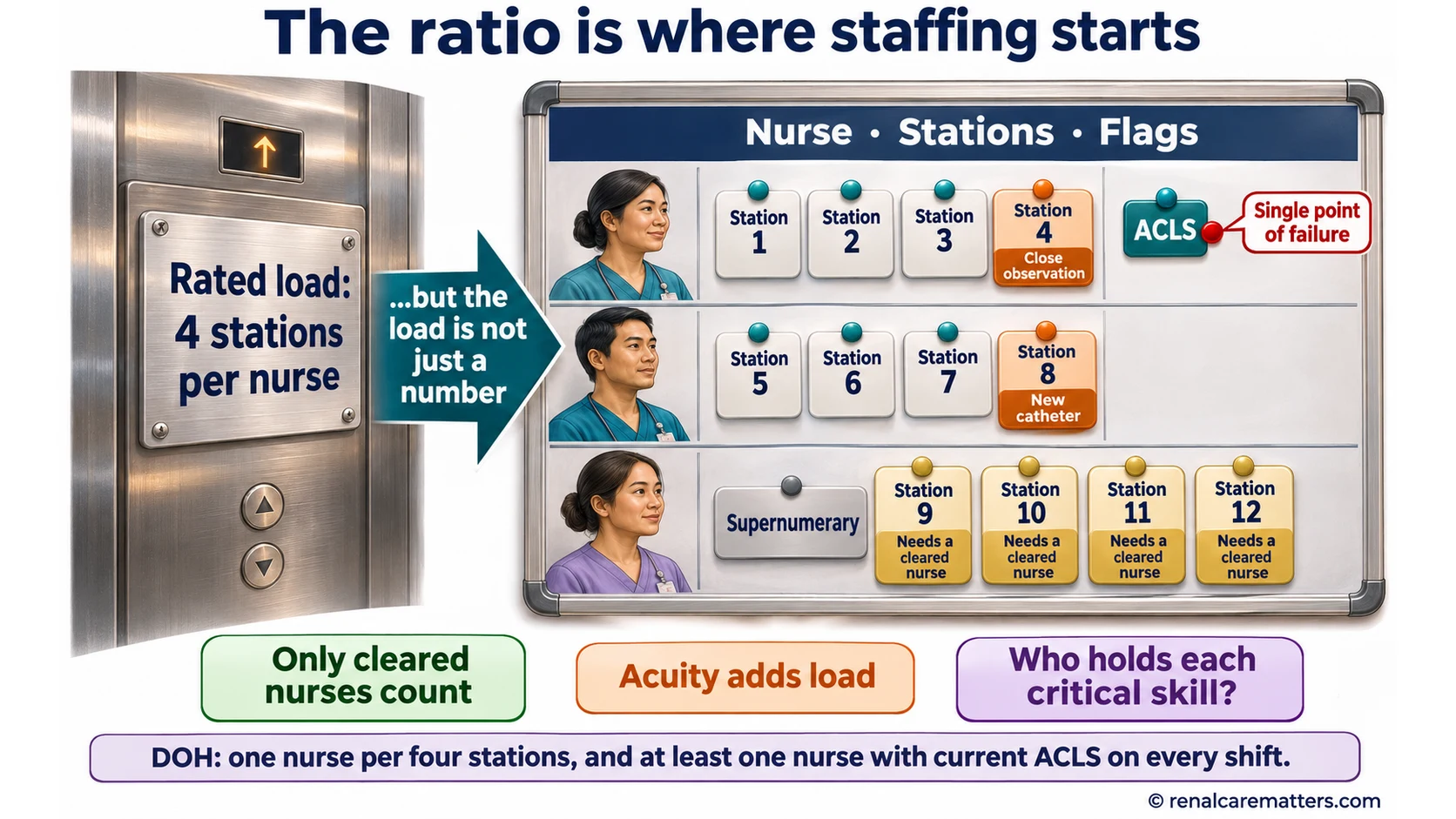
In plain wordsA staffing ratio is like the load rating on an elevator. It tells you the most the cable was certified to carry. It does not tell you whether today’s passengers are balanced, whether one of them is carrying something heavy, or whether the operator has ever run this elevator before.
The picture has a limit. An elevator over its rating fails all at once. A shift over its safe load fails quietly, one skipped check at a time, and the patients notice before the roster does.
Figure 1. A ratio is where staffing starts. Competency, acuity, and single points of failure decide whether the shift is safe.
Figure 2 · Key terms for this module
Staffing ruleThe Department of Health (DOH) provision of one nurse for every four hemodialysis stations.
SupernumeraryPresent but not counted, such as an orientee.
AcuityHow much nursing care a patient needs today.
Single point of failureA capability held by only one person on the shift.
DelegationHanding a task to another person while keeping responsibility for the decision to hand it over.
Care left undoneNecessary tasks that were not done because there was no time.
Competency matrixA table of each nurse’s signed-off skills, with dates.
Opening case · fictional
Case: The lone ACLS nurse calls in sick
At 5:15 on Saturday, Ms. Karen Dela Cruz calls in sick. She is the only nurse on the morning roster with a current Advanced Cardiovascular Life Support (ACLS) certificate. Twelve stations are scheduled. Present are Mr. Arnel Cruz and Ms. Joy Mercado, both signed off to work alone, and Ms. Bea Santos, an orientee in her second week.
One patient, Mrs. Lourdes Navarro, 80, had two episodes of low pressure last week and the nephrologist has asked for close observation. The reliever list has three names.
Before reading on, decide:
How many stations can open now, and why?
Can Ms. Santos fill the gap?
What do you still check once a reliever arrives?
Keep your answers in mind. The lesson gives you what you need, and the case review near the end shows one sound response.
Lesson · part 1
How thin staffing reaches the patient
The path from staffing to harm is not mysterious, and it tells you what to watch.
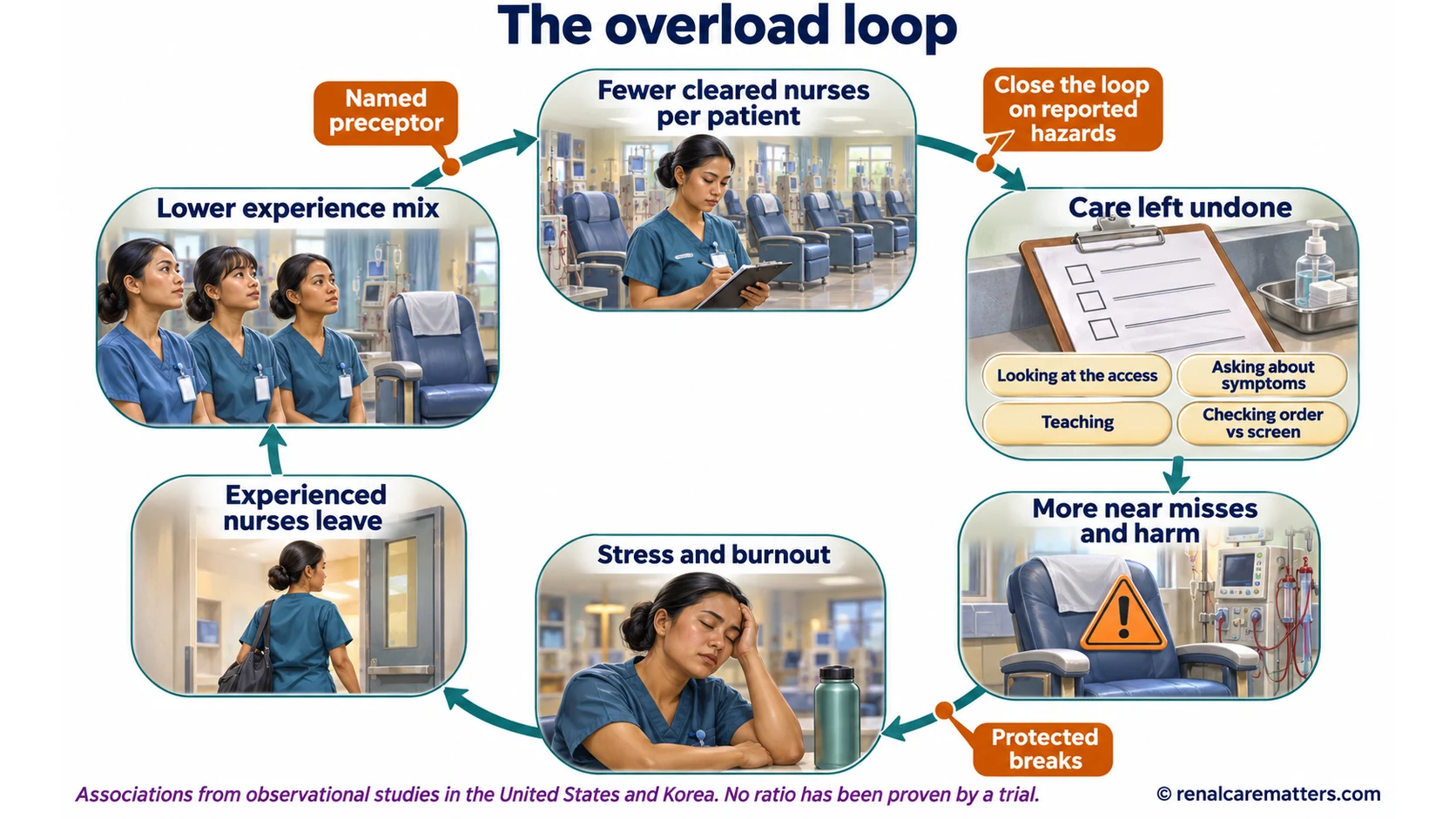
Figure 3. The overload loop. Thin staffing feeds itself unless someone breaks it.
Fewer or less experienced nurses per patient leads to care left undone. The tasks dropped first are the ones without an alarm: looking at the access, asking about symptoms, teaching, checking the order against the screen. Those are the safety layers the earlier modules depend on. Sustained overload then produces burnout and turnover, which lowers the experience mix, which leads to more care left undone. The loop feeds itself.
On the floor · The week two nurses resigned
In August, two experienced nurses resign in the same week, and the unit runs on relievers and overtime for a month. No alarm changes. Kt/V results look the same.
When you look at the observation round sheets, the line “access visible and needles checked” was ticked on 98% of rounds in July and 70% in August. Patient teaching notes fell by half. Nothing on a machine would have shown this. The checks that have no alarm were the first to go, exactly as the mechanism predicts. That month’s numbers become your evidence when you ask nursing administration for a reliever pool: the problem is not that the nurses worked less hard, but that the work without an alarm was what got dropped.
Illustrative scenario. Names and details are invented.
RememberUnder pressure, nurses drop the checks that have no alarm. Those are the checks that catch the problems the alarms miss.
Lesson · part 2
What the research shows about staffing
Finding
Data
Strength and limits
Ratios and care left undone
More patients per nurse and more tasks left undone were associated with more adverse events reported by nurses1,2
Cross-sectional, reported by nurses
Experience mix
Units where every nurse had two years of dialysis experience met more dose, pressure, and albumin targets3
Cross-sectional
Trained hours and attendance
More highly trained staff hours, lower odds of patients skipping4
Cohort
Staffing and transplant
Median 14.4 patients per nurse. The most stretched quartile was associated with 14% lower incidence of transplant in young patients5
Large cohort
Work environment
Workload and practice environment were related to burnout and intention to leave6,7
Cross-sectional
All of this is observational, and almost all of it comes from the United States and Korea, where technicians do much of the chairside work. It supports a reasonable inference that experience mix and workload are safety variables. It does not identify a correct ratio. No Philippine outcome data were found. You meet the DOH provision of one nurse to four stations because it is the rule,8 not because a trial chose the number.
Lesson · part 3
Building a safe assignment, step by step
Figure 4 · Five steps
The arithmeticStations to open ÷ 4, rounded up. Add the fixed requirement of at least one nurse with current ACLS. Confirm with your regional office how stations are counted.
Who countsOnly nurses with site sign-off to work alone. Orientees are supernumerary. A nurse covering reception or billing is not at the chair.
Weigh the loadAdd new patients, catheters, last session’s low pressure, isolation, close observation. Subtract breaks and any transfer that will take a nurse off the floor.
Single points of failureList each critical skill and who holds it today. Any skill held by one person needs a backup or a reliever.
The triggerWrite down in advance the condition that reduces capacity and who you call.
Arithmetic illustration. 12 stations ÷ 4 = 3 nurses. With 2 counted, open at most 8. ACLS cover is a separate gate. If neither present nurse holds it, no station opens until a nurse who does arrives.
Which patients can be deferred or moved is the nephrologist’s decision. Your part is to give them the facts and the options.
On the floor · Twelve patients, three nurses, one room
On Tuesday morning you have three nurses signed off to work alone and twelve stations, which meets the rule of one nurse to four stations. One station is the hepatitis B room, which needs a dedicated nurse. Two patients started with new catheters this week, and Mrs. Leonora Cruz, 78, is on close observation after low pressures.
A naive split gives each nurse four chairs. A weighted one looks different. The nurse assigned to the hepatitis B room cannot also care for patients outside it, so her assignment is the room plus nothing that crosses the line. The two new catheters go to the nurse with the most catheter experience. Mrs. Cruz goes to the nurse whose stations are nearest the nurses’ station, and that nurse gets one fewer patient if the roster allows. If it does not, the conversation with the physician about whether anyone can safely start later happens now, not at 10:00.
Illustrative scenario. Names and details are invented.
Stop and callStop and call nursing administration, the clinical head, and the physician on duty when you cannot meet the staffing rule or ACLS cover before the scheduled start. Ask the physician which patients can safely be deferred. Follow your unit’s protocol while you call.
Lesson · part 4
Delegating with the five rights
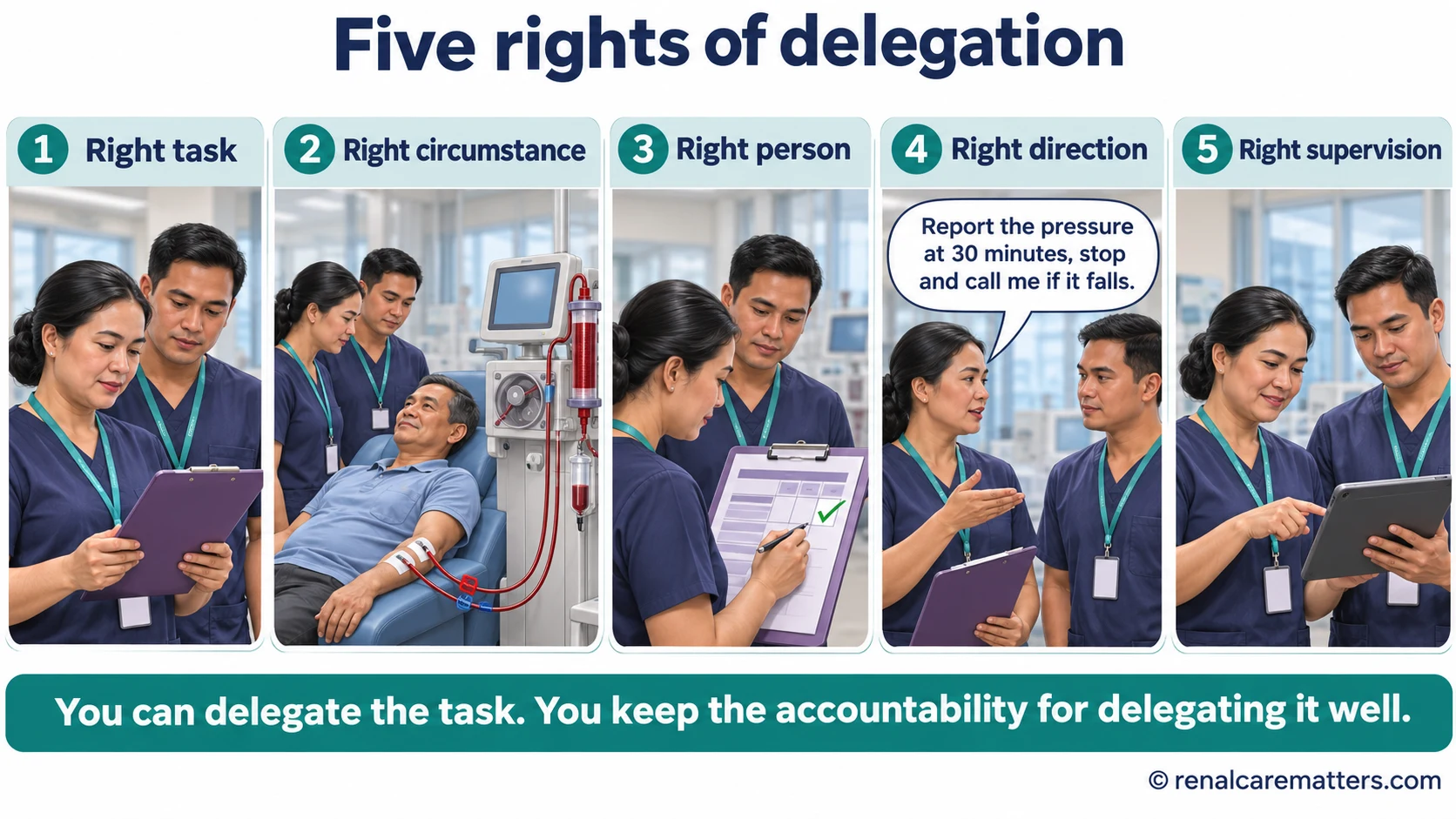
Figure 5. The five rights of delegation. You can delegate the task. You keep the accountability for delegating it well.
Figure 6 · The five rights
Right taskWithin the person’s scope of practice.
Right circumstanceAppropriate for this patient at this moment.
Right personCompetency verified for this task in your unit.
Right directionWhat to do, what to report, and when to stop.
Right supervisionYou check the result.
You can delegate the task. You cannot delegate the accountability for having delegated it well. The Philippine Nursing Act places supervision among a nurse’s responsibilities.9
On the floor · What the aide was told to report
You ask a nursing aide to weigh the second-shift patients and take their pre-dialysis pressures. A weak handover is “Do the weights and vitals.” A strong one gives the right direction: “Weigh each patient on the same scale, record it on the sheet, and tell me at once if anyone is above the weight gain limit written at the top of the sheet, has a pressure outside the limits on the sheet, or says they are short of breath.”
At 11:40 the aide tells you that Mr. Ruben Flores is 4.1 kilograms above his dry weight and says he slept sitting up. Because the aide knew what to report, you hear it before connection, not after. Then you supervise: you check two of the recorded weights yourself, because delegating the task did not delegate the accountability.
Illustrative scenario. Names and details are invented.
Lesson · part 5
Feedback that changes practice
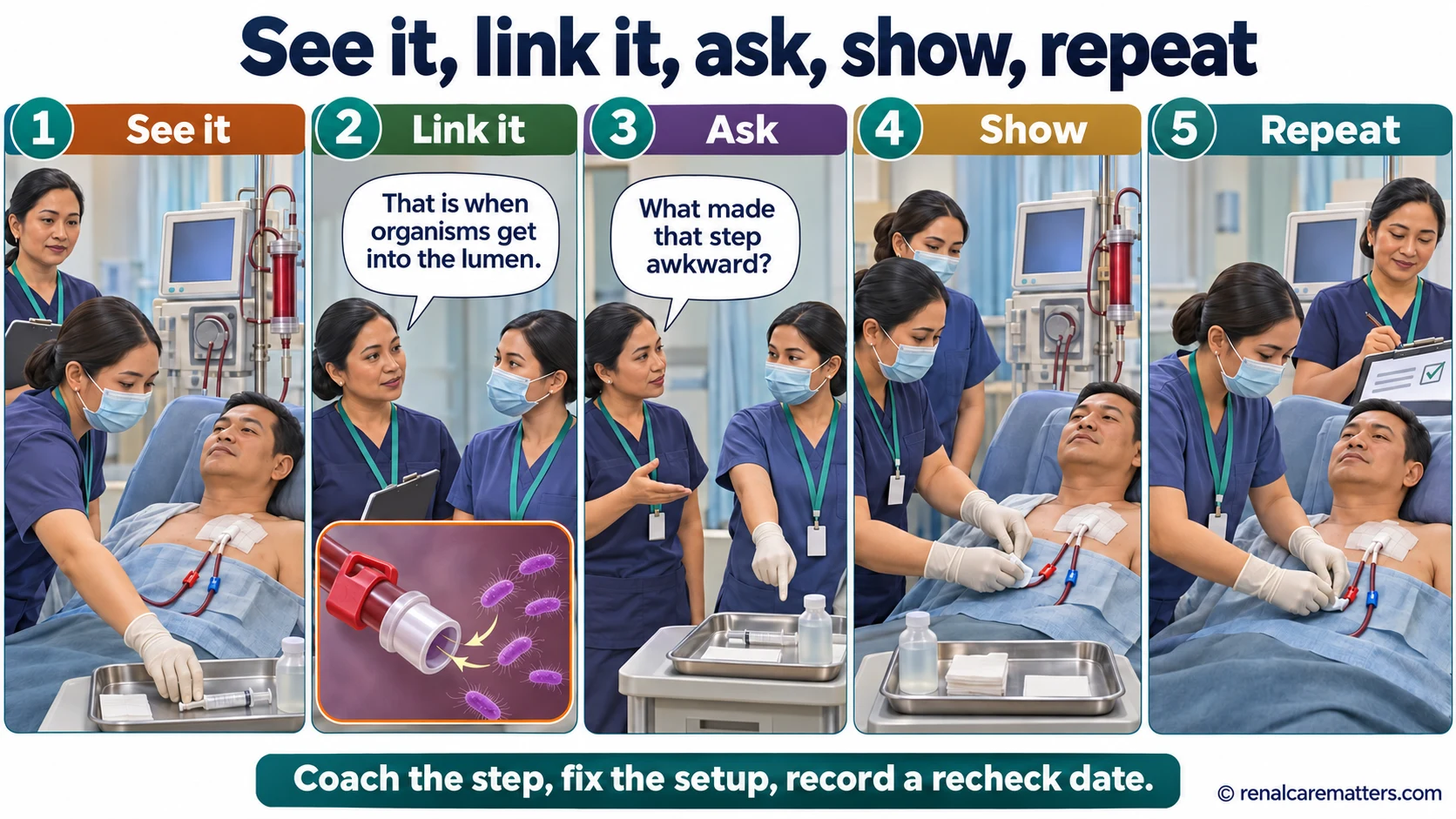
Figure 7. See it, link it, ask, show, repeat. Coach the step, fix the setup, and record a recheck date.
Figure 8 · See it, link it, ask, show, repeat
See it“At station 6, the hub was open for about twenty seconds while you reached for the syringe.”
Link it“That is the moment organisms get into the lumen.”
Ask“What made that step awkward?” The answer is often the setup.
ShowDemonstrate the approved technique, or fix the setup.
RepeatWatch it done again. Record the result, any restriction, and a date to recheck.
Feedback about a specific observed action changes behavior. Feedback about attitude does not. Repeated or serious lapses move to the formal management process.
Keeping the team. Retention is a safety intervention. The drivers you can influence are workload, a voice in unit decisions, and support from the head nurse.6,7 Protect breaks on the assignment board, rotate the hardest assignments, close the loop on every hazard a nurse reports, and give each new nurse a named preceptor for a defined period.
On the floor · The catheter cluster, every day
Ms. Joy Mercado, a nurse with four years in the unit, asks to speak with you. She has been assigned the four catheter patients at the far end of the floor every shift for two months, because she is the best at catheter care. She is tired, and she has an offer from a hospital.
Her skill was being rewarded with the hardest load, every day. You rotate the catheter cluster across the three most experienced nurses, pair Ms. Mercado with a newer nurse for two weeks so that her skill spreads, and record the rotation on the assignment board where everyone can see it. Ms. Mercado stays. Rotating the hard assignment cost nothing. Replacing her would have cost months.
Illustrative scenario. Names and details are invented.
On the floor
Real situations: problems and solutions
These are fictional but typical. For each one, cover the answer, decide what you would do, then compare. Where a step depends on local rules, your unit’s procedure and your supervisor’s direction come first.
The orientee who wants to help
What you see
An orientee offers to take four patients alone because the shift is short.
What is likely going on
She wants to be useful.
What to do
Thank her and keep her supernumerary. Pair her with a signed-off nurse.
Why it matters
The rule exists to prevent exactly this.
Two nurses, one skill
What you see
Only one nurse on the shift can manage the isolation machine.
What is likely going on
A single point of failure.
What to do
Name a backup or arrange a reliever, and plan the next training.
Why it matters
When that nurse goes on break, the skill leaves the floor.
Feedback that did not land
What you see
You told a nurse to be more careful, and nothing changed.
What is likely going on
The feedback was general.
What to do
Watch one specific step, describe what you saw, and ask what made it hard.
Why it matters
Specific feedback changes behavior. General feedback does not.
Field notes
Write the capacity trigger before the shift, not during the crisis.
Protect breaks on the assignment board.
Close the loop on every hazard a nurse reports.
Case review
Back to the case: The lone ACLS nurse calls in sick
How many stations? Twelve stations need three nurses who count. You have two, so at most eight can open on nursing grounds. Separately, nobody present holds a current ACLS certificate, which is its own failed gate. Until a nurse with ACLS arrives, no station opens. Call the reliever list in order, looking specifically for someone with current ACLS. Call nursing administration and the clinical head. Ask the physician on duty which patients could be deferred or sent elsewhere if relief does not come.
Can Ms. Santos fill the gap? No. She is in her second week and has no site sign-off, so she is supernumerary. Counting her would put a new nurse alone with four patients, which is exactly the situation the rule exists to prevent. She can still work alongside a signed-off nurse.
Once the reliever arrives. Recheck the whole board, not only the arithmetic. Who is on close observation with Mrs. Navarro? Who covers her during breaks? Is the only ACLS nurse now also the person most likely to be pulled into an emergency, leaving a gap on the floor? Write the trigger for the rest of the day: if anyone else leaves, which stations close first.
Skills lab · with your preceptor
Skills checklist: Assignment board and coaching
Build an assignment board for a synthetic shift, then coach an orientee who skipped the pre-start order check while your facilitator observes. Your preceptor rates each step as satisfactory, needs practice, or not observed. Steps marked Critical must all be satisfactory before sign-off. This checklist supports supervised learning; your unit’s own procedure and competency form are the authority. A printable version of every checklist is on the trainer page.
CriticalCalculates the minimum nurses for the stations planned.
CriticalCounts only signed-off nurses and identifies supernumerary staff.
CriticalConfirms ACLS cover as a separate requirement.
Adds acuity, isolation, and close-observation needs to the assignment.
CriticalNames a backup for each single point of failure.
Writes a trigger for reducing capacity and the people to call.
CriticalDoes not decide which patients are deferred, and asks the physician.
CriticalGives feedback on one specific observed step, linked to patient risk.
Asks what made the correct step difficult.
Records the result, any restriction, and a recheck date.
Placement activity. Keep a competency matrix for your unit for one month. Mark every empty and expired cell, and turn them into a teaching plan with dates.
Self-assessment
Check your understanding
Each visit draws 8 questions at random from this module’s 15-question bank. Choose the single best answer for each, then select Check answers; an explanation appears under the best answer. Select New set of questions for a different mix. A good target is 7 of 8 on two different sets. Nothing you select is sent anywhere; scoring happens in your browser.
Thomas-Hawkins, C., Flynn, L., & Clarke, S. P. (2008). Relationships between registered nurse staffing, processes of nursing care, and nurse-reported patient outcomes in chronic hemodialysis units. Nephrology Nursing Journal, 35(2), 123–130, 145; quiz 131.
Thomas-Hawkins, C., Flynn, L., & Dillon, J. (2020). Registered nurse staffing, workload, and nursing care left undone, and their relationships to patient safety in hemodialysis units. Nephrology Nursing Journal, 47(2), 133–142.
Jeong, E. (2023). Impact on health outcomes of hemodialysis patients based on the experience level of registered nurses in the hemodialysis department: a cross-sectional analysis. Frontiers in Health Services, 3, 1154989. https://doi.org/10.3389/frhs.2023.1154989
Saran, R., Bragg-Gresham, J. L., Rayner, H. C., Goodkin, D. A., Keen, M. L., Van Dijk, P. C., Kurokawa, K., Piera, L., Saito, A., Fukuhara, S., Young, E. W., Held, P. J., & Port, F. K. (2003). Nonadherence in hemodialysis: associations with mortality, hospitalization, and practice patterns in the DOPPS. Kidney International, 64(1), 254–262. https://doi.org/10.1046/j.1523-1755.2003.00064.x
Bicki, A. C., Grimes, B., McCulloch, C. E., Copeland, T. P., & Ku, E. (2024). Dialysis facility staffing ratios and kidney transplant access among adolescents and young adults. JAMA, 332(23), 2003–2013. https://doi.org/10.1001/jama.2024.18210
Flynn, L., Thomas-Hawkins, C., & Clarke, S. P. (2009). Organizational traits, care processes, and burnout among chronic hemodialysis nurses. Western Journal of Nursing Research, 31(5), 569–582. https://doi.org/10.1177/0193945909331430
Iroegbu, C., Lasater, K. B., & Brooks-Carthon, M. (2025). Evaluating the impact of the work environment on job outcomes among registered nurses working in outpatient dialysis centers: A cross-sectional study. Nephrology Nursing Journal, 52(1), 23–31.
Educational study material for nurses. Does not replace the attending nephrologist’s orders, the unit’s protocols, required training and certification, or supervised practice.