Nephrology Nursing Track · By Role · Module 7 of 13
Leading the First Minutes of an Emergency
Whether the circuit is the cause or a bystander, when blood is not returned, the five voices, and the transfer handoff.
PublishedNailathalaGipatikPepalwal:ReferencesMga SanggunianMga TinubdanReng Reperensya:9Audience: Head nurses and charge nurses in hemodialysis units · senior dialysis nurses preparing to lead · medical directors and nursing administrators who orient themRead timeOras ng pagbasaOras sa pagbasaOras ning pamamasa:
This module is study material for head nurses in hemodialysis units. It explains the reasoning behind common decisions; it is not a protocol. On the floor, follow your unit’s protocol and ask the attending nephrologist for guidance. Doses, limits, and cut-off values are set by your unit. Every case is fictional.
Learning objectives
After this module you should be able to
Decide whether the circuit is the cause of an emergency or a bystander.
State the events in which blood in the circuit must not be returned.
Explain why some dialysis patients cannot hold their blood pressure, and what that means at the chair.
Assign five named roles in the first thirty seconds and close each loop.
Summarize what is known about cardiac arrest in dialysis clinics, and why compressions matter more than the shock.
Deliver a structured transfer handoff and a short debrief.
Pre-testBefore you read, answer the 8 self-assessment questions and note your score. After the module, select New set of questions and compare. The difference is what you learned; the questions you still miss are what to reread.
Start here
The big picture, in plain words
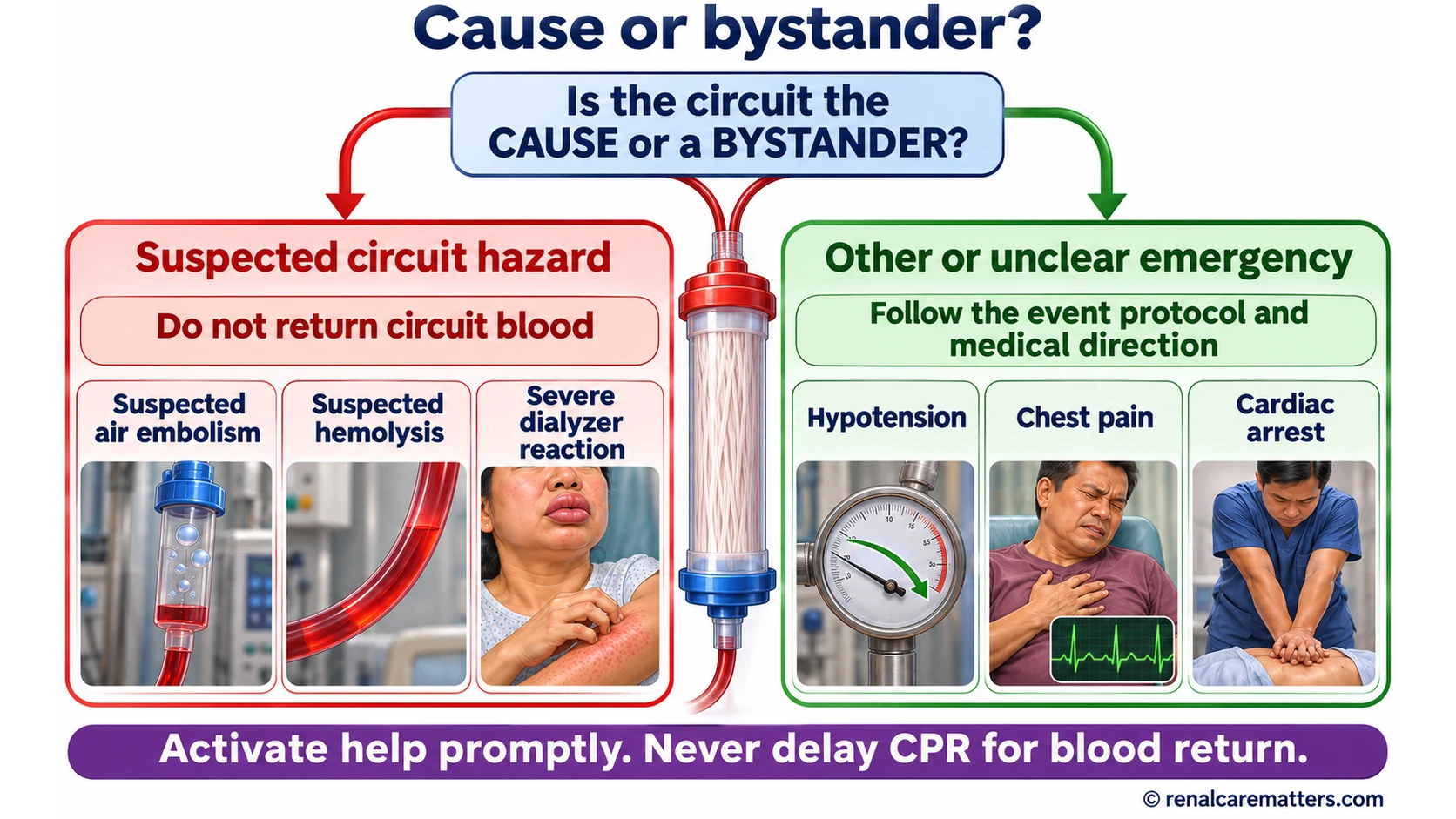
In plain wordsAn emergency in a dialysis unit involves two patients at once: the person, and the circuit holding about a quarter liter of their blood. Every dialysis emergency starts with the same question. Is the circuit the cause, or is it a bystander?
The picture has a limit. Sometimes you cannot tell at first. When you are unsure, treat the circuit as a possible cause: stop the pump and clamp. Returning blood can wait a minute. Undoing a return cannot.
Figure 1. The first fork in every dialysis emergency: is the circuit the cause, or a bystander?
Figure 2 · Key terms for this module
Cause or bystanderWhether the circuit produced the emergency (air, hemolysis, a reaction) or the patient did (low pressure, a heart problem).
Blood returnRinsing the blood in the circuit back to the patient at the end of treatment.
Closed-loop communicationA named instruction, repeated back, and reported when done.
Nonshockable rhythmA cardiac arrest rhythm that a defibrillator will not shock. Compressions are the treatment.
Dialyzer reactionAn allergic-type reaction to the dialyzer or tubing, usually in the first minutes.
At 9:40, during the morning shift, Mr. Benjamin Torres, 71, stops responding at station 7. He is in his third hour. His nurse, Ms. Rhea Castillo, shouts, and four nurses and the technician run to the chair. Eleven other patients are connected. At station 2, a machine begins to alarm.
The physician on duty, Dr. Paolo Lim, is at the far end of the unit examining a new patient.
Before reading on, decide:
What do you say in the first thirty seconds?
What happens to the blood in Mr. Torres’s circuit?
What do you hand over when the transfer team arrives, and what happens afterward?
Keep your answers in mind. The lesson gives you what you need, and the case review near the end shows one sound response.
Lesson · part 1
Why some patients fall further
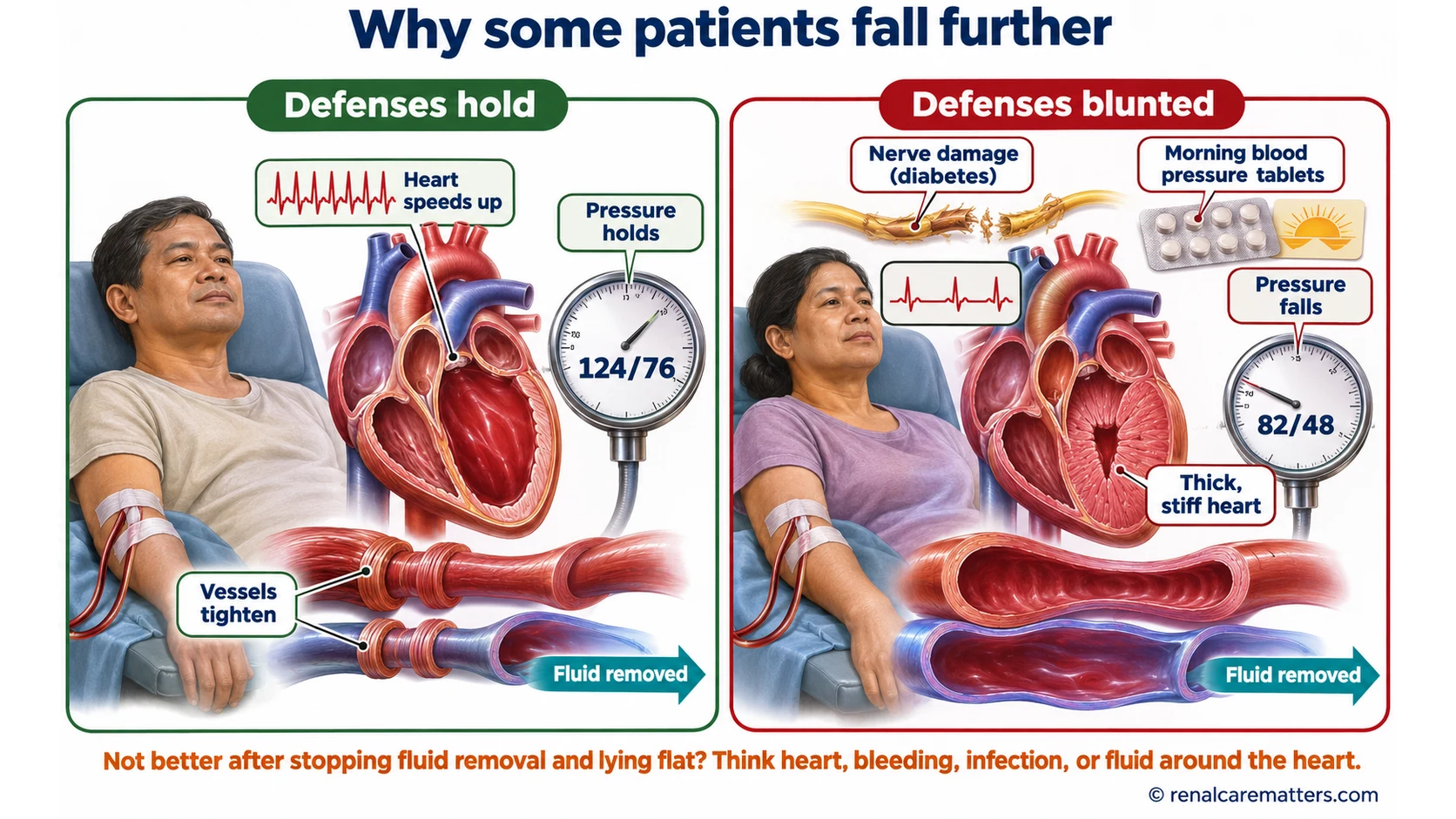
Module 2 explained that fluid removal can outrun refilling. A healthy body compensates by tightening its vessels and speeding the heart. Many dialysis patients cannot. Diabetic nerve damage stops the vessels tightening. A thick, stiff heart needs full filling to pump. Blood pressure tablets taken that morning blunt both responses.
Figure 3. Why some patients fall further. Stiff hearts, damaged nerves, and morning blood pressure tablets blunt the body's defenses.
A nadir systolic below 90 mm Hg is the level most strongly linked to mortality in observational data.1 A low pressure that does not improve after stopping fluid removal and laying the patient flat is something else until proven otherwise: a heart attack, an arrhythmia, bleeding, infection, or fluid around the heart.
Cardiac arrest is the most common cause of death in patients on hemodialysis.2 Risk peaks after the long gap.3 In a case-control study of in-clinic arrests, low-potassium dialysis fluid was among the factors associated with arrest.4
On the floor · The low pressure that did not come back
Mrs. Corazon Medina, 64, has diabetes and dialyzes on the morning shift. At two and a half hours, her systolic pressure is 82 mm Hg. Her nurse stops fluid removal, lays her flat, and raises her legs. Ten minutes later the pressure is still 80. Mrs. Medina is sweating, and when asked, she says her jaw aches.
A drop caused by fluid removal usually improves when removal stops and the patient lies flat, because refilling catches up. This one did not. That is the signal to think beyond fluid. Her nurse calls the physician on duty at once and says, “Low pressure not responding to stopping ultrafiltration (UF), sweating, and jaw pain. I am worried about her heart.” The physician orders an electrocardiogram under the unit’s protocol. The nurse’s job was not to diagnose a heart attack. It was to notice that the usual explanation no longer fit, and to say so in words that got the physician to the chair.
Illustrative scenario. Names and details are invented.
Lesson · part 2
Cause or bystander, event by event
Actions follow your unit’s algorithm and the physician’s direction. This table teaches the reasoning behind them.5
Event
Clues
Return blood?
First actions
Low pressure from fluid removal
Gradual fall, cramps, yawning, nausea, late in the session
Yes, if stopping, on order
Stop UF. Lay flat, legs raised. Fluid as the protocol allows. Reassess in minutes
Cardiac arrest
Unresponsive, not breathing normally
Per protocol. Never delay compressions for it
Call for help, start compressions, defibrillator pads on
Chest pain
Pressure, sweating, breathlessness
Usually, on order
Stop UF, slow the pump, electrocardiogram (ECG), call the physician
Air embolism
Air in the venous line, sudden cough, chest pain, collapse
No
Clamp the venous line, stop the pump. Left side down, head down. Oxygen
Hemolysis
Dark or cherry-red venous blood, chest or back pain, often several patients
No
Stop, clamp. Call the water lead (Module 6)
Severe dialyzer reaction
First minutes: itching, wheeze, swelling, low pressure
No
Stop, clamp. Treat as anaphylaxis on order
Needle out or access bleeding
Blood, pallor
Not through a contaminated needle
Stop, clamp, press (Module 4)
Seizure or sudden confusion
New patient with very high urea suggests disequilibrium. Otherwise think of sugar, stroke, pressure
On order
Protect the airway, check glucose, stop or slow, call
The left-side-down position in air embolism is meant to hold the air in the right side of the heart, away from the outflow to the lungs. It comes from physiology and expert advice, not trials.
On the floor · Two patients and the color of the line
Twenty minutes into the second shift, the patient at station 5 says his chest feels tight and his back hurts. At station 6, a patient complains of the same thing a minute later. The nurse looks at the venous line on both machines. The blood in the lines looks darker and clearer than usual, like red wine.
Two patients on the same water system, with the same symptoms at the same time, and blood that looks hemolyzed, point to the fluid, not the patients. The nurses stop both blood pumps and clamp the lines. They do not return the blood, because returning hemolyzed blood would deliver the potassium released from the broken red cells straight into the patient. The physician is called, every other connection on that water system is held, and the water lead is called to test the system (Module 6).
Illustrative scenario. Names and details are invented.
Stop and callStop the blood pump, clamp the lines, and do not return the blood when air, hemolysis, or a severe dialyzer reaction is suspected. Call the physician on duty and the attending nephrologist at once. Follow your unit’s protocol while you call.
Lesson · part 3
What the evidence shows about arrests in dialysis clinics
Study
Finding
Strength and limits
398 arrests in United States clinics
Staff started cardiopulmonary resuscitation (CPR) in 81.4% and applied a defibrillator before the ambulance came in 52.3%. Staff-started CPR was associated with three times the odds of leaving hospital alive. The first rhythm was nonshockable in 66%6
Observational. Arrests where staff acted may differ from those where they did not
The early cohort did not find better survival in clinics that had one on site7
Observational. Result consistent with mostly nonshockable rhythms
102 arrests attended by paramedics
10 happened before, 72 during, and 20 after dialysis8
Observational, older series
Two lessons follow. Staff compressions are the intervention that matters most. And a defibrillator will often advise no shock, so the team must keep compressing. The device does not replace the hands.
Use the survival figures to motivate prevention and honest conversations about goals of care with the nephrologist and family, not to discourage resuscitation.
Lesson · part 4
Five voices in the first thirty seconds
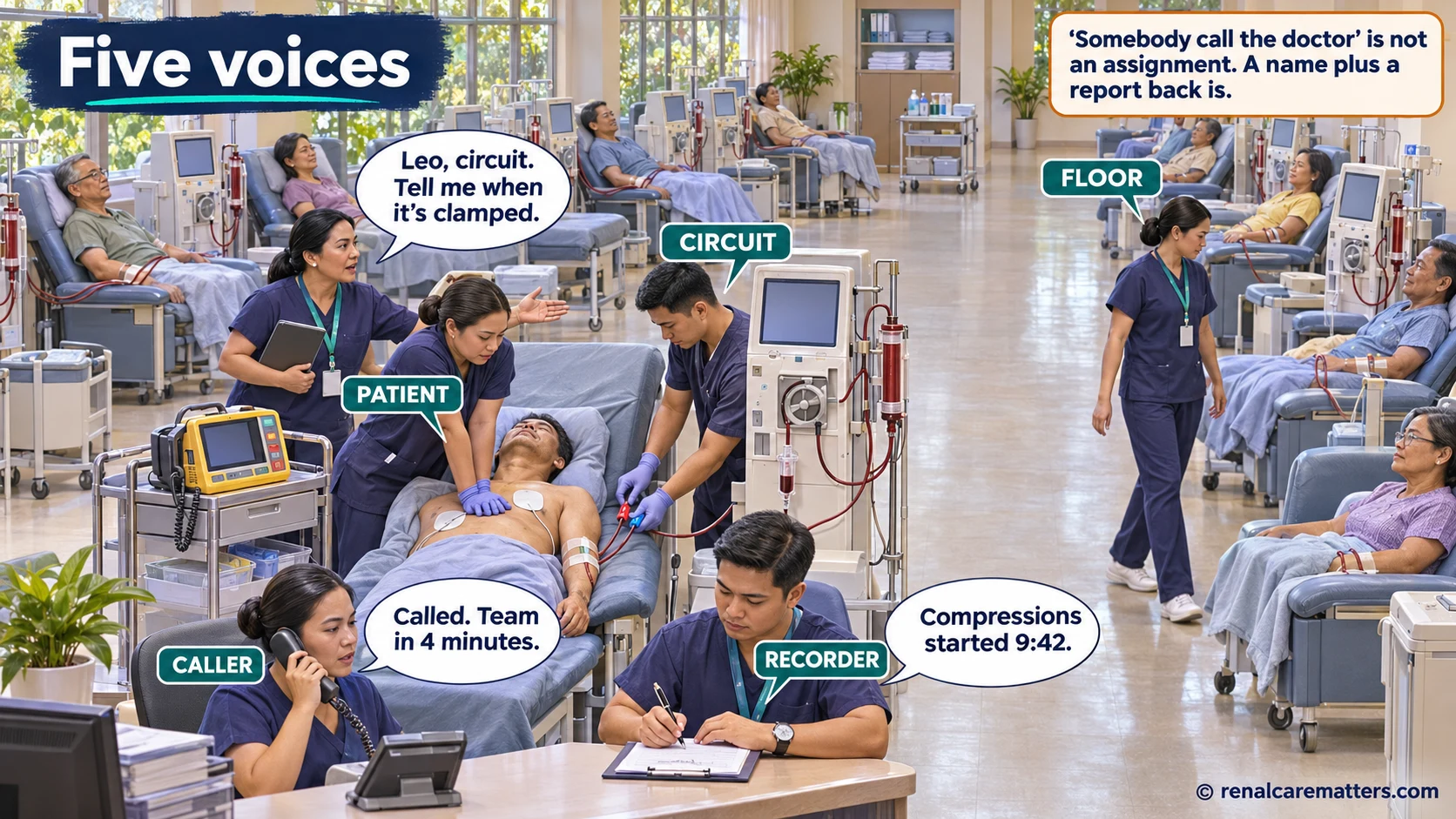
In the first thirty seconds, say the emergency aloud and give five jobs to five named people.
Figure 4. Five voices. Assign each job to one named person and ask for a report back. One nurse watches everyone else.
Figure 5 · Five voices
PatientAirway, breathing, compressions.
CircuitPump, clamps, and the return-or-not decision under protocol.
CallerPhysician and emergency response, then reports back: “Called. Team in four minutes.”
RecorderTimes, rhythms, drugs, who did what.
FloorOne nurse watches every other connected patient. Other alarms do not stop.
“Somebody call the doctor” is not an assignment. “Ana, call Dr. Lim and tell me when you have reached him” is. A name and a report back are what closed-loop communication means.
Structured handoff programs were associated with 23% fewer medical errors and 30% fewer preventable adverse events among hospital residents.9 Applying that to dialysis transfers is a reasonable inference, not a tested finding.
Figure 6 · Transfer handoff
IdentityName, age, unit, attending nephrologist.
EventWhat happened and when.
TreatmentTime on dialysis, fluid removed, whether blood was returned, estimated blood loss.
StatusObservations, rhythm, drugs given, access.
ResultsLast potassium and other recent results.
Accepted byThe name of the person who accepted the patient, and who will call the family.
Lesson · part 5
After the emergency
Spend ten minutes on a debrief: what happened, what went well, what to change, and how everyone is. Restock and reseal the emergency cart before the station is used again. Deeper review goes to Module 11.
Time every drill: seconds from collapse to first compression, to the call made, and to pads on. Plot the drills on a run chart (Module 11) so the team can see whether practice is making them faster.
On the floor · From 74 seconds to 31
In January, the unit’s first timed drill shows 74 seconds from the call “No response at station 3” to the first chest compression. The nurses spent the time lowering the chair, finding the backboard, and deciding who would start.
After the debrief, the backboard is clipped to the side of the emergency cart, the chair’s flat button is marked in red, and the first nurse at the chair is told that her job is compressions, not the circuit. The drills are repeated monthly with different nurses and plotted on a run chart. By April, the time is 31 seconds. No single change did it. The team did, by practicing and measuring.
Illustrative scenario. Names and details are invented.
RememberIn an emergency, the head nurse’s first job is often not at the chest. It is making sure that every job has a name and that the other eleven patients are watched.
On the floor
Real situations: problems and solutions
These are fictional but typical. For each one, cover the answer, decide what you would do, then compare. Where a step depends on local rules, your unit’s procedure and your supervisor’s direction come first.
Everyone runs
What you see
A patient collapses and every nurse goes to the chair.
What is likely going on
Instinct pulls people toward the emergency.
What to do
Assign the floor role first if needed: “Mark, stay with everyone else.”
Why it matters
Eleven other circuits are still running.
Dark blood at two chairs
What you see
Two patients have dark venous blood and back pain within minutes of each other.
What is likely going on
Hemolysis from the dialysis fluid or water.
What to do
Stop and clamp both. Do not return blood. Call the physician and the water lead.
Why it matters
More than one patient at once points to a shared source.
No shock advised
What you see
The defibrillator advises no shock and a nurse stops compressions.
What is likely going on
She expected a shock to fix it.
What to do
Restart compressions at once and continue the algorithm.
Why it matters
Most in-clinic arrests are nonshockable.
Field notes
Practice saying the five roles aloud until it is automatic.
Time every drill and plot the times.
Check on the nurse who found the patient.
Case review
Back to the case: Station 7 goes quiet
The first thirty seconds. Seven people at one chair and no one watching eleven circuits is the danger here. Say it: “Station 7, unresponsive. Rhea, check breathing and start compressions if he is not breathing normally. Leo, circuit: stop the pump and clamp. Ana, call Dr. Lim and the emergency team and tell me when they are coming. Joy, record. Mark, the floor: go to station 2 now and watch everyone else.” The defibrillator goes on. If it advises no shock, compressions continue.
The blood. Mr. Torres’s circuit is a bystander unless something suggests otherwise: there is no air in the line, no dark blood, and he is three hours in, not three minutes. Whether to return the blood follows your protocol and Dr. Lim’s direction. It never delays compressions. If anything suggests air or hemolysis, do not return it.
Handoff and afterward. Give the transfer team his identity, the time he collapsed, time on dialysis, fluid removed, whether blood was returned, rhythms, drugs, and his last potassium. Write down the name of the person who accepted him and who will call his family. Then debrief for ten minutes, restock the cart, and check on Ms. Castillo, who found him.
Skills lab · with your preceptor
Skills checklist: Emergency team leadership
Lead a simulated emergency at a dialysis chair while your facilitator observes. Repeat with two patients deteriorating at once. Your preceptor rates each step as satisfactory, needs practice, or not observed. Steps marked Critical must all be satisfactory before sign-off. This checklist supports supervised learning; your unit’s own procedure and competency form are the authority. A printable version of every checklist is on the trainer page.
CriticalNames the emergency aloud within the first few seconds.
CriticalAssigns patient, circuit, caller, recorder, and floor roles to named people.
CriticalAsks for and receives a report back from the caller.
CriticalEnsures compressions start without delay when indicated.
CriticalStates whether the circuit is a cause or a bystander, and the blood-return rule.
CriticalKeeps one nurse on the rest of the floor throughout.
CriticalContinues compressions after a no-shock advisory.
Gives a structured transfer handoff, including blood return and estimated loss.
Records the name of the person who accepted the patient.
Leads a ten-minute debrief and arranges cart restocking.
Placement activity. Run one emergency drill a month for three months. Time collapse to compressions, to call, and to pads on. Plot the results and review them with the team.
Self-assessment
Check your understanding
Each visit draws 8 questions at random from this module’s 15-question bank. Choose the single best answer for each, then select Check answers; an explanation appears under the best answer. Select New set of questions for a different mix. A good target is 7 of 8 on two different sets. Nothing you select is sent anywhere; scoring happens in your browser.
Flythe, J. E., Xue, H., Lynch, K. E., Curhan, G. C., & Brunelli, S. M. (2015). Association of mortality risk with various definitions of intradialytic hypotension. Journal of the American Society of Nephrology, 26(3), 724–734. https://doi.org/10.1681/ASN.2014020222
Pun, P. H., Lehrich, R. W., Smith, S. R., & Middleton, J. P. (2007). Predictors of survival after cardiac arrest in outpatient hemodialysis clinics. Clinical Journal of the American Society of Nephrology, 2(3), 491–500. https://doi.org/10.2215/CJN.02360706
Foley, R. N., Gilbertson, D. T., Murray, T., & Collins, A. J. (2011). Long interdialytic interval and mortality among patients receiving hemodialysis. New England Journal of Medicine, 365(12), 1099–1107. https://doi.org/10.1056/NEJMoa1103313
Pun, P. H., Lehrich, R. W., Honeycutt, E. F., Herzog, C. A., & Middleton, J. P. (2011). Modifiable risk factors associated with sudden cardiac arrest within hemodialysis clinics. Kidney International, 79(2), 218–227. https://doi.org/10.1038/ki.2010.315
Greenberg, K. I., & Choi, M. J. (2021). Hemodialysis emergencies: Core curriculum 2021. American Journal of Kidney Diseases, 77(5), 796–809. https://doi.org/10.1053/j.ajkd.2020.11.024
Pun, P. H., Dupre, M. E., Starks, M. A., Tyson, C., Vellano, K., Svetkey, L. P., Hansen, S., Frizzelle, B. G., McNally, B., Jollis, J. G., Al-Khatib, S. M., Granger, C. B., & CARES Surveillance Group. (2019). Outcomes for hemodialysis patients given cardiopulmonary resuscitation for cardiac arrest at outpatient dialysis clinics. Journal of the American Society of Nephrology, 30(3), 461–470. https://doi.org/10.1681/ASN.2018090911
Lehrich, R. W., Pun, P. H., Tanenbaum, N. D., Smith, S. R., & Middleton, J. P. (2007). Automated external defibrillators and survival from cardiac arrest in the outpatient hemodialysis clinic. Journal of the American Society of Nephrology, 18(1), 312–320. https://doi.org/10.1681/ASN.2006040392
Davis, T. R., Young, B. A., Eisenberg, M. S., Rea, T. D., Copass, M. K., & Cobb, L. A. (2008). Outcome of cardiac arrests attended by emergency medical services staff at community outpatient dialysis centers. Kidney International, 73(8), 933–939. https://doi.org/10.1038/sj.ki.5002749
Starmer, A. J., Spector, N. D., Srivastava, R., West, D. C., Rosenbluth, G., Allen, A. D., Noble, E. L., Tse, L. L., Dalal, A. K., Keohane, C. A., Lipsitz, S. R., Rothschild, J. M., Wien, M. F., Yoon, C. S., Zigmont, K. R., Wilson, K. M., O'Toole, J. K., Solan, L. G., Aylor, M., . . . I-PASS Study Group. (2014). Changes in medical errors after implementation of a handoff program. New England Journal of Medicine, 371(19), 1803–1812. https://doi.org/10.1056/NEJMsa1405556
Educational study material for nurses. Does not replace the attending nephrologist’s orders, the unit’s protocols, required training and certification, or supervised practice.