Nephrology Nursing Track · By Role · Module 6 of 13
Water, Machines, and Supplies
Why drinking water is not dialysis water, what each contaminant does, reading the water log, and the three documents for restart.
PublishedNailathalaGipatikPepalwal:ReferencesMga SanggunianMga TinubdanReng Reperensya:3Audience: Head nurses and charge nurses in hemodialysis units · senior dialysis nurses preparing to lead · medical directors and nursing administrators who orient themRead timeOras ng pagbasaOras sa pagbasaOras ning pamamasa:
This module is study material for head nurses in hemodialysis units. It explains the reasoning behind common decisions; it is not a protocol. On the floor, follow your unit’s protocol and ask the attending nephrologist for guidance. Doses, limits, and cut-off values are set by your unit. Every case is fictional.
Learning objectives
After this module you should be able to
Explain why water that is safe to drink is not safe for dialysis.
Name the main contaminants, the stage that removes each, and how each harms patients.
Read the water log and machine records before opening, and treat a missing result as an abnormal one.
Contain a shared hazard: hold new starts, protect connected patients, and list everyone exposed.
State the three documents required before restart.
Calculate reverse osmosis rejection and carbon contact time and say what a change means.
Pre-testBefore you read, answer the 8 self-assessment questions and note your score. After the module, select New set of questions and compare. The difference is what you learned; the questions you still miss are what to reread.
Start here
The big picture, in plain words
In plain wordsA person drinks about two liters of water a day, and the gut decides what gets in. A dialysis patient’s blood meets about 120 liters of fluid in one session, separated only by a thin membrane that lets small molecules through. The water room is doing the job of the gut wall. If it fails, it fails for every patient on the shift at once.
The picture has a limit. The gut can adapt and repair. A water system cannot. It only does what it was built and maintained to do, and it fails without warning.
Figure 1. Two liters a day by mouth, filtered by the gut. About 120 liters a session across a thin membrane, filtered by the water room.
Figure 2 · Key terms for this module
Reverse osmosis (RO)A membrane that removes most dissolved salts, metals, and microbes from water under pressure.
Carbon tankA tank of activated carbon that removes chlorine and chloramine.
ChloramineA disinfectant added by water utilities. It damages red blood cells.
EndotoxinFragments of bacterial cell walls that cross the membrane and cause fever and inflammation.
colony-forming unit (CFU)/mLColony-forming units per milliliter, a count of live bacteria.
Action levelA result below the maximum limit that still triggers corrective action, usually half the limit.
ReleaseA signed decision by the designated person that water or a machine may be used.
Opening case · fictional
Case: It looks fine, says the voice on the phone
At 11:50, before the second shift, the technician, Mr. Jun Mendoza, tests total chlorine after the carbon tanks. The result is above the limit in the unit’s procedure. The first-shift result at 5:30 was normal.
Three second-shift patients are already connected because they arrived early. Four are waiting. Mr. Mendoza calls the water consultant, who says on the phone: “It’s probably the test kit. It looks fine. Carry on and I’ll come tomorrow.”
Before reading on, decide:
What do you do about the four waiting patients and the three who are connected?
Who else may have been exposed, and why?
What has to exist before the unit restarts?
Keep your answers in mind. The lesson gives you what you need, and the case review near the end shows one sound response.
Lesson · part 1
Each contaminant has a signature
Contaminant
Source
What it does
How it presents
Chlorine and chloramine
Added by the water utility. Removed by carbon
Damages hemoglobin and red cell membranes
Hemolysis: dark or cherry-red blood in the venous line, chest or back pain, breathlessness. Several patients at once. Poor response to anemia treatment over time
Aluminum
Utility treatment chemicals
Builds up in brain and bone
Confusion, bone disease, anemia, over months
Fluoride
Utility dosing errors
Binds calcium, affects the heart
Itching, chest pain, arrhythmia, arrest
Calcium and magnesium
Hard water. Removed by the softener
Hard water syndrome
Nausea, vomiting, high blood pressure, weakness
Bacteria and endotoxin
Biofilm in stagnant pipes, tanks, and bicarbonate
Endotoxin triggers inflammation
Chills and fever in the first hour, low pressure. Chronic inflammation
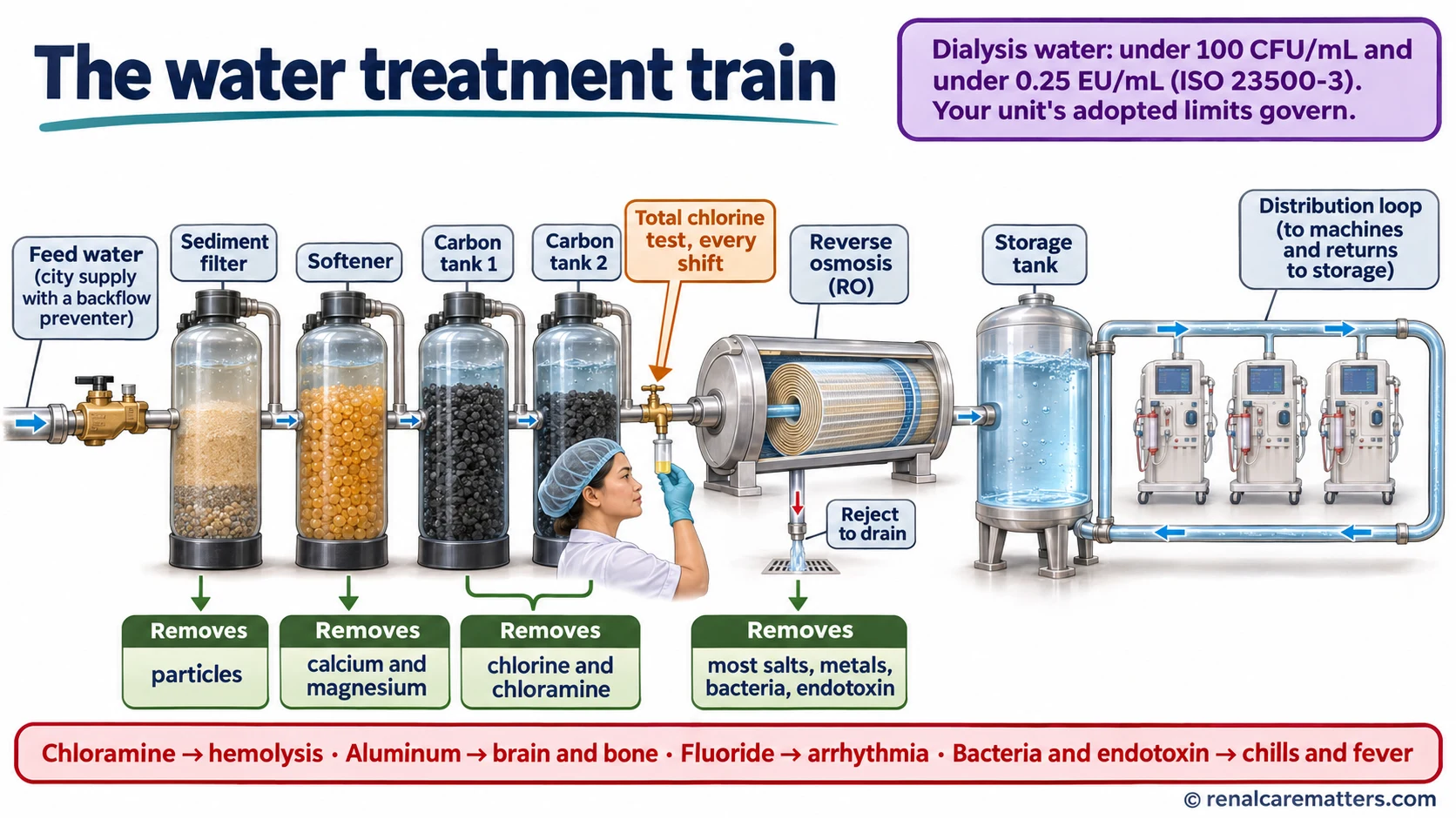
Chloramine deserves its own sentence. Reverse osmosis does not reliably remove it. Carbon is the only barrier, carbon runs out without warning, and the test is the last line of defense. That is why total chlorine is tested before every shift.
Lesson · part 2
How the system works, and what the standards say
Figure 3. The water treatment train and what each stage removes. Carbon is the only barrier to chloramine, which is why chlorine is tested every shift.
Water passes through a sediment filter, a softener that protects the reverse osmosis membrane from scale, two carbon tanks in series, and the reverse osmosis unit. Product water goes to a loop that keeps it moving to the machines and back, because standing water grows biofilm.
The international standard is International Organization for Standardization (ISO) 23500-3, reissued as a second edition in April 2024.1
Fluid
Bacteria
Endotoxin
Dialysis water
Under 100 CFU/mL
Under 0.25 endotoxin unit (EU)/mL
Standard dialysis fluid
Under 100 CFU/mL
Under 0.5 EU/mL
Ultrapure dialysis fluid, needed for hemodiafiltration
Under 0.1 CFU/mL
Under 0.03 EU/mL
Action levels are usually set at half the maximum, so the unit acts at 50 CFU/mL before the limit is reached. These standards come from outbreak investigations and expert consensus, not trials. No one will ever randomize patients to contaminated water. The limits that bind your unit are the ones adopted in its approved procedure under the Department of Health (DOH) water order.2 Know where that page is.
Lesson · part 3
What you see with your own eyes before opening
You do not run the water plant. You read its evidence, and you hold the floor when the evidence is missing.
Figure 4 · Before opening
ChlorineTotal chlorine tested this shift, after the carbon, within limit, signed.
Softener and ROHardness and RO readings logged and within range.
Cultures and endotoxinLatest results on file, none above action level without a documented response.
MachinesDisinfection complete, self-tests passed, repairs released in writing.
ConcentratesMatch the orders. Bicarbonate mixed today and labeled.
SuppliesEmergency stock, expiry dates, and lot records in order.
Record dialyzer and bloodline lot numbers for each patient and session, so that a recall can be traced in minutes. Where dialyzer reuse is approved, check patient identification, residual-disinfectant tests, and performance records every time.
On the floor · The recall notice on Friday
On Friday afternoon, a supplier sends a recall notice for one lot of bloodlines because of a faulty clamp. The notice gives the lot number.
In a unit that records lot numbers for each patient and session, the head nurse searches the log and finds that the lot was used for 14 sessions in 9 patients over three days. Every remaining box of that lot is pulled from the shelf and quarantined within 15 minutes. The physician is given the list of patients so that anyone with a problem can be identified. In a unit that does not record lots, the only answer is “We may have used it,” and every patient becomes a question.
Illustrative scenario. Names and details are invented.
RememberA missing result is an abnormal result. If you cannot see it, the gate is closed.
Lesson · part 4
When a result is abnormal or missing
Do not start new patients on the affected system. For patients already connected, call the physician. Whether to stop, and whether to return blood, is a medical decision under the event algorithm. Blood is not returned when hemolysis is suspected.
Call the water or biomedical lead. Record the result, the sample point, the time, and every patient and station exposed since the last normal result. Arrange other capacity for waiting patients (Module 12).
Stop and callStop and call the attending nephrologist and the clinical head as soon as a water result is above the adopted limit or is missing. Hold all new starts on the affected system. Do not return blood if hemolysis is suspected. Follow your unit’s protocol while you call.
On the floor · The test that was not done
At 5:30 on a Sunday, the technician who tests the water calls in sick. No one has tested total chlorine after the carbon for the first shift. The water looks clear, and the reverse osmosis readings are normal.
Clear water and a normal RO reading tell you nothing about chloramine, which the RO does not reliably remove. A missing result is an abnormal result, so the gate is closed. You call the backup tester named in the water procedure, who arrives at 6:05 and tests. The result is within limit and signed at 6:12. The first patients connect at 6:20. You record the gap, the reason, and who tested, and you raise at the next meeting that the backup list had only one name on it.
Illustrative scenario. Names and details are invented.
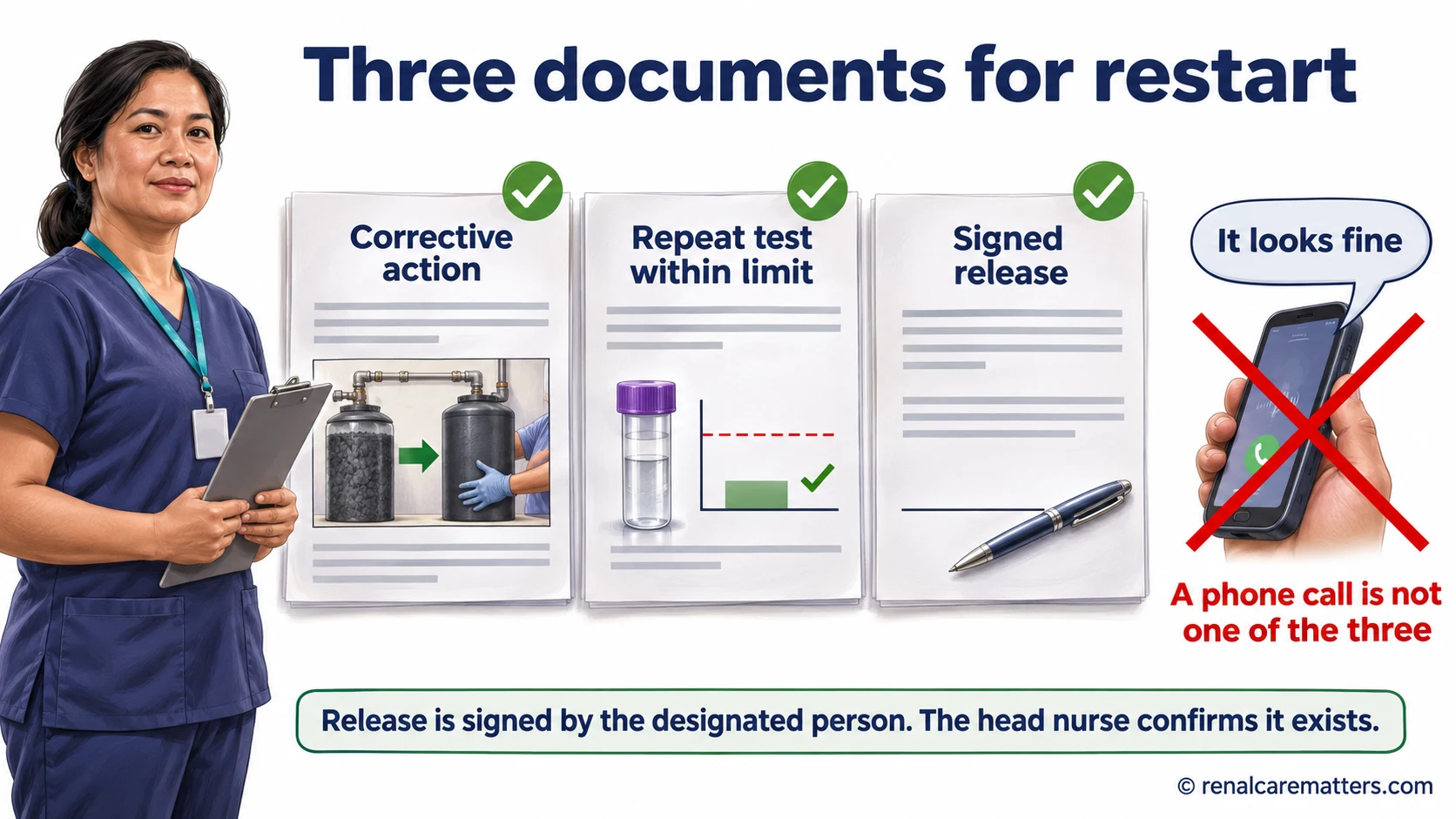
Figure 5. Restart needs three documents. A phone call saying it looks fine is none of them.
Restart requires three documents: the corrective action, a repeat test within the limit from the same sample point, and a release signed by the designated person. A phone call saying “it looks fine” is none of the three.
Carbon contact time = total carbon volume (L) ÷ flow (L/min). 200 L ÷ 18 L/min = 11.1 minutes.
A falling rejection trend means the RO membrane is failing even when today’s product water still looks acceptable. The design standard for carbon contact time is at least 10 minutes in total at the highest flow the system will run, usually at least 5 minutes in each of two carbon tanks in series (a worker tank and a polisher tank), so that the second tank catches what breaks through the first.3 Adding stations raises flow and quietly shortens contact time, so ask for it to be recalculated whenever the unit expands.
On the floor · Four new stations
The unit adds four stations. The water system was designed with 200 liters of carbon at a flow of 12 L/min, a contact time of about 17 minutes. With the new stations running, the peak flow is about 20 L/min.
The new contact time is 200 ÷ 20 = 10 minutes. That just meets the design standard, with nothing to spare. If the unit adds more stations, or if a technician raises the flow to fill the loop faster, contact time falls below the standard, and the carbon can let chloramine through even before it is exhausted. No alarm will sound. The calculation is the only warning, which is why it belongs in the plan for every expansion.
Illustrative scenario. Names and details are invented.
On the floor
Real situations: problems and solutions
These are fictional but typical. For each one, cover the answer, decide what you would do, then compare. Where a step depends on local rules, your unit’s procedure and your supervisor’s direction come first.
The test kit is “probably wrong”
What you see
A chlorine result is above limit and the technician suspects the reagent.
What is likely going on
It may be the kit, or it may be the carbon.
What to do
Treat the result as real. Hold new starts while a second test with fresh reagent is done.
Why it matters
The cost of a wrong hold is a delay. The cost of a wrong release is hemolysis.
A new wing, the same carbon
What you see
Four stations were added last month, and no one recalculated the carbon contact time.
What is likely going on
Higher flow has shortened contact time.
What to do
Ask the water lead to recalculate and report.
Why it matters
Contact time is volume divided by flow.
The recall notice
What you see
A supplier recalls a dialyzer lot.
What is likely going on
Some patients may have been treated with it.
What to do
Use the lot records to list affected patients and sessions, and inform the physician.
Why it matters
Lot numbers turn a recall into a short list.
Field notes
See the signed water result yourself before opening.
Treat a missing result as an abnormal one.
Know which page of your procedure holds the adopted limits.
Case review
Back to the case: It looks fine, says the voice on the phone
Waiting and connected patients. Hold the four waiting patients. The result is above the limit, and an opinion over the phone does not change it. Call the physician on duty about the three connected patients at once. Look at their venous lines for dark or cherry-red blood and ask about chest or back pain and breathlessness. Follow the physician’s orders on stopping. If hemolysis is suspected, the blood is not returned.
Who else was exposed? Every patient dialyzed since the last normal result at 5:30. Carbon can exhaust partway through a shift, so first-shift patients may have been exposed late in their sessions. List them by name, station, and time. The physician may order blood counts or other tests and calls to check on them at home.
Before restart. The water lead switches or replaces the carbon and retests from the same sample point. Restart needs the corrective action record, the repeat test within the limit, and the signed release. Tell the consultant politely that the unit will restart when those three exist. Then add a question to the next quality meeting: why was the carbon not changed before it exhausted?
Skills lab · with your preceptor
Skills checklist: Water event tabletop
Lead a tabletop exercise with a mock water log and an abnormal result while your facilitator plays the technician and the physician. Your preceptor rates each step as satisfactory, needs practice, or not observed. Steps marked Critical must all be satisfactory before sign-off. This checklist supports supervised learning; your unit’s own procedure and competency form are the authority. A printable version of every checklist is on the trainer page.
CriticalReads the log and identifies the abnormal or missing result.
CriticalHolds all new starts on the affected system.
CriticalCalls the physician about connected patients and does not decide on blood return herself.
CriticalStates that blood is not returned if hemolysis is suspected.
CriticalCalls the water or biomedical lead and the clinical head.
CriticalLists every patient exposed since the last normal result.
Arranges or requests alternate capacity for waiting patients.
CriticalNames the three documents required before restart.
CriticalDeclines to restart on a verbal assurance alone.
Calculates RO rejection or carbon contact time from mock values.
Placement activity. For two weeks, check the water log and machine release records yourself before every opening you lead. Record any gap and how it was closed.
Self-assessment
Check your understanding
Each visit draws 8 questions at random from this module’s 15-question bank. Choose the single best answer for each, then select Check answers; an explanation appears under the best answer. Select New set of questions for a different mix. A good target is 7 of 8 on two different sets. Nothing you select is sent anywhere; scoring happens in your browser.
International Organization for Standardization. (2024). Preparation and quality management of fluids for haemodialysis and related therapies: Part 3. Water for haemodialysis and related therapies (ISO Standard No. 23500-3:2024, 2nd ed.). ISO.
Department of Health. (2013). Administrative Order No. 2013-0003: Implementing guidelines in the analysis, monitoring and maintenance of water used in dialysis facilities. Republic of the Philippines.
Conditions for coverage for end-stage renal disease facilities, 42 C.F.R. § 494 (2025).
Educational study material for nurses. Does not replace the attending nephrologist’s orders, the unit’s protocols, required training and certification, or supervised practice.