Nephrology Nursing Track · By Role · Module 5 of 13
Making Infection Prevention Visible
Why dialysis patients and units are prone to infection, the core interventions, audits with honest numbers, and a possible cluster.
PublishedNailathalaGipatikPepalwal:ReferencesMga SanggunianMga TinubdanReng Reperensya:4Audience: Head nurses and charge nurses in hemodialysis units · senior dialysis nurses preparing to lead · medical directors and nursing administrators who orient themRead timeOras ng pagbasaOras sa pagbasaOras ning pamamasa:
This module is study material for head nurses in hemodialysis units. It explains the reasoning behind common decisions; it is not a protocol. On the floor, follow your unit’s protocol and ask the attending nephrologist for guidance. Doses, limits, and cut-off values are set by your unit. Every case is fictional.
Learning objectives
After this module you should be able to
Explain why dialysis patients are prone to infection, using the host, the portal, the environment, and the fluid.
Explain why hepatitis B needs a dedicated room, machine, and staff, and hepatitis C does not.
List the core interventions for preventing bloodstream infection, and state how strong the evidence is.
Observe hand hygiene and catheter care, and report the result with its uncertainty.
Calculate a bloodstream infection rate with the right denominator.
Start the review of a possible cluster without delaying care for the patients.
Pre-testBefore you read, answer the 8 self-assessment questions and note your score. After the module, select New set of questions and compare. The difference is what you learned; the questions you still miss are what to reread.
Start here
The big picture, in plain words
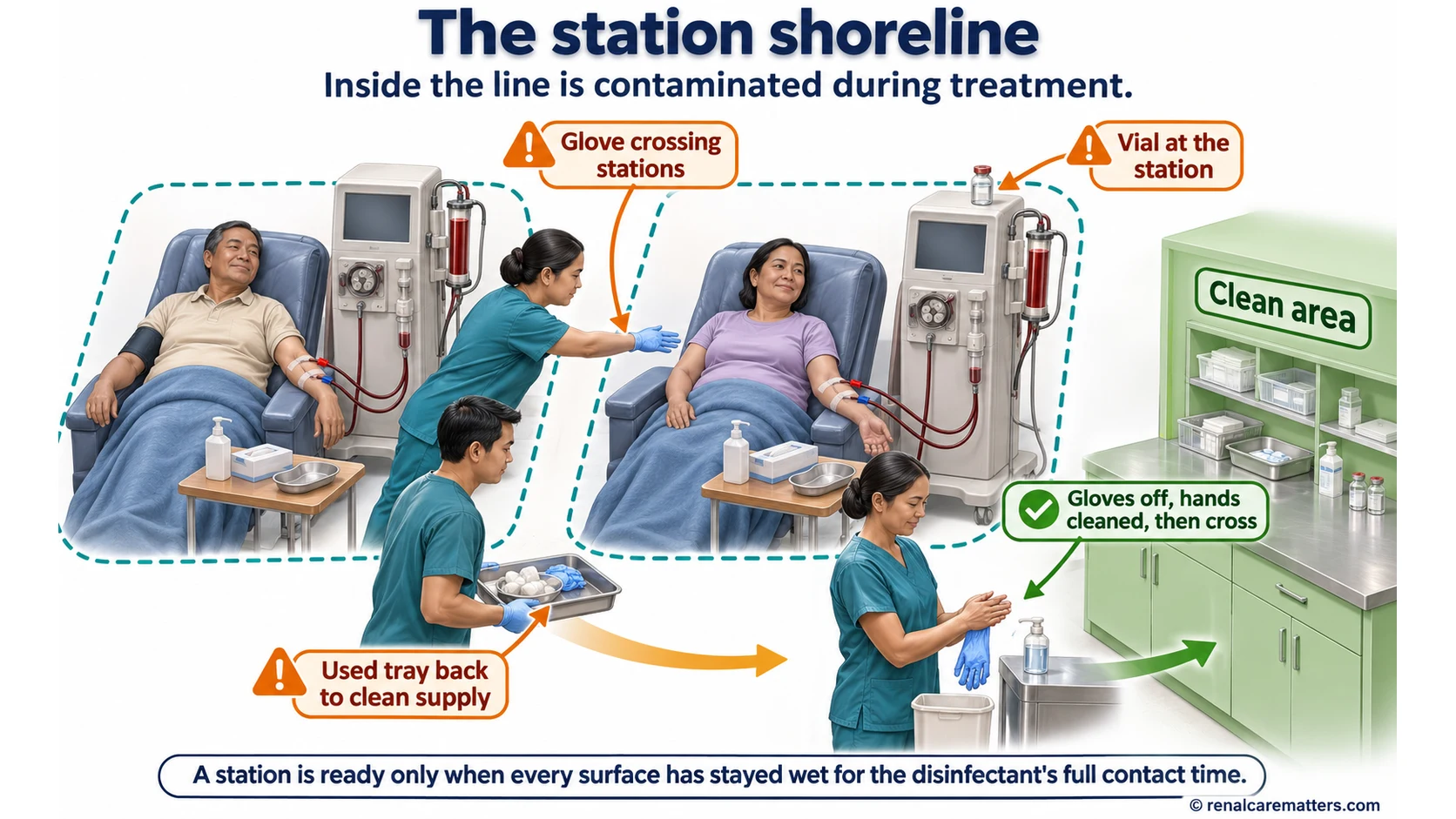
In plain wordsPicture every station as an island with an invisible shoreline. During treatment, everything inside the shoreline is contaminated with that patient’s blood until it is cleaned: the chair, the machine surface, the clamps, the blanket. Infection spreads when something crosses a shoreline without being cleaned.
The picture has a limit. Real contamination is invisible and uneven. That is exactly why the shoreline has to be treated as real even when nothing looks dirty.
Figure 1. Everything inside the shoreline is contaminated during treatment. Infection spreads when something crosses without being cleaned.
Figure 2 · Key terms for this module
Bloodstream infection (BSI)Organisms growing in the blood, shown by a positive blood culture.
Access-related BSIA bloodstream infection whose source is the access, usually a catheter.
Pyrogenic reactionFever and chills from fragments of bacteria in the fluid, not from live bacteria in the blood.
Hand-hygiene opportunityA moment when hand hygiene is required, such as before touching a patient or after touching the station.
Patient-monthOne patient followed for one month. The denominator for most dialysis infection rates.
Catheter-dayOne patient with a catheter for one day.
ClusterTwo or more linked infections close together in time or place.
Opening case · fictional
Case: Chills on the same shift
On the Wednesday morning shift, Mr. Ricardo Gomez, 55, and Mrs. Nenita Pascual, 69, both dialyzing through tunneled catheters at stations 3 and 4, start to shiver. Mr. Gomez’s chills began about twenty minutes after connection. Mrs. Pascual’s began at two hours. The patient at station 5 is well.
The supply officer mentions that a new lot of bicarbonate concentrate and a new brand of catheter-locking solution arrived on Monday.
Before reading on, decide:
What do you do first, and for whom?
What three groups of causes are you considering, and how does the timing help?
What do you record and preserve, and who decides what happens next?
Keep your answers in mind. The lesson gives you what you need, and the case review near the end shows one sound response.
Lesson · part 1
Why dialysis patients and units are prone to infection
The host. Kidney failure weakens white cell function. Diabetes, poor nutrition, and iron therapy add to it. Vaccines work less well, which is why hepatitis B vaccination uses higher doses and antibody levels are rechecked.
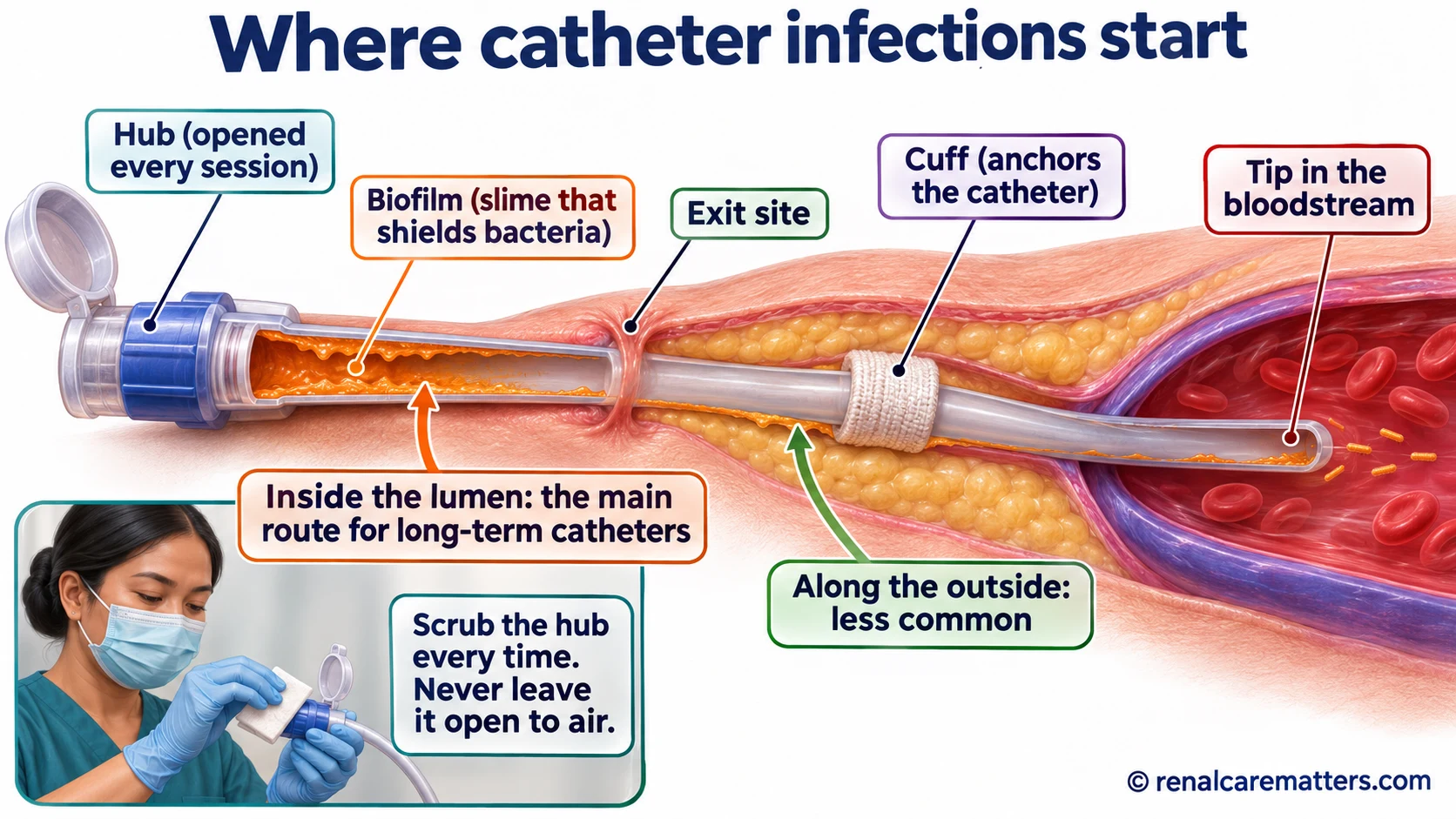
The portal. A patient with a fistula has the skin broken by a needle about 300 times a year. A patient with a catheter has a plastic tube open to the bloodstream all the time.
The environment. Hepatitis B virus survives on surfaces for days at high concentrations and spreads through invisible blood on shared equipment. That durability, not the severity of the disease, is why hepatitis B alone needs a dedicated room, machine, supplies, and staff. Hepatitis C is less hardy. Guidelines do not recommend isolating it and rely on strict standard precautions, because outbreaks have been traced to lapses such as shared medicine vials and poor station cleaning.
The fluid. Gram-negative water organisms grow in stagnant water, bicarbonate concentrate, and reused containers. Module 6 covers the water system.
Figure 3. Biofilm starts at the hub. Scrub the hub every time it is opened, and never leave it open to the air.
On the floor · One glucose meter for the whole floor
On the morning shift, one glucose meter moves from station to station as patients with diabetes are checked. Between patients it is put back in its case. It is not wiped. Nobody sees blood on it.
The meter does not need visible blood to carry a virus. A trace of blood from one finger is enough, and the next patient’s finger touches the same surface. Outbreaks of hepatitis B and C in dialysis units have been traced to shared items handled in this way. The fix is simple: a meter assigned to each station or each patient, or a meter cleaned and disinfected by the approved method after every use, and never a shared lancing device.
Illustrative scenario. Names and details are invented.
Lesson · part 2
The core interventions and what they achieved
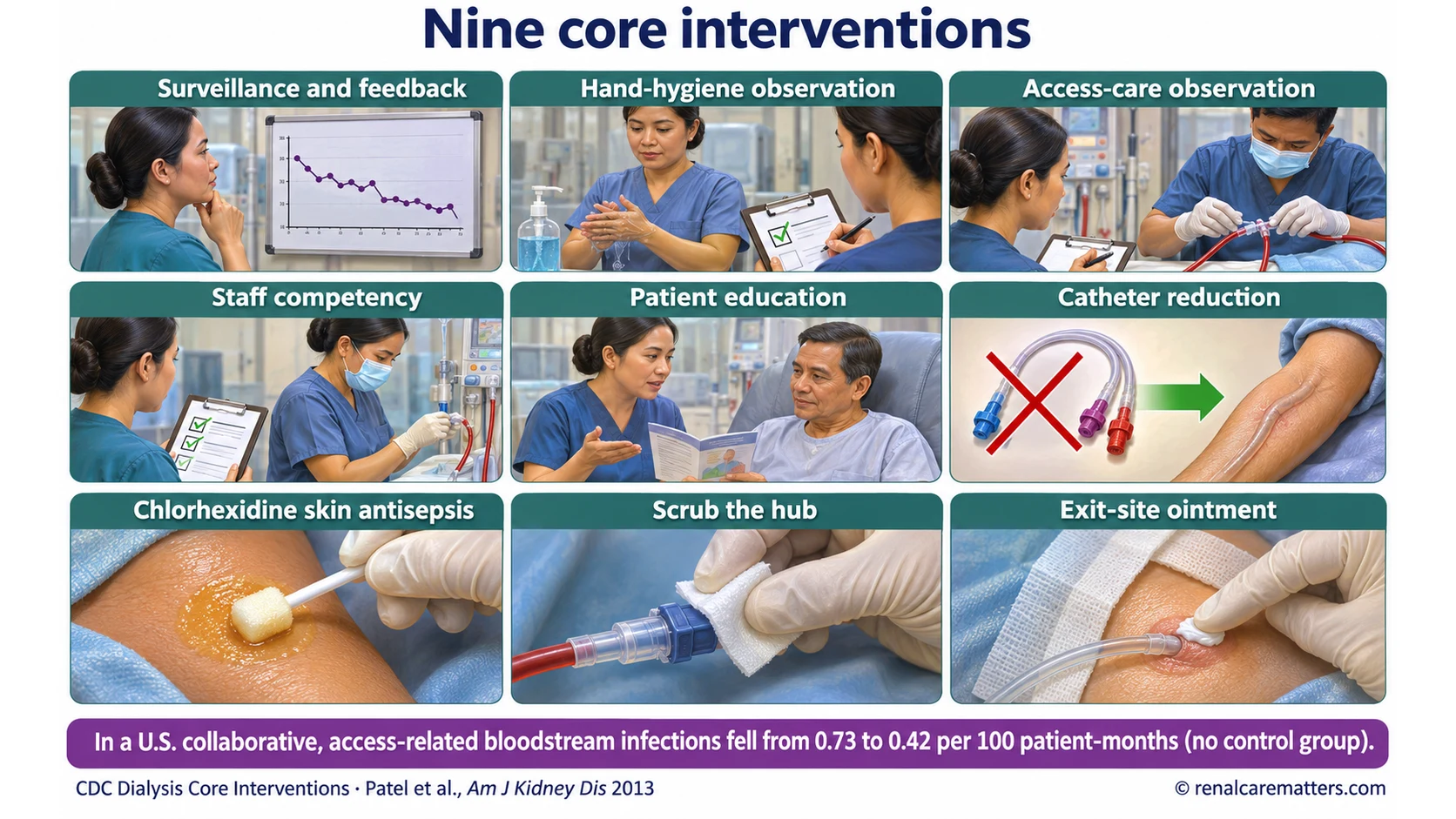
The United States Centers for Disease Control and Prevention (CDC) groups its recommendations for dialysis units into a set of core interventions.1
Figure 4. The nine core interventions for preventing bloodstream infection in dialysis units.
Figure 5 · The core interventions
SurveillanceTrack bloodstream infections monthly and feed the results back to staff.
Hand hygieneObserve monthly and share the results.
Catheter and access careObserve connection, disconnection, and dressing changes quarterly.
Staff competencyTrain and assess at hire and at least once a year.
Patient educationTeach patients how infection starts and what to report.
Catheter reductionMove patients to a fistula or graft where possible.
Skin antisepsisChlorhexidine with alcohol, or povidone-iodine if the patient cannot tolerate it.
Scrub the hubClean the catheter hub with antiseptic every time it is opened.
Exit-site ointmentApply antimicrobial ointment at dressing changes, as the unit’s policy directs.
In a United States collaborative, facilities that adopted these together saw bloodstream infections fall from 1.09 to 0.89 per 100 patient-months, and access-related infections from 0.73 to 0.42. The modeled decreases were 32% and 54%.2 There was no control group, and the facilities were volunteers, so the real effect may be smaller. It is still the best evidence that putting the whole bundle into practice, rather than any single product, lowers the rate.
The Philippine cohort in Module 4 reported 6.72 catheter infections per 1,000 catheter-days, mostly gram-negative.3 That is roughly ten times the control-arm rate in a United States cap trial, a different setting with a different case definition.4 It comes from one center, which is exactly why you need your own number.
Lesson · part 3
Making the shoreline real
Medicines. Draw up medicines in a clean area away from the stations, never at the chair. Single-dose vials are for one patient. Multidose vials are dated, stay in the clean area, and never go to a station. Nothing returns from a station to clean supply.
Turnover. A station is ready only when the last patient has left, all disposables are gone, and every surface has been wiped with the approved disinfectant and stayed wet for its full contact time. If the gap between shifts is shorter than that takes, the schedule is the hazard. Fix the schedule, not the nurse.
Hepatitis B. Confirm with the infection prevention lead that screening, vaccination, and the dedicated room, machine, supplies, and staff assignment can actually be delivered with today’s roster. A policy the roster cannot staff is not in force.
On the floor · The twenty-minute turnover
The roster allows 20 minutes between the first and second shift. You stand and watch one turnover. The nurse strips the bloodlines, wipes the chair and the machine in about a minute, and starts priming the next circuit while the surfaces are still drying. The disinfectant on the shelf needs the surface to stay wet for longer than that.
The nurse is not careless. She is doing what the schedule allows. The fix is in the schedule: stagger the second-shift start by station so that each chair gets its full turnover time, and post the disinfectant’s contact time on the bottle. After the change, you watch again, and the surfaces stay wet for their full time.
Illustrative scenario. Names and details are invented.
RememberWatch, do not ask. A nurse asked whether she cleaned the hub will say yes. A nurse watched for twenty minutes will show you what actually happens.
Lesson · part 4
Reporting audits and rates honestly
Stand where you can see five stations for twenty minutes. Count every hand-hygiene opportunity and how many were met. Watch one catheter connection and one cannulation against the checklist. Give feedback the same shift, in private, about the specific step.
Compliance = opportunities met ÷ opportunities observed. 18 of 24 = 75%. With only 24 observations, the 95% confidence interval runs from about 55% to 88%. 8 of 10 = 80%, with an interval from about 49% to 94%. Ten observations tell you almost nothing.
Aim for at least 30 observations before comparing one month with another.
Infection rate = events ÷ patient-months × 100. 3 bloodstream infections in 95 patients over one month = 3.2 per 100 patient-months. Catheter rate = events ÷ catheter-days × 1,000. 2 infections in 30 catheter patients over 30 days = 2.2 per 1,000 catheter-days.
Use the same case definition every month, or the trend means nothing. Post the results where staff can see them, without patient names.
On the floor · 100% on paper, 62% on the floor
For six months, the unit’s hand-hygiene report has said 100%. The report is a checklist each nurse fills in at the end of the shift.
You stand at the nurses’ station for twenty minutes on three different days and count. Of 61 opportunities, 38 were met: 62%. The nurses are not lying. They believe they wash their hands, and most of the time they do. The misses cluster in a few moments, such as touching the machine screen and then the access without cleaning hands in between. The 62% is the first honest number the unit has had, and the specific moments tell you exactly what to coach. Repeat the observation monthly, and report the count beside the percentage.
Illustrative scenario. Names and details are invented.
Lesson · part 5
When two patients shiver on the same shift
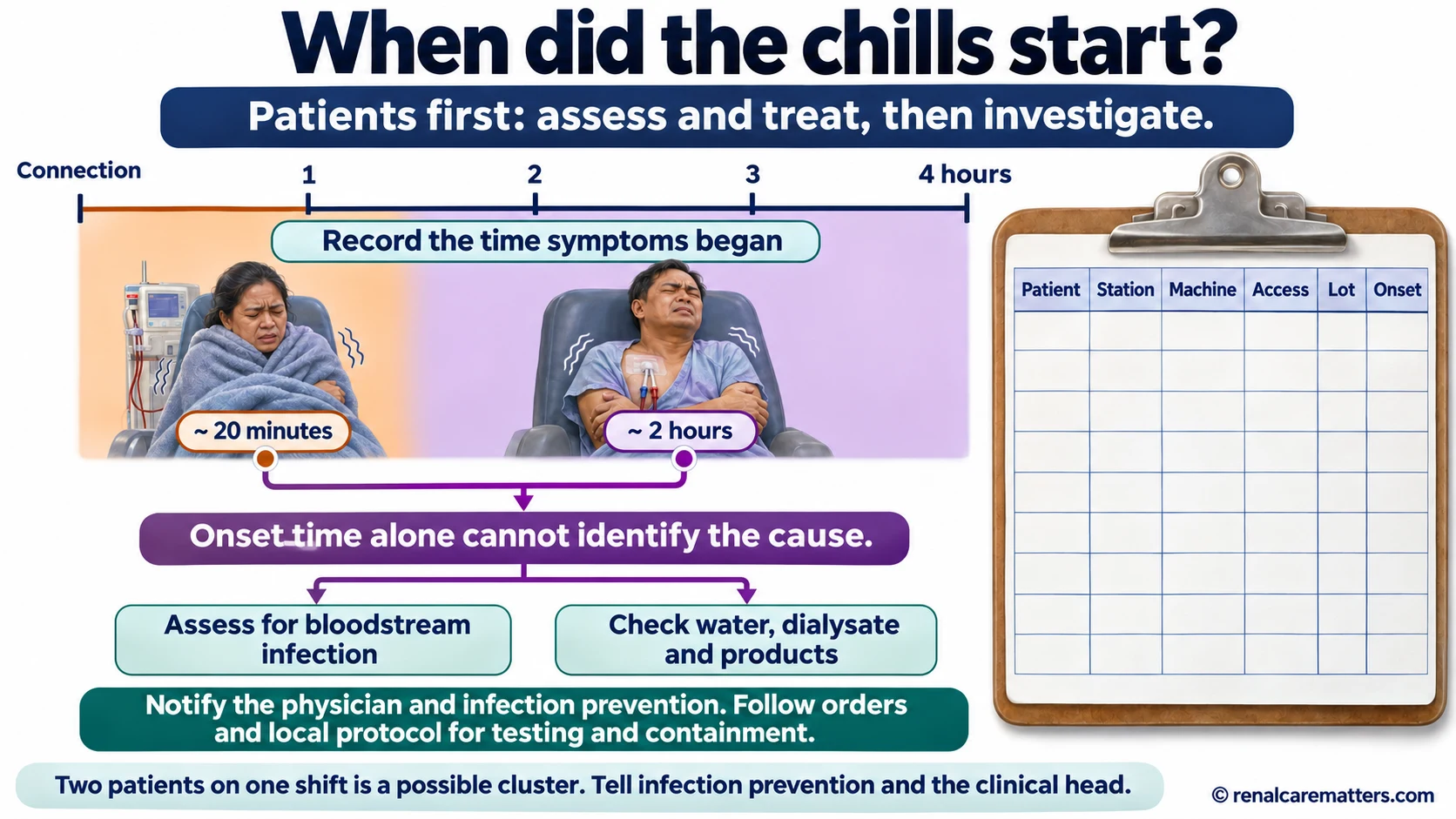
Two events on one shift may be chance. They may also be the first sign of a shared source. Patients come first, then the investigation, and the two run together.
Figure 6. When did the chills start? Timing points to the likely source and to whom you call, while the patient is cared for first.
Figure 7 · Possible cluster
PatientsAssess each patient. The physician orders cultures and treatment.
TimingChills in the first hour suggest a pyrogenic reaction from fluid or a product. Later onset suggests a bloodstream infection.
NotifyInfection prevention lead, the water or biomedical lead, the clinical head.
PreserveQuarantine new lots. Keep vials, concentrates, and lines. Record lot numbers.
Line listPatient, station, machine, access, nurse, medicines, lot numbers, time of onset.
DecideClinical leadership and infection prevention decide testing, case definition, and reporting.
Stop and callStop and call the attending nephrologist, the clinical head, and the infection prevention lead when more than one patient develops fever or chills on the same day. Tell the water or biomedical lead at once if onset was early in the session. Follow your unit’s protocol while you call.
On the floor
Real situations: problems and solutions
These are fictional but typical. For each one, cover the answer, decide what you would do, then compare. Where a step depends on local rules, your unit’s procedure and your supervisor’s direction come first.
The shared heparin vial
What you see
A multidose heparin vial is sitting on a machine top between two stations.
What is likely going on
It was carried out to save time.
What to do
Discard it, review medicine preparation with the team, and watch the next few preparations.
Why it matters
Shared vials have been traced in hepatitis C outbreaks.
The turnover squeeze
What you see
Stations are being wiped and set up for the next patient in under five minutes.
What is likely going on
The schedule leaves no time for the disinfectant’s contact time.
What to do
Change the schedule, not just the instruction.
Why it matters
When the schedule makes the process impossible, the schedule is the hazard.
The audit of ten
What you see
A nurse reports 100% hand hygiene from ten observations.
What is likely going on
The sample is too small to mean much.
What to do
Praise the effort and plan a sample of at least 30.
Why it matters
Ten observations have a very wide confidence interval.
Field notes
Watch, do not ask.
Post infection results monthly, without names.
Use the same case definition every month.
Case review
Back to the case: Chills on the same shift
First, and for whom? Both patients. Assess them, call the physician on duty, and follow orders for blood cultures and treatment. The physician decides whether to stop dialysis. Check the patient at station 5 and the others on the shift for symptoms.
Three groups of causes. Hands and hubs, a product, or water and dialysis fluid. Mr. Gomez’s chills began twenty minutes after connection, which points toward a pyrogenic reaction from fluid or a product. Mrs. Pascual’s began at two hours, which fits a bloodstream infection from the catheter. They may have different causes. Both catheter patients, and a new locking solution, keep the hub on the list. A new bicarbonate lot keeps the fluid on the list.
Record and preserve. Quarantine the new concentrate lot and the new locking solution. Keep the opened containers and the lines. Build the line list now, while staff remember. Notify the infection prevention lead and the water lead. Testing, case definitions, and any external report are decisions for the clinical head and infection prevention. Your part is to make sure the evidence still exists when they ask for it.
Skills lab · with your preceptor
Skills checklist: Observation audit and feedback
Observe a real or simulated shift for twenty minutes and give feedback to one nurse while your facilitator observes. Your preceptor rates each step as satisfactory, needs practice, or not observed. Steps marked Critical must all be satisfactory before sign-off. This checklist supports supervised learning; your unit’s own procedure and competency form are the authority. A printable version of every checklist is on the trainer page.
Positions herself to see several stations without interrupting care.
CriticalCounts each hand-hygiene opportunity and each one met, using a consistent definition.
CriticalObserves one catheter connection against the checklist, including hub scrubbing.
CriticalReports the result as a fraction and percentage, and states why a small sample is uncertain.
CriticalGives private feedback about one specific observed step, linked to patient risk.
Asks what made the correct step difficult.
Proposes one change to the setup or workflow.
CriticalCalculates a bloodstream infection rate with the correct denominator.
CriticalDescribes the first steps for a possible cluster, putting patient care first.
Placement activity. Run one hand-hygiene observation of at least 30 opportunities each week for four weeks. Post the results, without names, and discuss the trend with your facilitator.
Self-assessment
Check your understanding
Each visit draws 8 questions at random from this module’s 15-question bank. Choose the single best answer for each, then select Check answers; an explanation appears under the best answer. Select New set of questions for a different mix. A good target is 7 of 8 on two different sets. Nothing you select is sent anywhere; scoring happens in your browser.
Centers for Disease Control and Prevention. (n.d.). Dialysis safety: Core interventions. Retrieved November 23, 2026, from https://www.cdc.gov/dialysis-safety/hcp/clinical-safety/
Patel, P. R., Yi, S. H., Booth, S., Bren, V., Downham, G., Hess, S., Kelley, K., Lincoln, M., Morrissette, K., Lindberg, C., Jernigan, J. A., & Kallen, A. J. (2013). Bloodstream infection rates in outpatient hemodialysis facilities participating in a collaborative prevention effort: a quality improvement report. American Journal of Kidney Diseases, 62(2), 322–330. https://doi.org/10.1053/j.ajkd.2013.03.011
Pasilan, R. M., Tomacruz-Amante, I. D., & Dimacali, C. T. (2024). The epidemiology and microbiology of central venous catheter related bloodstream infections among hemodialysis patients in the Philippines: a retrospective cohort study. BMC Nephrology, 25(1), 331. https://doi.org/10.1186/s12882-024-03776-8
Hymes, J. L., Mooney, A., Van Zandt, C., Lynch, L., Ziebol, R., & Killion, D. (2017). Dialysis catheter-related bloodstream infections: A cluster-randomized trial of the ClearGuard HD antimicrobial barrier cap. American Journal of Kidney Diseases, 69(2), 220–227. https://doi.org/10.1053/j.ajkd.2016.09.014
Educational study material for nurses. Does not replace the attending nephrologist’s orders, the unit’s protocols, required training and certification, or supervised practice.