Nephrology Nursing Track · By Role · Module 4 of 13
Protecting the Access
Examining the fistula, graft, and catheter, why the alarm misses a dislodged needle, and the first minute of access bleeding.
PublishedNailathalaGipatikPepalwal:ReferencesMga SanggunianMga TinubdanReng Reperensya:8Audience: Head nurses and charge nurses in hemodialysis units · senior dialysis nurses preparing to lead · medical directors and nursing administrators who orient themRead timeOras ng pagbasaOras sa pagbasaOras ning pamamasa:
This module is study material for head nurses in hemodialysis units. It explains the reasoning behind common decisions; it is not a protocol. On the floor, follow your unit’s protocol and ask the attending nephrologist for guidance. Doses, limits, and cut-off values are set by your unit. Every case is fictional.
Learning objectives
After this module you should be able to
Examine a fistula, graft, and catheter, and name the findings that stop cannulation.
Explain how narrowing, clotting, and aneurysm change what you see, hear, and feel.
Explain why the venous pressure alarm can stay silent when a needle comes out.
Lead the first minute of access bleeding or needle dislodgement.
Summarize the Philippine and international evidence on catheter infection and how to reduce it.
Keep a list of patients on long-term catheters with a plan for each.
Pre-testBefore you read, answer the 8 self-assessment questions and note your score. After the module, select New set of questions and compare. The difference is what you learned; the questions you still miss are what to reread.
Start here
The big picture, in plain words
In plain wordsA fistula is a high-flow shortcut built into a low-flow arm. The pump takes 250 to 400 milliliters of blood a minute from it and returns the same amount through a second needle. If the return needle slips out and the pump keeps running, the pump empties the patient onto the floor at pump speed.
The picture has a limit. Water in a pipe has no defenses. The patient’s blood pressure falls as blood is lost, which brings its own danger, and the patient may not feel the needle move.
Figure 1 · Key terms for this module
Arteriovenous fistula (AVF)A direct connection between an artery and a vein, usually in the arm, made by a surgeon.
Arteriovenous graft (AVG)A synthetic tube joining an artery and a vein.
ThrillThe buzzing felt over a working access.
BruitThe sound heard over a working access with a stethoscope.
StenosisA narrowing in the access or its vein.
Venous needle dislodgement (VND)The return needle coming out of the vein during treatment.
Tunneled catheterA catheter that runs under the skin before entering a large vein in the neck or chest, with a cuff that anchors it.
Opening case · fictional
Case: The blanket
It is a cold afternoon, and Mrs. Imelda Santiago, 72, has asked for a blanket. It covers her left arm, where both fistula needles sit. At 3:20 her nurse, Ms. Grace Aquino, is charting observations at the next station. Mrs. Santiago says she feels faint. She looks pale. You notice that the sleeve of her blouse, just above the blanket, is dark and wet.
The machine is running at a blood flow of 350 mL/min. No alarm is sounding.
Before reading on, decide:
What do you do in the first sixty seconds, and in what order?
Why is no alarm sounding?
What will you change in the unit after Mrs. Santiago is safe?
Keep your answers in mind. The lesson gives you what you need, and the case review near the end shows one sound response.
Lesson · part 1
Examining the access before every cannulation
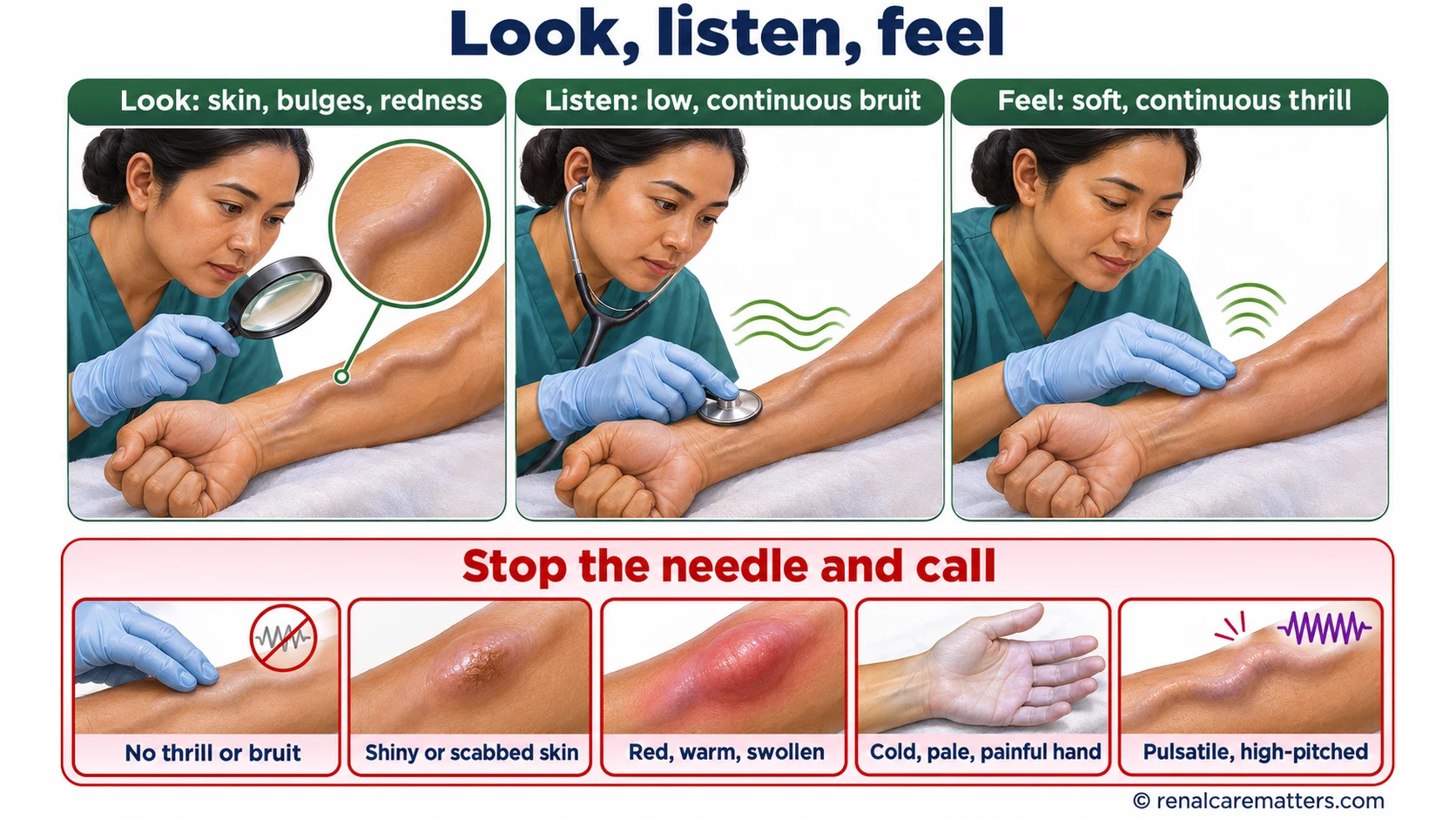
A healthy fistula has a soft, continuous thrill and a low-pitched bruit through the whole heartbeat. The vein collapses when the arm is raised. A narrowing changes all of this, and the change tells you where the narrowing is.
Figure 2. Look, listen, feel before every cannulation. An absent thrill, shiny skin over a bulge, or a cold hand stops the needle.
Finding
What it suggests
Pulsatile access, high-pitched bruit heard only in systole, vein does not collapse when the arm is raised, bleeding after needle removal lasts longer than usual, rising venous pressures
A mature fistula is often described by the rule of sixes: flow above 600 mL/min, diameter at least 6 millimeters, depth no more than 6 millimeters. The Kidney Disease Outcomes Quality Initiative (KDOQI) 2019 guideline moved away from “fistula first” toward an access plan built around each patient’s life, and it relies on regular physical examination by trained staff as the core of monitoring.1
On the floor · Twenty-five minutes of bleeding
Mr. Nestor Aguilar’s fistula has served him for four years. Over the past three weeks, his nurses have noticed that his needle sites bleed for 20 to 25 minutes after removal instead of the usual 10. His venous pressure at the same blood flow has crept from about 160 to about 210 mm Hg. The fistula now feels pulsatile, like a pulse rather than a buzz, and the vein stays full when he raises his arm.
Each finding alone could be dismissed. Together they point to one place: a narrowing downstream, on the outflow side, pushing pressure back into the access. The nurse who records the trend and raises it gives the nephrologist the chance to refer him for imaging and treatment of the narrowing while the fistula still works. The nurse who simply holds pressure longer each week waits for the morning it clots.
Illustrative scenario. Names and details are invented.
Stop and callStop and call the attending nephrologist before cannulation for an absent thrill or bruit, scabbed or shiny skin over an aneurysm, signs of infection, or a cold, painful hand. Do not cannulate through or beside a scabbed aneurysm. Follow your unit’s protocol while you call.
Lesson · part 2
Why the alarm may not sound
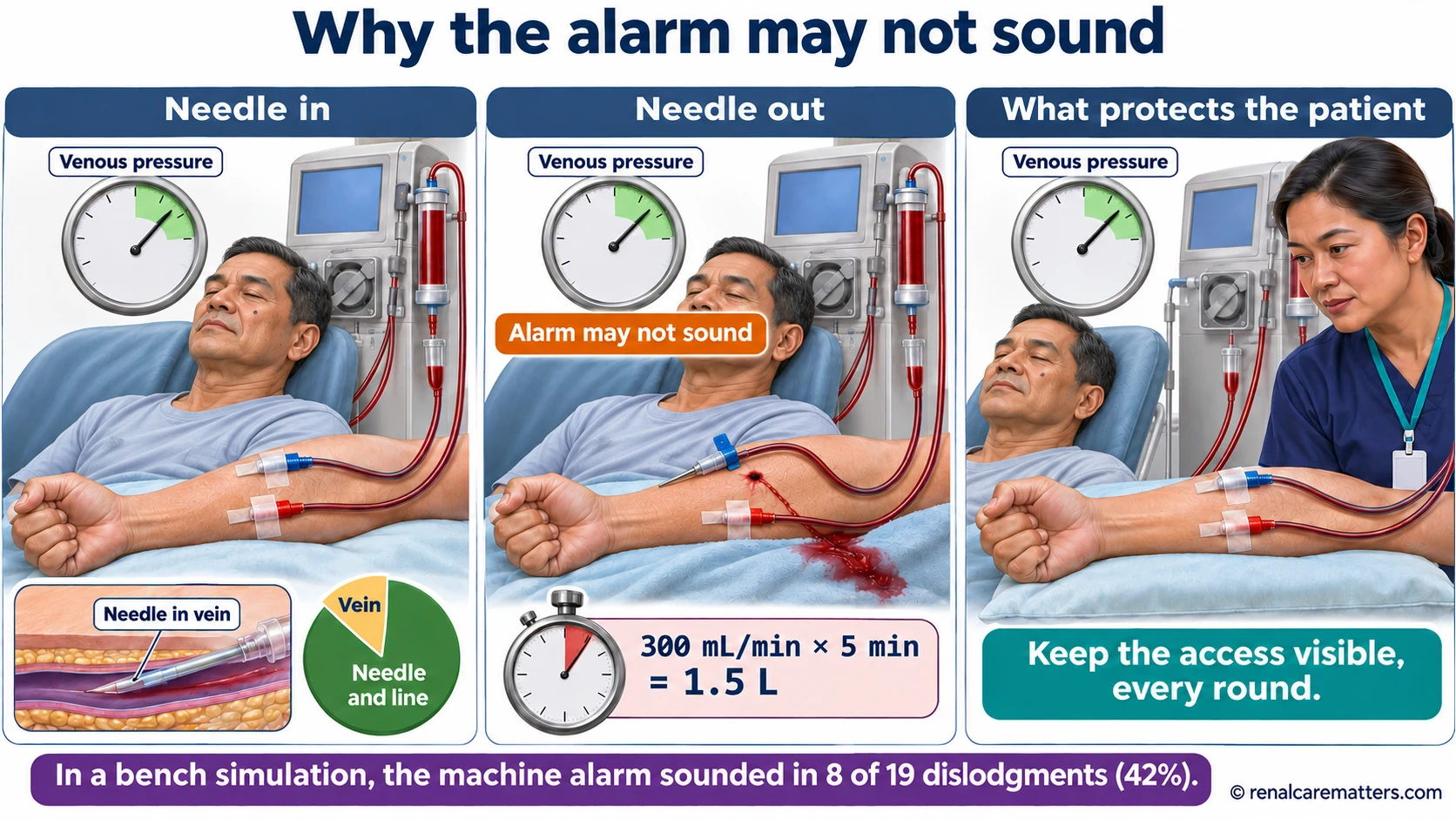
The venous pressure the machine reads comes mostly from the resistance of the needle and the line, not from the pressure inside the vein. When the needle slips out, that resistance is still there. The reading may fall only a little and stay inside the alarm window.
Figure 3. Why the venous pressure alarm can stay silent when a needle comes out. In a bench study it sounded in 8 of 19 dislodgments. Only an uncovered access is a reliable detector.
In a bench simulation of 19 needle dislodgements under different pressures and flows, the machine alarm sounded in only 8, or 42%.2 This was a simulation, not a study of patients, but it matches the experience of many units and the advice of the American Nephrology Nurses Association task force.3
Blood-loss clock. Pump speed (mL/min) × minutes unobserved. 350 mL/min × 4 minutes = 1,400 mL. For a 55-kg patient with about 3,850 mL of blood, that is more than a third.
The protection is human, not mechanical. No blanket over the access, ever. Lines taped by the unit’s method, with no tension. Venous alarm limits set close to the running pressure. And every observation round includes looking at the needle sites.
RememberThe only reliable detector of a dislodged needle is a nurse who can see the access.
Lesson · part 3
The first sixty seconds of access bleeding
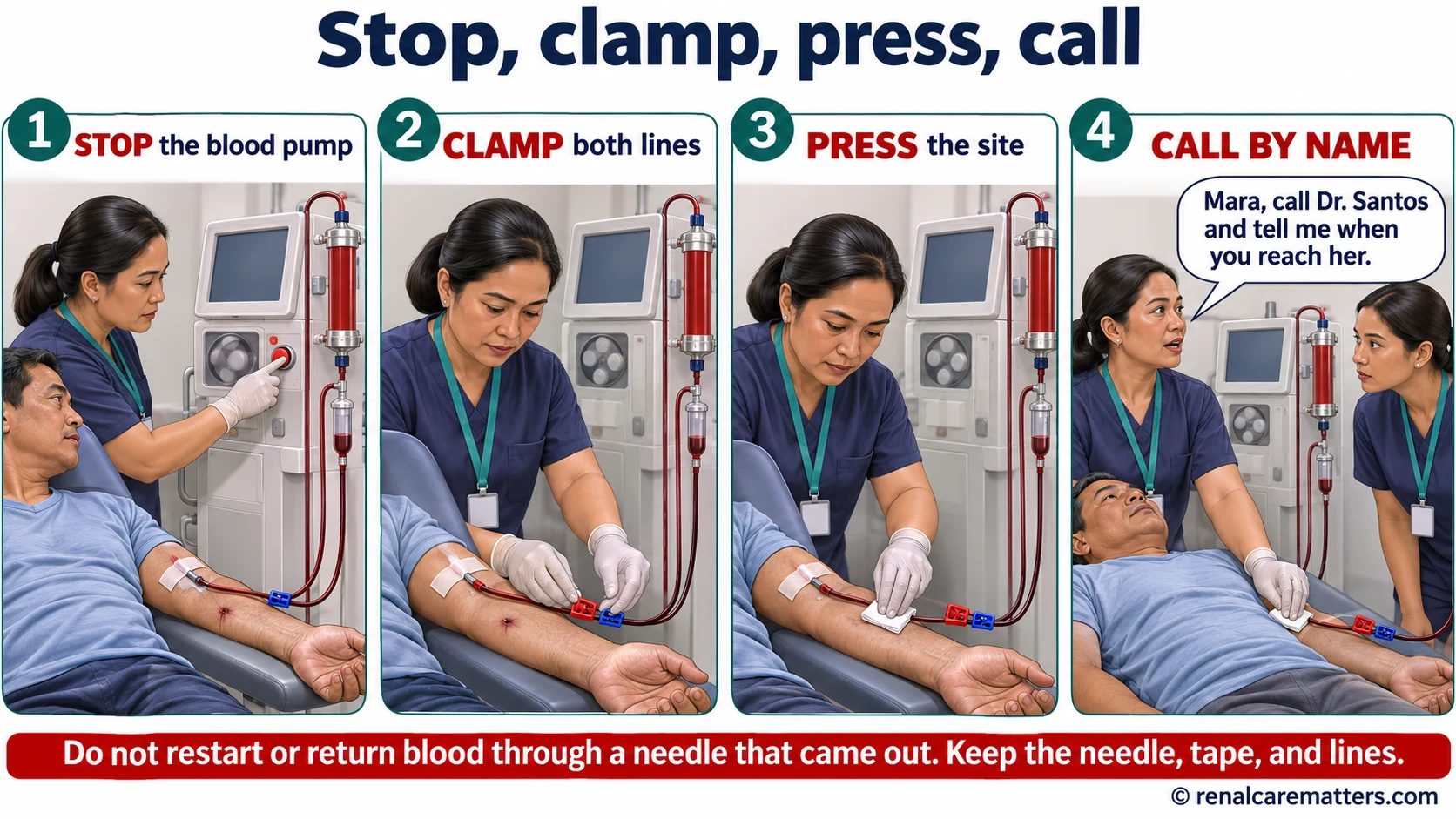
Figure 4. The first sixty seconds of access bleeding: stop, clamp, press, call by name.
Figure 5 · Access bleeding or needle dislodgement
StopStop the blood pump.
ClampClamp both lines near the access.
PressFirm, direct pressure on the site with gauze.
Call by name“Grace, call the physician on duty and tell me when you have reached him.”
Lay flatLay the patient flat and check pressure, pulse, and consciousness.
SaveKeep the needle, the tape, and the lines. Record the times.
Do not restart, and do not return blood through a needle that has been out of the vein. The physician decides whether and how the session continues. Module 7 covers the team roles when the bleeding is severe.
A ruptured aneurysm bleeds fast and does not stop easily. Teach patients and families to press hard with a clean cloth and call for emergency help.
On the floor · The drill that took 95 seconds
On a quiet Thursday, you run an unannounced drill with a practice arm and a circuit filled with colored water. You tell a nurse, “The venous needle is out. Go.” She looks for gauze first, then for gloves, then stops the pump. Ninety-five seconds pass before the pump stops. At 300 mL/min, that would have cost close to half a liter.
No one is blamed. You talk through the order: pump first, because the pump is what moves the blood. The gauze can wait the three seconds it takes to press a button. The next week, the same nurse stops the pump in under ten seconds. The drill takes five minutes and costs nothing. Repeated every month with different nurses, it turns a written flow into a reflex.
Illustrative scenario. Names and details are invented.
Lesson · part 4
Catheters: the access with the most infection
A catheter gives organisms a plastic surface on which to build a slimy layer called a biofilm. For catheters used for months, most bloodstream infections start inside the lumen, from the hub each time it is opened. That is why hub handling matters more than the dressing.
Unplanned starts are common in this region. About 70% of patients in lower and lower-middle income countries of South and Southeast Asia start hemodialysis without a prepared access.4 Many units therefore carry many catheters for many months.
Evidence
Finding
Strength and limits
Philippine single-center cohort
6.72 catheter-related bloodstream infections per 1,000 catheter-days, mortality 6.09%. Gram-negative organisms were most common, including Burkholderia cepacia complex, Enterobacter, and Acinetobacter. Using the catheter for transfusion or intravenous medicines was a risk factor5
One center. May not represent your unit
Antimicrobial barrier caps, United States
0.26 vs 0.59 positive blood cultures per 1,000 catheter-days with chlorhexidine-coated caps6. A second trial compared them with another connector system7
Cluster-randomized. Industry-linked. Check local availability and cost
Buttonhole versus rope-ladder cannulation
No consistent pain benefit in randomized trials, and more infection with buttonhole8
Systematic review
The gram-negative pattern in the Philippine cohort points toward water, solutions, and multidose containers as possible sources. That is an inference from the organisms, not a finding of the study. It is why Module 5 treats medicine preparation as part of access care.
The dialysis catheter is for dialysis. Using it for transfusion or other infusions needs an explicit order and the same aseptic technique.
On the floor · The transfusion overnight
Mr. Danilo Reyes, 60, dialyzes through a tunneled neck catheter. He was admitted overnight for anemia, and the ward ran a unit of blood through his dialysis catheter because his arm veins were hard to find. At his next session, 40 minutes after connection, he shivers and his temperature is 38.6 °C.
The nurse calls the physician, who orders blood cultures from the catheter and a vein and starts treatment. You record that the catheter was used for a transfusion, by whom, and when, because the Philippine cohort found exactly this to be a risk factor. Then you act on the system: a label on every dialysis catheter that reads “For dialysis only,” a note to the wards that refer patients to your unit, and a line in the discharge summary template. One infection is a patient event. A label prevents the next one.
Illustrative scenario. Names and details are invented.
Lesson · part 5
Keep a list of every long-term catheter
Each month, list every patient dialyzing through a catheter for more than 90 days. For each one, record the reason and the next step toward a permanent access: vein mapping, surgical referral, a maturing fistula, or a documented decision to stay with a catheter.
Catheter dependence = patients on a catheter more than 90 days ÷ all patients. 9 of 95 = 9.5%.
The list belongs to the nephrologists and the access surgeon as much as to you. Your contribution is to keep it current and to bring it to the monthly review, so that no catheter stays in by default.
On the floor · Seven months by default
At the monthly review, the catheter list shows that Mrs. Erlinda Castro has dialyzed through a catheter for seven months. Vein mapping was done in May. A referral to the access surgeon was written the same week. Nothing has happened since.
No one decided that Mrs. Castro should keep a catheter. The referral was simply lost between visits. When the nurse asks her, Mrs. Castro says she could not afford the surgeon’s fee and was embarrassed to say so. The nephrologist asks the social worker to help with coverage and a referral to a government hospital, and a fistula is created in September. Without the list, the eighth month and the ninth would have passed the same way.
Illustrative scenario. Names and details are invented.
On the floor
Real situations: problems and solutions
These are fictional but typical. For each one, cover the answer, decide what you would do, then compare. Where a step depends on local rules, your unit’s procedure and your supervisor’s direction come first.
The cold room
What you see
Several older patients ask for blankets on a cold morning.
What is likely going on
The room is cold and the access arms are being covered.
What to do
Offer blankets tucked below the elbow and warm the room. Keep every access visible.
Why it matters
The alarm may not sound when a needle comes out.
Bleeding that lasts
What you see
A patient’s needle sites now bleed for 25 minutes after removal. It used to be 10.
What is likely going on
A narrowing on the outflow side may be raising the pressure.
What to do
Tell the nephrologist the same day and check the venous pressure trend.
Why it matters
Prolonged bleeding is often the first sign of a stenosis.
The catheter used for a transfusion
What you see
A ward asks to run a blood transfusion through the dialysis catheter.
What is likely going on
It is the easiest line to reach.
What to do
Ask for an explicit order and use the same aseptic technique, or ask for another line.
Why it matters
Non-dialysis use of the catheter was a risk factor for infection in a Philippine cohort.
Field notes
Make “access visible” a line on the observation round sheet.
Keep a monthly list of every catheter older than 90 days, with a next step.
Teach every family direct pressure for a bleeding access.
Case review
Back to the case: The blanket
The first sixty seconds. Pull back the blanket and call for help in the same motion. Stop the blood pump, clamp both lines, and press hard on the site. Name your helpers: Ms. Aquino on the site, another nurse on Mrs. Santiago’s airway, pressure, and consciousness, someone to call the physician on duty, and one nurse to watch the other patients. Lay her flat. Do not return blood through the needle that came out.
Why no alarm? The venous pressure reading comes mostly from needle resistance, so it may stay inside its window after the needle leaves the vein. At 350 mL/min, a few unobserved minutes can cost more than a liter. Use the blood-loss clock to estimate how much, and tell the physician.
What changes? This is a system failure, not one nurse’s. Make “access visible” an item on the observation round sheet. Offer warmer alternatives that leave the arm uncovered: a blanket tucked below the elbow, a warmer room for older patients. Review taping and alarm-limit practice. Then measure: audit visible access at random times for a month (Module 11).
Skills lab · with your preceptor
Skills checklist: Access examination and bleeding response
Examine a fistula on a volunteer patient or model, then respond to a simulated dislodgement while your facilitator observes. Your preceptor rates each step as satisfactory, needs practice, or not observed. Steps marked Critical must all be satisfactory before sign-off. This checklist supports supervised learning; your unit’s own procedure and competency form are the authority. A printable version of every checklist is on the trainer page.
CriticalLooks at the skin, the arm, and the hand before touching.
CriticalFeels the thrill and listens to the bruit along the whole access.
Performs the arm elevation test and states what it shows.
CriticalNames each finding that stops cannulation.
CriticalRecognizes the simulated bleed without waiting for an alarm.
CriticalStops the pump, clamps both lines, and applies direct pressure in that order.
CriticalCalls for help by name and asks for a report back.
Lays the patient flat and checks pressure, pulse, and consciousness.
CriticalDoes not restart or return blood through the dislodged needle.
Estimates blood loss with the blood-loss clock.
Keeps the needle, tape, and lines and records the times.
Placement activity. For one month, check at random times whether every access on the floor is visible. Record the result per round and share it with the team weekly.
Self-assessment
Check your understanding
Each visit draws 8 questions at random from this module’s 15-question bank. Choose the single best answer for each, then select Check answers; an explanation appears under the best answer. Select New set of questions for a different mix. A good target is 7 of 8 on two different sets. Nothing you select is sent anywhere; scoring happens in your browser.
Lok, C. E., Huber, T. S., Lee, T., Shenoy, S., Yevzlin, A. S., Abreo, K., Allon, M., Asif, A., Astor, B. C., Glickman, M. H., Graham, J., Moist, L. M., Rajan, D. K., Roberts, C., Vachharajani, T. J., Valentini, R. P., & National Kidney Foundation. (2020). KDOQI Clinical Practice Guideline for Vascular access: 2019 update. American Journal of Kidney Diseases, 75(4 Suppl 2), S1–S164. https://doi.org/10.1053/j.ajkd.2019.12.001
Frinak, S., Kennedy, J., Zasuwa, G., Passalacqua, K. D., & Yee, J. (2023). Detection of hemodialysis venous needle dislodgment using venous access pressure measurements: A simulation study. Kidney360, 4(4), e476–e485. https://doi.org/10.34067/KID.0000000000000093
Speranza-Reid, J., Brouwer-Maier, D., Cruz, C. M., & Inglese, M. (2021). Venous needle dislodgement and access-bloodline separation. Nephrology Nursing Journal, 48(4), 347–365.
Ramachandran, R., Bhargava, V., Jasuja, S., Gallieni, M., Jha, V., Sahay, M., Alexender, S., Mostafi, M., Pisharam, J. K., Chi Wai, T. S., Jacob, C., Gunawan, A., Leong, G. B., Thwin, K. T., Agrawal, R. K., Vareesangthip, K., Tanchanco, R., Choong, L., Herath, C., . . . Vachharajani, T. (2022). Interventional nephrology and vascular access practice: A perspective from South and Southeast Asia. The Journal of Vascular Access, 23(6), 849–860. https://doi.org/10.1177/11297298211011375
Pasilan, R. M., Tomacruz-Amante, I. D., & Dimacali, C. T. (2024). The epidemiology and microbiology of central venous catheter related bloodstream infections among hemodialysis patients in the Philippines: a retrospective cohort study. BMC Nephrology, 25(1), 331. https://doi.org/10.1186/s12882-024-03776-8
Hymes, J. L., Mooney, A., Van Zandt, C., Lynch, L., Ziebol, R., & Killion, D. (2017). Dialysis catheter-related bloodstream infections: A cluster-randomized trial of the ClearGuard HD antimicrobial barrier cap. American Journal of Kidney Diseases, 69(2), 220–227. https://doi.org/10.1053/j.ajkd.2016.09.014
Brunelli, S. M., Van Wyck, D. B., Njord, L., Ziebol, R. J., Lynch, L. E., & Killion, D. P. (2018). Cluster-randomized trial of devices to prevent catheter-related bloodstream infection. Journal of the American Society of Nephrology, 29(4), 1336–1343. https://doi.org/10.1681/ASN.2017080870
Wong, B., Muneer, M., Wiebe, N., Storie, D., Shurraw, S., Pannu, N., Klarenbach, S., Grudzinski, A., Nesrallah, G., & Pauly, R. P. (2014). Buttonhole versus rope-ladder cannulation of arteriovenous fistulas for hemodialysis: a systematic review. American Journal of Kidney Diseases, 64(6), 918–936. https://doi.org/10.1053/j.ajkd.2014.06.018
Educational study material for nurses. Does not replace the attending nephrologist’s orders, the unit’s protocols, required training and certification, or supervised practice.