Nephrology Nursing Track · By Role · Module 3 of 13
The Order, the Machine, and the Record
How each line of the order works, the three-way check before connection, the dose of dialysis, and the minutes lost to short sessions.
PublishedNailathalaGipatikPepalwal:ReferencesMga SanggunianMga TinubdanReng Reperensya:7Audience: Head nurses and charge nurses in hemodialysis units · senior dialysis nurses preparing to lead · medical directors and nursing administrators who orient themRead timeOras ng pagbasaOras sa pagbasaOras ning pamamasa:
This module is study material for head nurses in hemodialysis units. It explains the reasoning behind common decisions; it is not a protocol. On the floor, follow your unit’s protocol and ask the attending nephrologist for guidance. Doses, limits, and cut-off values are set by your unit. Every case is fictional.
Learning objectives
After this module you should be able to
Explain diffusion, convection, and ultrafiltration, and link each line of the dialysis order to one of them.
Carry out a three-way check of order, machine, and patient before connection, and hold when they disagree.
Calculate the urea reduction ratio and single-pool Kt/V, and judge whether the blood sample was valid.
Summarize what the major trials of dose, time, temperature, and hemodiafiltration showed, including absolute effects.
Audit delivered time against prescribed time and find the sessions that lose the most.
Remove outdated documents that carry prescription details.
Pre-testBefore you read, answer the 8 self-assessment questions and note your score. After the module, select New set of questions and compare. The difference is what you learned; the questions you still miss are what to reread.
Start here
The big picture, in plain words
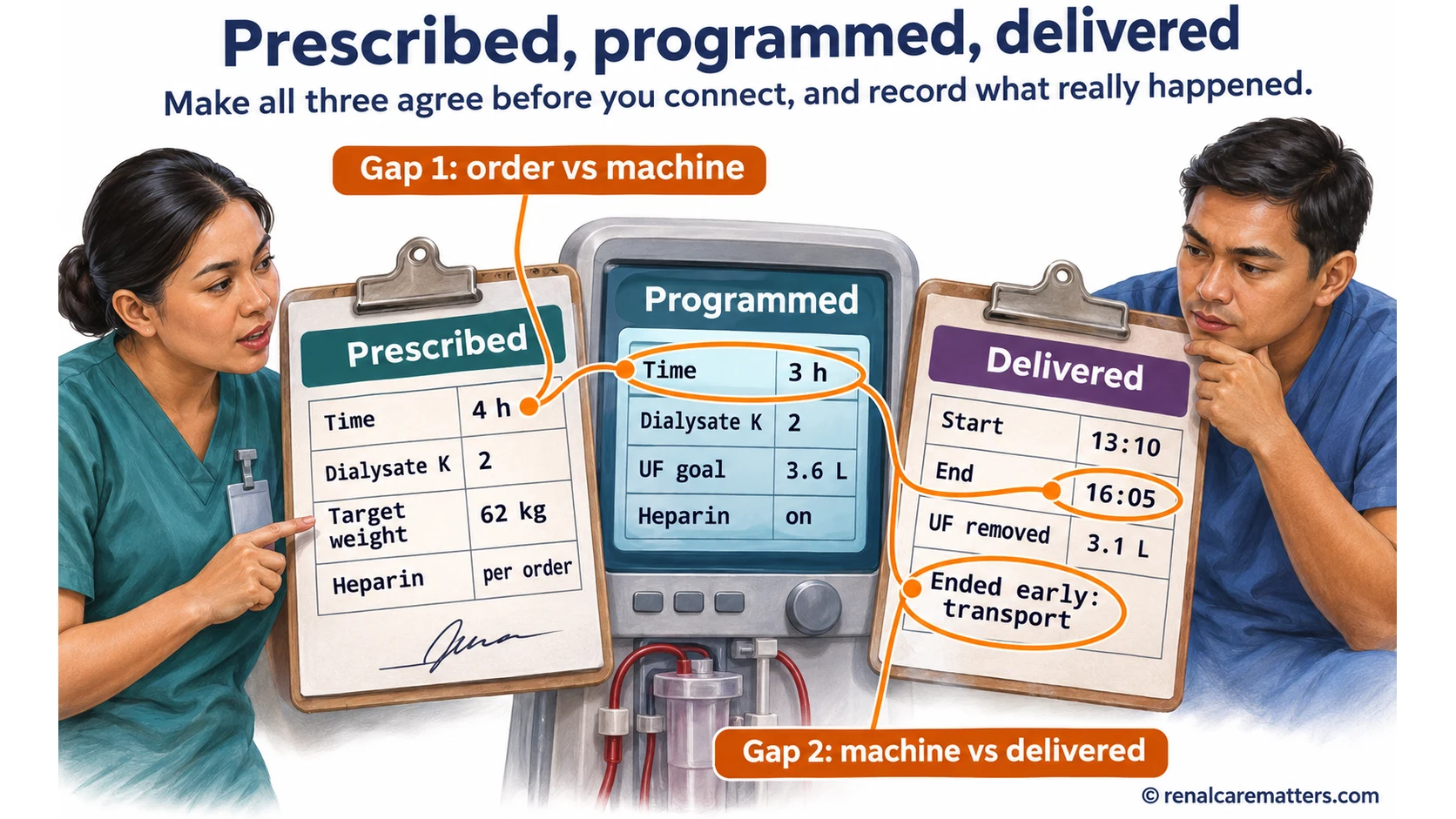
In plain wordsEvery session exists three times: what the physician prescribed, what the nurse programmed, and what the patient actually received. Harm lives in the gaps between them.
A wrong dialysis fluid potassium is a gap between the first and the second. A patient who leaves forty minutes early is a gap between the second and the third. Your job is to make all three visible on the same page.
Figure 1. Every session exists three times: as prescribed, as programmed, and as delivered. Harm lives in the gaps.
Figure 2 · Key terms for this module
DiffusionMovement of a dissolved substance from a high concentration to a low one across the membrane. It clears small molecules such as urea and potassium.
ConvectionSolutes dragged across the membrane with water. It clears larger “middle” molecules better than diffusion.
Hemodiafiltration (HDF)Dialysis that adds a large volume of convection, replaced with sterile fluid made on line.
Urea reduction ratio (URR)The fraction by which blood urea falls during a session.
Kt/VA measure of the dose of dialysis: clearance (K) times time (t), divided by the volume of body water (V).
Delivered timeThe minutes the patient actually received, not the minutes prescribed.
Opening case · fictional
Case: Three hours or four
At 1:10 in the afternoon, Mr. Arnel Cruz, a nurse with eight months in the unit, is ready to connect Mr. Romeo Dizon, 66. The signed order, dated two weeks ago, says four hours. The machine is set for three. Mr. Cruz shows you the handover sheet taped to the station, which also says three hours.
You look at the last month of records for the afternoon shift. Seven of Mr. Dizon’s twelve sessions were three hours. His last single-pool Kt/V, reported this week, was 1.08.
Before reading on, decide:
What do you do before Mr. Dizon is connected?
What do you look at before anyone changes his prescription because of the low Kt/V?
What system problem does this case reveal, and how will you fix it?
Keep your answers in mind. The lesson gives you what you need, and the case review near the end shows one sound response.
Lesson · part 1
What each line of the order does
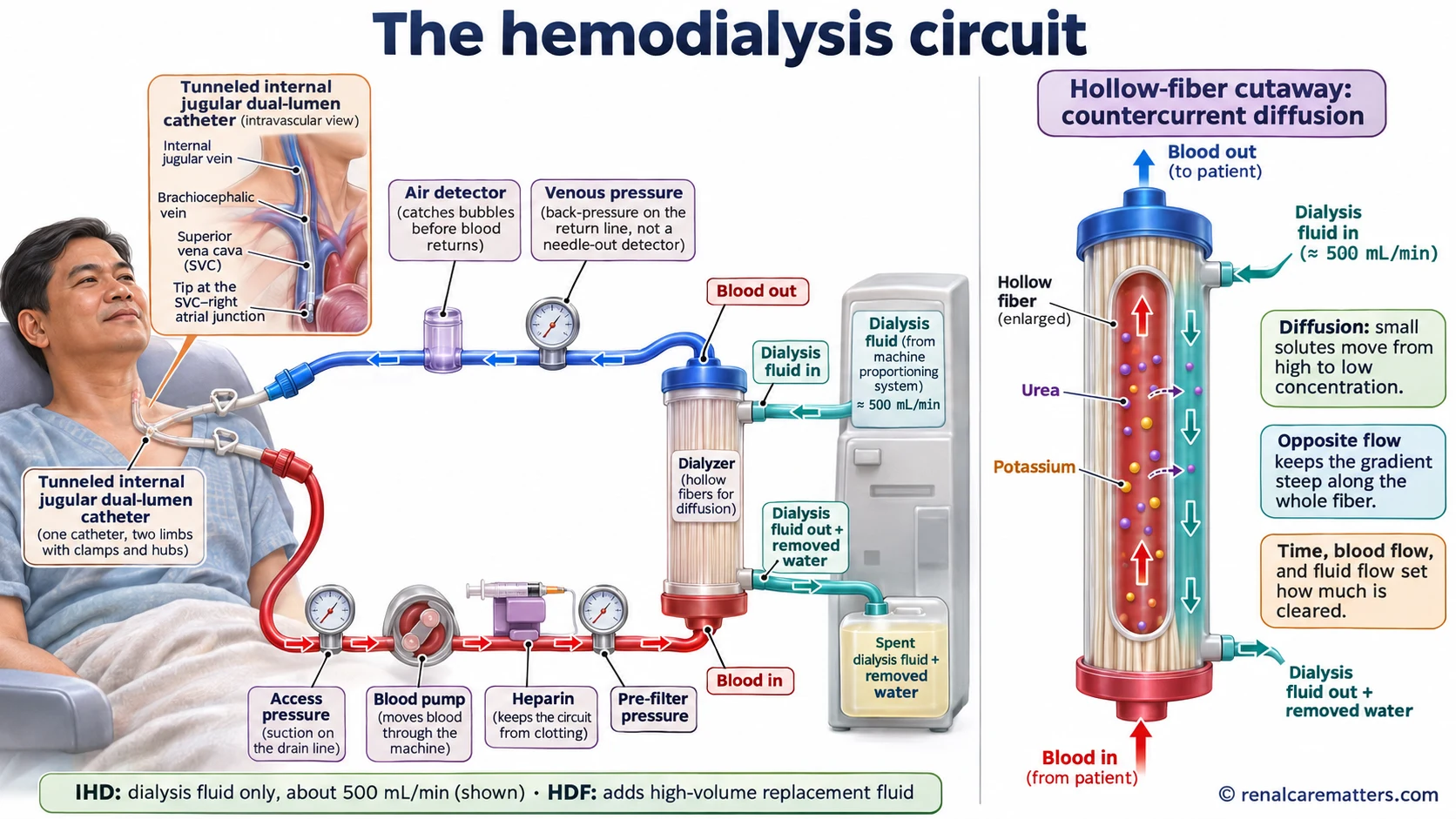
Blood leaves the patient, passes through thousands of hollow fibers in the dialyzer, and returns. Dialysis fluid flows around the fibers in the opposite direction, so the gradient stays steep along the whole fiber. Small molecules such as urea and potassium move from blood into the fluid by diffusion. Water is pushed out by pressure, which is ultrafiltration. Larger molecules are carried out with that water, which is convection.
Figure 3. The hemodialysis circuit. Solutes move from blood into the dialysis fluid, which flows the opposite way to keep the gradient along the whole fiber.
Line of the order
What it controls
What goes wrong when it is off
Time
Total clearance, and how gently water can be removed
Less dialysis. A faster ultrafiltration (UF) rate for the same fluid
Blood flow and dialyzer
Clearance per minute
Less dialysis. Strain on the access
Dialysis fluid potassium
The gradient pulling potassium out
Too low: a fast shift and arrhythmia. Too high: potassium left behind
Dialysis fluid sodium and temperature
Pressure stability and thirst
Low pressure, cramps, or more weight gain
Dry weight and UF goal
Volume
Low pressure, or overload that persists
Anticoagulation
Keeping the circuit open
Clotting and blood loss, or bleeding
Each of these is the prescriber’s decision. Your part is to make sure the machine carries out the order that exists today.
On the floor · A blood flow nobody chose
Mrs. Agnes Domingo’s order says a blood flow of 350 mL/min. For three weeks, her nurses have been running 250, because her fistula has been hard to needle and the arterial pressure alarms at higher flows. Each nurse made a reasonable decision on the day. No one decided it for the whole three weeks.
Less blood through the dialyzer each minute means less urea removed each minute, so her Kt/V falls. The alarms themselves were a message: a narrowing in her access, which is exactly what Module 4 teaches you to look for. The fix is not to quietly keep running 250. It is to record the actual flow and the reason at every session, so that the trend reaches the nephrologist and the access is examined.
Illustrative scenario. Names and details are invented.
Lesson · part 2
What the trials of dose, time, and modality showed
Dose. The Hemodialysis (HEMO) Study randomized 1,846 patients. Raising the dose from a single-pool Kt/V of 1.32 to 1.71 did not reduce deaths (relative risk 0.96; 95% confidence interval 0.84 to 1.10). High-flux membranes did not either.1 Since then the target has been a floor, not a race. The Kidney Disease Outcomes Quality Initiative (KDOQI) 2015 guideline recommends a target single-pool Kt/V of 1.4 per session for patients dialyzing three times a week, with a minimum delivered dose of 1.2.2 Below the floor, the usual causes are short delivered time, recirculation in the access, low blood flow, and a bad sample.
Time. Observational studies link longer sessions with better survival. The TiME trial randomized 266 units and 7,035 new patients, but the two groups received 216 and 207 minutes on average, a difference of nine minutes. It found no difference in death or admission and was stopped early.3 The trial could not answer its question because the groups barely differed. It is not evidence that time does not matter.
Cooler dialysis fluid. Cooling tightens the vessels and was expected to protect the heart. In MyTEMP, 84 centers were randomized to a cooler fluid policy or a standard one. Cardiovascular death or admission did not differ.4 Cooling may still help an individual patient with frequent low pressure. It is not a proven default for everyone.
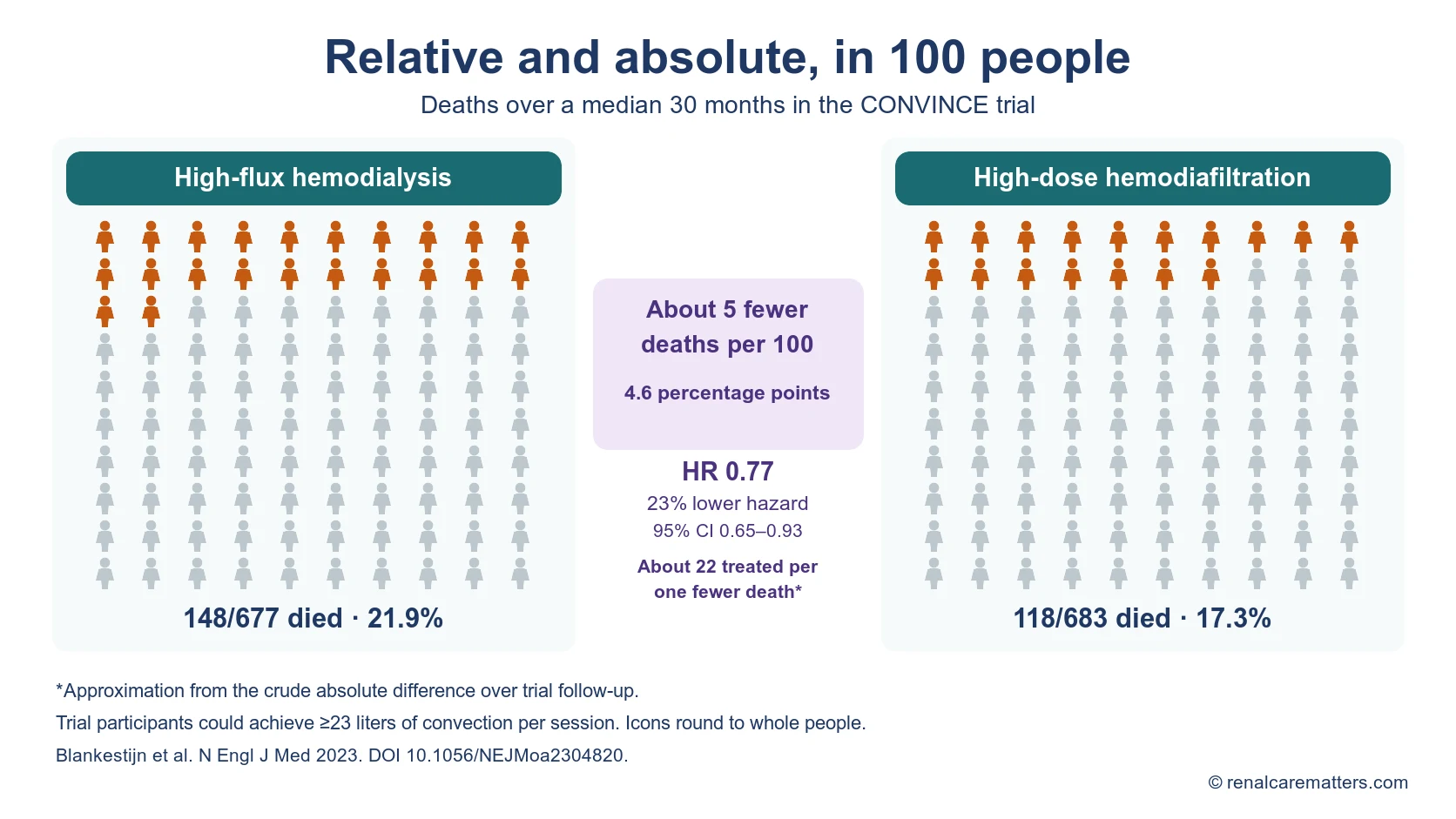
Hemodiafiltration. In Comparison of high-dose HDF with high-flux HD trial (CONVINCE), 1,360 patients able to reach a convection volume of at least 23 liters were randomized to high-dose HDF or high-flux hemodialysis. Over a median of 30 months, death from any cause occurred in 17.3% with HDF and 21.9% with hemodialysis (hazard ratio 0.77; 95% confidence interval 0.65 to 0.93).5 The absolute difference is 4.6 percentage points, so about 22 patients would need HDF for 30 months to prevent one death. Quality of life declined in both groups, more slowly with HDF.6 The benefit applies to high-volume HDF in patients with good access flow and requires ultrapure fluid (Module 6). A pooled analysis of the randomized trials is consistent with this.7
A trial comparing default dialysis fluid sodium of 137 and 140 mmol/L was still running on the review date. No default sodium is evidence-based yet.
On the floor · The brochure with the big number
Ms. Liza Ramos brings you a supplier’s brochure. “It says hemodiafiltration cuts deaths by 23%. Why aren’t we doing it for everyone?”
The 23% is the relative reduction from the CONVINCE trial. Turned into the absolute terms you just read, about 22 patients would need high-volume HDF for 30 months to prevent one death. The trial enrolled patients who could reach a high convection volume, which needs good access flow, and HDF needs ultrapure fluid and machines that can make it. So a fair answer is: “There is good trial evidence for high-volume HDF in patients who can reach the volume. Before we offer it, we need ultrapure water, compatible machines, and a way to choose who can reach the volume. Let me bring this to the clinical head with the water results.” That answer takes the evidence seriously without promising more than it shows.
Illustrative scenario. Names and details are invented.
Figure 4. Relative and absolute effects describe the same result. Deaths over about 30 months in the CONVINCE trial, in 100 people.
RememberWhen you report a trial to an administrator, give the absolute difference and who was eligible, not only the relative reduction.
Lesson · part 3
The three-way check before connection
Figure 5 · Before connection
IdentityTwo identifiers, checked against the order.
The orderThe current signed order. Check the date and version, not the handover sheet.
The machineRead the order aloud against the screen with a second nurse, as your double-check policy requires.
What is hungThe dialyzer and the concentrate actually on the machine.
The patientToday’s assessment from Module 2.
MismatchAny mismatch is a hold.
When the order and the screen disagree, the order governs, provided it is clear and current. When the order itself is unclear, incomplete, or seems wrong for the patient today, call the prescriber. Nurses do not resolve a discrepancy by choosing the value that seems more sensible.
During treatment, watch the trends, keep the access visible, and escalate chest symptoms, a change in consciousness, repeated low pressure, or bleeding under the approved algorithm. At disconnection, record actual minutes, actual fluid removed, the reason for any shortfall, bleeding control, post-treatment observations, and what the patient was told.
Stop and callStop and call the prescriber when the current order is unclear, incomplete, or appears unsafe for the patient today. Do not connect until the order is clarified. Follow your unit’s protocol while you call.
Lesson · part 4
Measuring the dose, and why the sample matters
Urea reduction ratio = (pre-dialysis urea − post-dialysis urea) ÷ pre-dialysis urea. From 60 to 18 mg/dL: (60 − 18) ÷ 60 = 70%.
Single-pool Kt/V (Daugirdas second-generation formula) = −ln(R − 0.008 × t) + (4 − 3.5 × R) × UF ÷ W where R = post ÷ pre urea, t = hours, UF = liters removed, W = post-dialysis weight in kg. R = 0.30, 4 hours, 3 L, 60 kg gives 1.46.
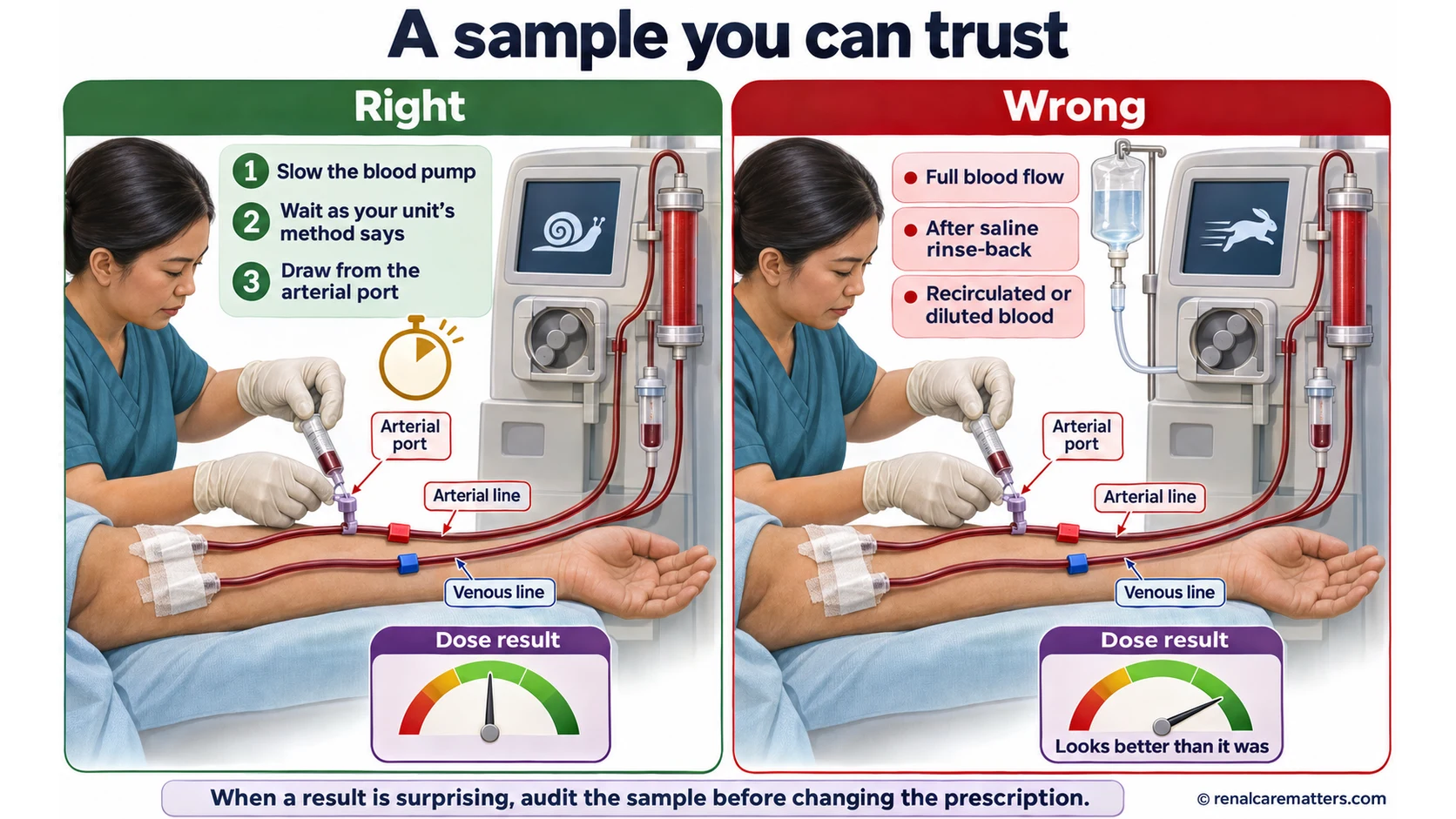
Figure 6. A dose result is only as good as the sample. A post-dialysis sample taken the wrong way makes the dose look better than it was.
On the floor · The Kt/V that was too good
Mr. Felipe Ocampo’s single-pool Kt/V has been between 1.10 and 1.18 for six months. This month it is 1.71. Nothing in his prescription changed.
A jump that large without a change in the order is more likely to be a sampling problem than better dialysis. You ask who drew the post-dialysis sample and how. A nurse in her second week drew it after the blood had been rinsed back with saline. The saline diluted the urea, which made the post value falsely low and the dose falsely high. The result is set aside, the sample is repeated by the unit’s method, and the new nurse’s sampling goes into her competency plan. Had anyone acted on the 1.71, they might have shortened a session that was already too short.
Illustrative scenario. Names and details are invented.
A result is only as good as the sample. The post-dialysis sample must be drawn by your unit’s slow-flow or stop-dialysate method. A sample drawn at full blood flow with recirculation, or after the blood has been rinsed back with saline, gives a falsely low urea and a falsely good dose. When a result is surprisingly good or surprisingly bad, audit the sampling before anyone changes the prescription.
Then look at time. Delivered minutes divided by prescribed minutes, for each patient and each shift. A unit average of 97% can hide one shift where a third of patients lose thirty minutes to late starts.
Arithmetic illustration. One hour off a four-hour session removes a quarter of the diffusion time. For the same fluid goal, it raises the UF rate by a third.
Lesson · part 5
Remove documents that carry old prescriptions
Old handover sheets, laminated cards, and notes taped to machines are a common source of wrong settings. They are written once and never updated, and they look official.
Anything that carries prescription details must be version-controlled or removed. The working document at the chair is the current signed order. If staff need a quick-reference card, it should come from the order, carry a date, and be replaced every time the order changes.
On the floor · The card on station 4
Station 4 has a laminated card listing the usual settings for the patients on that chair. It was made last year and looks official. One line says that Mr. Rogelio Santos uses a dialysis fluid potassium of 2 mmol/L. Three months ago, after a low potassium, his nephrologist changed the order to 3.
A busy nurse who glances at the card instead of the order will set up the old prescription, and the machine will deliver it without complaint. You remove the card that afternoon. If the staff want a quick-reference sheet, it is printed from the current orders, dated, and replaced every time an order changes.
Illustrative scenario. Names and details are invented.
RememberIf a piece of paper at the chair can disagree with the order, sooner or later it will.
On the floor
Real situations: problems and solutions
These are fictional but typical. For each one, cover the answer, decide what you would do, then compare. Where a step depends on local rules, your unit’s procedure and your supervisor’s direction come first.
The new potassium bath
What you see
The order was changed yesterday to a higher dialysis fluid potassium, but the concentrate hung is the old one.
What is likely going on
The supply at the station was not updated.
What to do
Hold, change the concentrate, and re-check against the order before connection.
Why it matters
The three-way check includes what is actually hung, not only what is on the screen.
The perfect Kt/V
What you see
A patient with a failing fistula has a Kt/V of 1.9 this month.
What is likely going on
The post-dialysis sample may have been drawn after rinse-back.
What to do
Ask how the sample was drawn and repeat it correctly before anyone celebrates.
Why it matters
A result that is too good to be true usually is.
Late starts every afternoon
What you see
The afternoon shift starts an average of 25 minutes late and patients still leave on time.
What is likely going on
Every patient loses time, and the fluid comes off faster.
What to do
Audit delivered time for the shift, find the cause of the delay, and fix the turnover.
Why it matters
Minutes lost are dose lost.
Field notes
The working document at the chair is the current signed order. Nothing else.
Quote trials to administrators with the absolute difference and who was eligible.
Audit sampling before anyone changes a prescription for a surprising dose result.
Case review
Back to the case: Three hours or four
Before connection. Hold. The signed order says four hours and is current. The machine and the handover sheet say three. The order governs, so the machine is set to four hours. You do not need to call the prescriber about the time, because the order is clear. You do need to tell the physician on duty about the low Kt/V and the shortened sessions today.
Before anyone changes the prescription. Look at the sampling first: how was the post-dialysis sample drawn, and by whom? Then look at time: seven of twelve sessions ran an hour short, which alone can explain a low dose. Check blood flow and access function. A higher blood flow or a bigger dialyzer would not fix a problem caused by an hour missing from every other session.
The system problem. An outdated handover sheet carried an old prescription, and nobody compared it with the order. Remove it through document control. Audit the afternoon shift’s delivered time for all patients, not only Mr. Dizon. Coach Mr. Cruz on the three-way check (Module 8) without blame: he did what the paper at the station told him to do. The fix belongs to the system.
Skills lab · with your preceptor
Skills checklist: Three-way check and session tracer
Perform the pre-connection check on a simulated patient, then trace one synthetic session through order, machine log, and nursing record. Your preceptor rates each step as satisfactory, needs practice, or not observed. Steps marked Critical must all be satisfactory before sign-off. This checklist supports supervised learning; your unit’s own procedure and competency form are the authority. A printable version of every checklist is on the trainer page.
CriticalConfirms identity with two identifiers against the order.
CriticalConfirms the order is current by its date and version.
CriticalReads each line of the order aloud against the machine screen with a second nurse.
Checks the dialyzer and concentrate actually hung.
CriticalHolds the start when any value disagrees.
CriticalCalls the prescriber when the order itself is unclear, and does not choose a value herself.
Calculates URR and single-pool Kt/V from synthetic values.
CriticalStates how the post-dialysis sample should be drawn and how a wrong method changes the result.
Calculates delivered time as a percentage and names the sessions that lost 30 minutes or more.
Identifies at least one document at the station that could carry an outdated prescription.
Placement activity. Audit delivered minutes for one shift for two weeks. Present the percentage, the sessions that lost 30 minutes or more, and their reasons to your facilitator.
Self-assessment
Check your understanding
Each visit draws 8 questions at random from this module’s 15-question bank. Choose the single best answer for each, then select Check answers; an explanation appears under the best answer. Select New set of questions for a different mix. A good target is 7 of 8 on two different sets. Nothing you select is sent anywhere; scoring happens in your browser.
Eknoyan, G., Beck, G. J., Cheung, A. K., Daugirdas, J. T., Greene, T., Kusek, J. W., Allon, M., Bailey, J., Delmez, J. A., Depner, T. A., Dwyer, J. T., Levey, A. S., Levin, N. W., Milford, E., Ornt, D. B., Rocco, M. V., Schulman, G., Schwab, S. J., Teehan, B. P., . . . Hemodialysis (HEMO) Study Group. (2002). Effect of dialysis dose and membrane flux in maintenance hemodialysis. New England Journal of Medicine, 347(25), 2010–2019. https://doi.org/10.1056/NEJMoa021583
National Kidney Foundation. (2015). KDOQI clinical practice guideline for hemodialysis adequacy: 2015 update. American Journal of Kidney Diseases, 66(5), 884–930. https://doi.org/10.1053/j.ajkd.2015.07.015
Dember, L. M., Lacson, E., Brunelli, S. M., Hsu, J. Y., Cheung, A. K., Daugirdas, J. T., Greene, T., Kovesdy, C. P., Miskulin, D. C., Thadhani, R. I., Winkelmayer, W. C., Ellenberg, S. S., Cifelli, D., Madigan, R., Young, A., Angeletti, M., Wingard, R. L., Kahn, C., Nissenson, A. R., . . . Landis, J. R. (2019). The TiME trial: A fully embedded, cluster-randomized, pragmatic trial of hemodialysis session duration. Journal of the American Society of Nephrology, 30(5), 890–903. https://doi.org/10.1681/ASN.2018090945
MyTEMP writing committee. (2022). Personalised cooler dialysate for patients receiving maintenance haemodialysis (MyTEMP): a pragmatic, cluster-randomised trial. The Lancet, 400(10364), 1693–1703. https://doi.org/10.1016/S0140-6736(22)01805-0
Blankestijn, P. J., Vernooij, R. W. M., Hockham, C., Strippoli, G. F. M., Canaud, B., Hegbrant, J., Barth, C., Covic, A., Cromm, K., Cucui, A., Davenport, A., Rose, M., Török, M., Woodward, M., Bots, M. L., & CONVINCE Scientific Committee Investigators. (2023). Effect of hemodiafiltration or hemodialysis on mortality in kidney failure. New England Journal of Medicine, 389(8), 700–709. https://doi.org/10.1056/NEJMoa2304820
Rose, M., Fischer, F. H., Liegl, G., Strippoli, G. F. M., Hockham, C., Vernooij, R. W. M., Barth, C., Canaud, B., Covic, A., Cromm, K., Cucui, A. M., Davenport, A., Fischer, K. I., Hegbrant, J., Jaha, H., Schappert, A., Török, M., Woodward, M., Bots, M. L., . . . CONVINCE Scientific Committee and CONVINCE Investigators. (2024). The CONVINCE randomized trial found positive effects on quality of life for patients with chronic kidney disease treated with hemodiafiltration. Kidney International, 106(5), 961–971. https://doi.org/10.1016/j.kint.2024.07.014
Vernooij, R. W. M., Hockham, C., Strippoli, G., Green, S., Hegbrant, J., Davenport, A., Barth, C., Canaud, B., Woodward, M., Blankestijn, P. J., Bots, M. L., CONVINCE Scientific Committee, & HDF Pooling Project Investigators. (2024). Haemodiafiltration versus haemodialysis for kidney failure: an individual patient data meta-analysis of randomised controlled trials. The Lancet. https://doi.org/10.1016/S0140-6736(24)01859-2
Educational study material for nurses. Does not replace the attending nephrologist’s orders, the unit’s protocols, required training and certification, or supervised practice.