Nephrology Nursing Track · By Role · Module 2 of 13
Reading Trends Across Sessions
What builds up between sessions, why fast fluid removal drops pressure, which findings need action now, and how to close a result loop.
PublishedNailathalaGipatikPepalwal:ReferencesMga SanggunianMga TinubdanReng Reperensya:8Audience: Head nurses and charge nurses in hemodialysis units · senior dialysis nurses preparing to lead · medical directors and nursing administrators who orient themRead timeOras ng pagbasaOras sa pagbasaOras ning pamamasa:
This module is study material for head nurses in hemodialysis units. It explains the reasoning behind common decisions; it is not a protocol. On the floor, follow your unit’s protocol and ask the attending nephrologist for guidance. Doses, limits, and cut-off values are set by your unit. Every case is fictional.
Learning objectives
After this module you should be able to
Explain what builds up between sessions, and why the first session after the weekend carries the most risk.
Explain why removing fluid faster than the tissues can refill the blood lowers blood pressure.
Calculate interdialytic weight gain and the fluid removal rate, and say what each number means.
Sort a pre-dialysis finding into Now, Today, or This month, and act at the right speed.
Summarize what the evidence shows about missed sessions, fast fluid removal, and low pressure during dialysis.
Close a critical result loop so that a named person owns the next step.
Pre-testBefore you read, answer the 8 self-assessment questions and note your score. After the module, select New set of questions and compare. The difference is what you learned; the questions you still miss are what to reread.
Start here
The big picture, in plain words
In plain wordsA healthy kidney adjusts all day, like a thermostat. Thrice-weekly dialysis adjusts in three short bursts, like switching on the air conditioner for four hours and off for forty-four. Between bursts, everything the kidney would have cleared builds up.
The picture has a limit. A room tolerates fast cooling. A patient does not tolerate fast fluid removal, because water leaves the blood faster than the tissues can refill it.
Figure 1 · Key terms for this module
Interdialytic weight gain (IDWG)Weight gained between the end of one session and the start of the next. Almost all of it is water.
Dry weightThe target weight at the end of a session, set by the attending nephrologist.
Ultrafiltration (UF)Removal of water from the blood by pressure across the dialyzer membrane.
UF rateFluid removed per hour per kilogram of body weight, in mL/h/kg.
Plasma refillingMovement of water from the tissues back into the blood vessels as the machine removes it.
Nadir pressureThe lowest systolic pressure recorded during a session.
Critical resultA laboratory value that needs a clinician’s decision within a set time under the unit’s policy.
Opening case · fictional
Case: Monday, station 9
Mrs. Teresita Villanueva, 58, dialyzes on Mondays, Wednesdays, and Fridays through a left forearm fistula. She missed Friday because her son’s tricycle broke down. Today she says she could not lie flat last night and her heart “keeps jumping.” Her weight is 3.4 kilograms above her dry weight of 60 kilograms, about what she usually gains over a weekend.
In the chart, a potassium result from Thursday’s routine blood test is flagged critical. There is no note that anyone called a physician about it. Her daughter asks, “She missed Friday. Can she just stay an hour longer today?”
Before reading on, decide:
Which lane does this belong in, and what do you do first?
Why is her near-usual weight gain not reassuring?
What does the daughter’s request need before anyone answers it?
Keep your answers in mind. The lesson gives you what you need, and the case review near the end shows one sound response.
Lesson · part 1
What builds up between sessions
Water and salt. Without urine, every glass of water and every salty meal stays in the body. It goes first into the blood, then into the tissues. Blood pressure rises, then the pressure in the lung capillaries. Breathlessness when lying flat is fluid until proven otherwise, even when the scale looks familiar. A patient who has lost muscle during an illness is overloaded at an unchanged dry weight, because the dry weight no longer fits the body.
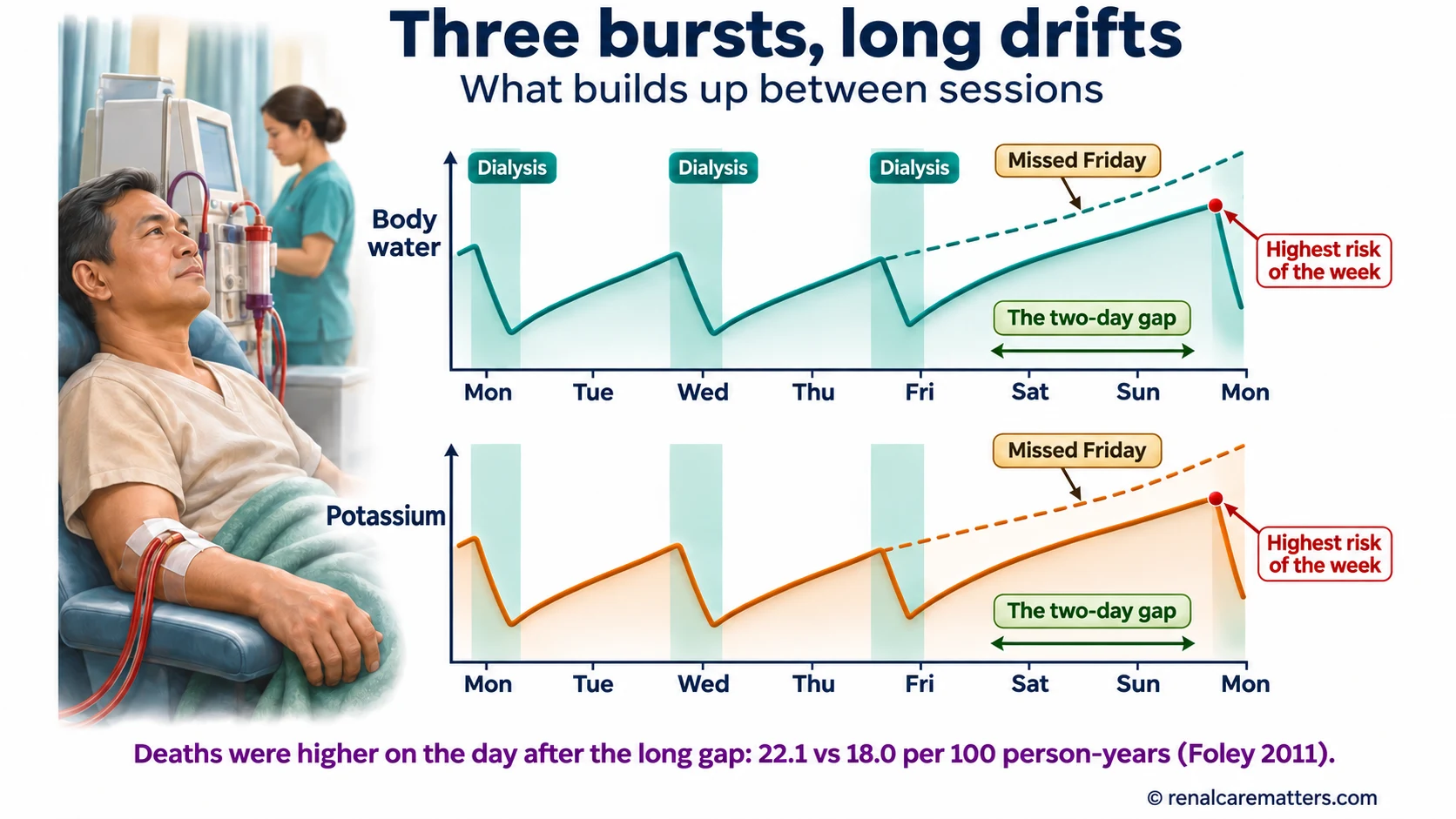
Potassium. Almost all potassium removal now depends on dialysis. The level rises across the gap and peaks before the first session of the week. A missed session, potassium-rich food, constipation, and acidosis push it higher. A high potassium makes the heart’s electrical system unstable. It may cause weakness or palpitations, or nothing at all, before an arrhythmia.
Figure 2. Three short bursts of dialysis, long drifts between them. The highest point of the week comes before the first session after the weekend.
The long gap shows up in deaths. In a large United States cohort of patients on thrice-weekly dialysis, all-cause mortality on the day after the two-day gap was 22.1 per 100 person-years, against 18.0 on other days. Deaths from cardiac causes and admissions for heart attack were also higher.1 This is an observational finding, but it is large, consistent, and fits the physiology.
Missing a session makes it worse. In the international Dialysis Outcomes and Practice Patterns Study (DOPPS), missed sessions were associated with 68% higher mortality. The risk of missing ranged from under 1% in Italy and Japan to 24% in the United States, and longer travel time and depressive symptoms predicted it.2 A fiftyfold difference between countries means that much of the problem lies in systems, not in patients. Module 9 returns to this.
On the floor · The dry weight that stopped fitting
Mr. Benjamin Torres, 71, spent two weeks in hospital with pneumonia and returns to dialysis on Wednesday. His weight is 61.2 kilograms, just above his dry weight of 61 kilograms. By the scale, he has almost no fluid to remove.
But his ankles are swollen, and he props himself on two pillows to breathe. During the admission he lost muscle and fat. The tissue is gone, so the same weight now carries more water. The dry weight was right for the body he had a month ago. It is not right for the body he has now. The nurse who reads only the scale will remove almost nothing. The nurse who examines him raises it as a Today finding, and the nephrologist sets a new, lower dry weight.
Illustrative scenario. Names and details are invented.
RememberMonday is the most dangerous day of the week for a Monday-Wednesday-Friday patient, and the patient who missed Friday is the most dangerous patient on Monday.
Lesson · part 2
Why fast fluid removal drops the pressure
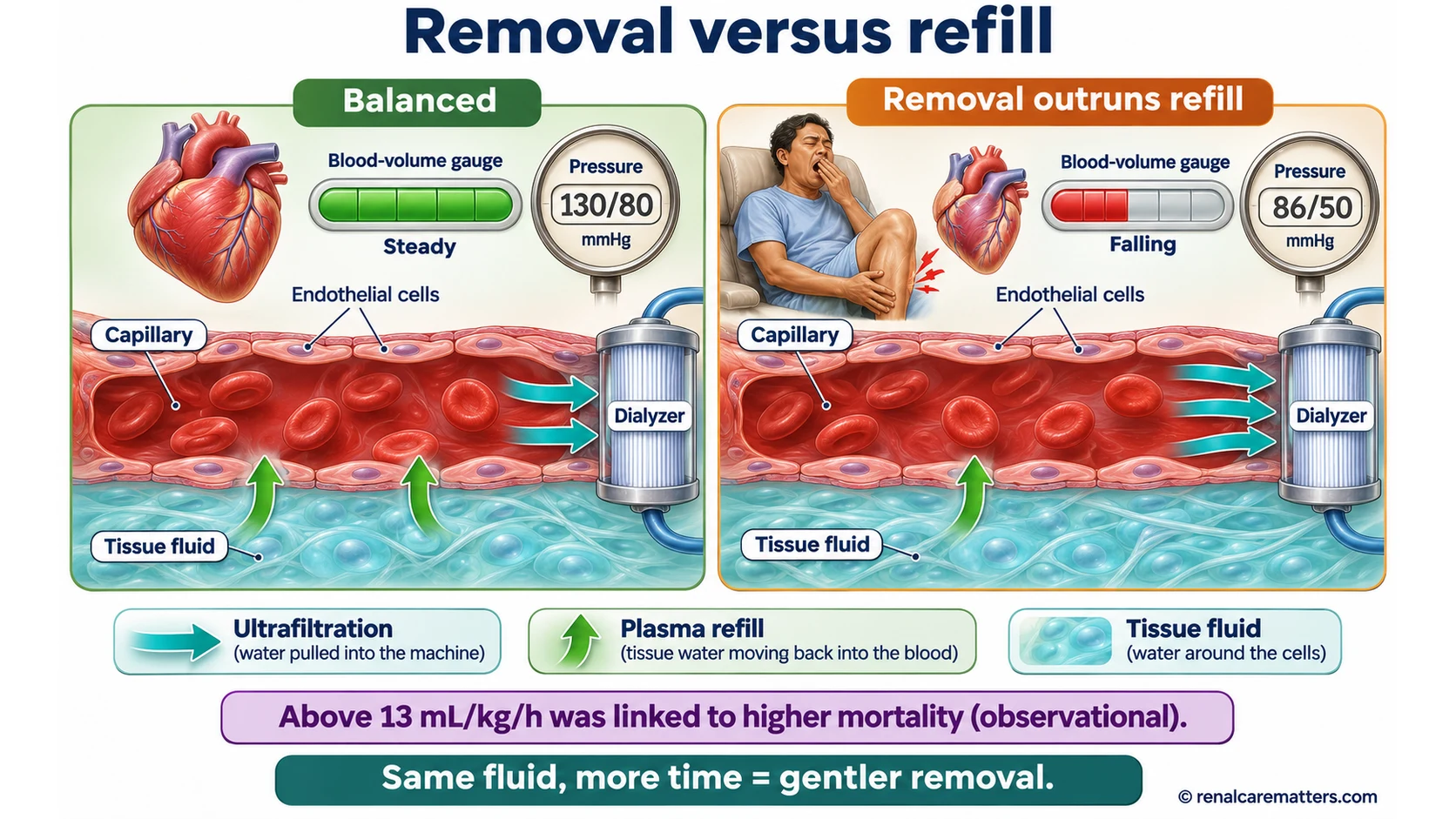
The machine removes water only from the blood. The tissues must refill the blood as it goes. Refilling has a speed limit, and the limit differs between patients. When removal outruns refilling, blood volume falls, the heart fills less, and the pressure drops. The patient yawns, cramps, feels sick, or goes quiet.
Figure 3. When removal outruns refill, blood volume falls and the pressure follows. The same fluid over more time is gentler.
The body defends itself by tightening the vessels and speeding the heart. Many dialysis patients have weaker defenses: diabetic nerve damage, a thick or stiff heart, or blood pressure tablets taken that morning. Module 7 covers what happens when the defenses fail.
Repeated drops in pressure may injure the heart and gut over time. Imaging studies show parts of the heart muscle working less well during sessions. This link between repeated episodes and lasting damage is a reasonable hypothesis, not a proven chain.
Finding
Data
Strength and limits
Fast fluid removal
Above 13 mL/h/kg, compared with 10 or less, was associated with 59% higher all-cause and 71% higher cardiovascular mortality. Risk began to rise above 103
Observational data from a trial cohort. Large weight gains may explain part of it
Low pressure during dialysis
A nadir systolic below 90 mm Hg was the definition most strongly associated with death. If the session started at 160 or more, below 100 was4
Observational
Recovery time
One patient in ten needed more than 12 hours to recover after a session. Longer recovery was associated with greater weight loss during dialysis, hospital admission, and death5
Observational
Lung ultrasound to guide dry weight
In a trial of 367 high-risk patients, it cleared more lung congestion but did not reduce death, heart attack, or heart failure (hazard ratio 0.88; 95% confidence interval 0.63 to 1.24)6. A smaller trial showed smaller heart chambers7
Randomized. Benefit shown on images, not on outcomes patients feel
No trial has shown that capping the fluid removal rate at any number saves lives. The numbers 10 and 13 are flags for a conversation with the nephrologist, not limits for the nurse to enforce.
Arithmetic illustration, not a target. UF rate = fluid to remove (mL) ÷ hours ÷ weight (kg). 3,400 mL over 4 hours in a 60-kg patient = about 14 mL/kg/h. The same 3,400 mL over 3 hours = about 19 mL/kg/h.
On the floor · Same fluid, different patients
Two patients on the same afternoon shift each need 3,000 mL removed over four hours. Mrs. Lourdes Navarro weighs 45 kilograms. Mr. Eduardo Salcedo weighs 80 kilograms.
For Mrs. Navarro, 3,000 ÷ 4 ÷ 45 = about 17 mL/kg/h. For Mr. Salcedo, 3,000 ÷ 4 ÷ 80 = about 9 mL/kg/h. The same goal on the screen asks almost twice as much of the smaller patient’s refilling. This is why the number is worth calculating. It does not tell you what to do. It tells you that Mrs. Navarro’s goal should go to the nephrologist before connection, with her blood pressure history, so that the prescriber can decide on more time, an extra session, or a different goal.
Illustrative scenario. Names and details are invented.
Lesson · part 3
Sort every finding into a lane
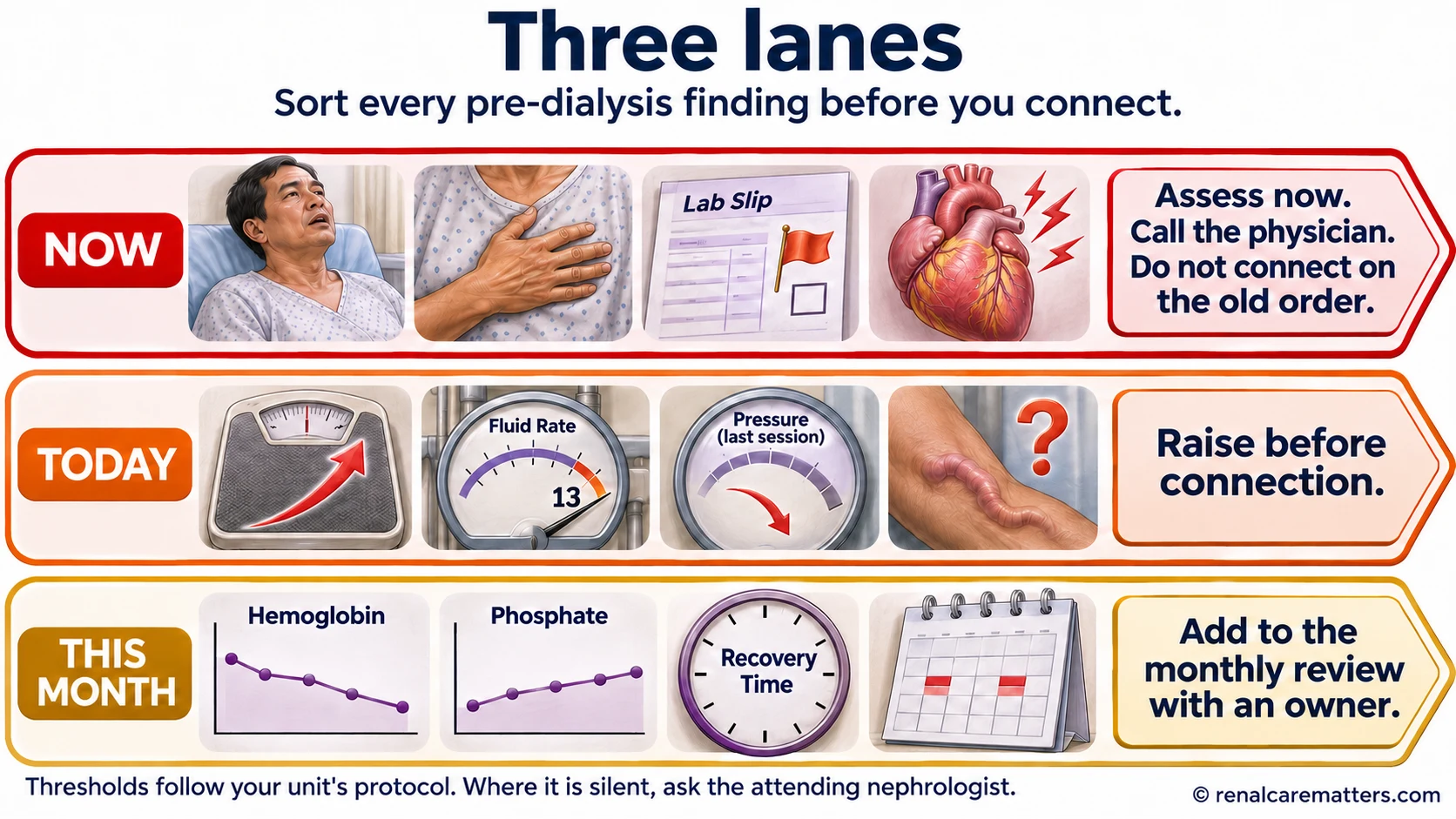
A pre-dialysis assessment produces many findings. The skill is to decide how fast each one needs action.
Figure 4. Sort every finding into one of three lanes. The lane decides how fast you act and whom you call.
Lane
Examples
What you do
Now
New breathlessness at rest, chest pain, confusion, palpitations or weakness after a missed session, a critical result with no documented call
Assess at once. Call the physician. Do not connect on the old order until the physician has seen the patient or given an order
Today
Weight gain well above the patient’s usual, a planned UF rate above 13 mL/h/kg, a nadir below 90 mm Hg last session, a change in the access
Raise it before connection. Longer time, an extra session, or a new dry weight are the prescriber’s options
This month
Hemoglobin drifting, phosphate rising, albumin falling, recovery time lengthening, two shortened sessions
Add it to the monthly review list with an owner
The thresholds for “Now” follow your unit’s protocol. Where the protocol is silent, ask the attending nephrologist.
For anemia, the Kidney Disease: Improving Global Outcomes (KDIGO) 2026 guideline replaced the 2012 edition. For patients on hemodialysis, it suggests weighing the benefits and risks of starting an erythropoiesis-stimulating agent when hemoglobin is 9 to 10 g/dL or below, once iron deficiency and other causes are addressed, and pausing intravenous iron during active infection.8 Use your unit’s adopted targets for maintenance ranges.
On the floor · Sorting three findings at 6:15
Before the first connection, a nurse brings you three findings. Mr. Ronaldo Pascual’s potassium from yesterday’s blood test is 7.1 mmol/L. Mrs. Celia Bautista has gained 4.2 kilograms over the weekend, a planned UF rate of 16 mL/kg/h. And Mr. Jose Manalo’s hemoglobin has drifted from 10.4 to 9.6 g/dL over two months.
The laboratory flagged the potassium as critical, so it goes to the Now lane: a physician decides before Mr. Pascual connects. Mrs. Bautista’s goal is a Today finding, raised before connection. Mr. Manalo’s hemoglobin is a This month finding: it goes on the monthly review list with an owner, and nobody needs to be woken up for it. Sorting does not make any finding less important. It decides how fast each one needs a decision.
Illustrative scenario. Names and details are invented.
Stop and callStop and call the physician on duty or the attending nephrologist at once for any Now finding. Do not connect on the existing order until a physician has decided. Follow your unit’s protocol while you call.
Lesson · part 4
Closing a result loop
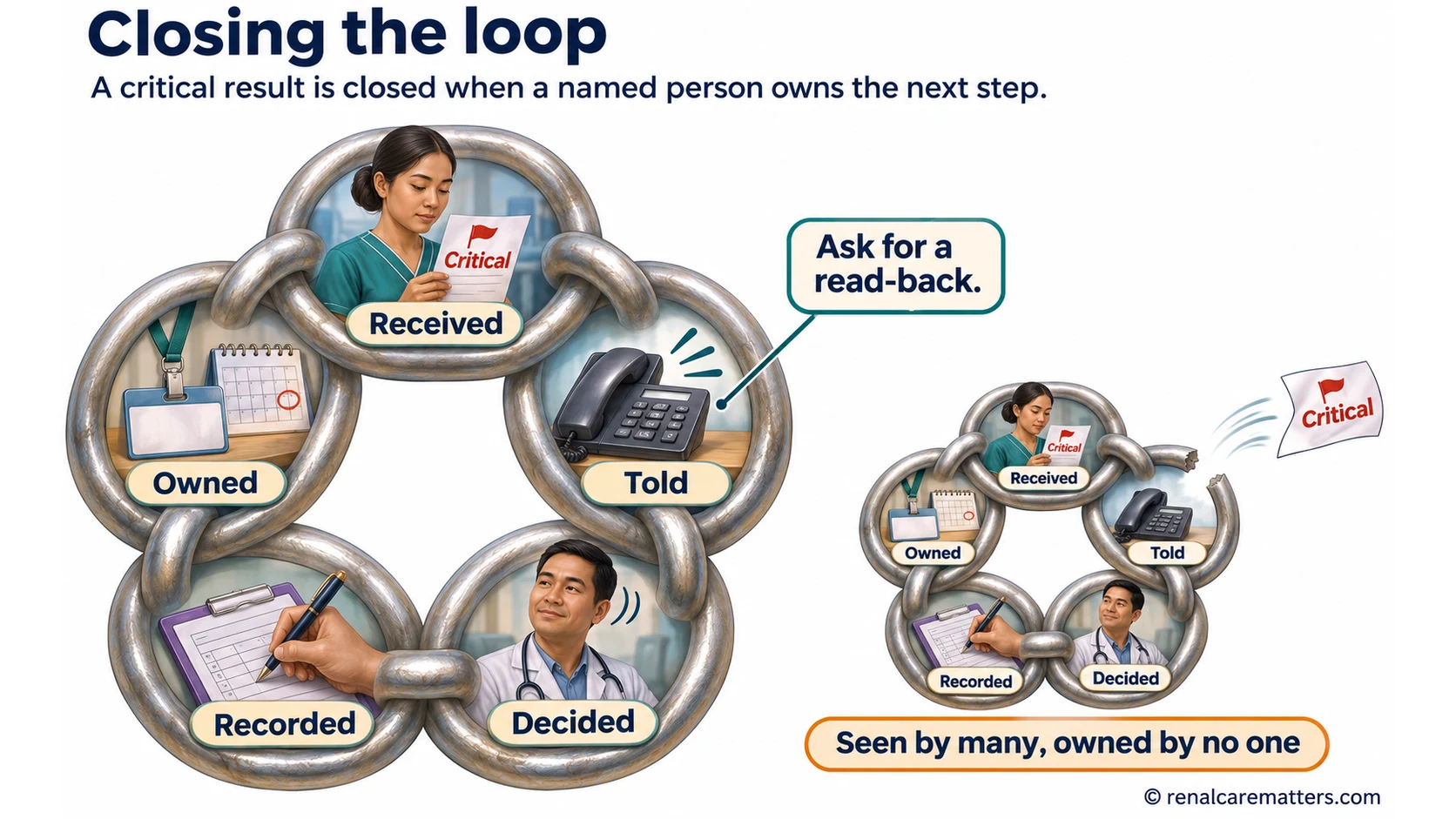
A critical result that nobody acted on is one of the most common ways patients are harmed between sessions. The result exists. The decision does not.
Figure 5. A critical result is closed when a named person owns the next step. One missing link leaves it open.
Figure 6 · A closed loop
ReceivedThe result reaches a named nurse, with the time.
ToldA named physician hears the value, the time it was taken, and the clinical context. Ask for a read-back.
DecidedThe physician gives an order or a plan.
RecordedThe order, the time, and who gave it are written down.
OwnedA named person is responsible for the next step: a repeat test, a change in the prescription, a call to the patient.
Check the context before calling. A potassium from a hemolyzed sample, or one drawn after a long tourniquet, may be falsely high. Report it anyway, with that context. The physician decides whether to repeat it.
Two questions belong in every monthly review. “How long does it take you to recover after a session?” and “What symptom bothers you most?” The first has outcome data behind it.5
On the floor · The call at 4:50
At 4:50 in the afternoon, the laboratory calls. Mrs. Gloria Rivera, who finished dialysis at noon and went home, has a potassium of 6.8 mmol/L on her pre-dialysis sample. The nurse who takes the call writes down the value and the time and reads it back.
The loop is not closed yet. The nurse calls the physician on duty, gives the value, the fact that it was drawn before this morning’s session, and that the sample was not hemolyzed, and asks for a decision. The physician asks for a repeat test and asks that Mrs. Rivera be told to avoid potassium-rich food until then. The nurse calls Mrs. Rivera at 5:20 and records the physician’s order, the time, and the call. A named nurse on tomorrow’s shift owns the repeat test. Now the loop is closed.
Illustrative scenario. Names and details are invented.
RememberA loop is closed when a named person owns the next step. Until then, it is open, however many people have seen the result.
On the floor
Real situations: problems and solutions
These are fictional but typical. For each one, cover the answer, decide what you would do, then compare. Where a step depends on local rules, your unit’s procedure and your supervisor’s direction come first.
The scale says fine, the patient says no
What you see
A patient is at her usual weight gain but says she slept sitting up.
What is likely going on
She may have lost flesh during an illness, so her dry weight no longer fits.
What to do
Treat orthopnea as a Now finding. Call the physician before connection.
Why it matters
The scale measures weight, not where the water is.
The result nobody owns
What you see
A potassium flagged critical three days ago has no documented call.
What is likely going on
Everyone assumed someone else had called.
What to do
Call the physician now, record the decision, and name the owner of the next step. Then review how results reach a named person.
Why it matters
A loop is closed only when someone owns the next step.
The fast-fluid request
What you see
A patient asks for all 4.5 kilograms off in three hours so he can attend a wedding.
What is likely going on
He wants to keep his plans and does not see the risk.
What to do
Calculate the rate with him. Tell the physician, who decides. Offer a time that fits both.
Why it matters
Numbers the patient can see change decisions better than warnings.
Field notes
Ask “How long does it take you to recover after a session?” every month and write down the answer.
Monday is the most dangerous day of the week. Staff it like one.
Report a result with its context. Let the physician decide whether it is false.
Case review
Back to the case: Monday, station 9
Which lane, and what first? Now. She missed Friday, so her last session was Wednesday. She has breathlessness lying flat, palpitations, and an open critical potassium. Each of these alone would be urgent. Together, with the long gap, they are the picture Module 2 warns about. Seat her upright, put her on the monitor if your unit has one, take her pulse yourself, and call the physician on duty now. Give the facts in order: missed Friday, symptoms and when they started, the vital signs, the critical potassium and the date it was drawn, and her current prescription.
Why is the weight not reassuring? Her gain is close to her usual weekend gain, but her weekend was five days, not three. If she gained the same amount over a longer gap, she may have been eating little, which can also mean she is losing muscle and her dry weight is now too high. Breathlessness lying flat tells you more than the scale does.
The daughter’s request. Her instinct is sensible: more time does remove more. But how long, how fast, and with which dialysis fluid potassium are the prescriber’s decisions. Removing a large potassium load quickly carries its own risk of arrhythmia, which Module 7 explains. Thank her, tell her the doctor is deciding now, and come back to the broken tricycle once the acute risk is handled. That is a Module 9 conversation.
Skills lab · with your preceptor
Skills checklist: Pre-dialysis trend review and SBAR call
Review three synthetic patients before a shift, sort the findings, and make one call to a facilitator playing the physician. Your preceptor rates each step as satisfactory, needs practice, or not observed. Steps marked Critical must all be satisfactory before sign-off. This checklist supports supervised learning; your unit’s own procedure and competency form are the authority. A printable version of every checklist is on the trainer page.
CriticalCalculates weight gain and the planned UF rate for each patient.
Compares today’s gain with the patient’s own usual gain and the length of the gap.
CriticalAsks about breathing, orthopnea, palpitations, and chest pain, and looks for edema.
CriticalSorts each finding into Now, Today, or This month and states why.
CriticalIdentifies any open critical result and its date.
CriticalDelivers a one-minute Situation, Background, Assessment, Recommendation (SBAR) call that states urgency first and asks for a specific decision.
Obtains and records a read-back of the order.
CriticalNames the owner of each pending result.
Asks the recovery-time question and records the answer.
CriticalDoes not change the prescription or connect on the old order for a Now finding.
Placement activity. For two weeks, list every patient arriving after a missed session and every planned UF rate above 13 mL/h/kg. Note what was done and who decided. Review the list with your facilitator.
Self-assessment
Check your understanding
Each visit draws 8 questions at random from this module’s 15-question bank. Choose the single best answer for each, then select Check answers; an explanation appears under the best answer. Select New set of questions for a different mix. A good target is 7 of 8 on two different sets. Nothing you select is sent anywhere; scoring happens in your browser.
Foley, R. N., Gilbertson, D. T., Murray, T., & Collins, A. J. (2011). Long interdialytic interval and mortality among patients receiving hemodialysis. New England Journal of Medicine, 365(12), 1099–1107. https://doi.org/10.1056/NEJMoa1103313
Al Salmi, I., Larkina, M., Wang, M., Subramanian, L., Morgenstern, H., Jacobson, S. H., Hakim, R., Tentori, F., Saran, R., Akiba, T., Tomilina, N. A., Port, F. K., Robinson, B. M., & Pisoni, R. L. (2018). Missed hemodialysis treatments: International variation, predictors, and outcomes in the dialysis outcomes and Practice patterns study (DOPPS). American Journal of Kidney Diseases, 72(5), 634–643. https://doi.org/10.1053/j.ajkd.2018.04.019
Flythe, J. E., Kimmel, S. E., & Brunelli, S. M. (2011). Rapid fluid removal during dialysis is associated with cardiovascular morbidity and mortality. Kidney International, 79(2), 250–257. https://doi.org/10.1038/ki.2010.383
Flythe, J. E., Xue, H., Lynch, K. E., Curhan, G. C., & Brunelli, S. M. (2015). Association of mortality risk with various definitions of intradialytic hypotension. Journal of the American Society of Nephrology, 26(3), 724–734. https://doi.org/10.1681/ASN.2014020222
Rayner, H. C., Zepel, L., Fuller, D. S., Morgenstern, H., Karaboyas, A., Culleton, B. F., Mapes, D. L., Lopes, A. A., Gillespie, B. W., Hasegawa, T., Saran, R., Tentori, F., Hecking, M., Pisoni, R. L., & Robinson, B. M. (2014). Recovery time, quality of life, and mortality in hemodialysis patients: the dialysis outcomes and Practice patterns study (DOPPS). American Journal of Kidney Diseases, 64(1), 86–94. https://doi.org/10.1053/j.ajkd.2014.01.014
Zoccali, C., Torino, C., Mallamaci, F., Sarafidis, P., Papagianni, A., Ekart, R., Hojs, R., Klinger, M., Letachowicz, K., Fliser, D., Seiler-Mußler, S., Lizzi, F., Wiecek, A., Miskiewicz, A., Siamopoulos, K., Balafa, O., Slotki, I., Shavit, L., Stavroulopoulos, A., . . . London, G. M. (2021). A randomized multicenter trial on a lung ultrasound-guided treatment strategy in patients on chronic hemodialysis with high cardiovascular risk. Kidney International, 100(6), 1325–1333. https://doi.org/10.1016/j.kint.2021.07.024
Loutradis, C., Papadopoulos, C. E., Sachpekidis, V., Ekart, R., Krunic, B., Papadopoulou, D., Papagianni, A., Mallamaci, F., Zoccali, C., & Sarafidis, P. A. (2022). Lung ultrasound-guided dry-weight reduction and echocardiographic changes in clinically euvolemic hypertensive hemodialysis patients: 12-month results of a randomized controlled trial. Hellenic Journal of Cardiology, 64, 1–6. https://doi.org/10.1016/j.hjc.2021.11.002
Kidney Disease: Improving Global Outcomes (KDIGO) Anemia Work Group. (2026). KDIGO 2026 clinical practice guideline for the management of anemia in chronic kidney disease (CKD). Kidney International, 109(1S), S1–S99. https://doi.org/10.1016/j.kint.2025.06.006
Educational study material for nurses. Does not replace the attending nephrologist’s orders, the unit’s protocols, required training and certification, or supervised practice.