Counting safe slots, the limiting resource, reorder points, and a one-page brief an owner can act on.
PublishedNailathalaGipatikPepalwal:Audience: Physician heads of adult maintenance hemodialysis units · nephrologists preparing to take an appointment · head nurses, operations managers, and quality leads who share the leadership tableRead timeOras ng pagbasaOras sa pagbasaOras ning pamamasa:
Training track for physician heads of hemodialysis services
This module is study material for physician heads of adult maintenance hemodialysis services. It explains the reasoning behind common decisions; it is not a protocol and not legal advice. Regulations change: confirm every rule against the current text and your regional office before you rely on it. Clinical limits are set by your unit’s approved protocols and the attending nephrologist. Every case and record is fictional.
Learning objectives
After this module you should be able to
Calculate safe capacity from the narrowest gate: released machines, competence-matched staffing, physician coverage, and isolation needs.
Reserve capacity for patients with time-sensitive needs, and test the margin against foreseeable losses.
Calculate a reorder point and days of cover, and recalculate when lead time changes.
Control critical supplies: expiry rotation, recalls, approved substitutes, and verified lead times.
Write a one-page board brief that asks for a decision, with its cost, effect on patients, and owner.
State the lost capacity and activate a transfer plan when operational targets conflict with safety.
Pre-testBefore you read, answer the 8 self-assessment questions and note your score. After the module, select New set of questions and compare. The difference is what you learned; the questions you still miss are what to reread.
Start here
The big picture, in plain words
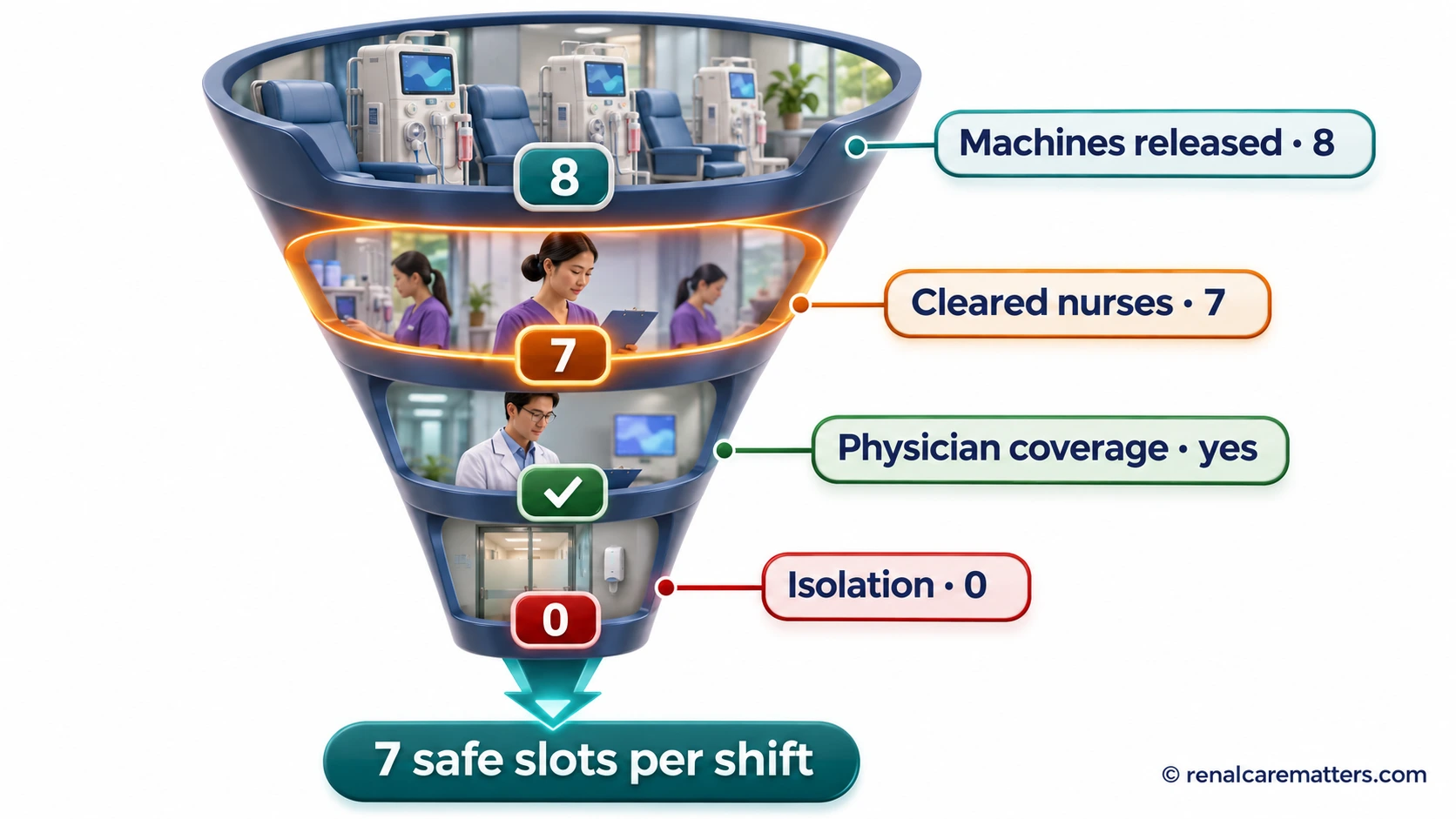
In plain wordsCapacity is like a funnel with several narrow points. However wide the top, only as much passes as the narrowest point allows.
Figure 1. Safe capacity is set by the narrowest gate, not the number of machines.
The picture has a limit. In a funnel the narrow point never moves. In a dialysis unit it moves every day: a machine fails its disinfection, a nurse calls in sick, a patient needs isolation. Safe capacity is a number you recalculate whenever one of the gates changes, not a number painted on the door.
Figure 2 · Key terms for this module
Safe slotA treatment place that is released, staffed by a validated nurse, covered by a physician, and suitable for the patient assigned to it.
Limiting resourceThe gate that sets the number of safe slots today.
Lead timeDays from placing an order to having verified stock on the shelf.
Safety stockA buffer held for unexpected demand or delay.
Reorder pointThe stock level at which you order, equal to daily use times lead time plus safety stock.
Board briefA one-page document that asks the governing body for one decision.
Opening case · fictional
Case: Eighteen on the schedule
Your unit in Quezon City has ten stations and runs two shifts. Two machines are quarantined after failed disinfection tests. The head nurse, Ms. Rowena Lim, tells you that the cleared nurses on today’s roster can safely cover seven patients per shift. Eighteen sessions are scheduled.
The stockroom reports 30 dialyzer kits used a day, a supplier lead time of four days, and a policy of 60 kits of safety stock. The supplier has just warned that a courier strike may double the lead time. The owner, Mr. Victor Tan, asks: “We have ten machines. Why are we not treating twenty?”
Before reading on, decide:
How many patients can you safely treat today?
What is your plan for those who still need a place?
What do you take to Mr. Tan, and what do you ask him to decide?
Keep your answers in mind. The lesson gives you what you need, and the case review near the end shows one sound response.
Lesson · part 1
Count what you can run safely
Count each gate per shift, then take the smallest.
Gate
Today
Machines released for use
10 − 2 quarantined = 8
Patients the cleared nurses can safely cover
7
Physician coverage
Adequate for both shifts
Isolation or other restrictions
None today
Safe slots per shift
7 (staffing is the limiting resource)
Today. 7 safe slots × 2 shifts = 14. Demand is 18, so 4 patients need a plan before any further loss. If one more nurse calls in, the number falls again. Calculator 1 does this with your own numbers.
Reserve room for patients whose treatment cannot move: those after a missed session, those returning from hospital, and those needing isolation. Then test the margin. What happens if one more machine fails, or one more nurse is absent? Write the trigger at which you activate transfers, before you need it.
Stop and callStop booking beyond the safe number. Ask the attending nephrologists which of the patients without a slot can safely move, and which must be placed today. Confirm any transfer by name with the receiving unit.
Lesson · part 2
Order before the shelf looks low
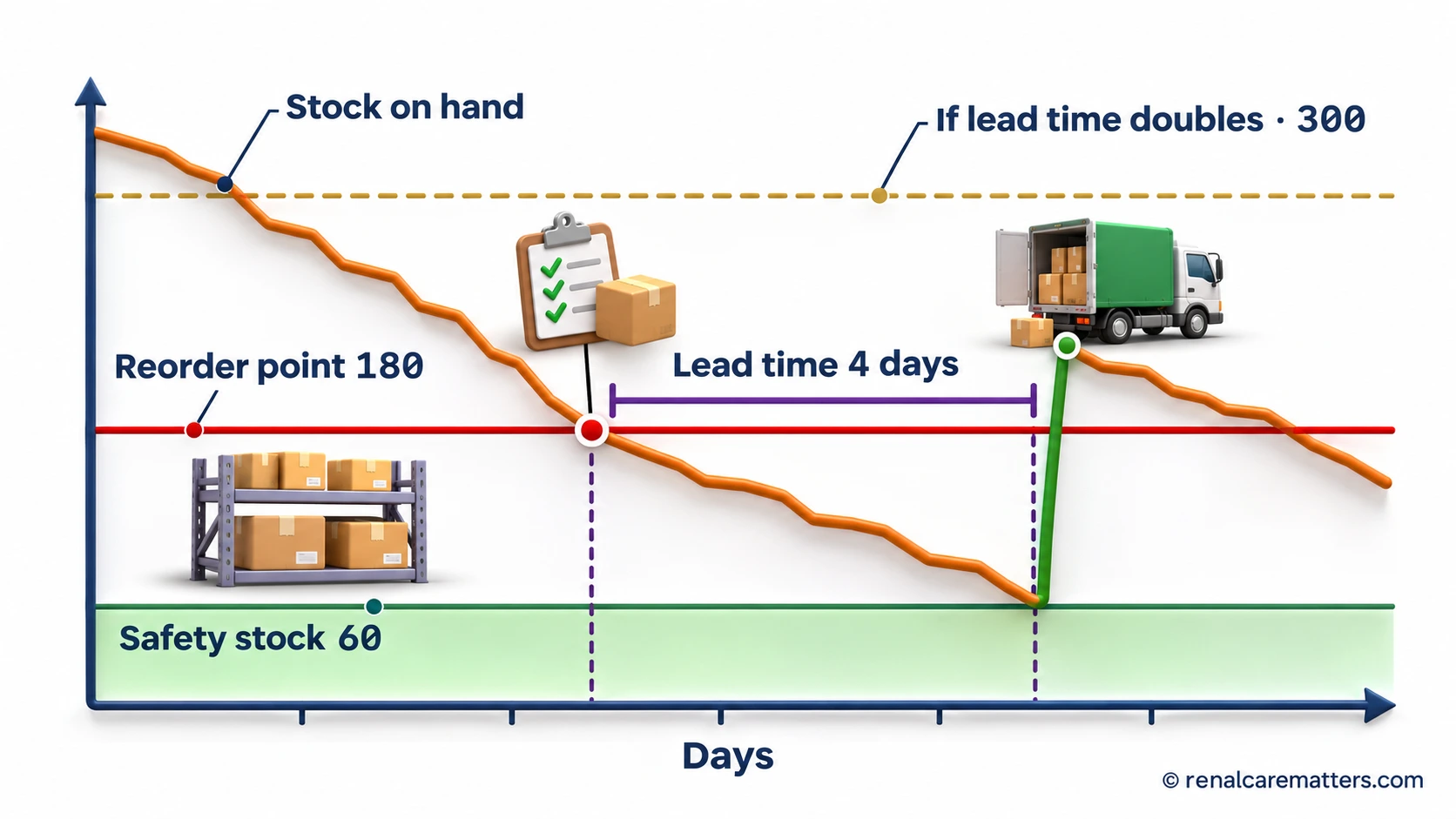
Figure 3. The reorder point. Order when stock covers the lead time plus a safety buffer, not when the shelf looks low.
A reorder point protects you from running out while an order is in transit. It is daily use multiplied by lead time, plus safety stock.
Reorder point. 30 kits a day × 4 days + 60 = 180 kits. If lead time doubles to 8 days: 30 × 8 + 60 = 300 kits. The day the supplier warns you, your reorder point rises by 120 kits. Calculator 2 recalculates it and shows days of cover.
Check the units (kits, not boxes), use the actual daily use over recent weeks, and review the safety stock if demand or lead time varies. Rotate stock by expiry, keep recall traceability to the lot, and qualify substitutes before a shortage, not during it (Module 11). Maintain service agreements for water and machines with response times that match your risk.
Lesson · part 3
Give the owner a decision, not a worry
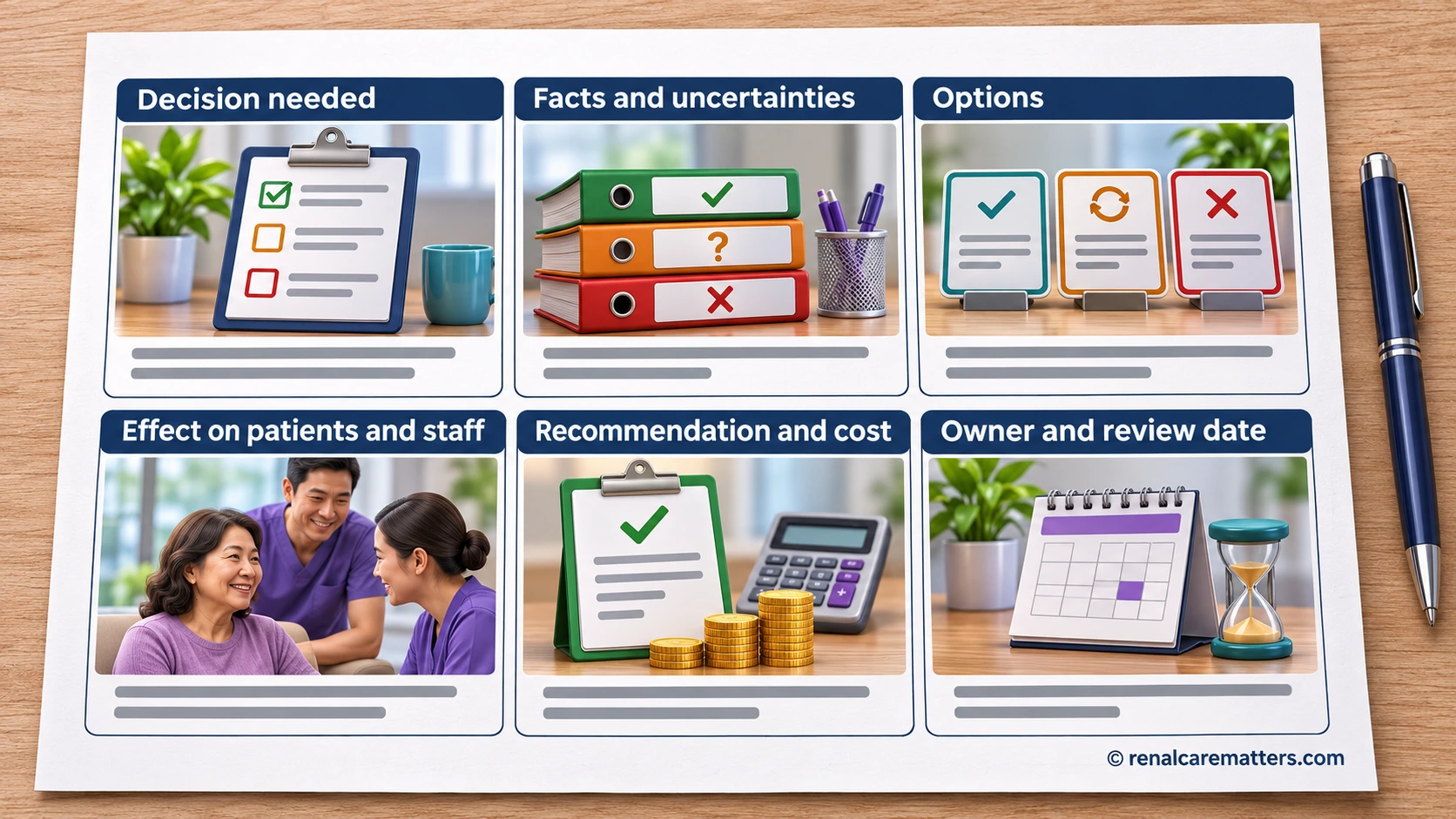
Figure 4. The one-page board brief. An owner can act on a decision, not on a worry.
Owners act on choices. A memo that lists problems without asking for anything leaves the decision to whoever reads it last. A one-page brief has six parts.
Figure 5 · The one-page brief
1. Decision needed and deadlineApprove overtime for two relief nurses for two weeks, by Friday.
2. Facts and uncertaintiesSeven safe slots per shift; four patients without a place; supplier lead time may double.
3. OptionsRelief nurses; transfer four patients to a partner unit; extend a third shift with existing staff.
4. Effect on patients and staffWhich patients move, how far, and the risk to staff of repeated overtime.
5. Recommendation and costWith a range when assumptions are uncertain.
6. Owner and reviewWho carries it out and when the board hears whether it worked.
Include equity. If transfers fall on patients without transport or money for fares, the cheapest option on paper may be the most harmful in practice.
RememberWhen a target conflicts with safety, state the capacity you are losing and activate the plan for it. Do not let the gap be absorbed silently by the floor.
Lesson · part 4
A rhythm that finds problems early
Lead short readiness huddles every shift (Module 4), review incidents and trends at fixed intervals, and invite patient feedback. Resolve complaints with a named owner, immediate safety triage, and timely feedback to the patient. Keep confidential incident and personnel records separate from operational reports.
Interval
Review
Every shift
Safe slots, holds, patients without a place
Weekly
Stock against reorder points, lead-time changes, open complaints
Monthly
Quality measures with denominators, incidents, staffing gaps, claims returns
Quarterly
Board brief on capacity, risks, and decisions needed
On the floor
Real situations: problems and solutions
These are fictional but typical. For each one, cover the answer, decide what you would do, then compare. Where a step depends on local rules, your unit’s procedure and your supervisor’s direction come first.
Ten machines, seven nurses’ worth
What you see
The owner counts ten machines and expects ten patients per shift.
What is likely going on
Machines mistaken for capacity.
What to do
Show the limiting resource and the safe number. Present the options for the gap.
Why it matters
Capacity is the narrowest gate.
The courier strike
What you see
The supplier warns that delivery may take eight days instead of four.
What is likely going on
A longer lead time.
What to do
Recalculate the reorder point now and order the difference.
Why it matters
The math changes before the shelf does.
The brief that was a complaint
What you see
Your memo to the board lists problems but asks for nothing.
What is likely going on
A worry, not a decision.
What to do
Rewrite it as one decision, the options, the cost, and the owner.
Why it matters
Boards act on choices.
Field notes
Recalculate safe capacity every time a gate changes.
Keep lead times for critical supplies in writing.
Bring the owner a choice, not a complaint.
Case review
Back to the case: Eighteen on the schedule
How many today? Fourteen: seven per shift, because staffing, not machines, is the limiting resource. The two quarantined machines would not help even if released, until more cleared nurses are available.
The four without a place. Ask the attending nephrologists to review all four. Those who cannot wait are placed today at a partner unit, confirmed by name, with transport arranged. Those who can safely move are rescheduled within the window the physician sets. Every one has a named owner until treated.
What to take to Mr. Tan. A one-page brief: the safe number and why, the four patients’ plan, the options to restore capacity with costs, and a request to approve the reorder at 300 kits now because of the courier warning. Ask for a decision by a date, and name who will report back.
Skills lab · with your preceptor
Skills checklist: Safe capacity, reorder point, and board brief
Calculate safe capacity and reorder points for a fictional unit, then present a one-page brief to a preceptor playing the owner. Your preceptor rates each step as satisfactory, needs practice, or not observed. Steps marked Critical must all be satisfactory before sign-off. This checklist supports supervised learning; your unit’s own procedure and competency form are the authority. A printable version of every checklist is on the trainer page.
CriticalCounts each gate and identifies the limiting resource.
CriticalBooks no more than the safe number of slots.
CriticalAsks physicians to prioritize patients without a slot and confirms transfers by name.
Calculates the reorder point with correct units and recalculates for a longer lead time.
Writes a brief with a decision, options, effect on patients, cost, and owner.
Considers equity in transfer options.
Sets a review date to confirm the decision worked.
Placement activity. Calculate your own unit’s safe capacity every day for two weeks and record the limiting resource. Bring the pattern to your next board meeting.
Self-assessment
Check your understanding
Each visit draws 8 questions at random from this module’s 15-question bank. Choose the single best answer for each, then select Check answers; an explanation appears under the best answer. Select New set of questions for a different mix. A good target is 7 of 8 on two different sets. Nothing you select is sent anywhere; scoring happens in your browser.
Educational material for physicians and unit leaders. Completing it is an Academy learning record only. It does not confer CPD units, PSN attestation, DOH eligibility, PhilHealth accreditation, or appointment authority, and it does not replace current regulations, your facility’s bylaws and protocols, or legal advice.