Clinical Oversight: Coverage, Pathways, and Rights
Who covers each shift, the readiness huddle, care pathways that do not leak, the transfer handoff, and patient rights.
PublishedNailathalaGipatikPepalwal:ReferencesMga SanggunianMga TinubdanReng Reperensya:6Audience: Physician heads of adult maintenance hemodialysis units · nephrologists preparing to take an appointment · head nurses, operations managers, and quality leads who share the leadership tableRead timeOras ng pagbasaOras sa pagbasaOras ning pamamasa:
Training track for physician heads of hemodialysis services
This module is study material for physician heads of adult maintenance hemodialysis services. It explains the reasoning behind common decisions; it is not a protocol and not legal advice. Regulations change: confirm every rule against the current text and your regional office before you rely on it. Clinical limits are set by your unit’s approved protocols and the attending nephrologist. Every case and record is fictional.
Learning objectives
After this module you should be able to
Explain why patients just back from hospital, or who missed a session, carry the highest risk on any shift.
Decide whether a shift can open by matching competencies, coverage, and acuity, not by counting names on a roster.
Run a five-minute readiness huddle that changes the plan while there is still time.
Design care pathways in which every result, missed session, and referral has a named owner.
Audit delivered dialysis dose against the Kidney Disease Outcomes Quality Initiative (KDOQI) target using a valid post-dialysis sample.
Close a transfer handoff, and protect patient rights: consent, privacy, interpreters, and complaints.
Pre-testBefore you read, answer the 8 self-assessment questions and note your score. After the module, select New set of questions and compare. The difference is what you learned; the questions you still miss are what to reread.
Start here
The big picture, in plain words
In plain wordsA roster is a guest list. It tells you who is coming. It does not tell you who can carve the roast, who knows where the fire extinguisher is, or who will look after the guest who arrives unwell.
The picture has a limit. Guests can improvise. A nurse who has never been validated on catheter care cannot safely improvise a catheter connection, and a physician who is not reachable cannot assess a patient by hope. Oversight means checking the skills and the coverage behind each name.
Figure 1 · Key terms for this module
CoverageThe physician and nurse arrangements that guarantee someone qualified can assess, decide, and respond during every shift.
Validated competencyA skill a staff member has been observed doing correctly in your unit, signed and dated.
Readiness huddleA short, structured meeting before the first connection that reviews risks and changes the plan.
Care pathwayThe planned route a patient follows from acceptance to transfer, with owners at each step.
spKt/VSingle-pool Kt/V, a measure of the urea clearance delivered in one session, scaled to body water.
Closed-loop handoffA handoff in which the receiver repeats back and confirms acceptance.
Opening case · fictional
Case: Before the first patient connects
It is 5:35 on a Monday at a twelve-station unit in Quezon City. The physician on duty, Dr. Paolo Navarro, calls in sick. His reliever cannot arrive before 8:00. Two patients missed Friday: Mrs. Teresita Villanueva because her son’s tricycle broke down, and Mr. Efren Santos, who was in hospital with pneumonia until yesterday. Mrs. Villanueva arrives breathless and cannot lie flat.
The head nurse, Ms. Carmela Reyes, calls you. “Eleven patients are here. Three nurses are cleared. Do we start?”
Before reading on, decide:
Who sees Mrs. Villanueva now, and where?
What must be in place before the rest of the shift begins?
What do you change in the system after today?
Keep your answers in mind. The lesson gives you what you need, and the case review near the end shows one sound response.
Lesson · part 1
Why some patients carry the shift’s risk
Patients do not carry equal risk into a shift. Three groups deserve attention before the first connection.
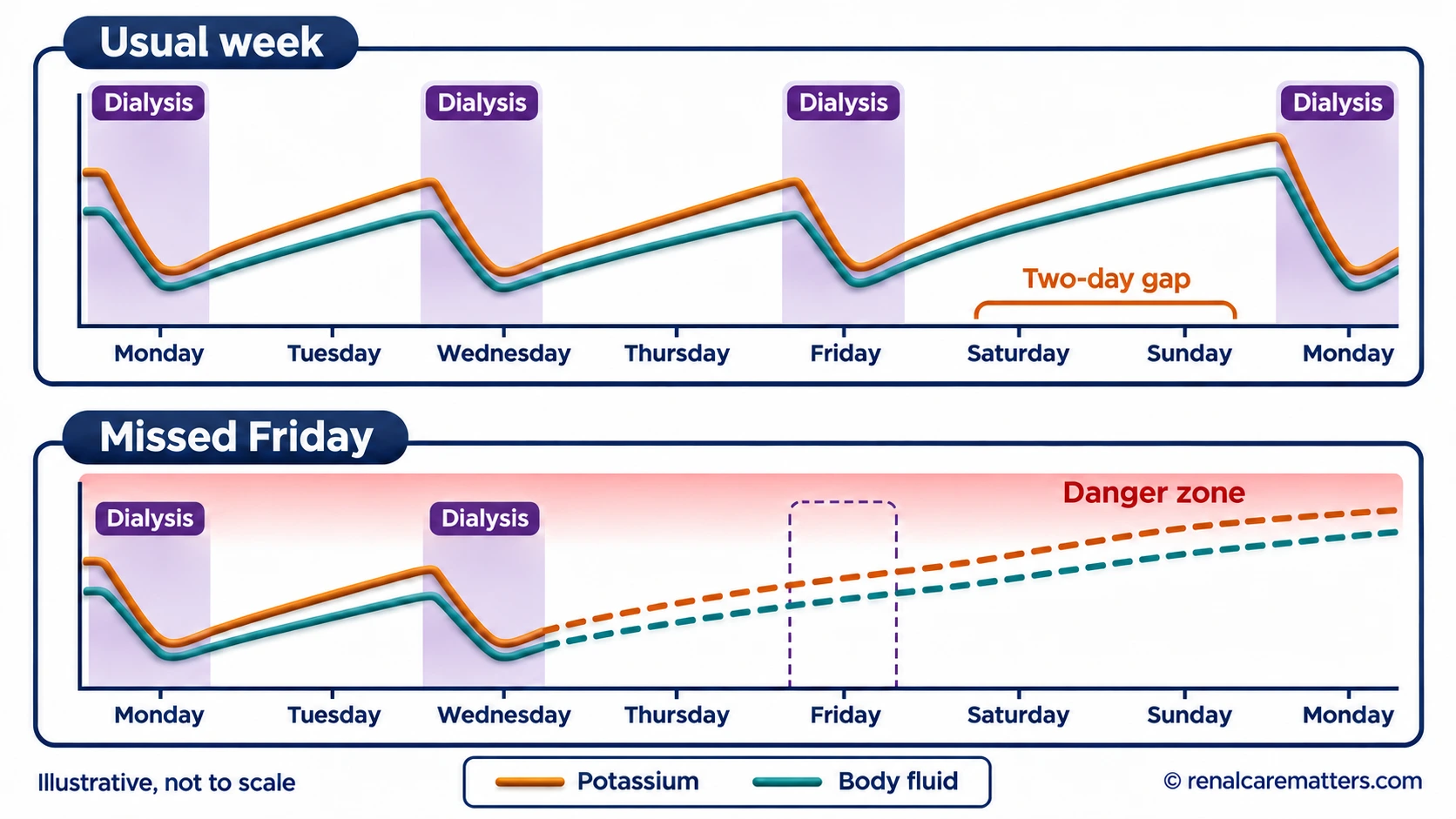
After the long gap. Potassium and fluid peak before the first session of the week. In a large United States cohort, deaths and admissions for heart failure, arrhythmia, and myocardial infarction were all more frequent on the day after the two-day gap.1
After a missed session. Across 20 countries in the Dialysis Outcomes and Practice Patterns Study (DOPPS), missing at least one session in four months was associated with higher mortality (hazard ratio 1.68) and more hospitalization.2 This is observational; patients who miss sessions differ in other ways. It still tells you who to look at first.
After hospital. Patients return with new medicines, lost muscle that makes the old dry weight wrong, healing access, and sometimes active infection. Their orders need review before they connect.
Figure 2. Why Monday and missed sessions carry the risk. Illustrative, not to scale.
RememberThe patient who arrives breathless after a missed session is not a scheduling problem. That patient is the emergency of the morning.
Lesson · part 2
A full roster is not a safe one
Plan coverage around scope, validated competencies, current certifications, patient acuity, and the staffing your licensing rules require. Include breaks, foreseeable absences, and alternates. An incomplete roster should trigger a capacity decision before patients connect, not a scramble after.
What the evidence shows
Design
Strength and limits
Higher patient-to-nurse ratios and more tasks left undone were associated with more frequent hypotension, skipped and shortened treatments, and complaints3
Survey of nurses, United States
Cross-sectional; events reported by nurses
Each 10% more hours from highly trained staff was associated with lower odds of patients skipping treatment4
DOPPS cohort, seven countries
Observational
Among 54,141 young adults, units with the most patients per nurse had a 14% lower incidence of transplant5
National cohort, United States
Observational; large and adjusted
No trial has tested a staffing ratio in dialysis, and Philippine data were not found. Together these studies support a reasonable inference: staffing and skill mix behave like patient-safety variables. They do not prove that any single ratio is correct.
Stop and callStop and hold the opening of any station whose patients cannot be assessed by a qualified physician or cared for by a validated nurse. Ask the attending nephrologists which waiting patients cannot be delayed. Follow your unit’s protocol while you arrange cover.
Lesson · part 3
Five minutes that change the plan
Figure 3. The readiness huddle. Five minutes before the first connection is the cheapest time to change a plan.
A huddle is useful only if it can change what happens next. Keep it short, run it at the same time every shift, and use the same list.
Figure 4 · Readiness huddle
PatientsBack from hospital, missed sessions, new orders, high-risk access, pending critical results.
PeopleWho is cleared for what today, who is on break when, who holds the emergency role.
PhysicianPresent, or reachable within the time your protocol sets.
Equipment and waterReleased, alarms resolved, emergency cart and defibrillator checked.
TransportPatients who may not get home, or may not get back on Wednesday.
The huddle ends with decisions: who starts first, who waits, who is reassigned, who is assessed before connection, and who calls whom.
Lesson · part 4
Care pathways that do not leak
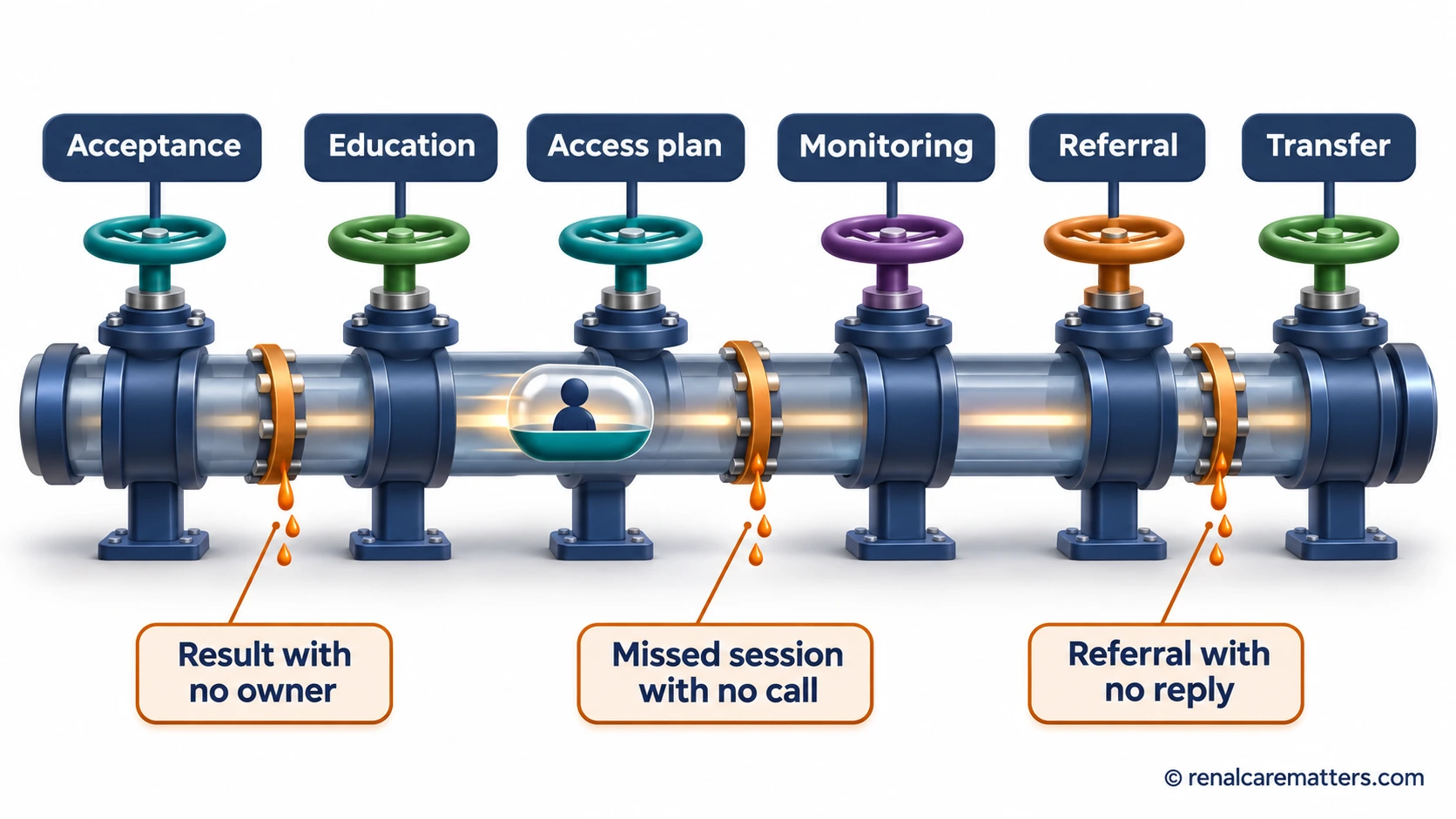
Figure 5. Care pathways leak at the joints. Every handoff needs a named owner and a way to know it arrived.
Review clinical governance from acceptance to transfer. Most harm in chronic care comes from things that fall between people: an abnormal result filed without being read, a missed session nobody called about, a referral nobody chased.
Joint
Owner to name
How you know it worked
Critical laboratory result
A named clinician for each result type and shift
Time from result to documented decision
Missed session
Nurse who calls the patient the same day
Call recorded; next session confirmed
Access problem
Access coordinator
Referral date, procedure date, catheter days
Modality and transplant education
Attending nephrologist
Documented shared decision
Nutrition and psychosocial referral
Dietitian or social worker
Seen within the set time
Audit the dose. KDOQI recommends a target single-pool Kt/V of 1.4 per session for patients dialyzed three times a week, with a minimum delivered value of 1.2.6 A dose result is only as good as the post-dialysis sample: a sample drawn at full blood flow after rinse-back dilutes the urea and makes the dose look better than it was. Calculator 10 computes Kt/V and the urea reduction ratio from valid samples.
Lesson · part 5
The transfer handoff and patient rights
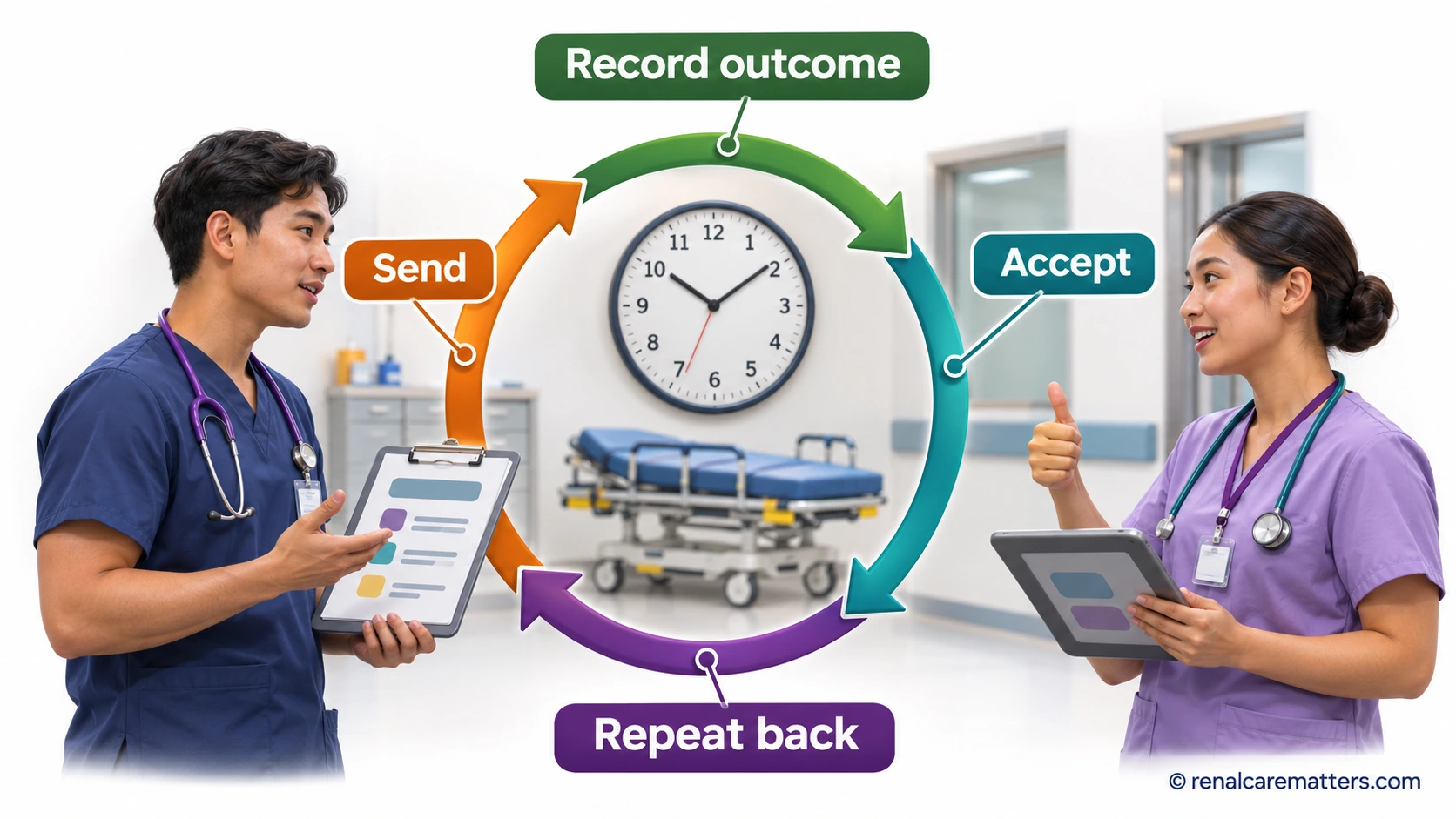
Figure 6. A transfer is complete when the receiver confirms, not when the patient leaves.
During acute deterioration, the unit’s response protocol runs the first minutes (the Physician on Duty track covers the clinical steps). Your system question is the handoff. Who calls emergency services and the receiving team? What travels with the patient? Who confirms arrival and outcome?
Figure 7 · A handoff that closes
SendLast treatment, current concern, access, relevant orders and results, actions taken, code status.
ConfirmThe receiver repeats the key facts and accepts the patient by name.
RecordReceiving clinician, time, transport, and outcome when known.
Follow upA named person calls for the outcome if it is not received.
Rights belong in the same system. Patients should consent to treatment with information they understand, have an interpreter or family translator where needed, know how to complain without fear of losing their slot, and have their information shared only with those who need it for care.
On the floor
Real situations: problems and solutions
These are fictional but typical. For each one, cover the answer, decide what you would do, then compare. Where a step depends on local rules, your unit’s procedure and your supervisor’s direction come first.
The full roster
What you see
The roster has every name filled, but the only nurse with catheter competency is on leave.
What is likely going on
A complete roster that is not a safe one.
What to do
Reassign catheter patients or arrange a validated reliever before they connect.
Why it matters
Competency, not attendance, decides safety.
The result in the folder
What you see
A potassium of 7.1 mmol/L from Friday was filed without anyone being called.
What is likely going on
A pathway with no owner for results.
What to do
Contact the patient and the attending nephrologist now, then fix who receives critical results.
Why it matters
A filed result is not a read result.
“He left by ambulance”
What you see
A patient was sent to the emergency room. No one knows whether he arrived or what happened.
What is likely going on
An open handoff.
What to do
Call the receiving team, confirm the outcome, and record it.
Why it matters
A transfer is complete when the receiver confirms.
Field notes
Run the huddle at the same time every shift.
Name an owner for every result category.
Post the complaint route where patients wait, not only at reception.
Case review
Back to the case: Before the first patient connects
Who sees Mrs. Villanueva now? She needs a physician’s assessment immediately, in a monitored chair or the emergency area, and a potassium level and electrocardiogram. With no physician on site, you or the covering nephrologist must assess her by the fastest safe route; if no physician can reach her within your protocol’s time, she goes to the emergency department by ambulance. Breathlessness after a missed session is a medical emergency, not a scheduling question.
What must be in place before the rest of the shift starts? A physician who can assess and respond, either on site or reachable within the protocol’s time, and confirmation that the three cleared nurses can cover the stations to be opened. Mr. Santos’s orders need review after his hospitalization. The attending nephrologists decide which waiting patients cannot be delayed.
What changes afterward? A backup physician list with response times, a rule that a missed session triggers a same-day call, and a huddle item for patients back from hospital. Write the escalation for when the physician on duty is absent, so Ms. Reyes does not have to call you to decide whether to start.
Skills lab · with your preceptor
Skills checklist: Shift readiness and closed-loop escalation
Lead a readiness huddle with a preceptor and two role players, then manage one deteriorating patient through to a confirmed handoff. Your preceptor rates each step as satisfactory, needs practice, or not observed. Steps marked Critical must all be satisfactory before sign-off. This checklist supports supervised learning; your unit’s own procedure and competency form are the authority. A printable version of every checklist is on the trainer page.
CriticalIdentifies patients after a missed session, after hospital, and with pending critical results.
CriticalMatches assignments to validated competencies, not to names on the roster.
CriticalConfirms physician coverage within the protocol’s response time.
CriticalHolds stations that cannot be safely covered and records the decision.
Asks the attending nephrologists which patients cannot be delayed.
CriticalActivates the emergency pathway for an unstable patient without waiting for the schedule.
Gives a structured handoff and obtains a repeat-back and acceptance.
Names an owner for each critical result type.
Uses only the information needed for care in the handoff.
Placement activity. For one month, record each shift where coverage was incomplete at opening, what was held, and how long it took to resolve. Use the record to set a backup physician list.
Self-assessment
Check your understanding
Each visit draws 8 questions at random from this module’s 15-question bank. Choose the single best answer for each, then select Check answers; an explanation appears under the best answer. Select New set of questions for a different mix. A good target is 7 of 8 on two different sets. Nothing you select is sent anywhere; scoring happens in your browser.
Foley, R. N., Gilbertson, D. T., Murray, T., & Collins, A. J. (2011). Long interdialytic interval and mortality among patients receiving hemodialysis. New England Journal of Medicine, 365(12), 1099–1107. https://doi.org/10.1056/NEJMoa1103313
Al Salmi, I., Larkina, M., Wang, M., Subramanian, L., Morgenstern, H., Jacobson, S. H., Hakim, R., Tentori, F., Saran, R., Akiba, T., Tomilina, N. A., Port, F. K., Robinson, B. M., & Pisoni, R. L. (2018). Missed hemodialysis treatments: International variation, predictors, and outcomes in the dialysis outcomes and practice patterns study (DOPPS). American Journal of Kidney Diseases, 72(5), 634–643. https://doi.org/10.1053/j.ajkd.2018.04.019
Thomas-Hawkins, C., Flynn, L., & Clarke, S. P. (2008). Relationships between registered nurse staffing, processes of nursing care, and nurse-reported patient outcomes in chronic hemodialysis units. Nephrology Nursing Journal, 35(2), 123-30, 145; quiz 131.
Saran, R., Bragg-Gresham, J. L., Rayner, H. C., Goodkin, D. A., Keen, M. L., Van Dijk, P. C., Kurokawa, K., Piera, L., Saito, A., Fukuhara, S., Young, E. W., Held, P. J., & Port, F. K. (2003). Nonadherence in hemodialysis: associations with mortality, hospitalization, and practice patterns in the DOPPS. Kidney International, 64(1), 254–262. https://doi.org/10.1046/j.1523-1755.2003.00064.x
Bicki, A. C., Grimes, B., McCulloch, C. E., Copeland, T. P., & Ku, E. (2024). Dialysis facility staffing ratios and kidney transplant access among adolescents and young adults. JAMA, 332(23), 2003–2013. https://doi.org/10.1001/jama.2024.18210
National Kidney Foundation. (2015). KDOQI clinical practice guideline for hemodialysis adequacy: 2015 update. American Journal of Kidney Diseases, 66(5), 884–930. https://doi.org/10.1053/j.ajkd.2015.07.015
Educational material for physicians and unit leaders. Completing it is an Academy learning record only. It does not confer CPD units, PSN attestation, DOH eligibility, PhilHealth accreditation, or appointment authority, and it does not replace current regulations, your facility’s bylaws and protocols, or legal advice.