The donor who moved
- What you see
- A donor moved to Mindanao.
- What is likely going on
- Distance as a barrier.
- What to do
- Arrange checks with a local doctor and receive results.
- Why it matters
- Follow-up can travel; the duty does not end.
Two continuing-care plans, recall with respect, donor yearly checks, and navigating graft failure.

This module is study material for kidney transplant coordinators and coordination-support staff. It explains the reasoning behind coordination decisions; it is not a hospital protocol, legal advice, or a benefits ruling. Rules and rates change: confirm every rule against the current issuance and your facility’s approved policy. Medical decisions belong to the transplant team, donation ethics to the ethics committee, and benefits to PhilHealth. Every case, name, and identifier is fictional.
The picture has a limit. A car that skips a service usually tells you with a noise. A donor whose blood pressure creeps up, or whose urine starts to leak albumin, feels nothing. Those quiet changes are exactly what yearly checks are designed to catch, because a donor has less kidney reserve (Module 7) and long-term risks that are small but real: in a large US cohort, kidney failure within 15 years was 30.8 per 10,000 donors against 3.9 per 10,000 matched healthy nondonors.1
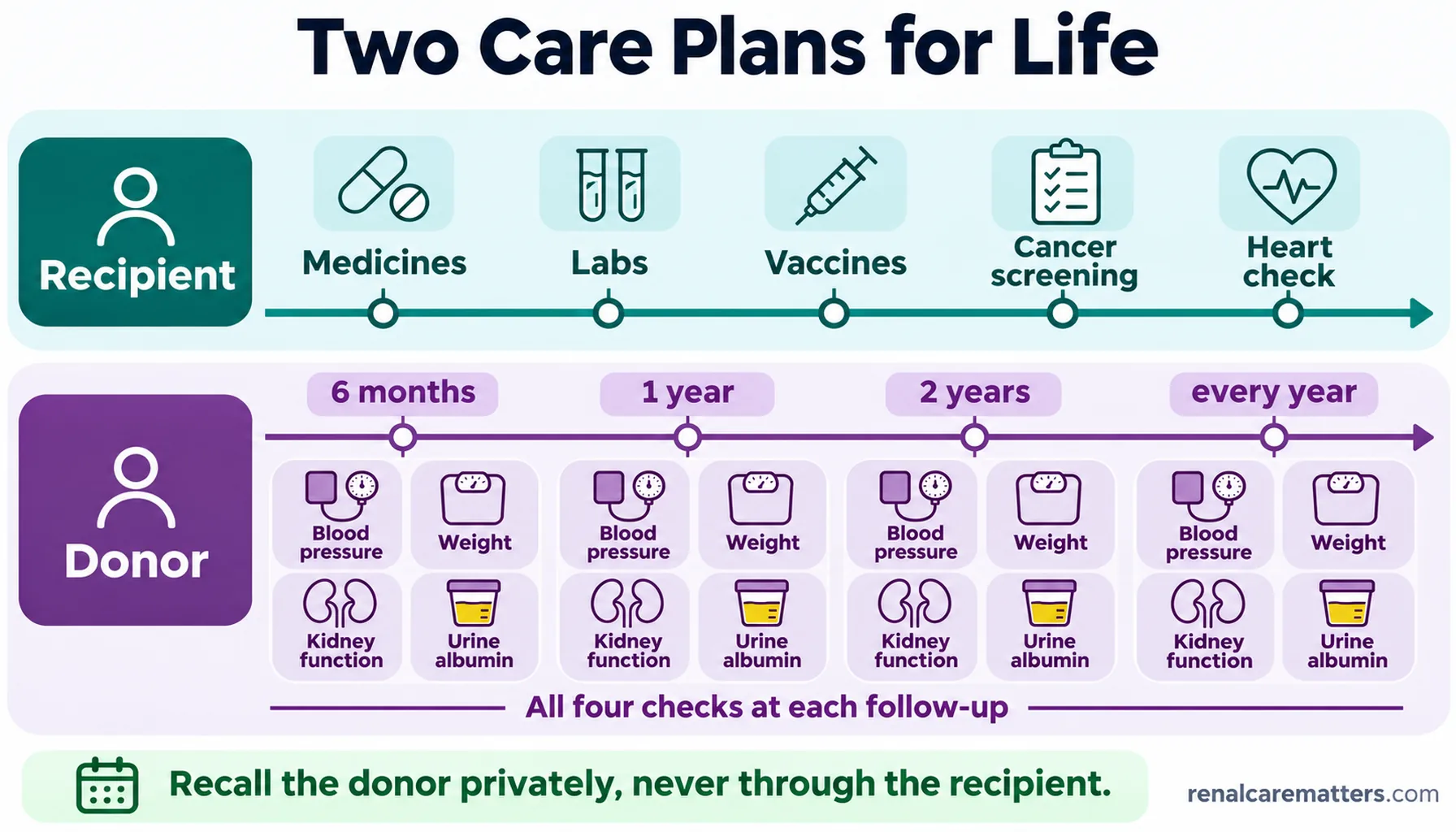
Kidney Disease: Improving Global Outcomes (KDIGO)’s living donor guideline asks programs to provide lifelong post-donation care, centered on blood pressure, body weight, kidney function, and albumin in the urine, and the Department of Health (DOH) living-donor order makes lifetime monitoring part of the donor’s protection.2,3 Philippine Health Insurance Corporation (PhilHealth)’s post-transplant packages list living donor monitoring among their services.4 For the recipient, KDIGO’s recipient guideline sets out monitoring and prevention for life: kidney function, drug levels, infections, cancer screening, cardiovascular risk, and bone health.5 Your job is to keep both plans running.
Figure 2 · Key terms for this module
It is five years after Mrs. Gina Torres, 45, received a kidney from her husband, Mr. Ramon Torres, 50. Mrs. Torres comes to clinic every three months; her kidney works well.
Mr. Torres came for his checks at 6 months and 1 year, and then stopped. His last recorded blood pressure, four years ago, was 138/88. He now works night shifts as a security guard and says clinic hours are impossible.
At her visit, Mrs. Torres asks you to “remind Ramon to come” and offers to bring his urine sample herself. Separately, another recipient, Mr. Oscar Lim, 60, has a creatinine that has risen steadily for a year; his nephrologist says the graft is failing.
Before reading on, decide:
Keep your answers in mind. The lesson gives you what you need, and the case review near the end shows one sound response.
| Recipient | Donor | |
|---|---|---|
| Who leads | Transplant nephrology | Donor team or the clinician the program designates |
| Typical focus | Kidney function, drug levels, infection prevention and vaccines, cancer screening, heart and bone health, medicine supply | Blood pressure, weight, kidney function, urine albumin, general health, wellbeing |
| Frequency | Frequent early, then regular for life, as the team sets | An early post-operative schedule, then at least yearly for life, as the program sets |
| Funding | Post-transplant package and other sources | Not charged to the donor for donation-related follow-up; package lists donor monitoring |
| Contact | Recipient’s named coordinator | Donor’s named contact |
The donor follow-up planner drafts an example schedule from the donation date (for example, 6 months, 1 year, 2 years, then yearly). Align it with your program’s protocol; schedules used in other countries, such as the United States reporting points, are comparisons, not Philippine rules.6
People miss follow-up for ordinary reasons: work, distance, cost, feeling well, or not knowing why it matters. A recall that scolds or goes through the family does more harm than good.
Figure 3 · A respectful recall
If a donor declines follow-up, respect it, record it, and leave the door open: tell them how to come back at any time.
Transplanted kidneys do not always last a lifetime. When a graft is failing, the worst outcome is a person who arrives at an emergency needing dialysis without an access and without a plan. Navigation means starting the conversation early, led by the team: options (dialysis, retransplant, conservative care), preparation (dialysis access, retransplant evaluation, a possible new living donor), medicines (decided by the team), feelings (grief, guilt, and fear are common), and funding (which packages apply next).
The site’s guide on allograft failure covers the clinical side for patients and clinicians. Your part is the map: who owns each step, by when, and how the person hears about it.
A recipient’s graft function has fallen steadily for a year. The nephrologist asks coordinator Ms. Liza Reyes to start a transition plan.
She books a modality education session, a vascular access consultation, and a retransplant evaluation visit, and checks the dialysis package enrollment. Four months later the patient starts dialysis through a working fistula, as a planned outpatient.
The difference between an emergency start and a planned one was a plan made months earlier.
Illustrative scenario. Names and details are invented.
Separation does not expire. Five years later, the recipient still may not receive the donor’s results, and the donor’s follow-up is still not arranged through the recipient. A recipient offering to carry the donor’s urine sample, or to “remind” the donor, means well; thank them, and contact the donor directly. A donor’s sample must be collected under the program’s procedure, with identity confirmed, to be trustworthy.
These are fictional but typical. For each one, cover the answer, decide what you would do, then compare. Where a step depends on local rules, your unit’s procedure and your supervisor’s direction come first.
Recalling Mr. Torres. Contact him directly, through his preferred channel. Explain in one sentence why donors are checked every year. Offer a slot that fits night shifts (early morning after his shift, or a weekend), or a nearer laboratory with results sent to the program. Confirm that donation-related follow-up is not charged to him. Record the outcome.
Mrs. Torres’s offer. Thank her warmly and decline. His follow-up and results are his, and a sample carried by someone else cannot be verified as his. Recalling a donor through the recipient also risks pressure in both directions.
Mr. Lim. With his nephrologist, start the transition plan now: modality education, dialysis access, retransplant evaluation (including whether a new living donor wishes to come forward privately), psychological support, and the funding route for what comes next. Put each step in the register with an owner and date.
Draft follow-up plans for a fictional pair and carry out a simulated donor recall while your preceptor observes. Your preceptor rates each step as satisfactory, needs practice, or not observed. Steps marked Critical must all be satisfactory before sign-off. This checklist supports supervised learning; your unit’s own procedure and competency form are the authority. A printable version of every checklist is on the trainer page.
Each visit draws 5 questions at random from this module’s 10-question bank. Choose the single best answer for each, then select Check answers; an explanation appears under the best answer. Select New set of questions for a different mix. A good target is 4 of 5 on two different sets. Nothing you select is sent anywhere; scoring happens in your browser.

Internal Medicine · Nephrology · Nutrition · Philippines · PRC 0105184
Educational material for transplant coordination staff. Completing it is an Academy learning record only. It is not a DOH-recognized training credit, a PhilHealth requirement, a certification, or CPD units, and it does not appoint anyone as a donor advocate or confer any clinical authority.

Scan and save