What the donor workup asks, honest numbers for short- and long-term risk, and planning care beyond discharge.
PublishedNailathalaGipatikPepalwal:ReferencesMga SanggunianMga TinubdanReng Reperensya:8Audience: Clinical transplant coordinators (usually registered nurses) and coordination-support staff in Philippine kidney transplant programs · Z Benefits coordinators · transplant and dialysis staff who refer, prepare, or follow recipients and living donorsRead timeOras ng pagbasaOras sa pagbasaOras ning pamamasa:
Training track for the people who navigate kidney recipients and living donors
This module is study material for kidney transplant coordinators and coordination-support staff. It explains the reasoning behind coordination decisions; it is not a hospital protocol, legal advice, or a benefits ruling. Rules and rates change: confirm every rule against the current issuance and your facility’s approved policy. Medical decisions belong to the transplant team, donation ethics to the ethics committee, and benefits to PhilHealth. Every case, name, and identifier is fictional.
Learning objectives
After this module you should be able to
Explain the questions a donor evaluation answers and who answers them.
State the best available numbers for surgical death, complications, and long-term kidney failure after donation, in absolute terms.
Distinguish a relative risk from an absolute risk when a donor asks “how dangerous is it?”
Keep the donor’s medical and ethics gates visible and separate from the recipient’s schedule.
Start the donor’s long-term follow-up plan before discharge.
Classroom 2 hSkills lab 2 hSupervised placement 2 h
Pre-testBefore you read, answer the 5 self-assessment questions and note your score. After the module, select New set of questions and compare. The difference is what you learned; the questions you still miss are what to reread.
Start here
The big picture, in plain words
In plain wordsTwo healthy kidneys are like two engines on an airplane. One engine can fly the plane, and after a donation the remaining kidney works harder to make up much of the lost capacity. But a plane with one engine has less in reserve if something else goes wrong later in life, such as high blood pressure, diabetes, or an injury to the remaining kidney.
The picture has a limit. An engine does not grow. A remaining kidney does: in the months after donation, its filtration rises as its nephrons adapt, so a donor typically keeps well over half of their pre-donation kidney function. What the donor loses is reserve. That is why the donor evaluation asks two different questions — is surgery safe now, and is this person likely to stay healthy with one kidney for the rest of their life — and why the donor needs follow-up long after the wound heals.
The job of this module is to help the donor hear honest numbers. Kidney Disease: Improving Global Outcomes (KDIGO)’s 2017 living donor guideline asks programs to estimate each donor’s risk using the best available evidence and to communicate it in a way the donor understands, then to plan lifelong care.1 The donor’s clinicians give the numbers; you make sure the conversation happens, is understood, and is followed up.
Figure 1 · Key terms for this module
Donor evaluationThe tests and reviews that answer whether donation is safe now and over a lifetime.
Absolute riskHow many people out of a number have the event, such as 3 per 10,000.
Relative riskHow many times more likely the event is in one group than another. Easy to misread without the absolute numbers.
Kidney reserveExtra filtering capacity the body can call on when the kidney is stressed.
Clavien gradeA scale of how serious a surgical complication is; grade intravenous (IV) is life-threatening.
Opening case · fictional
Case: “Am I safe for life?”
Ms. Daisy Navarro, 29, a call-center agent in Pasig, is being evaluated as a donor for her mother, Mrs. Teodora Navarro, 58. Her tests so far look normal. Her blood pressure was 132/84 at one visit.
After the nephrologist’s risk discussion, she finds you in the corridor. “The doctor said my risk of kidney failure is 8 times higher after donating. Eight times! But then she said it was small. Which is it? Am I safe for life?”
Mrs. Navarro’s surgeon would like to schedule the operation in three weeks, “before Christmas, while the OR is free.” Ms. Navarro’s 24-hour blood pressure monitoring has not been done.
Before reading on, decide:
How do you help Ms. Navarro understand “8 times higher” and “small” at the same time?
Which donor gate is still open, and who decides it?
What does “safe for life” require the program to do?
Keep your answers in mind. The lesson gives you what you need, and the case review near the end shows one sound response.
Lesson · part 1
What the donor evaluation asks
The donor evaluation follows KDIGO’s framework: kidney function, albumin in the urine, blood pressure, metabolic health (weight, glucose), kidney stones, infections that could pass to the recipient, cancer, psychosocial readiness, and a family history of kidney disease, among others.1 Each finding feeds two questions: is surgery safe now, and what is this person’s lifetime risk with one kidney?
That lifetime risk starts before donation. A large analysis of seven cohorts (4.9 million people) projected that a healthy 40-year-old similar to typical donors had a 15-year risk of kidney failure, without donating, of 0.04% to 0.24% depending on race and sex, and that the risk rose with lower kidney function, more albumin in the urine, high blood pressure, smoking, diabetes, and obesity.2 This is why a single blood pressure of 132/84 in a young donor matters: it may prompt more measurement, and the clinicians decide what it means.
The site’s donor kidney failure risk calculator is a clinician tool. You may collect the inputs the clinician asks for; you do not use the output to clear or exclude anyone.
RememberA donor evaluation asks two questions: safe now, and safe for a lifetime with one kidney. Clinicians answer both.
Lesson · part 2
Absolute risks, from the best data we have
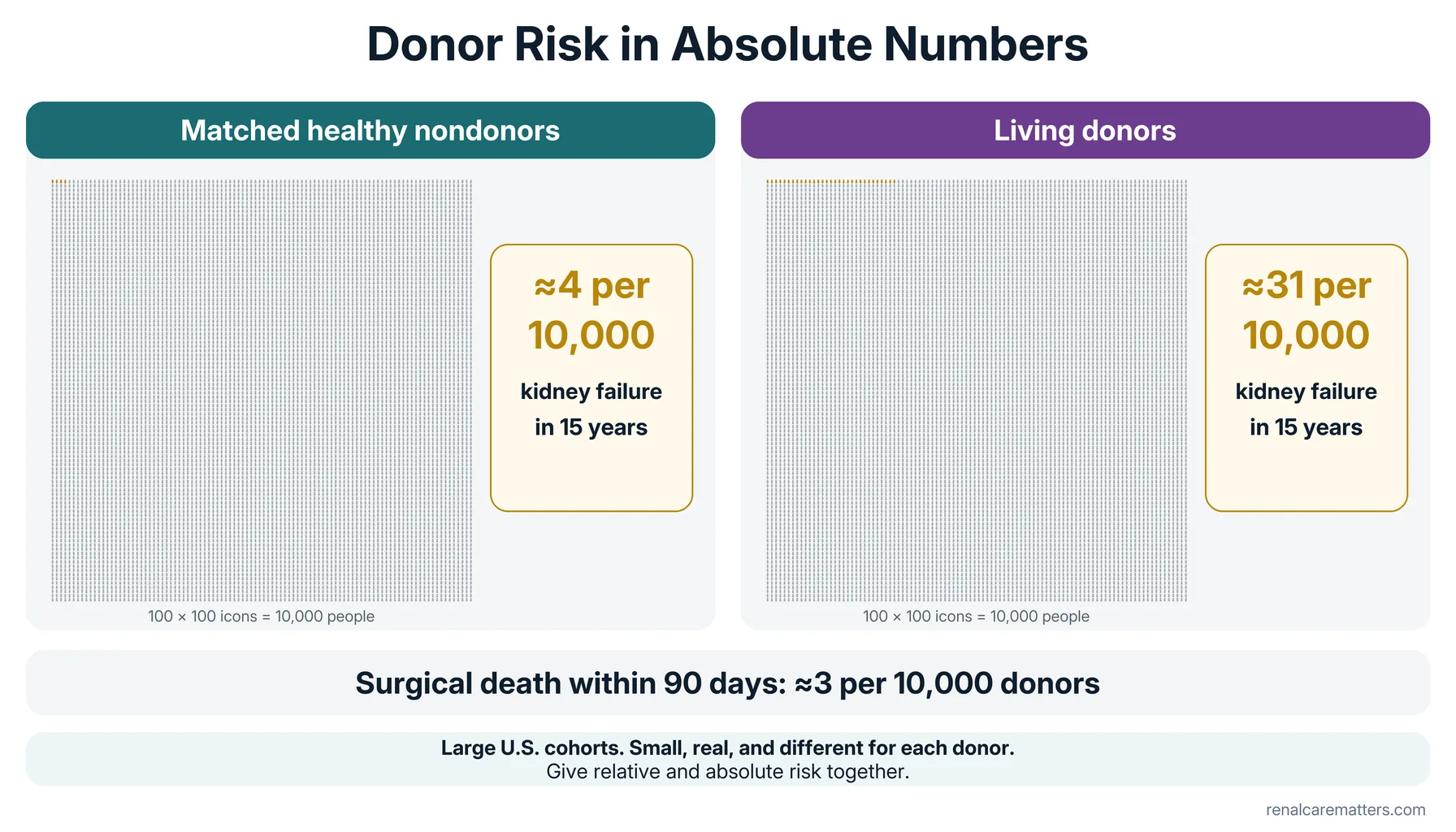
Figure 2. Donor risk in absolute numbers, from large United States cohorts. Small, real, and different for each donor.
Donors deserve numbers they can picture. The strongest data come from large United States cohorts; Philippine data are limited, so treat these as the best available estimates, not local guarantees.
Outcome
Best available estimate
Source and limit
Death within 90 days of surgery
3.1 per 10,000 donors (95% confidence interval (CI) 2.0 to 4.6); 36.7 per 10,000 in donors with hypertension vs 1.3 without
Now the arithmetic that confused Ms. Navarro. Thirty-one per 10,000 is about eight times 3.9 per 10,000: that is the relative risk. The absolute difference is about 27 extra cases of kidney failure per 10,000 donors over 15 years — roughly 1 in 370. Both statements are true. The first tells you the direction and size of the change; the second tells you how often it actually happens. Never give a donor one without the other.
These studies were observational. Donors and comparison groups differ in ways no matching fully removes, and the Norwegian study suggested that many donors who later developed kidney failure had an immunological kidney disease, sometimes possibly inherited — a reason the family history and the relationship matter in the evaluation.6
RememberGive every donor both numbers: how many times more likely, and how many out of 10,000. Relative risk alone frightens; absolute risk alone can mislead.
Lesson · part 3
The recipient’s schedule does not set the donor’s pace
The commonest pressure on a donor evaluation is not a person. It is a calendar: an operating room slot, a holiday, a recipient getting sicker. The donor’s medical gate closes only when the donor’s evaluating clinicians have reviewed every result and written their decision. The ethics gate closes only when the Hospital Transplant Ethics Committee (HTEC) has decided (Module 9). Neither may be closed to fit the recipient’s schedule.
Donor gate
Owner
Closed by
Medical suitability
Donor’s evaluating clinicians
A written decision on current results
Psychosocial readiness
Psychiatrist or clinical psychologist; social worker
Reports received and reviewed
Advocate review
Designated donor advocate
The advocate’s documented review
Ethics
HTEC
Written decision; conditions closed
Consent
Surgeon, with independent witnessing
Consent record (Module 8)
On the floor · The Christmas slot
A surgeon asks coordinator Mr. Leo Bautista to book a living-donor transplant for December 18 “while the OR is free.” The donor’s 24-hour blood pressure monitoring and psychiatric report are still pending.
Mr. Bautista replies with an Situation, Background, Assessment, Recommendation (SBAR) listing the two open donor gates and their owners, and books the earliest monitoring slot. The surgeon agrees to a provisional January date.
A free operating room is a resource, not a gate. The donor’s pace is set by the donor’s evaluation.
Illustrative scenario. Names and details are invented.
RememberNever let the recipient’s calendar close a donor gate. Show the open donor gates, with owners, to anyone who proposes a date.
Lesson · part 4
Safe for life means followed for life
“Safe for life” is not a promise anyone can make. What a program can promise is to watch for problems for life, so they are found early. KDIGO’s donor guideline asks programs to provide a personalized post-donation care plan and long-term follow-up, and the Department of Health (DOH) order makes lifetime monitoring part of the donor’s protection.1,7 Philippine Health Insurance Corporation (PhilHealth)’s post-transplant packages list living donor monitoring among their covered services.8
Start the follow-up plan before the donor leaves hospital: the schedule, the tests (blood pressure, weight, kidney function, urine albumin), where they will be done, who pays, and how the donor will be reminded. The donor follow-up planner drafts an example schedule to align with your protocol. Module 17 covers recall.
RememberBefore discharge, the donor leaves with a dated follow-up plan, a named contact, and a funding route.
On the floor
Real situations: problems and solutions
These are fictional but typical. For each one, cover the answer, decide what you would do, then compare. Where a step depends on local rules, your unit’s procedure and your supervisor’s direction come first.
“Zero risk”
What you see
A recipient tells the donor online that donating has “zero risk.”
What is likely going on
Well-meant misinformation.
What to do
Make sure the donor hears accurate numbers from the donor team.
Why it matters
Donors decide on what they believe.
The borderline reading
What you see
A donor’s clinic blood pressure is borderline once.
What is likely going on
Possibly white-coat, possibly real.
What to do
Route to the donor clinicians; arrange the measurements they order.
Why it matters
Hypertension changes surgical and lifetime risk.
The family history
What you see
A donor mentions her father was on dialysis for an unknown cause.
What is likely going on
Possible inherited risk.
What to do
Record it and route to the donor clinicians.
Why it matters
Inherited disease can affect a donor’s lifetime risk.
Field notes
Give relative and absolute risk together.
Use a picture of 10,000 people.
Show open donor gates to anyone proposing a date.
Start the follow-up plan before discharge.
Case review
Back to the case: “Am I safe for life?”
“Eight times” and “small.” Both are true. Draw it: out of 10,000 healthy people like her, about 4 would develop kidney failure over 15 years without donating; out of 10,000 donors, about 31 would. That is about eight times as many, but about 27 more people out of 10,000, roughly 1 in 370. Then encourage her to bring her questions back to her nephrologist, who can tailor the numbers to her.
The open gate. Her medical gate is open: the 24-hour blood pressure monitoring is pending, and a borderline reading in a 29-year-old matters for lifetime risk. Her evaluating clinicians decide. Tell the surgeon, by SBAR, which donor gates are open and who owns them; the recipient’s schedule does not close them.
“Safe for life.” No one can promise it. The program can promise yearly checks of blood pressure, weight, kidney function, and urine albumin for life, with a named contact and a funding route, starting before she leaves hospital.
Skills lab · with your preceptor
Skills checklist: Donor risk conversation support
Support a simulated donor risk discussion and draft a follow-up plan while your preceptor observes. Your preceptor rates each step as satisfactory, needs practice, or not observed. Steps marked Critical must all be satisfactory before sign-off. This checklist supports supervised learning; your unit’s own procedure and competency form are the authority. A printable version of every checklist is on the trainer page.
Explains the two questions of donor evaluation: safe now, and safe for a lifetime.
CriticalConverts a relative risk into an absolute difference per 10,000 correctly.
Uses a picture (an icon array or a drawing) to explain risk without giving clinical advice.
CriticalLists the donor’s open gates with owners in an SBAR when a date is proposed.
CriticalDrafts a post-donation follow-up plan with schedule, tests, place, funding, and contact.
Placement activity. Sit in on one donor risk discussion (with consent). Afterward, write down the numbers the donor heard and check that both relative and absolute risk were given.
Self-assessment
Check your understanding
Each visit draws 5 questions at random from this module’s 10-question bank. Choose the single best answer for each, then select Check answers; an explanation appears under the best answer. Select New set of questions for a different mix. A good target is 4 of 5 on two different sets. Nothing you select is sent anywhere; scoring happens in your browser.
Lentine, K. L., Kasiske, B. L., Levey, A. S., Adams, P. L., Alberú, J., Bakr, M. A., Gallon, L., Garvey, C. A., Guleria, S., Li, P. K., Segev, D. L., Taler, S. J., Tanabe, K., Wright, L., Zeier, M. G., Cheung, M., & Garg, A. X. (2017). KDIGO clinical practice guideline on the evaluation and care of living kidney donors. Transplantation, 101(8S Suppl 1), S1–S109. https://doi.org/10.1097/TP.0000000000001769
Grams, M. E., Sang, Y., Levey, A. S., Matsushita, K., Ballew, S., Chang, A. R., Chow, E. K., Kasiske, B. L., Kovesdy, C. P., Nadkarni, G. N., Shalev, V., Segev, D. L., Coresh, J., Lentine, K. L., & Garg, A. X. (2016). Kidney-failure risk projection for the living kidney-donor candidate. The New England Journal of Medicine, 374(5), 411–421. https://doi.org/10.1056/NEJMoa1510491
Segev, D. L., Muzaale, A. D., Caffo, B. S., Mehta, S. H., Singer, A. L., Taranto, S. E., McBride, M. A., & Montgomery, R. A. (2010). Perioperative mortality and long-term survival following live kidney donation. JAMA, 303(10), 959–966. https://doi.org/10.1001/jama.2010.237
Lentine, K. L., Lam, N. N., Axelrod, D., Schnitzler, M. A., Garg, A. X., Xiao, H., Dzebisashvili, N., Schold, J. D., Brennan, D. C., Randall, H., King, E. A., & Segev, D. L. (2016). Perioperative complications after living kidney donation: A national study. American Journal of Transplantation, 16(6), 1848–1857. https://doi.org/10.1111/ajt.13687
Muzaale, A. D., Massie, A. B., Wang, M. C., Montgomery, R. A., McBride, M. A., Wainright, J. L., & Segev, D. L. (2014). Risk of end-stage renal disease following live kidney donation. JAMA, 311(6), 579–586. https://doi.org/10.1001/jama.2013.285141
Mjøen, G., Hallan, S., Hartmann, A., Foss, A., Midtvedt, K., Øyen, O., Reisæter, A., Pfeffer, P., Jenssen, T., Leivestad, T., Line, P. D., Øvrehus, M., Dale, D. O., Pihlstrøm, H., Holme, I., Dekker, F. W., & Holdaas, H. (2014). Long-term risks for kidney donors. Kidney International, 86(1), 162–167. https://doi.org/10.1038/ki.2013.460
Educational material for transplant coordination staff. Completing it is an Academy learning record only. It is not a DOH-recognized training credit, a PhilHealth requirement, a certification, or CPD units, and it does not appoint anyone as a donor advocate or confer any clinical authority.