Blood group, tissue type, antibodies and crossmatch in plain words, sensitizing events, and the specimen chain.
PublishedNailathalaGipatikPepalwal:ReferencesMga SanggunianMga TinubdanReng Reperensya:1Audience: Clinical transplant coordinators (usually registered nurses) and coordination-support staff in Philippine kidney transplant programs · Z Benefits coordinators · transplant and dialysis staff who refer, prepare, or follow recipients and living donorsRead timeOras ng pagbasaOras sa pagbasaOras ning pamamasa:
Training track for the people who navigate kidney recipients and living donors
This module is study material for kidney transplant coordinators and coordination-support staff. It explains the reasoning behind coordination decisions; it is not a hospital protocol, legal advice, or a benefits ruling. Rules and rates change: confirm every rule against the current issuance and your facility’s approved policy. Medical decisions belong to the transplant team, donation ethics to the ethics committee, and benefits to PhilHealth. Every case, name, and identifier is fictional.
Learning objectives
After this module you should be able to
Explain blood group, tissue type, antibodies, and crossmatch in plain words, and why each matters.
Recognize sensitizing events and make sure they reach the transplant team and the HLA laboratory.
Protect the specimen chain from labeling to laboratory receipt.
Relay a critical compatibility result with read-back, without interpreting it.
Classroom 2 hSkills lab 2 hSupervised placement 2 h
Pre-testBefore you read, answer the 5 self-assessment questions and note your score. After the module, select New set of questions and compare. The difference is what you learned; the questions you still miss are what to reread.
Start here
The big picture, in plain words
In plain wordsThink of the immune system as a security guard with a very good memory for faces. Every cell in your body carries a kind of ID badge. The guard ignores your own badges and attacks strangers. A transplanted kidney arrives wearing someone else’s badges, so the team needs to know two things: how different the new badges are, and whether the guard has already met, and learned to hate, badges like them.
The picture has a limit. Real immune memory is not a single guard but many cells, and the “badges” come in several kinds. Two matter most for a coordinator to understand. The first is the ABO blood group, the same system used for blood transfusion: people make antibodies against blood groups they do not have, so a group O recipient cannot receive a standard kidney from a group A donor. The second is the human leukocyte antigen (HLA) system, the tissue type. A recipient can carry antibodies against HLA from earlier exposure to someone else’s tissue. If those antibodies match the donor’s HLA — a donor-specific antibody (DSA) — the kidney can be attacked, sometimes within hours.
Your job is not to interpret any of this. Your job is to keep the samples trustworthy, keep the laboratory informed about anything that can change a person’s antibodies, and get critical results to the right clinician fast.
Figure 1 · Key terms for this module
ABO blood groupGroups O, A, B, and AB. Standard transplants follow blood-transfusion compatibility.
HLA (tissue type)Markers on cells that the immune system uses to recognize self.
HLA antibodiesAntibodies a person has made against other people’s HLA.
Calculated panel reactive antibody (cPRA)An estimate of the share of donors a person would likely react against.
CrossmatchA laboratory test that mixes recipient serum with donor cells or HLA to look for a reaction.
Sensitizing eventAn exposure that can create new HLA antibodies: blood transfusion, pregnancy, or a previous transplant.
Opening case · fictional
Case: The transfusion nobody mentioned
Mr. Allan Ramos, 44, is on the waiting list and has a living donor, his wife, Mrs. Cora Ramos, under evaluation. His last HLA antibody screen, three months ago, showed few antibodies.
On a Saturday he is admitted to a district hospital in Laguna for bleeding from a dialysis access and receives two units of packed red cells. He goes home Monday. Nobody tells the transplant center.
On Wednesday you are preparing the final crossmatch samples for both. At the bedside, the recipient’s tube is labeled with his name only; the request form has his name and hospital number. The courier to the HLA laboratory is waiting at the door.
Before reading on, decide:
Why does the transfusion matter, and who must know?
What do you do with the half-labeled tube?
If the laboratory later phones a positive crossmatch, what is your role?
Keep your answers in mind. The lesson gives you what you need, and the case review near the end shows one sound response.
Lesson · part 1
Two systems in plain words
A coordinator does not need immunology to coordinate well, but needs enough to know why the steps exist.
Test
The question it answers
What changes it
ABO blood group
Are recipient and donor blood groups compatible?
Nothing; it is fixed (except in rare situations the team handles)
HLA typing
What tissue type do recipient and donor have?
Nothing; it is fixed
HLA antibody screen (and cPRA)
Which HLA does the recipient have antibodies against?
The last two rows explain the coordinator’s duty. Antibodies change; blood group and tissue type do not. Kidney Disease: Improving Global Outcomes (KDIGO) advises HLA antibody testing at evaluation and at regular intervals before transplant, and that all sensitizing events, and clinical events that can affect antibody levels, be communicated to the HLA laboratory.1 A transfusion in another hospital that nobody reports can make a three-month-old antibody result describe a different person.
A high cPRA means a person reacts to many potential donors and may wait longer; a separate site guide explains how programs approach highly sensitized candidates. ABO-incompatible or HLA-incompatible transplant programs exist in some centers, but whether and how to use them is a clinical decision.
RememberBlood group and tissue type stay the same; antibodies change. Every transfusion, pregnancy, or previous transplant must reach the team and the HLA laboratory.
Lesson · part 2
Ask, every time
Sensitizing events happen outside the transplant center: a transfusion during an emergency, a pregnancy, a miscarriage, a surgery elsewhere. People rarely think to mention them. Build the question into every contact.
At every monthly or waiting-list contact: “Since we last spoke, have you been admitted anywhere, had a blood transfusion, been pregnant, or had any surgery?”
Ask the person’s dialysis unit to tell you of any transfusion, and give them a direct number.
Record the date and place of the event, and request the transfusion record if possible.
Tell the transplant physician and the HLA laboratory the same day, through the program’s channel.
On the floor · The miscarriage
At a waiting-list call, a candidate mentions she had a miscarriage two months ago and was treated in a provincial hospital. She did not think it mattered.
Coordinator Ms. Ana Lim thanks her, records the date in the candidate’s file, and notifies the transplant physician and the HLA laboratory that afternoon. The laboratory asks for a new sample at her next dialysis session.
Pregnancy, including one that ends early, can create HLA antibodies. The person did not know; the question found it.
Illustrative scenario. Names and details are invented.
RememberAsk about admissions, transfusions, pregnancies, and surgeries at every contact, and report the same day.
Lesson · part 3
A sample is only as good as its weakest link
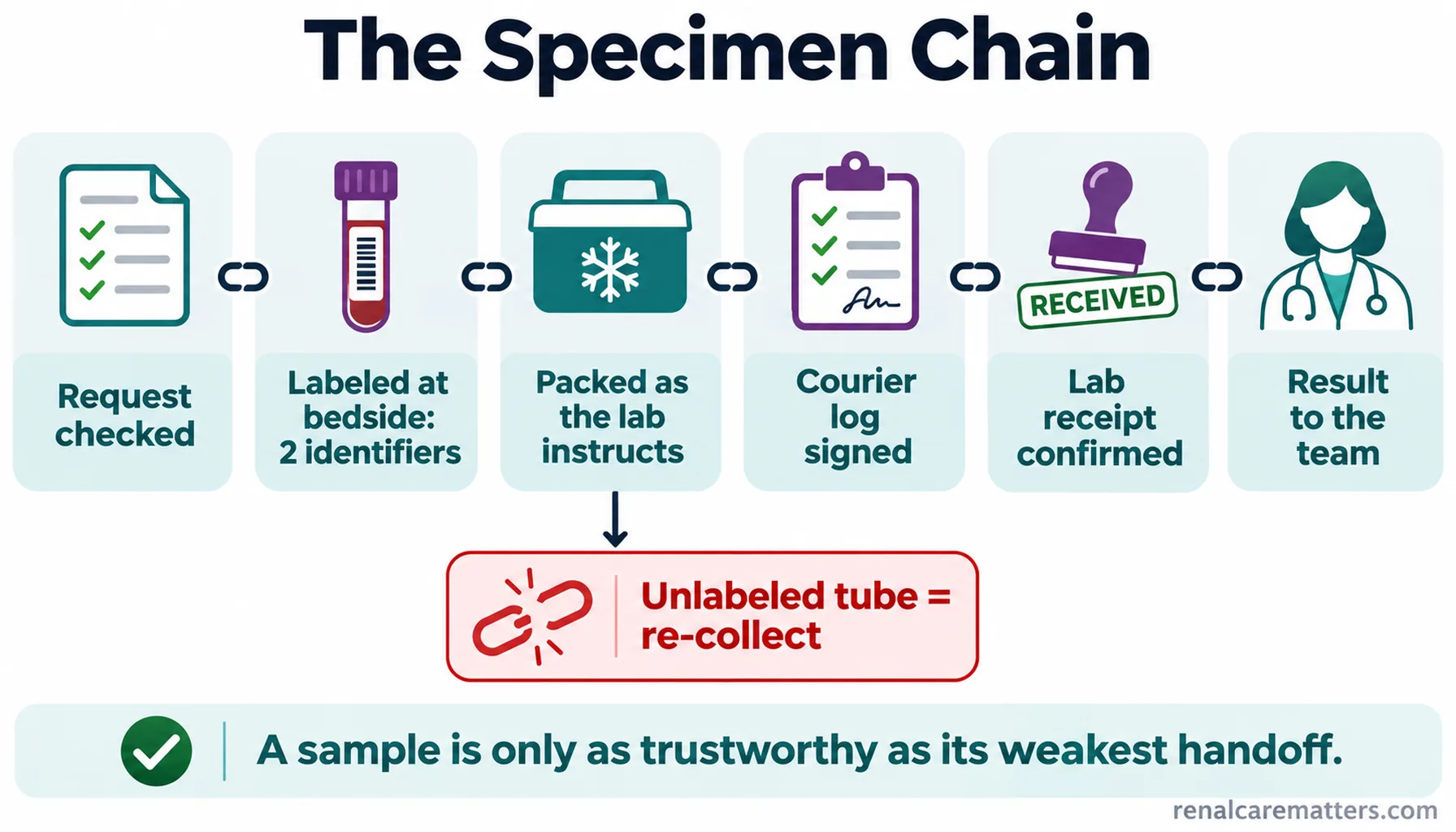
Figure 2. The specimen chain. A sample is only as trustworthy as its weakest handoff.
A compatibility result is only as trustworthy as the sample behind it. A mislabeled or delayed tube can produce a result that belongs to someone else, or a result that no longer describes the person.
Link
What can go wrong
Control
Request
Wrong test, wrong donor paired
Check the request against the team’s order and the pairing
Collection and labeling
Wrong patient, incomplete label
Two identifiers on the tube, labeled at the bedside, at the time of collection
Packaging
Wrong temperature, leaking tube
Follow the laboratory’s transport instructions and container
Transport
Delay, loss
A courier log with times and signatures
Receipt
Sample unaccounted for
The laboratory confirms receipt; you record it
An incompletely labeled sample is never repaired after collection. Writing the second identifier on the tube later, or asking the courier to do it, breaks the link between the tube and the person. Re-collect and relabel at the bedside, and let the courier wait or reschedule.
RememberLabel at the bedside with two identifiers. A tube labeled later is a tube of unknown origin.
Lesson · part 4
Relay critical results, do not interpret them
Compatibility results can change the plan in an hour. When the laboratory calls with a critical result — a positive crossmatch, a new donor-specific antibody, a blood-group discrepancy — three things matter: speed, accuracy, and the right recipient of the message.
Write the result down as stated, with the caller’s name and time.
Read it back to the caller and confirm.
Call the transplant physician on duty at once; read it again.
Record who received it and when. Close the loop when the physician confirms the next step.
Do not tell the recipient or donor what the result means. A positive crossmatch has several possible explanations and responses, all of them clinical. If a family asks, say truthfully that a result has come in and the doctor will speak with them.
RememberWrite it, read it back, route it, record it. The meaning of the result belongs to the team.
On the floor
Real situations: problems and solutions
These are fictional but typical. For each one, cover the answer, decide what you would do, then compare. Where a step depends on local rules, your unit’s procedure and your supervisor’s direction come first.
The unlabeled backup tube
What you see
A nurse hands you an extra unlabeled tube “in case the lab needs more.”
What is likely going on
Well-meant, unsafe.
What to do
Discard it per policy; collect any extra sample labeled at the bedside.
Why it matters
An unlabeled tube can become someone else’s result.
The late courier
What you see
The courier will arrive after the laboratory’s cut-off.
What is likely going on
A timing risk.
What to do
Call the laboratory and team; arrange storage or another courier as the laboratory instructs.
Why it matters
Some samples degrade with time and temperature.
The new pregnancy
What you see
A wait-listed candidate tells you she is pregnant.
What is likely going on
A sensitizing event and a major clinical change.
What to do
Route to the transplant physician and HLA laboratory today; support her.
Why it matters
Pregnancy affects antibodies and the whole plan.
Field notes
Ask about transfusions, pregnancies, and surgeries at every contact.
Label at the bedside with two identifiers.
Log courier times and laboratory receipt.
Read back critical results; never interpret them.
Case review
Back to the case: The transfusion nobody mentioned
The transfusion. Two units of red cells can create new HLA antibodies, so Mr. Ramos’s three-month-old antibody screen may no longer describe him, and his wife’s crossmatch could change. Tell the transplant physician and the HLA laboratory today, with the date, place, and units, and request the transfusion record from the Laguna hospital. Ask his dialysis unit to report future transfusions directly.
The tube. Do not send it and do not add the hospital number yourself. Re-collect and label at the bedside with two identifiers; let the courier wait or reschedule. Record the re-collection.
A positive crossmatch. Write it down, read it back, call the transplant physician at once, and record the handoff. Do not interpret it for the couple. The team will decide what it means and what to do next.
Skills lab · with your preceptor
Skills checklist: Specimen chain and critical result relay
Prepare, label, package, and dispatch a mock compatibility specimen, and relay a mock critical result, while your preceptor observes. Your preceptor rates each step as satisfactory, needs practice, or not observed. Steps marked Critical must all be satisfactory before sign-off. This checklist supports supervised learning; your unit’s own procedure and competency form are the authority. A printable version of every checklist is on the trainer page.
Explains ABO, HLA, antibodies, cPRA, and crossmatch in plain words.
CriticalAsks a candidate about admissions, transfusions, pregnancies, and surgeries since last contact.
CriticalReports a sensitizing event to the transplant physician and the HLA laboratory the same day.
CriticalRefuses to dispatch an incompletely labeled tube and arranges re-collection.
Completes a courier log and confirms laboratory receipt.
CriticalRelays a critical result with read-back and records the handoff, without interpreting it.
Placement activity. Follow one real compatibility sample from request to laboratory receipt and map every handoff.
Self-assessment
Check your understanding
Each visit draws 5 questions at random from this module’s 10-question bank. Choose the single best answer for each, then select Check answers; an explanation appears under the best answer. Select New set of questions for a different mix. A good target is 4 of 5 on two different sets. Nothing you select is sent anywhere; scoring happens in your browser.
Chadban, S. J., Ahn, C., Axelrod, D. A., Foster, B. J., Kasiske, B. L., Kher, V., Kumar, D., Oberbauer, R., Pascual, J., Pilmore, H. L., Rodrigue, J. R., Segev, D. L., Sheerin, N. S., Tinckam, K. J., Wong, G., & Knoll, G. A. (2020). KDIGO clinical practice guideline on the evaluation and management of candidates for kidney transplantation. Transplantation, 104(4S1 Suppl 1), S11–S103. https://doi.org/10.1097/TP.0000000000003136
Educational material for transplant coordination staff. Completing it is an Academy learning record only. It is not a DOH-recognized training credit, a PhilHealth requirement, a certification, or CPD units, and it does not appoint anyone as a donor advocate or confer any clinical authority.