Two protected journeys, four systems at every gate, the barrier register, and coordinating within authority.
PublishedNailathalaGipatikPepalwal:ReferencesMga SanggunianMga TinubdanReng Reperensya:6Audience: Clinical transplant coordinators (usually registered nurses) and coordination-support staff in Philippine kidney transplant programs · Z Benefits coordinators · transplant and dialysis staff who refer, prepare, or follow recipients and living donorsRead timeOras ng pagbasaOras sa pagbasaOras ning pamamasa:
Training track for the people who navigate kidney recipients and living donors
This module is study material for kidney transplant coordinators and coordination-support staff. It explains the reasoning behind coordination decisions; it is not a hospital protocol, legal advice, or a benefits ruling. Rules and rates change: confirm every rule against the current issuance and your facility’s approved policy. Medical decisions belong to the transplant team, donation ethics to the ethics committee, and benefits to PhilHealth. Every case, name, and identifier is fictional.
Learning objectives
After this module you should be able to
Map the recipient’s and the living donor’s journeys as two separate pathways with separate decision rights.
Apply the four-gate question (medical, legal, ethical, insurance) at every step of both pathways.
Build a barrier register row that names an owner, a due date, and the evidence that will close it.
Tell clinical coordination apart from procurement coordination, donor advocacy, and Z Benefits work.
Write an Situation, Background, Assessment, Recommendation (SBAR) request that asks a named decision maker for a specific decision by a specific time.
Classroom 2 hSkills lab 2 hSupervised placement 2 h
Pre-testBefore you read, answer the 5 self-assessment questions and note your score. After the module, select New set of questions and compare. The difference is what you learned; the questions you still miss are what to reread.
Start here
The big picture, in plain words
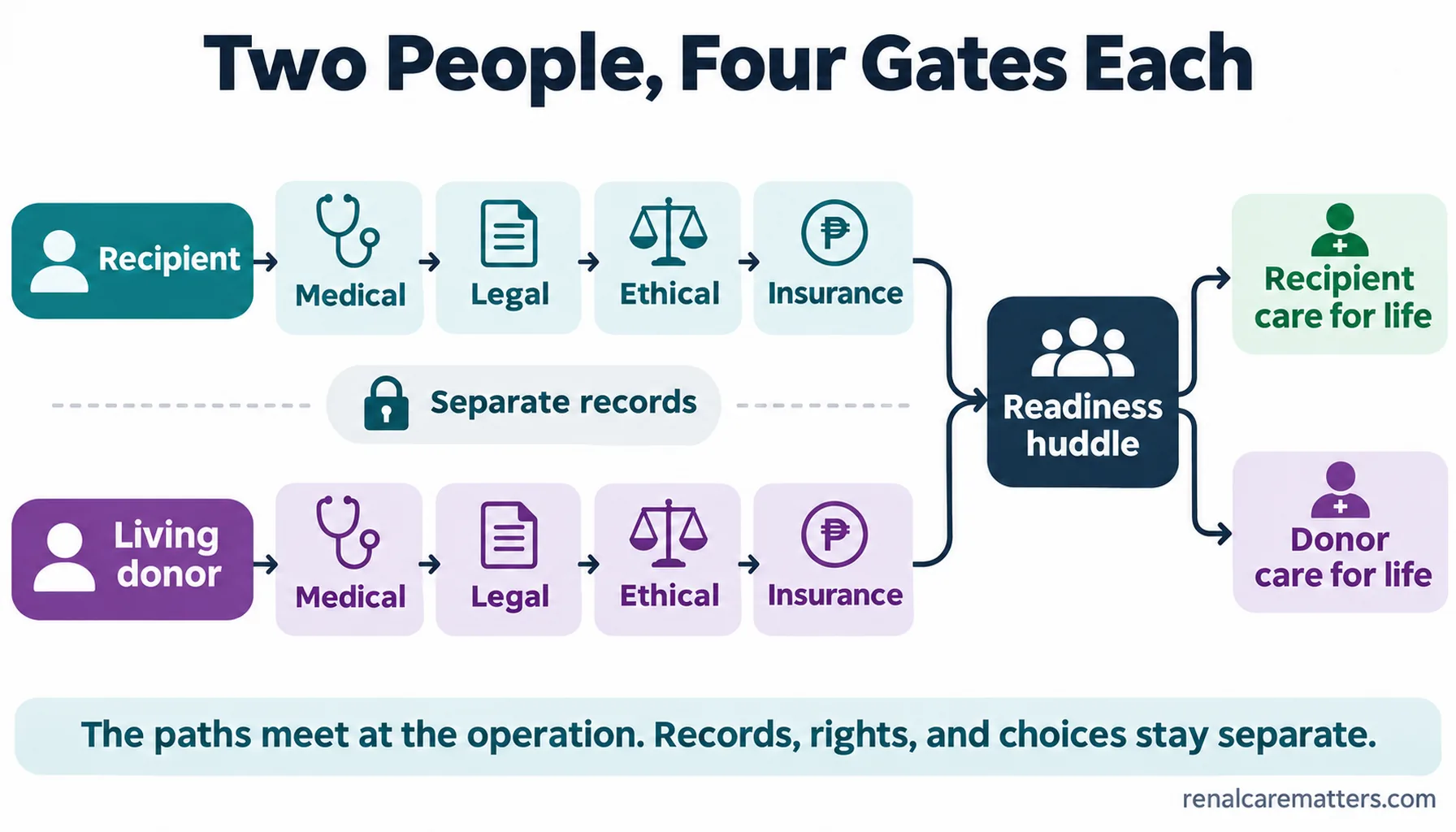
In plain wordsPicture an airport with two travelers who are going to the same city. One is a patient flying home for treatment; the other is a volunteer flying with them to help. Each has their own passport, their own ticket, their own baggage, and their own right to turn back at the gate. Both must clear the same four checkpoints — health, immigration, security, and the ticket counter — and no checkpoint will wave anyone through because another checkpoint already did. The transplant coordinator is the airline’s escort for both travelers.
Figure 1. Two journeys, four gates each. The paths meet at the operation; the records, rights, and choices stay separate.
The picture has a limit. At an airport the volunteer is there for a short trip and comes home unchanged. A living kidney donor accepts a surgical risk and a small, lifelong change in kidney function, and gets no medical benefit from the operation. That is why the donor’s checkpoints are not a copy of the recipient’s. They are designed to protect someone who is healthy, and their gates include one the recipient does not face: the question of whether the gift is truly free.
Your job in this module is to learn the map. Most failures in a transplant program are not dramatic. A referral that nobody acknowledged. A test that expired the week before the case conference. A donor who wanted to stop but did not know how to say so in private. A family that believed a signed insurance form meant the surgery was approved. Each of these is a coordination failure, and each is preventable by the same habit: keep the two journeys separate, ask the four questions at every gate, and close each step with evidence from the person who owns it.
Figure 2 · Key terms for this module
RecipientThe person with kidney failure who may receive the kidney.
Living donorA healthy person who may give a kidney. The donor has their own team, record, rights, and choices.
GateA point where a decision must be made before the journey continues.
Four systemsMedical, legal, ethical, and insurance. Each gate asks all four questions.
Barrier registerA table of every open problem: who it affects, the owner, the next action, the due date, and what will prove it is closed.
SBARSituation, background, assessment, request: a short structure for asking someone to decide.
Opening case · fictional
Case: One family, two journeys, one folder
You have been the clinical transplant coordinator at a Quezon City transplant center for two weeks. Mrs. Lorna Bautista, 47, has been on hemodialysis for three years. Her younger brother, Mr. Ramon Castillo, 41, has started donor testing.
At 10:15 a.m. Mrs. Bautista calls, delighted. “The Philippine Health Insurance Corporation (PhilHealth) form was signed this morning. So the operation is approved, right? Can we book it for next month?”
At 11:40 a.m. Mr. Castillo stops you in the corridor and asks, very quietly, whether he is allowed to stop the tests. He does not say why. He asks you not to tell his sister.
At 2:00 p.m. the unit manager suggests a timesaver: “Put the brother’s papers in the sister’s folder. One family, one folder. Easier for everyone.”
Before reading on, decide:
What is the next safe action for Mrs. Bautista, and what will you tell her about the PhilHealth form?
What is the next safe action for Mr. Castillo, and what may you not disclose?
How do you answer the unit manager, and what will you put in the barrier register today?
Keep your answers in mind. The lesson gives you what you need, and the case review near the end shows one sound response.
Lesson · part 1
One relationship, two people
Start with the idea every later module rests on. A transplant links two people. It does not merge them.
The recipient seeks treatment for their own illness. The donor accepts a risk for someone else’s benefit. Their interests overlap, but they are not the same, and sometimes they pull in opposite directions. A recipient may hope the donor never hesitates. A donor may need, at any point, to stop. The program serves both by keeping them apart where it matters: separate records, separate conversations, separate consent, separate contact preferences, and a separate team member who looks out for the donor alone.
Kept separate
Why
What may be shared
Medical record and test results
Each person’s health information belongs to them
Only what each person authorizes
Private conversations
A donor cannot speak freely with the recipient or family listening
Nothing, unless the person chooses
Reasons for stopping
A donor’s reasons can expose them to pressure or blame
A neutral, agreed statement only
Insurance and funding plans
Different packages, different responsibilities
The shared timeline, when both agree
Next-step plans
Each person has different gates and deadlines
Milestones both have agreed to share
The shared view — what a family sees on a joint update — shows only the milestones both people have agreed to share. Everything else lives in each person’s own record. This is not secrecy for its own sake. The Department of Health (DOH) order on living donation builds the same separation into its safeguards: an advocate for the donor, separate psychosocial review, and the donor’s right to withdraw.1
RememberTwo people, two records, two sets of rights. The shared view shows only what both have agreed to share.
On the floor · The joint update
Coordinator Ms. Arlene Ramos gives a weekly phone update to a recipient and his wife. The wife asks whether the donor, a cousin, “finished his blood tests.”
Ms. Ramos answers: “I can tell you everything about your husband’s next steps. Your cousin’s information is his to share; I’ll let him know you asked.” She then calls the cousin, who says he would rather update them himself.
The update stayed useful, and the donor kept control of his own story.
Illustrative scenario. Names and details are invented.
Lesson · part 2
Ask all four questions, every time
At every step — referral, workup, approval, scheduling, discharge, transfer — ask four questions for each person.
Medical. Has the authorized clinician made the decision this step needs, on current results?
Legal. Are the documents authentic, current, and complete, and is consent valid?
Ethical. Are the protections complete: voluntariness, no reward, the advocate, the ethics committee review?
Insurance. Is the funding route confirmed in writing, for this person, under the right version of the rule?
The four systems do not answer for each other. A completed laboratory request is not a medical clearance. An insurance pre-authorization is not consent. A signed consent is not ethics approval. A free operating slot is not readiness. When a family hears “the form was signed,” they naturally hear “it is approved.” Part of your job is to say, gently and precisely, which approval that was and which ones are still open.
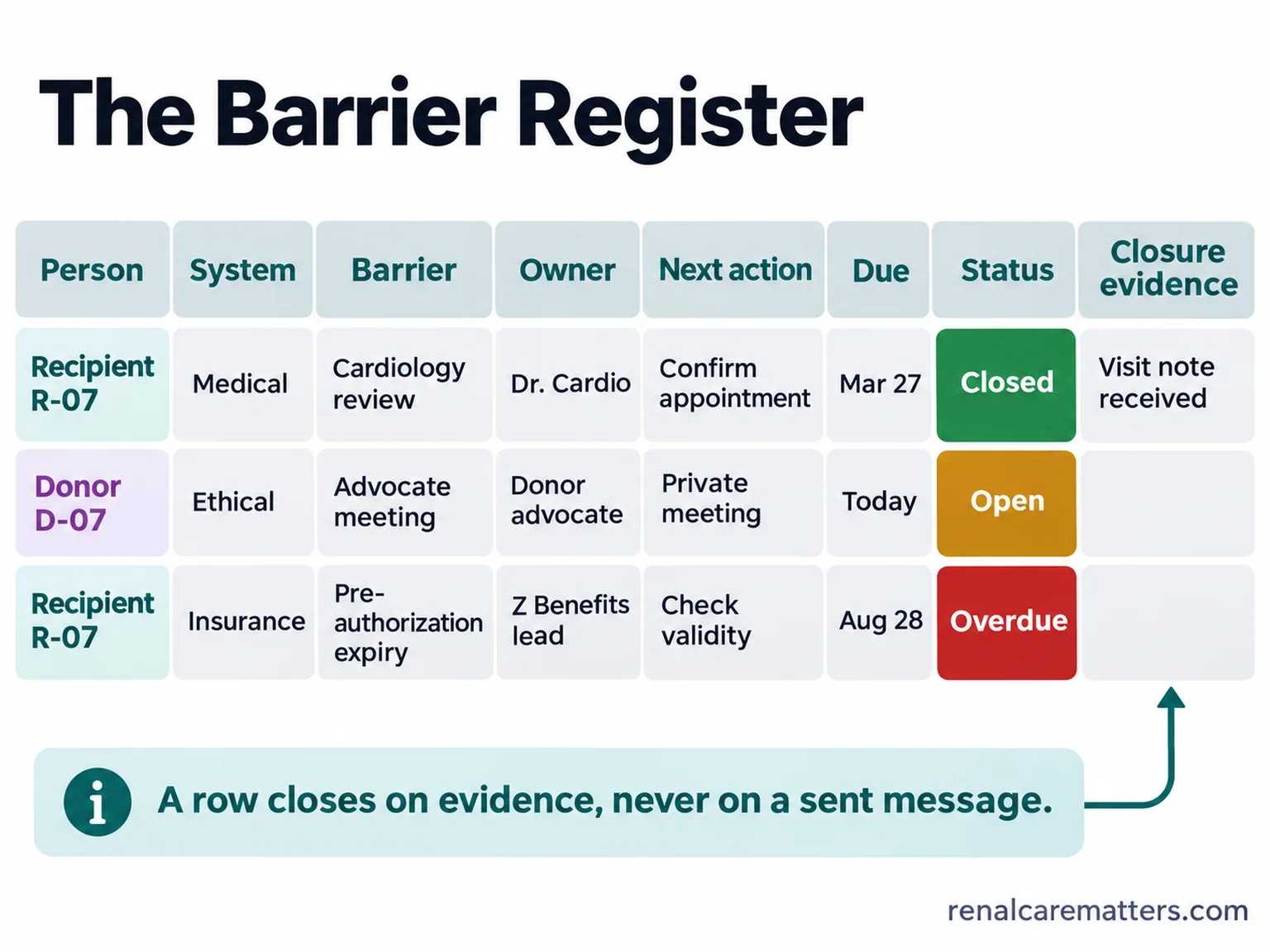
Figure 3. The barrier register. A row closes on evidence from the responsible service, never on a sent message.
The barrier register
Every open problem gets one row. A row has ten fields: the person (by case pseudonym in any shared list), the system, the barrier, the risk if it stays open, the owner, the next action, the due date, the escalation contact, the status, and the closure evidence with its date. The last field is the one people skip, and it is the one that matters most. A row closes only when the service that owns it confirms the work is done — an appointment that happened, a result reviewed, a decision written. An email that left your outbox closes nothing.
The barrier register aging tool in the toolkit turns a row’s open date and due date into days open, days overdue, and an escalation tier.
RememberA sent message is not a closed loop. A row closes on evidence from the service that owns it.
On the floor · The cardiology referral
On March 3 coordinator Mr. Paolo Navarro sends a cardiology referral for a recipient. On March 20 the register shows it as “sent.” He calls cardiology: no appointment exists; the fax went to a retired number.
He resends to the current number, gets a verbal acknowledgment with a name, books the slot himself through the clinic secretary, and updates the row: “Appointment confirmed for March 27 by Ms. Ocampo, cardiology clinic.” He closes it only after the visit note arrives.
Seventeen days were lost to a status that described an action, not an outcome.
Illustrative scenario. Names and details are invented.
Lesson · part 3
Who decides what
The coordinator is the person who keeps the next step clear and follows it to completion. The coordinator is not the person who decides whether it happens. Learn the owners now; every later module uses this table.
Decision
Owner
What you do
Recipient medical suitability
The transplant multidisciplinary team
Assemble the evidence, prepare the case conference, record the decision
Donor medical suitability
The donor’s evaluating clinicians
Coordinate the workup on the donor’s own pathway
Donor surgical consent
The surgeon, with independent witnessing under the DOH order
Arrange the meeting, interpreter, and witnesses
Ethics of a living donation
The Hospital Transplant Ethics Committee (HTEC)
Prepare a complete submission; track conditions
Benefits
PhilHealth and other payers, under the applicable circular
Assemble the request; track validity and deadlines
Organ acceptance
The transplant physician or surgeon on call
Capture the offer with read-back; convene the team
Four job titles get confused. A clinical transplant coordinator guides recipients and donors through the program within a facility-assigned clinical scope. A procurement coordinator manages deceased donors and organ retrieval, a separate role the DOH defines for deceased donation.2 A donor advocate is designated under the DOH living-donor order to protect the donor’s interests; a job title or this course does not make anyone one.1 A Z Benefits Coordinator handles PhilHealth package navigation and evidence; each contracted facility must have at least one, and one coordinator may handle at most three Z packages.3 One person may hold more than one of these roles only if the hospital assigns them in writing and the conflicts are managed — and the recipient’s coordinator should never quietly stand in for the donor’s advocate.
Asking for a decision: SBAR
When you need a decision, ask in four parts. Situation: what needs deciding. Background: the facts the decision maker needs. Assessment: your view of the coordination problem — not a clinical judgment. Request: the specific decision, from whom, by when. “FYI, some tests are old” asks for nothing. “Please decide by Friday whether the 14-month-old stress test must be repeated before Tuesday’s conference” asks for exactly one thing.
RememberYou coordinate decisions; you do not make them. Every SBAR ends with a named person, one decision, and a time.
Lesson · part 4
What the evidence shows, and what it does not
Why invest in a coordinator at all? Because transplantation is, for most people with kidney failure who can have one, the better long-term treatment — and because many people who could benefit never finish the steps to get there.
Start with the benefit. A systematic review of 110 cohort studies, covering about 1.9 million people, found that kidney transplantation was associated with lower mortality, fewer cardiovascular events, and substantially better quality of life than chronic dialysis.4 These were observational studies: healthier people are more likely to be transplanted, and no trial has randomized people to transplant or dialysis. A large United States registry study tried to reduce that bias by comparing transplant recipients only with people already on the waiting list. Death risk was higher in the first two weeks after transplant (relative risk 2.8, reflecting the operation itself) and then fell well below the wait-listed group, to a relative risk of 0.32 by 18 months.5 That early dip in safety is one reason readiness matters so much (Module 14).
Now the gap. People stall at different steps: interest, referral, the first visit, the workup, finding a donor. In a cluster randomized trial in 23 hemodialysis units in Ohio, 167 patients were assigned to monthly meetings with trained transplant-recipient navigators or to usual care. Navigated patients completed 3.5 transplant-process steps against 1.6 in the control group (difference 1.9 steps; 95% confidence interval 1.3 to 2.5), with similar effects across race and sex.6 The trial measured steps completed, a process outcome. It did not show that navigation increased the number of transplants or improved survival, and its navigators were peers, not hospital coordinators. Still, the mechanism is the one this course teaches: someone who knows the next step, removes the barrier, and follows up.
Claim
Strength
Say it as
Transplant is associated with longer life than dialysis
Many consistent cohorts; no randomized trial
“is associated with”
Navigation increases steps completed
One randomized trial, 167 patients
“a trial showed more steps completed”
Navigation increases transplants
Not shown by that trial
“has not been shown”
RememberMatch your words to the evidence. “Associated with” for cohorts, “showed” for trials, and say what a study did not measure.
On the floor
Real situations: problems and solutions
These are fictional but typical. For each one, cover the answer, decide what you would do, then compare. Where a step depends on local rules, your unit’s procedure and your supervisor’s direction come first.
“Approved na!”
What you see
A recipient posts on social media that her transplant is “approved” the day her pre-authorization arrives.
What is likely going on
One approval heard as all approvals.
What to do
Call her, celebrate the step, and name the approvals still open: medical, donor, ethics. Agree on what she will tell family.
Why it matters
Families plan leave, travel, and money around what they believe is approved.
The donor in the waiting room
What you see
A potential donor arrives for testing with the recipient, who insists on joining every appointment.
What is likely going on
Love, anxiety, or control; you cannot tell which.
What to do
Welcome both; explain that donor visits are private by program rule; offer the recipient a separate update.
Why it matters
A rule that applies to everyone protects the donor without accusing anyone.
The register nobody reads
What you see
Your predecessor’s barrier register has 60 rows marked “sent.”
What is likely going on
Actions recorded as outcomes.
What to do
Review each row for closure evidence; reopen those without it; call owners for the oldest first.
Why it matters
A register of sent messages hides every open loop.
Field notes
Say which approval you mean every time you say “approved.”
Keep a printed decision-owner table by your phone.
Close register rows only with evidence from the owner.
Open the donor’s record on day one, separate from the recipient’s.
Case review
Back to the case: One family, two journeys, one folder
Mrs. Bautista. Thank her for the good news and name the approval precisely: “That form is PhilHealth’s pre-authorization. It tells us how the operation can be paid for. The transplant team still has to finish your medical review, your brother has his own separate evaluation, and the ethics committee has its review. I’ll call you on Friday with your next step.” Record the pre-authorization date in the register; its 180-day validity clock has started (Module 10).
Mr. Castillo. Thank him for asking. Tell him that yes, he may pause or stop at any time, and that this conversation stays private. Offer a confidential meeting with his designated donor advocate and the donor team, today if he wishes. Do not ask him to explain himself to you, and do not tell his sister anything except what he later agrees to. Record the fact of the request, factually and briefly, in his restricted record.
The unit manager. Decline the shared folder kindly and explain: “Their records have to stay separate under our donor safeguards and privacy rules. I can give you one shared timeline that shows only the milestones both have agreed to share.” Open two register rows: the donor’s request for a confidential meeting (owner: donor advocate; due today) and the recipient’s open gates (owner: transplant team; next review Friday).
None of these actions decided anything clinical. Each one made sure the right person would decide, and that each person knew exactly where they stood.
Skills lab · with your preceptor
Skills checklist: Two pathway maps and an SBAR
Using a fictional recipient and donor, build both pathway maps and a barrier register while your preceptor observes. Your preceptor rates each step as satisfactory, needs practice, or not observed. Steps marked Critical must all be satisfactory before sign-off. This checklist supports supervised learning; your unit’s own procedure and competency form are the authority. A printable version of every checklist is on the trainer page.
Draws separate recipient and donor pathways, each with medical, legal, ethical, and insurance gates.
CriticalExplains which information may appear in the shared view and which stays in each person’s record.
CriticalWrites three barrier register rows with owner, due date, escalation contact, and closure evidence.
Distinguishes clinical coordination, procurement coordination, donor advocacy, and Z Benefits roles.
CriticalExplains to a simulated recipient which approval a signed payer form represents, and which remain open.
Writes and delivers one SBAR that names a decision maker, one decision, and a time.
CriticalResponds to a simulated donor’s private request to stop without disclosing it.
Placement activity. Shadow a coordinator for one clinic day. List every handoff you see and mark which ones were closed with evidence from the receiving service.
Self-assessment
Check your understanding
Each visit draws 5 questions at random from this module’s 10-question bank. Choose the single best answer for each, then select Check answers; an explanation appears under the best answer. Select New set of questions for a different mix. A good target is 4 of 5 on two different sets. Nothing you select is sent anywhere; scoring happens in your browser.
Go deeper
Read next on this site
Kidney TransplantThe patient guide to kidney transplantation, to see the journey from the patient’s side.
Department of Health. (2010). Administrative Order No. 2010-0019 on deceased organ donation, including procurement and clinical transplant coordinators, as amended by Administrative Order No. 2010-0019-A. https://elibrary.judiciary.gov.ph/thebookshelf/showdocs/10/52063
Tonelli, M., Wiebe, N., Knoll, G., Bello, A., Browne, S., Jadhav, D., Klarenbach, S., & Gill, J. (2011). Systematic review: Kidney transplantation compared with dialysis in clinically relevant outcomes. American Journal of Transplantation, 11(10), 2093–2109. https://doi.org/10.1111/j.1600-6143.2011.03686.x
Wolfe, R. A., Ashby, V. B., Milford, E. L., Ojo, A. O., Ettenger, R. E., Agodoa, L. Y., Held, P. J., & Port, F. K. (1999). Comparison of mortality in all patients on dialysis, patients on dialysis awaiting transplantation, and recipients of a first cadaveric transplant. The New England Journal of Medicine, 341(23), 1725–1730. https://doi.org/10.1056/NEJM199912023412303
Sullivan, C., Leon, J. B., Sayre, S. S., Marbury, M., Ivers, M., Pencak, J. A., Bodziak, K. A., Hricik, D. E., Morrison, E. J., Albert, J. M., Navaneethan, S. D., Reyes, C. M., & Sehgal, A. R. (2012). Impact of navigators on completion of steps in the kidney transplant process: A randomized, controlled trial. Clinical Journal of the American Society of Nephrology, 7(10), 1639–1645. https://doi.org/10.2215/CJN.11731111
Educational material for transplant coordination staff. Completing it is an Academy learning record only. It is not a DOH-recognized training credit, a PhilHealth requirement, a certification, or CPD units, and it does not appoint anyone as a donor advocate or confer any clinical authority.