Transplant Access, Psychosocial Preparation, and Donor Protection
The psychosocial evaluation and its limits, supporting candidates, the donor’s separate path, and coercion and trafficking.
PublishedNailathalaGipatikPepalwal:ReferencesMga SanggunianMga TinubdanReng Reperensya:11Audience: Registered social workers in dialysis units, hospital medical social work departments, and kidney transplant programs · medical social workers rotating into kidney care · navigation and support staff on the orientation pathRead timeOras ng pagbasaOras sa pagbasaOras ning pamamasa:
This module is study material for social workers and navigation staff in kidney care. It explains the reasoning behind social work decisions; it is not a facility procedure, legal advice, a benefits ruling, or a mental health diagnosis. Rules, assistance programs, and amounts change: confirm them against the current issuance and your facility’s approved policy. Medical treatment belongs to the nephrologist, benefits to PhilHealth, donation ethics to the ethics committee, and psychiatric diagnosis to the mental health team. Every case, name, and identifier is fictional.
Learning objectives
After this module you should be able to
Explain why transplantation is the preferred option for many people who can have one, with the strength of that evidence.
Conduct a transplant psychosocial evaluation that supports a person toward readiness rather than screening them out.
State the limits of structured psychosocial ratings such as SIPAT, and why no score decides candidacy.
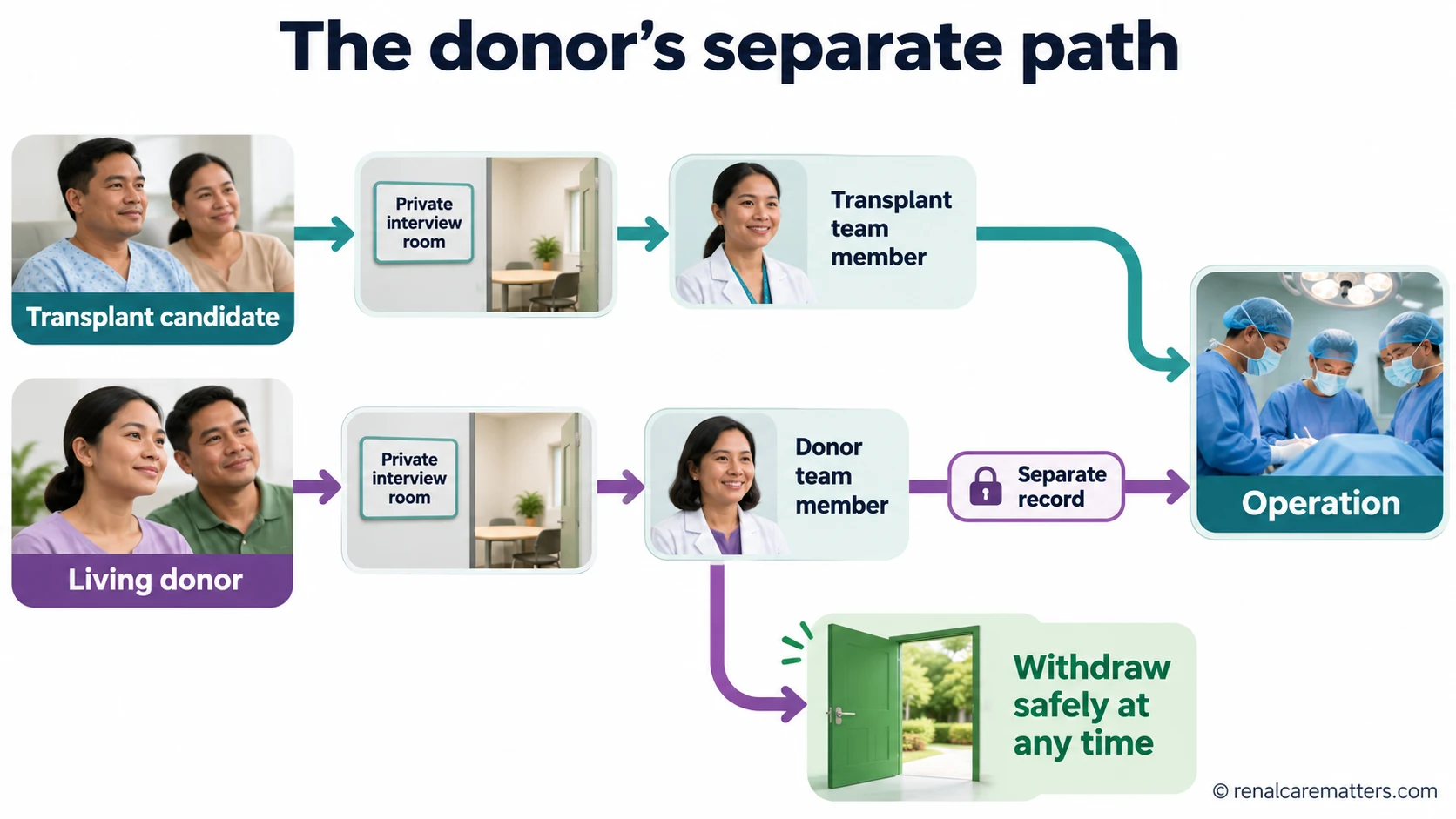
Keep the living donor’s evaluation separate and private, with a safe way to withdraw at any point.
Recognize signs of coercion, inducement, or organ trafficking and route them through the protected pathway.
Classroom 1 hSkills lab 1 hSupervised placement 1 h
Pre-testBefore you read, answer the 5 self-assessment questions and note your score. After the module, select New set of questions and compare. The difference is what you learned; the questions you still miss are what to reread.
Start here
The big picture, in plain words
In plain wordsA living kidney donation joins two people for one operation, like two climbers roped together on a mountain. The rope helps, but it also means that each climber’s choices affect the other. A good guide checks each climber separately before the climb: are you fit, do you want this, do you know you can turn back?
Figure 1. The donor's separate path. Private interviews, their own advocate, and a safe way to stop at any point.
The picture has a limit. On a mountain, both climbers hope to reach the summit for themselves. In living donation, only one person gets the medical benefit. The donor is healthy and accepts a surgical risk and a small lifelong change in kidney function for someone else. That is why the donor’s path is not a copy of the recipient’s. It has extra protections, and the most important of them is the donor’s freedom to say no, privately, at any time, without blame.
Your job in this module has two halves. For the person with kidney failure, help them understand transplant, get evaluated without being screened out for problems that support could solve, and prepare. For the living donor, protect their freedom: private conversations, accurate information about risk, and a safe exit. Philippine living donation follows Department of Health (DOH) guidelines on ethical donation from living donors;1 obtain the full current order and your transplant program’s procedure, because the operative safeguards are local.
Figure 2 · Key terms for this module
Transplant candidateA person with kidney failure being evaluated for a transplant.
Psychosocial evaluationAn assessment of understanding, support, coping, adherence history, substance use, and resources before transplant.
Living donorA healthy person who may give a kidney; they have their own evaluation, record, and rights.
Donor advocateA person designated to protect the donor’s interests, separate from the recipient’s team.
InducementAn offer of money, goods, or favors in exchange for donation; illegal and unethical.
Organ traffickingRecruiting, transporting, or exploiting a person for the removal or sale of an organ; a crime under Philippine anti-trafficking law.
Opening case · fictional
Case: The cousin who is “volunteering”
Thursday, 10:00 a.m. Mr. Benjamin Soriano, 45, a businessman, is being evaluated for a living-donor transplant. His proposed donor is Mr. Mark Soriano, 24, described as a cousin, who arrived from a province in the Visayas two weeks ago and is staying in a room the family rented for him.
At the donor’s first private interview with you, he answers quickly and says he is donating “because family helps family.” He does not know his cousin’s birthday or the names of his cousin’s children. He says he left a construction job to come, and that “Kuya Ben will help me start a business after.” He asks twice how soon the operation will be.
The recipient’s wife calls you that afternoon to ask whether the donor’s interview “went well” and to say they are “taking good care of him.”
Before reading on, decide:
What concerns does this interview raise, and what do they not yet prove?
What do you do next, and through which route?
What do you say to the recipient’s wife?
Keep your answers in mind. The lesson gives you what you need, and the case review near the end shows one sound response.
Lesson · part 1
The evidence and its limits
For many people with kidney failure who can have one, a transplant offers the best long-term outcome. A review of 110 cohort studies with 1,922,300 participants found transplantation associated with lower mortality, fewer cardiovascular events, and better quality of life than dialysis.2 These are observational studies; healthier people are more likely to receive transplants, and no trial has randomized people between transplant and dialysis. In a large registry study comparing transplant recipients with people on the waiting list, the risk of death was higher in the first weeks after the operation and then fell well below that of those still waiting.3
Many people who might benefit never complete the steps. In a cluster randomized trial in 23 hemodialysis units, patients who met monthly with trained peer navigators completed more steps toward transplant (3.5 against 1.6 steps); the trial measured steps, not transplants or survival.4 Social barriers (money, transport, fear, misinformation, no donor) are often what stop people. Those are your work.
Transplant is not right or possible for everyone. Medical suitability is decided by the transplant team using guidelines such as the Kidney Disease: Improving Global Outcomes (KDIGO) guideline on transplant candidates, which also addresses psychosocial assessment as part of candidacy.5 Payment follows Philippine Health Insurance Corporation (PhilHealth)’s transplant Z Benefits by version and date (Module 7).
RememberTransplant is associated with longer, better lives for many who can have one. Your work removes the social barriers that stop people from getting there.
Lesson · part 2
Toward readiness, not out of line
A transplant psychosocial evaluation asks whether the person understands transplant and its demands, has the support to recover and take medicines for life, has coped with treatment so far, and has any risks (such as active substance use or untreated mental illness) that support could address. The point is to prepare, not to exclude.
Area
What you assess
If there is a gap
Understanding
Benefits, risks, lifelong medicines, follow-up
Education with teach-back
Support
Who helps after surgery and with clinic visits
A written support plan with backup (Module 13)
Adherence history
Attendance, medicines, in their own words and records
Find the barrier behind any lapse (Module 12)
Mental health and substances
Mood, past psychiatric care, alcohol, smoking, other substances
Referral and treatment before listing, where needed
Money and logistics
Medicine costs, travel to the center, time off
Benefits and assistance plan (Modules 7 and 8)
Some programs use a structured rating such as the Stanford Integrated Psychosocial Assessment for Transplantation (SIPAT). In a prospective study of 217 heart, lung, liver, and kidney recipients, higher pre-transplant SIPAT scores were associated with more rejection episodes, hospital admissions, infections, psychiatric decompensation, and support-system failure in the first year, but not with organ failure or death, and the association with nonadherence did not reach significance.6 A rating can organize an assessment. It cannot decide candidacy, and a high score is a list of things to work on, not a verdict.
RememberEvaluate to prepare. A score organizes your thinking; it never decides who deserves a transplant.
Lesson · part 3
Private, informed, free to stop
Everything about the donor’s evaluation should protect their freedom. See them alone, in private, more than once. Keep their record separate from the recipient’s. Make sure someone on the team looks out for the donor alone, separate from the recipient’s team, and that the donor knows who that is. The KDIGO living donor guideline places the donor’s informed, voluntary decision and independent evaluation at the center of donor care.7
Give honest information about risk. Across 52 observational studies with 118,426 donors, donors did not have higher risks of death, cardiovascular disease, high blood pressure, diabetes, or adverse psychosocial outcomes than non-donors; they did have a higher relative risk of kidney failure (relative risk 8.83), but the absolute risk stayed low (about 0.5 events per 1,000 person-years), and female donors had a higher risk of preeclampsia.8 In a United States study, the estimated 15-year risk of kidney failure after donation was 30.8 per 10,000 donors, compared with 3.9 per 10,000 in matched healthy non-donors.9 Control groups and follow-up varied, and few studies came from low- and middle-income countries.
The donor needs
What you do
To speak without the recipient’s family present
Private interviews; no family in the room or on the phone
To understand risk in numbers
Ensure the donor team explains it; check with teach-back
To be able to stop without blame
Explain that they can withdraw at any time and that the team will say only that the donation cannot proceed, without giving their reasons
Protection of their own future
Their work, insurance, and follow-up after donation are planned
RememberSee the donor alone, more than once. Make it safe to say no, and never share their reasons with the recipient’s family.
Lesson · part 4
Recognize and route
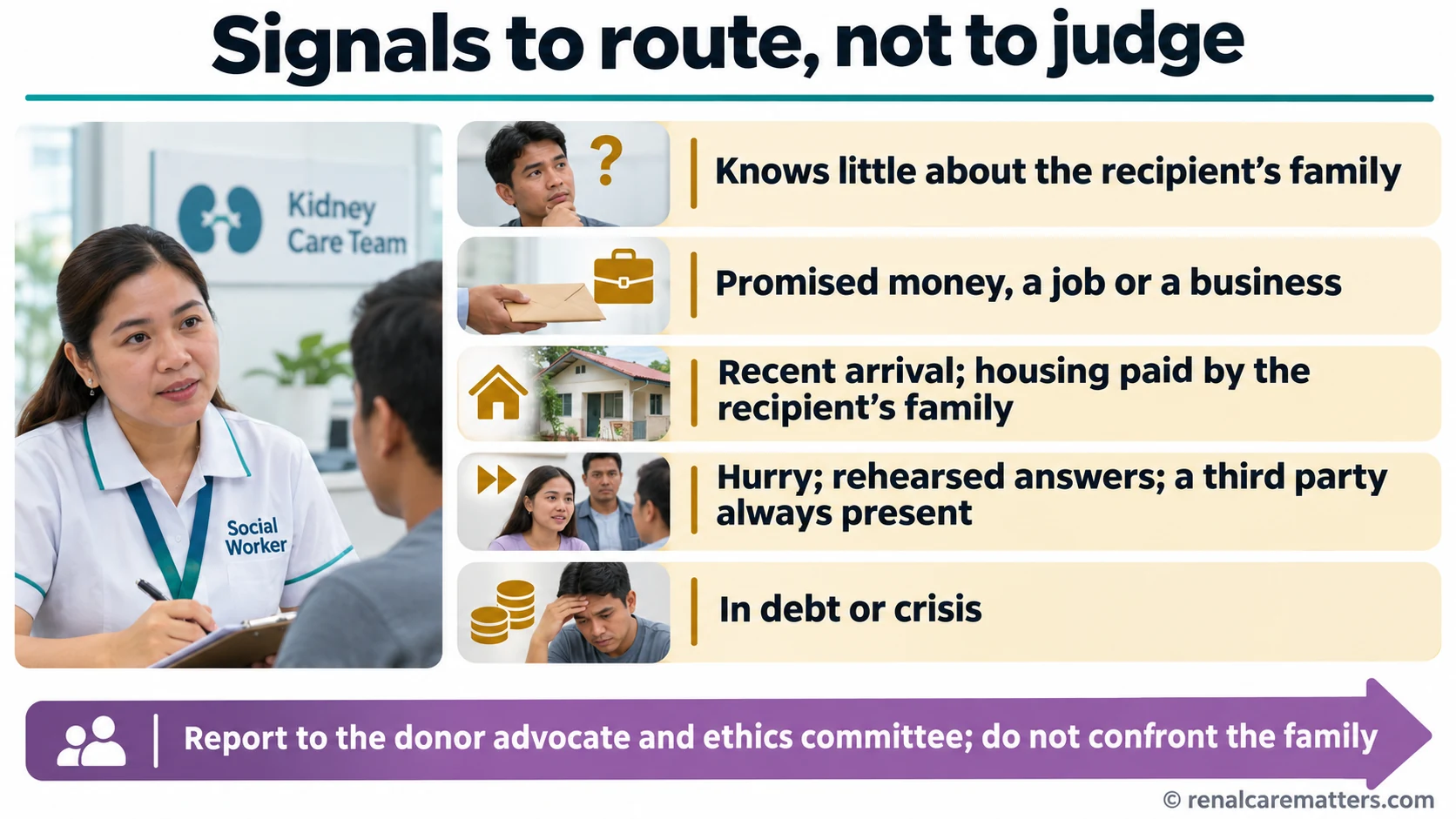
Pressure on donors can be quiet (a family that assumes the youngest sibling will give) or criminal (a stranger recruited and paid). Selling or buying organs is illegal, and recruiting a person for the removal or sale of an organ is trafficking under Philippine law.10,11 Your role is not to investigate or accuse. It is to notice, ask in private, and route concerns through the program’s protected pathway to the ethics committee.
Figure 3. A signal is not proof; route it through the protected pathway.
Signal
Why it matters
A “relative” who knows little about the recipient’s family
The stated relationship may not be real
A promise of money, a job, a business, or debt relief
Inducement
Recent arrival, housing or living costs paid by the recipient’s family
Dependence that makes refusal hard
Hurry, rehearsed answers, or a third party who accompanies the donor everywhere
Possible coaching or control
A donor in debt or in financial crisis
Vulnerability to pressure
A signal is not proof. Many families are generous and many donors are sincere. Record what you observed and what the donor said, factually. Report through the protected route your program defines, to the donor advocate and the ethics committee. Do not discuss your concerns with the recipient’s family.
Stop and callAny sign that a donor is being paid, promised a reward, or controlled by a third party: report through your program’s protected pathway to the ethics committee before the evaluation proceeds. Do not confront the family.
On the floor · The withdrawal
A sister tells social worker Ms. Hazel Cortez privately that she is afraid of the operation but feels she cannot refuse her brother.
Ms. Cortez explains that she may stop at any time and that the team will tell her brother only that the donation cannot proceed. The sister withdraws. The family is told exactly that.
A safe exit is part of a free choice. Without one, there is no consent.
Illustrative scenario. Names and details are invented.
On the floor
Real situations: problems and solutions
These are fictional but typical. For each one, cover the answer, decide what you would do, then compare. Where a step depends on local rules, your unit’s procedure and your supervisor’s direction come first.
The eager stranger
What you see
A proposed donor who recently moved from a distant province asks only when the operation will be.
What is likely going on
Possible inducement or a false relationship.
What to do
Record observations, see the donor privately, and route concerns through the protected pathway.
Why it matters
Your role is to notice and route, not to accuse.
The sister who wants out
What you see
A sister privately says she is afraid but cannot refuse her brother.
What is likely going on
Pressure from love and duty.
What to do
Explain she can withdraw safely and that only “the donation cannot proceed” will be said.
Why it matters
Without a safe exit there is no free consent.
The high score
What you see
A candidate’s structured rating is high because of past missed sessions.
What is likely going on
Risks that support might address.
What to do
Find the barriers behind the missed sessions and build a support plan.
Why it matters
A score is a to-do list, not a verdict.
Field notes
Never interview a donor with the recipient’s family in the room or on the phone.
Keep donor and recipient records strictly separate.
Case review
Back to the case: The cousin who is “volunteering”
The concerns. A stated cousin who knows little about the recipient’s family; a recent arrival with housing paid by the recipient’s family; a lost job; a promise of help with a business after; hurry. Each is a recognized signal of possible inducement or a false relationship. Together they are serious. They do not prove trafficking, and the donor may be sincere. Your job is not to decide; it is to route.
Next steps. Document factually what he said and what you observed. Report through the program’s protected pathway to the donor advocate and the ethics committee before the evaluation goes further. See him again privately, with an interpreter for his own language if he prefers, and make sure he knows he can stop at any time without blame. Do not confront the recipient’s family, and do not share the donor’s answers with them.
The recipient’s wife. “The donor’s evaluation is private, so I cannot discuss it with you. I can tell you everything about your husband’s own next steps.” That rule applies to every family, so it accuses no one. Continue supporting Mr. Soriano’s own preparation, and make sure he knows the transplant team will talk with him about donor options whatever happens.
Skills lab · with your preceptor
Skills checklist: A transplant evaluation and a private donor interview
In two role-plays, conduct a candidate psychosocial evaluation and a private donor interview while your supervisor observes. Your preceptor rates each step as satisfactory, needs practice, or not observed. Steps marked Critical must all be satisfactory before sign-off. This checklist supports supervised learning; your unit’s own procedure and competency form are the authority. A printable version of every checklist is on the trainer page.
Explains the benefits of transplant with the strength of the evidence, without overpromising.
Evaluates a candidate area by area and turns each gap into a support plan.
Explains that a structured rating organizes the assessment and does not decide candidacy.
CriticalInterviews the donor alone and keeps the donor’s information separate.
CriticalExplains to the donor that they can withdraw at any time without their reasons being shared.
CriticalRecognizes signals of inducement or a false relationship and reports through the protected pathway.
CriticalDeclines to share the donor’s evaluation with the recipient’s family, using a rule that applies to everyone.
Placement activity. Observe one transplant evaluation meeting. List the psychosocial questions asked of the candidate and of the donor, and how each was kept separate.
Self-assessment
Check your understanding
Each visit draws 5 questions at random from this module’s 10-question bank. Choose the single best answer for each, then select Check answers; an explanation appears under the best answer. Select New set of questions for a different mix. A good target is 4 of 5 on two different sets. Nothing you select is sent anywhere; scoring happens in your browser.
Tonelli, M., Wiebe, N., Knoll, G., Bello, A., Browne, S., Jadhav, D., Klarenbach, S., & Gill, J. (2011). Systematic review: Kidney transplantation compared with dialysis in clinically relevant outcomes. American Journal of Transplantation, 11(10), 2093–2109. https://doi.org/10.1111/j.1600-6143.2011.03686.x
Wolfe, R. A., Ashby, V. B., Milford, E. L., Ojo, A. O., Ettenger, R. E., Agodoa, L. Y., Held, P. J., & Port, F. K. (1999). Comparison of mortality in all patients on dialysis, patients on dialysis awaiting transplantation, and recipients of a first cadaveric transplant. New England Journal of Medicine, 341(23), 1725–1730. https://doi.org/10.1056/NEJM199912023412303
Sullivan, C., Leon, J. B., Sayre, S. S., Marbury, M., Ivers, M., Pencak, J. A., Bodziak, K. A., Hricik, D. E., Morrison, E. J., Albert, J. M., Navaneethan, S. D., Reyes, C. M., & Sehgal, A. R. (2012). Impact of navigators on completion of steps in the kidney transplant process: A randomized, controlled trial. Clinical Journal of the American Society of Nephrology, 7(10), 1639–1645. https://doi.org/10.2215/CJN.11731111
Chadban, S. J., Ahn, C., Axelrod, D. A., Foster, B. J., Kasiske, B. L., Kher, V., Kumar, D., Oberbauer, R., Pascual, J., Pilmore, H. L., Rodrigue, J. R., Segev, D. L., Sheerin, N. S., Tinckam, K. J., Wong, G., & Knoll, G. A. (2020). KDIGO clinical practice guideline on the evaluation and management of candidates for kidney transplantation. Transplantation, 104(4S1 Suppl 1), S11–S103. https://doi.org/10.1097/TP.0000000000003136
Maldonado, J. R., Sher, Y., Lolak, S., Swendsen, H., Skibola, D., Neri, E., David, E. E., Sullivan, C., & Standridge, K. (2015). The Stanford Integrated Psychosocial Assessment for Transplantation: A prospective study of medical and psychosocial outcomes. Psychosomatic Medicine, 77(9), 1018–1030. https://doi.org/10.1097/PSY.0000000000000241
Lentine, K. L., Kasiske, B. L., Levey, A. S., Adams, P. L., Alberú, J., Bakr, M. A., Gallon, L., Garvey, C. A., Guleria, S., Li, P. K., Segev, D. L., Taler, S. J., Tanabe, K., Wright, L., Zeier, M. G., Cheung, M., & Garg, A. X. (2017). KDIGO clinical practice guideline on the evaluation and care of living kidney donors. Transplantation, 101(8S Suppl 1), S1–S109. https://doi.org/10.1097/TP.0000000000001769
O’Keeffe, L. M., Ramond, A., Oliver-Williams, C., Willeit, P., Paige, E., Trotter, P., Evans, J., Wadström, J., Nicholson, M., Collett, D., & Di Angelantonio, E. (2018). Mid- and long-term health risks in living kidney donors: A systematic review and meta-analysis. Annals of Internal Medicine, 168(4), 276–284. https://doi.org/10.7326/M17-1235
Muzaale, A. D., Massie, A. B., Wang, M. C., Montgomery, R. A., McBride, M. A., Wainright, J. L., & Segev, D. L. (2014). Risk of end-stage renal disease following live kidney donation. JAMA, 311(6), 579–586. https://doi.org/10.1001/jama.2013.285141
Educational material for social workers and navigation staff in kidney care. Completing it is an Academy learning record only. It is not a Professional Regulation Commission (PRC) license, a specialty credential, CPD units, or DOH or PhilHealth recognition, and it does not authorize anyone to practice beyond their own registration.