Modality Decisions, Home Therapy, and Practical Feasibility
What each modality asks of a household, home peritoneal dialysis feasibility, assisted options, and respecting choices.
PublishedNailathalaGipatikPepalwal:ReferencesMga SanggunianMga TinubdanReng Reperensya:2Audience: Registered social workers in dialysis units, hospital medical social work departments, and kidney transplant programs · medical social workers rotating into kidney care · navigation and support staff on the orientation pathRead timeOras ng pagbasaOras sa pagbasaOras ning pamamasa:
This module is study material for social workers and navigation staff in kidney care. It explains the reasoning behind social work decisions; it is not a facility procedure, legal advice, a benefits ruling, or a mental health diagnosis. Rules, assistance programs, and amounts change: confirm them against the current issuance and your facility’s approved policy. Medical treatment belongs to the nephrologist, benefits to PhilHealth, donation ethics to the ethics committee, and psychiatric diagnosis to the mental health team. Every case, name, and identifier is fictional.
Learning objectives
After this module you should be able to
Explain what in-center hemodialysis, home peritoneal dialysis, transplantation, and conservative kidney management each ask of a household.
Assess the practical feasibility of home peritoneal dialysis: space, storage, water, hygiene, the person who will do the exchanges, and backup.
Separate feasibility problems that can be solved from those that cannot, and propose solutions before ruling an option out.
Describe what the evidence does and does not show when comparing peritoneal dialysis with hemodialysis.
Support a person’s informed choice of treatment, including a choice you would not make.
Classroom 1 hSkills lab 1 hSupervised placement 1 h
Pre-testBefore you read, answer the 5 self-assessment questions and note your score. After the module, select New set of questions and compare. The difference is what you learned; the questions you still miss are what to reread.
Start here
The big picture, in plain words
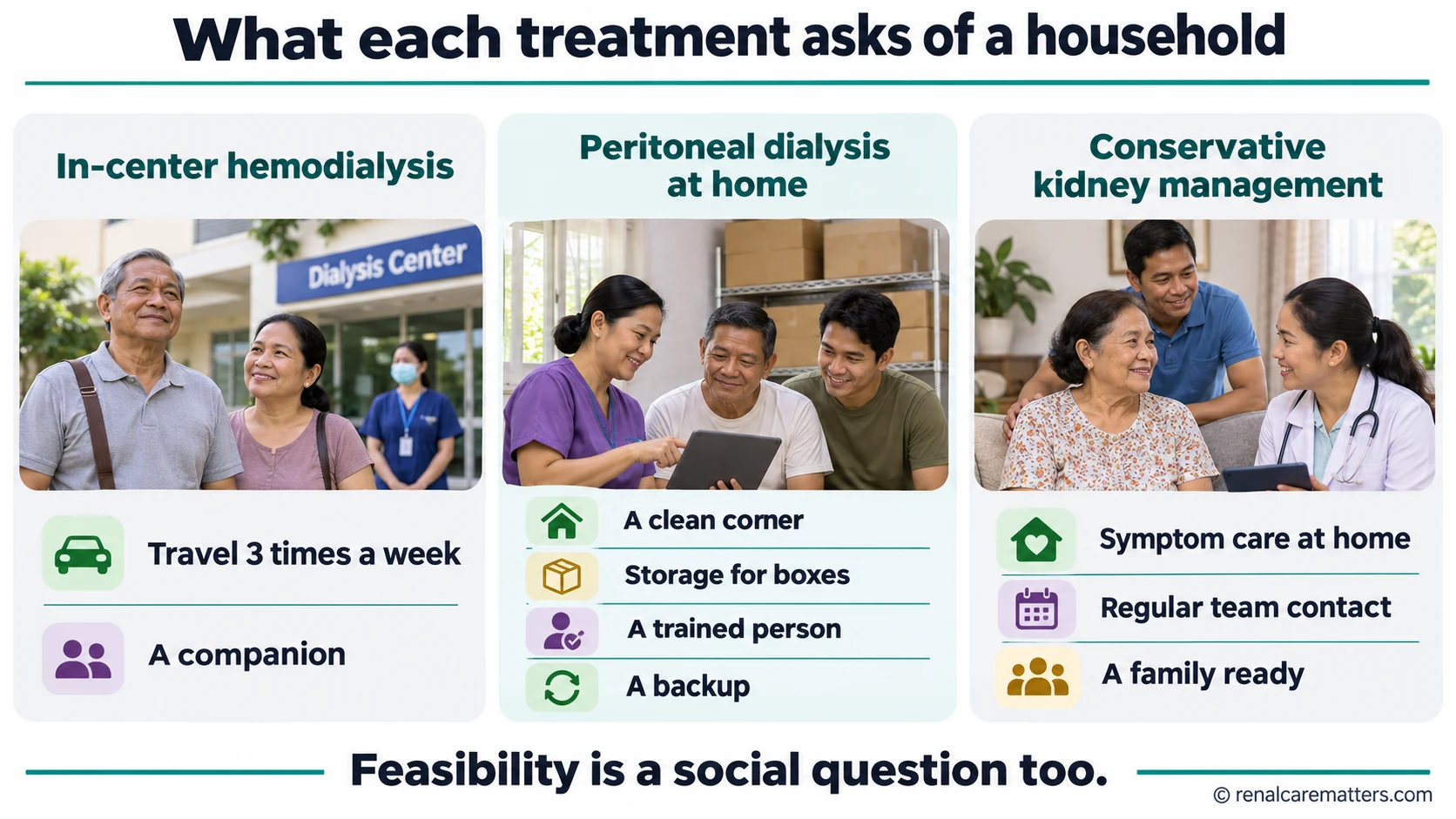
In plain wordsChoosing a dialysis type is like choosing how to carry water to a farm: by truck three times a week from the town (in-center hemodialysis), or with a small pump at the house that runs every day (home peritoneal dialysis). Both can water the farm. Which one works depends on the road, the house, who is home to run the pump, and what the family wants their days to look like.
Figure 1. What each modality asks of a household. Feasibility is a social question as much as a medical one.
The picture has a limit. Water is water, whatever carries it; dialysis types differ in how they feel, what they protect, and what they risk. The clinical side of the choice (which type is medically suitable, and what each means for this person’s body) belongs to the nephrologist. What makes the social worker essential is that so much of the decision is about daily life: a family’s space, routines, transport, work, and who will help.
Your job in this module is to make sure no one is steered away from a treatment because of a problem that could have been solved, and no one is pushed into one their household cannot sustain. In South and Southeast Asia, peritoneal dialysis is underused: a regional survey found it made up about 3.4% of dialysis in lower-income countries against 10.1% in higher-income ones, with lack of policy support, awareness, training, and affordability named as deterrents.1 Some of those barriers are social, and solvable.
Figure 2 · Key terms for this module
ModalityThe type of kidney replacement treatment: hemodialysis, peritoneal dialysis, transplant, or conservative kidney management.
Continuous ambulatory peritoneal dialysis (CAPD)Manual peritoneal dialysis exchanges, usually four a day.
Automated peritoneal dialysis (APD)Peritoneal dialysis by a machine overnight.
Assisted peritoneal dialysisPeritoneal dialysis with help from a trained family member or a visiting helper.
Home visitA visit to assess space, storage, water, and hygiene before or during home therapy.
Shared decision makingA decision made together, combining clinical facts with the person’s values.
Opening case · fictional
Case: The peritoneal dialysis bag storage problem
Tuesday, 2:00 p.m. Ms. Angelica Ramos, 29, a call-center agent, is nearing dialysis. The nephrologist says she is a good candidate for peritoneal dialysis, and she wants it: she wants to keep her night-shift job and avoid three trips a week across the city.
The peritoneal dialysis nurse visited her home last week and wrote: “Not suitable. Small room shared with sister. No storage. Area floods in heavy rain. Recommend hemodialysis (HD).” Ms. Ramos is upset. “So because my house is small, I lose my job?”
She rents a 20-square-meter unit in Malabon with her sister. Her mother lives in a larger house in Valenzuela, 20 minutes away. Her employer has an occupational nurse and a clinic room on site.
Before reading on, decide:
Which of the nurse’s findings are solvable, and how?
How do you support Ms. Ramos without overruling the clinical team?
What would you bring to the team meeting?
Keep your answers in mind. The lesson gives you what you need, and the case review near the end shows one sound response.
Lesson · part 1
The social side of the choice
For each treatment, list what it needs from the home and the family. This is the part of the choice that the person and family know best and that you can help them think through.
Treatment
Time and travel
Space and supplies
People
In-center hemodialysis
3 trips a week, about 4 hours each plus travel
None at home
Often a companion for transport
Manual peritoneal dialysis (CAPD)
About 4 exchanges a day at home; monthly clinic visits
A clean area; storage for boxes of bags; a place to wash hands
The patient, or a trained helper; a backup
Automated peritoneal dialysis (APD)
Overnight on a machine; daytime free
Storage, electricity, a stable table by the bed
The patient or helper; a backup; power outage plan
Transplant
Evaluation visits; frequent clinic visits early, then fewer
Medicines stored properly
Support during recovery; a donor, if living donation
Conservative kidney management
Regular team contact
Comfort at home
Family ready for symptom care and decline (Module 16)
Make this table with the family, using their own days. A night-shift worker, a farmer, a grandmother who cares for grandchildren, and a student will fill it in very differently.
RememberMap each treatment onto the household’s real days. That is where you add most to the decision.
Lesson · part 2
Solvable or not
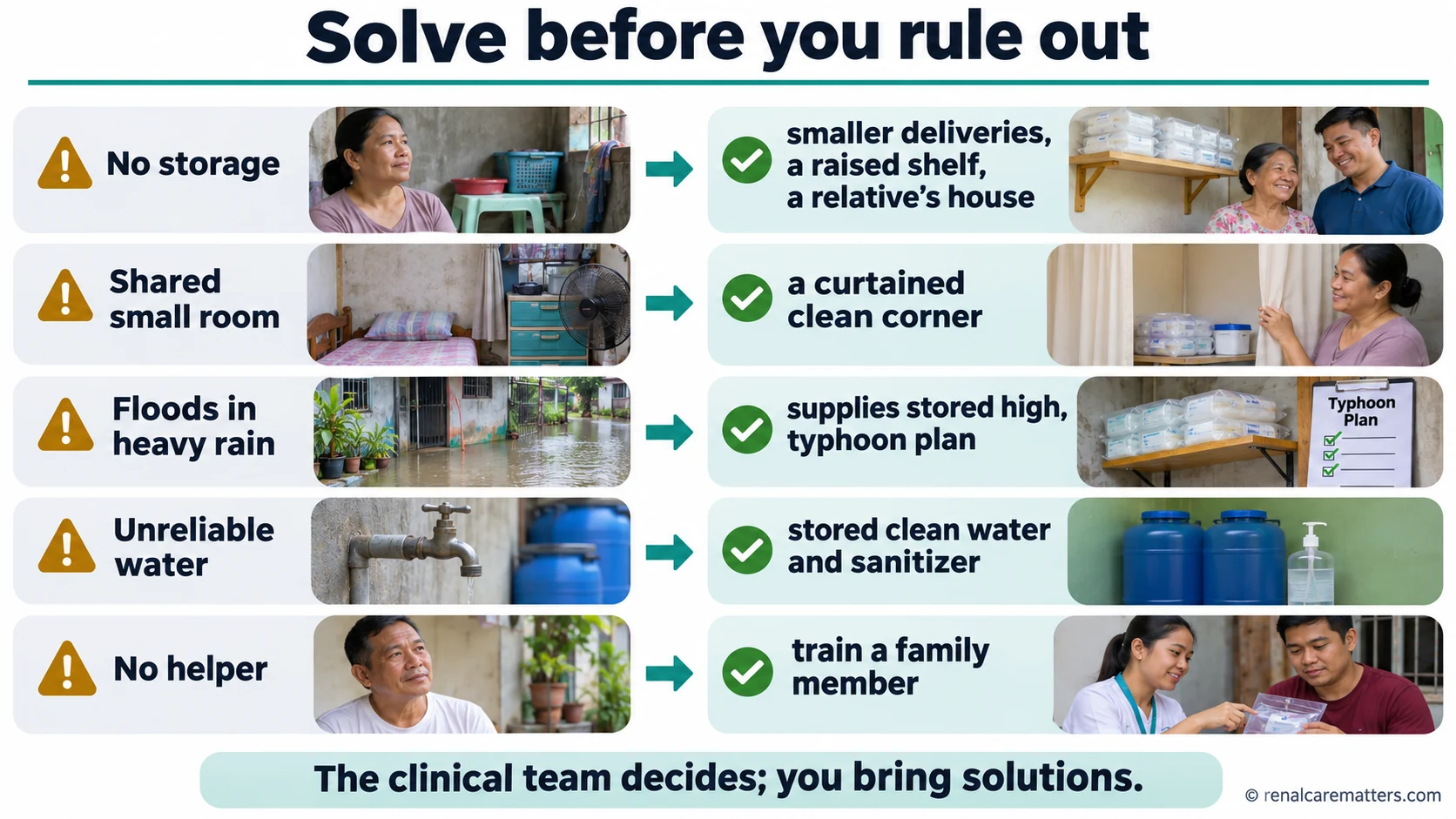
A home visit for peritoneal dialysis looks at space, storage, water and hygiene, electricity for a machine, who will do the exchanges, and backup. A finding is a problem to solve before it is a reason to refuse.
Figure 3. Treat each home-visit finding as a problem to solve first.
Finding
Possible solutions
Who decides
No storage for boxes
Smaller, more frequent deliveries; a raised shelf; storage at a relative’s house nearby
Peritoneal dialysis team, supplier
Shared small room
A curtained clean corner; a set exchange routine when the room is quiet
Peritoneal dialysis nurse
Flooding in heavy rain
Supplies stored high; a typhoon plan with a relative’s house (Module 17)
Peritoneal dialysis team
Unreliable water
Stored clean water and hand sanitizer for hand hygiene
Peritoneal dialysis nurse
No one to help an older patient
Train a family member; assisted peritoneal dialysis where a program exists
Peritoneal dialysis team
Cost of supplies
Philippine Health Insurance Corporation (PhilHealth) peritoneal dialysis Z Benefits through a contracted provider (Module 7)
PhilHealth, provider
Some findings may not be solvable, or not yet: a person who cannot learn the technique and has no helper, a home that cannot be made hygienic, or an unsafe household. Those are real reasons, and the clinical team decides. Your role is to make sure every solvable problem was tried first, and that the person hears why an option was ruled out.
RememberTreat each home-visit finding as a problem to solve first. Rule an option out only after solutions were tried, and explain why.
Lesson · part 3
Uncertain comparisons, real preferences
People often ask which dialysis is “better.” The honest answer is that, for most outcomes, we do not know. A 2024 Cochrane review compared peritoneal dialysis with hemodialysis in people starting dialysis. It found only two small randomized trials, at high risk of bias, and 82 observational studies, which varied widely and were at risk of selection bias and residual confounding. For most outcomes, the benefits and harms of one over the other remained uncertain.2
That uncertainty matters to your work. When the clinical evidence does not clearly favor one option for a person who is medically suitable for both, the person’s values and circumstances (work, travel, family, independence, fear of needles, fear of infection) properly carry more weight. That is what shared decision making means: the clinician brings the medical facts; the person brings what matters to them; the decision combines both.
What the person values
Leans toward
Keeping a daytime job; fewer trips
Peritoneal dialysis, if suitable
Not doing treatment at home; staff doing the work
In-center hemodialysis
The longest life with the best quality, if possible
Discuss transplant evaluation (Module 15)
Comfort and time at home over life extension, especially when very old and frail
RememberWhen the evidence does not pick a winner, the person’s values and circumstances should.
Lesson · part 4
Including one you would not make
Your part in a modality decision is to make sure the person has accurate information about what each option asks of their life, that practical barriers were tested and not assumed, and that their own values are heard by the team. You do not choose for them, and you do not argue the team’s preference for them.
Figure 4 · Supporting a modality decision
Ask what mattersWork, family, travel, independence, fears, hopes.
Map each optionOn their real week, with the household.
Test the barriersHome visit findings, cost, help, backup.
Bring it to the teamThe person’s values and the solvable barriers, to the nephrologist and nurse.
Record the decisionWhat was chosen, why, and when it will be revisited.
A person may choose an option you think is wrong: in-center hemodialysis when they could do home dialysis, or no transplant evaluation. If they understood the information and the choice is theirs, respect it, record it, and leave the door open. Decisions about treatment can be revisited, and people often change their minds once a choice no longer feels forced.
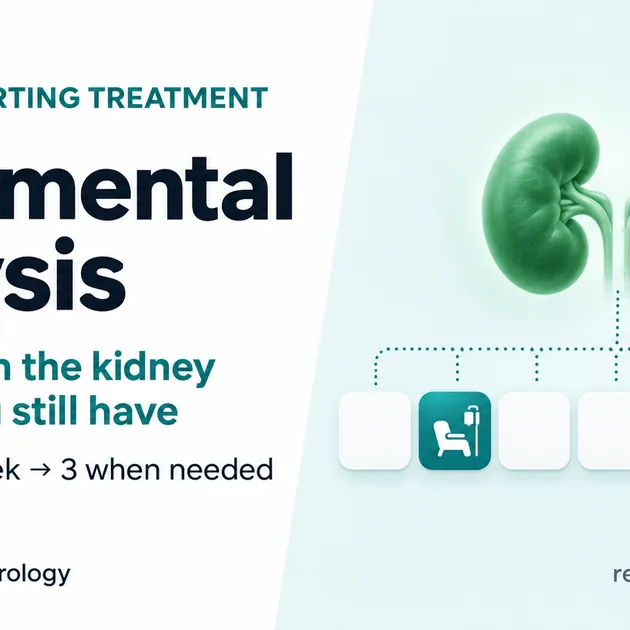
Some units offer incremental dialysis, starting with fewer sessions while the person still has kidney function. That is a clinical decision for the nephrologist; the site’s guide explains it for patients.
RememberInform, map, test barriers, bring the person’s values to the team, and record the decision with a date to revisit.
On the floor · The overnight machine
An older farmer refuses peritoneal dialysis because he believes he will have to stop working the fields. Social worker Mr. Dan Robles asks the nurse to explain automated peritoneal dialysis, which runs overnight.
The farmer chooses it, with his son trained as backup. Six months later he is still farming.
The barrier was a gap in information, not a lack of interest.
Illustrative scenario. Names and details are invented.
On the floor
Real situations: problems and solutions
These are fictional but typical. For each one, cover the answer, decide what you would do, then compare. Where a step depends on local rules, your unit’s procedure and your supervisor’s direction come first.
“Not suitable”
What you see
A home visit report rules out peritoneal dialysis for lack of storage.
What is likely going on
A solvable problem treated as final.
What to do
Propose solutions and ask the team to reconsider.
Why it matters
People should not lose a treatment option to a shelf.
The cost rumor
What you see
A patient wants peritoneal dialysis because he heard “it is free forever.”
What is likely going on
A choice driven by a rumor.
What to do
Check the real cost picture and bring his other reasons to the team.
Why it matters
Modality decisions deserve accurate information.
The overnight machine
What you see
A worker refuses home dialysis because he thinks it ends his job.
What is likely going on
He has not heard about overnight automated peritoneal dialysis.
What to do
Ask the nurse to explain it.
Why it matters
Missing information can masquerade as lack of interest.
Field notes
Join at least one home visit in your first month.
Map each treatment onto the family’s actual week.
Case review
Back to the case: The peritoneal dialysis bag storage problem
Solvable findings. Storage: supplies could be kept at her mother’s larger house 20 minutes away, with smaller, more frequent deliveries, or a raised shelf. Shared room: a curtained clean corner and a set routine. Flooding: supplies stored high and a typhoon plan using her mother’s house. Her employer’s clinic room might even allow a daytime exchange, if the team agrees. Overnight automated peritoneal dialysis could free her daytime and evening hours for a night-shift job, depending on schedule; ask the nephrologist.
Supporting her without overruling. Acknowledge the nurse’s findings as real, and her goal as legitimate. “The nurse found real problems. Let us see which ones we can solve before anyone decides.” Do not promise peritoneal dialysis; the clinical team decides.
At the team meeting. Her goal (keeping her job and avoiding three cross-city trips), each finding with a proposed solution, the PhilHealth peritoneal dialysis package through a contracted provider (Module 7), and a request for a second home visit to her mother’s house or a revised plan. Record the decision, and if peritoneal dialysis is still ruled out, make sure she hears why from the nephrologist.
Skills lab · with your preceptor
Skills checklist: A modality map and a feasibility review
With a simulated patient and a home-visit report, map the options and review feasibility while your supervisor observes. Your preceptor rates each step as satisfactory, needs practice, or not observed. Steps marked Critical must all be satisfactory before sign-off. This checklist supports supervised learning; your unit’s own procedure and competency form are the authority. A printable version of every checklist is on the trainer page.
Maps each treatment option onto the person’s real week with the household.
Asks what matters most to the person before discussing options.
Classifies each home-visit finding as solvable or not, with a proposed solution.
Explains honestly that evidence comparing peritoneal dialysis and hemodialysis is uncertain.
CriticalDoes not promise a treatment the clinical team has not approved.
Brings the person’s values and proposed solutions to the team.
Records the decision, its reasons, and a date to revisit.
Placement activity. Join the peritoneal dialysis nurse on one home visit (with consent). Write down every finding and the solutions you would propose.
Self-assessment
Check your understanding
Each visit draws 5 questions at random from this module’s 10-question bank. Choose the single best answer for each, then select Check answers; an explanation appears under the best answer. Select New set of questions for a different mix. A good target is 4 of 5 on two different sets. Nothing you select is sent anywhere; scoring happens in your browser.
Bhargava, V., Jasuja, S., Tang, S. C., Bhalla, A. K., Sagar, G., Jha, V., Ramachandran, R., Sahay, M., Alexander, S., Vachharajani, T., Lydia, A., Mostafi, M., Pisharam, J. K., Jacob, C., Gunawan, A., Leong, G. B., Thwin, K. T., Agrawal, R. K., Vareesangthip, K., Tanchanco, R., Choong, L., & Herath, C. (2021). Peritoneal dialysis: Status report in South and South East Asia. Nephrology, 26(11), 898–906. https://doi.org/10.1111/nep.13949
Ethier, I., Hayat, A., Pei, J., Hawley, C. M., Johnson, D. W., Francis, R. S., Wong, G., Craig, J. C., Viecelli, A. K., Htay, H., Ng, S., Leibowitz, S., & Cho, Y. (2024). Peritoneal dialysis versus haemodialysis for people commencing dialysis. Cochrane Database of Systematic Reviews, 6(6), CD013800. https://doi.org/10.1002/14651858.CD013800.pub2
Educational material for social workers and navigation staff in kidney care. Completing it is an Academy learning record only. It is not a Professional Regulation Commission (PRC) license, a specialty credential, CPD units, or DOH or PhilHealth recognition, and it does not authorize anyone to practice beyond their own registration.