Philippine Requirements and a Defensible Service Model
Who issues which rule, what the reviewed documents say and do not say, a service charter, and coverage and escalation.
PublishedNailathalaGipatikPepalwal:ReferencesMga SanggunianMga TinubdanReng Reperensya:11Audience: Registered social workers in dialysis units, hospital medical social work departments, and kidney transplant programs · medical social workers rotating into kidney care · navigation and support staff on the orientation pathRead timeOras ng pagbasaOras sa pagbasaOras ning pamamasa:
This module is study material for social workers and navigation staff in kidney care. It explains the reasoning behind social work decisions; it is not a facility procedure, legal advice, a benefits ruling, or a mental health diagnosis. Rules, assistance programs, and amounts change: confirm them against the current issuance and your facility’s approved policy. Medical treatment belongs to the nephrologist, benefits to PhilHealth, donation ethics to the ethics committee, and psychiatric diagnosis to the mental health team. Every case, name, and identifier is fictional.
Learning objectives
After this module you should be able to
Identify which body issues each rule that touches renal social work: Congress and the Professional Regulation Commission (PRC), the DOH, Philippine Health Insurance Corporation (PhilHealth), assistance agencies, and the employer.
Read a rule for its issuer, scope, version, and effective date before relying on it.
State accurately what the reviewed DOH and PSN documents say, and do not say, about social workers in dialysis.
Draft a one-page service charter with referral criteria, response targets, coverage, and escalation.
Compare Philippine practice with the United States, England, and Australia without importing foreign rules as local requirements.
Classroom 1 hSkills lab 1 hSupervised placement 0 h
Pre-testBefore you read, answer the 5 self-assessment questions and note your score. After the module, select New set of questions and compare. The difference is what you learned; the questions you still miss are what to reread.
Start here
The big picture, in plain words
In plain wordsA renal social worker’s rules come from several rulebooks at once, like a basketball game where the league, the referee, the school, and the barangay each have their own rules. A play can be legal under one and forbidden under another. You need to know which rulebook a rule comes from before you decide whether it binds you.
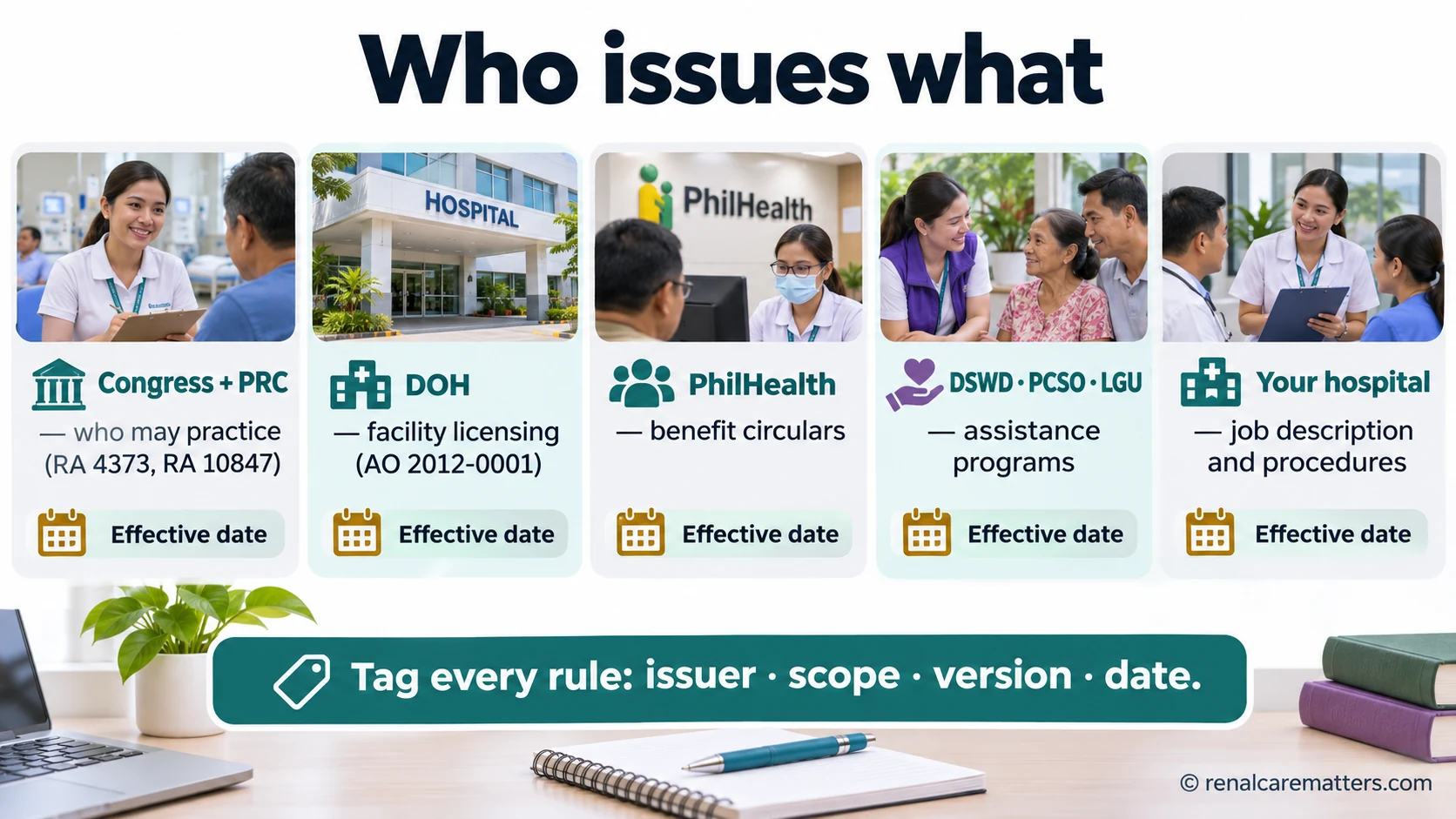
Figure 1. Who issues what. Read every rule for its issuer, its scope, and the date it took effect.
The picture has a limit. In a game, the rulebooks are printed and stable. In health care, rules are amended, superseded, and sometimes published before they take effect. Some important documents are hard to obtain in full. A rule you remember from orientation two years ago may no longer be the rule. So the habit is not to memorize rules; it is to check each one by issuer, scope, version, and date, and to say plainly when you could not check.
This module has a second purpose. Many Philippine dialysis units have no social worker of their own, or share one with a whole hospital. You may be asked to set up the service from nothing. A service that can explain why it exists, whom it serves first, and what happens when the social worker is away is a service that survives the next budget meeting.
Figure 2 · Key terms for this module
IssuerThe body that made the rule (Congress, PRC, DOH, PhilHealth, Department of Social Welfare and Development (DSWD), the employer).
ScopeWhom and what the rule applies to; for example, freestanding dialysis clinics, or hospital units.
Effective dateThe date a rule starts to apply, which may be later than its publication date.
Service charterA one-page statement of what the social work service does, for whom, how fast, and who covers.
Response targetA local goal for how quickly a referral is acknowledged and seen; not a national deadline unless a rule says so.
Bounded findingA statement limited to what was actually reviewed, such as “not identified in the documents reviewed.”
Opening case · fictional
Case: The new unit with no social worker
A private hospital in Pampanga opened a 15-station hemodialysis unit six months ago. The hospital’s medical social work department has two social workers for 200 beds. The dialysis unit has never sent them a referral. You have just been hired as the hospital’s third social worker, with the dialysis unit as part of your assignment.
At your first meeting on Monday at 10:00 a.m., the unit’s clinical head says: “We do not need a social worker; DOH did not require one in our license inspection. But patients keep missing sessions and the claims officer is drowning in assistance requests. What can you actually do for us?”
The hospital administrator, in the same meeting, asks you to promise “same-day assessment for every patient.”
Before reading on, decide:
How do you answer “DOH did not require one” accurately?
What would you put on a one-page service charter for this unit?
How do you answer the request for same-day assessment for every patient?
Keep your answers in mind. The lesson gives you what you need, and the case review near the end shows one sound response.
Lesson · part 1
Five rulebooks
Every rule you use should be tagged with its issuer. Mixing them up is how a payer rule is mistaken for a licensing rule, or an employer habit is mistaken for law.
Issuer
What it governs
Examples you will use
Congress and the PRC
Who may practice social work, the title, registration, ethics
Republic Act No. 4373 as amended by Republic Act No. 10847; the 2023 code of ethics resolution1,2,3
Department of Health (DOH)
Licensing of dialysis facilities and hospitals; living-donor safeguards; social work assessment tools
Administrative Order No. 2012-0001; Administrative Order No. 2021-0059; Department Memorandum No. 2024-03724,5,6
PhilHealth
What is covered and how claims are paid
Circulars on hemodialysis, peritoneal dialysis, and kidney transplant (Module 7)
Assistance agencies
Who may receive crisis, medical, or transport aid, and what documents are needed
DSWD crisis assistance, Philippine Charity Sweepstakes Office (PCSO) medical access, Malasakit Centers, local government (Module 8)
Your employer
Your job description, procedures, forms, privacy rules
Hospital or unit policies, appointment papers
Professional societies add guidance, not law. The Philippine Society of Nephrology (PSN) hemodialysis guidelines guide nephrologists and units; they are not a licensing rule for social workers.7
RememberTag every rule with its issuer, its scope, and its date. Ask “who made this rule, and does it apply here?”
Lesson · part 2
Bounded findings
The DOH order that licenses dialysis facilities describes duties that touch your work directly: continuing patient education, including treatment options and transplantation; linkage with transplant centers; and adequate, competent services. The reviewed text does not name a renal social worker post, a social worker staffing ratio, or a specialty certificate.4 A text search of the PSN 2024 hemodialysis guidelines for “social” found no match.7
Be precise about what that means. It means those two documents, as reviewed, do not set such a requirement. It does not mean that no requirement exists anywhere. The full current DOH licensing checklist for dialysis clinics could not be retrieved for this course; only a 2015 revision was listed, and a 2015 date does not prove it is the current tool.8 Hospital licensing, later issuances, regional offices, and service contracts can add duties. In 2024 the DOH also issued a memorandum on demographic and assessment tools for medical social workers; only its overview was reviewed, so its forms are not reproduced here.6
Say this
Not this
“The DOH dialysis licensing order we reviewed does not specify a social worker post or ratio.”
“DOH does not require social workers.”
“We could not obtain the full current checklist; the licensing office can confirm.”
“We are fully compliant with the checklist.”
“Our response targets are our unit’s own goals.”
“DOH requires assessment within ten days.”
Abroad, the picture differs, and the differences are instructive. United States dialysis facilities must have a social worker with a clinically focused master’s degree and must include psychosocial assessment in the team’s plan.9 An English National Health Service employer asks for a registered social worker with safeguarding and complex-assessment skills.10 A Northern Territory, Australia, renal service emphasizes family support, community liaison, and telehealth for remote patients.11 Borrow their ideas about good service. Do not borrow their rules as if they were ours.
RememberReport a negative finding with its boundary: “not identified in the documents reviewed.” Never upgrade it to “not required anywhere.”
Lesson · part 3
One page that explains the service
The strongest argument for a renal social work service is a clear account of what it does and what happens without it. A service charter is that account on one page.
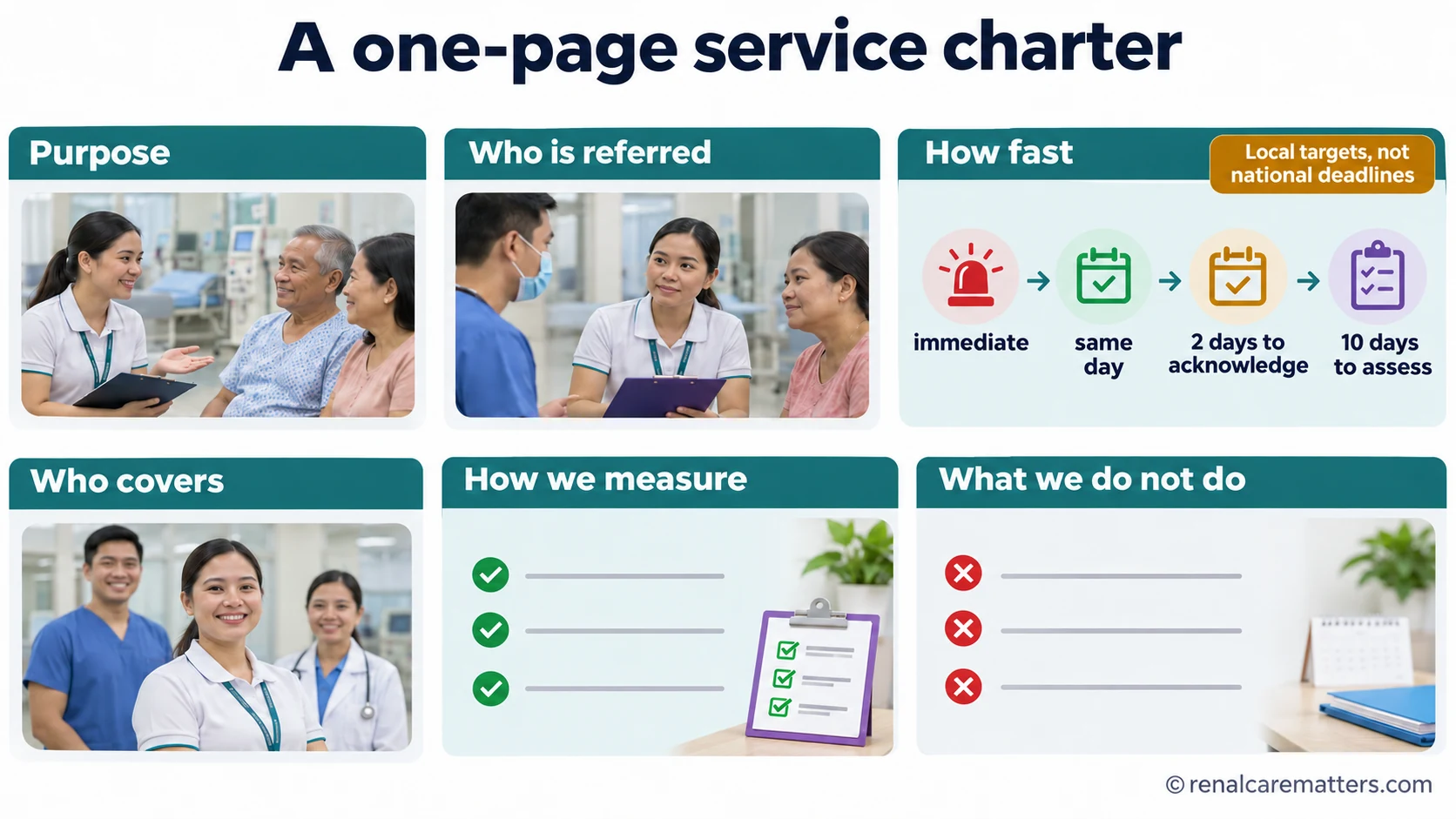
Figure 3. The service charter fits on one page.
Figure 4 · The parts of a one-page service charter
PurposeOne sentence: help people with kidney disease and their families address psychosocial and social barriers to the care they choose.
Who is referredNew patients starting dialysis; missed or shortened sessions; benefit exhaustion; distress or safety concerns; caregiver strain; transplant or donor work-up; transfers; end-of-life decisions.
How fastImmediate danger goes to the emergency route at once. Urgent access barriers before the next session: same-day contact where possible. Routine: acknowledged within two working days and assessed within ten.
Who coversThe covering social worker, the department head, and the after-hours route.
How you measureReferral response time, outcomes confirmed, patient feedback (Module 19).
The response targets in that flow are a starting proposal for your governance to approve. They are not national deadlines. If you cannot meet a target, record the risk, tell the person the revised plan, and raise the capacity problem with your head.
A good charter also says what the service does not do: it does not prescribe, decide claims, diagnose psychiatric illness, choose transplant candidates, or guarantee assistance. Saying so protects the team from false expectations and protects you from tasks outside your authority.
RememberA charter states purpose, referral criteria, response targets, coverage, measures, and exclusions on one page.
Lesson · part 4
When there is one of you
Most Philippine units share a social worker with a hospital, or have none. That makes coverage the central design problem. The question is not “what ratio does the law require?” (none was identified in the documents reviewed) but “how many hours of work does this unit generate, and who does them?”
Estimate demand from the work itself: the number of new patients a month, the routine and complex episodes, and fixed duties such as case conferences. The toolkit’s workload and coverage tool adds those up and compares them with the hours available. A shortfall is a fact to report, not a personal failure.
Worked example, illustrative. Demand hours = (episodes × minutes ÷ 60), summed, + fixed hours. Routine episodes: 8 × 45 min = 6 h. Complex episodes: 2 × 120 min = 4 h. Fixed (case conference, records): 5 h. Demand = 6 + 4 + 5 = 15 hours a week. Hours available for this unit: 12. Balance = 12 − 15 = −3 hours a week. At 30 productive hours per full-time equivalent (FTE), demand equals 0.50 FTE. What the number tells you: the unit generates more work than the assigned time. What it does not tell you: the right staffing. That is a management decision.
When the unit generates more work than you have hours, triage by risk, not by who asks loudest: safety first, then barriers that threaten the next session, then everything else. Tell your head in writing what will wait and what the risk is.
On the floor · The 40-patient referral list
Social worker Ms. Rhea Lopez inherits a list of 40 unseen referrals. She sorts them in an hour: two with safety concerns (seen today), nine with access problems threatening the next session (contacted this week), the rest booked in order.
She sends her head a one-paragraph note with the numbers and the date by which the backlog will clear at current capacity.
A backlog described in numbers becomes a management problem; a silent backlog stays the social worker’s private burden.
Illustrative scenario. Names and details are invented.
On the floor
Real situations: problems and solutions
These are fictional but typical. For each one, cover the answer, decide what you would do, then compare. Where a step depends on local rules, your unit’s procedure and your supervisor’s direction come first.
The old checklist
What you see
A colleague hands you a licensing checklist printed years ago as “the DOH requirements.”
What is likely going on
A document whose current version is unknown.
What to do
Record it as unverified and ask the licensing office for the current tool.
Why it matters
An outdated rule followed confidently is worse than an honest gap.
The foreign ratio
What you see
A manager proposes “one social worker per 75 patients like in America.”
What is likely going on
A borrowed number with no Philippine authority.
What to do
Explain the comparison is not a local rule and offer a workload estimate in hours instead.
Why it matters
Staffing should follow the work your unit generates.
The promise in the brochure
What you see
A unit brochure promises “same-day social work for every patient.”
What is likely going on
A target nobody can keep.
What to do
Propose realistic targets by risk and ask to correct the brochure.
Why it matters
A broken promise costs more trust than an honest target.
Field notes
Keep a one-page source register: issuer, title, version, effective date, date you checked.
Write “not identified in the documents reviewed” whenever you report that a rule was not found.
Case review
Back to the case: The new unit with no social worker
“DOH did not require one.” Agree with the accurate part and set its boundary: “The DOH dialysis licensing order I reviewed does not name a social worker post or ratio. It does require patient education on treatment options and transplant linkage, and the missed sessions and assistance requests you describe are exactly what social work addresses. I have not seen the full current licensing checklist; the Center for Health Development (CHD) licensing office can confirm what it requires of us.”
The charter. One page: purpose; referral criteria (new starts, missed sessions, benefit exhaustion, distress or safety, caregiver strain, transplant and donor work-up, transfers, end-of-life decisions); response targets as proposals for approval; coverage by the department’s other social workers and an after-hours route; three measures; and what the service does not do.
“Same-day assessment for every patient.” Decline the promise politely, with numbers. Offer same-day response for safety and urgent access, two working days to acknowledge routine referrals, and ten to assess. Show the workload estimate. A promise the service cannot keep becomes a broken promise to patients.
Skills lab · with your preceptor
Skills checklist: A source register and a service charter
Using your own unit or a fictional one, tag rules by issuer and draft a charter while your supervisor observes. Your preceptor rates each step as satisfactory, needs practice, or not observed. Steps marked Critical must all be satisfactory before sign-off. This checklist supports supervised learning; your unit’s own procedure and competency form are the authority. A printable version of every checklist is on the trainer page.
Tags five rules by issuer, scope, version, and effective date.
CriticalStates a negative finding with its boundary (“not identified in the documents reviewed”).
Drafts a one-page service charter with purpose, referral criteria, targets, coverage, measures, and exclusions.
CriticalLabels local response targets as local goals, not national deadlines.
Calculates weekly demand hours and balance with the workload tool and explains what the number does not show.
Triages a referral list by risk and reports the backlog in writing.
Placement activity. Ask your department head for the hospital’s current licensing and accreditation documents that mention social work. List what each one requires.
Self-assessment
Check your understanding
Each visit draws 5 questions at random from this module’s 10-question bank. Choose the single best answer for each, then select Check answers; an explanation appears under the best answer. Select New set of questions for a different mix. A good target is 4 of 5 on two different sets. Nothing you select is sent anywhere; scoring happens in your browser.
Educational material for social workers and navigation staff in kidney care. Completing it is an Academy learning record only. It is not a Professional Regulation Commission (PRC) license, a specialty credential, CPD units, or DOH or PhilHealth recognition, and it does not authorize anyone to practice beyond their own registration.