What the kidneys do, what dialysis can and cannot replace, the treatment options, and when a social fact becomes a clinical fact.
PublishedNailathalaGipatikPepalwal:ReferencesMga SanggunianMga TinubdanReng Reperensya:6Audience: Registered social workers in dialysis units, hospital medical social work departments, and kidney transplant programs · medical social workers rotating into kidney care · navigation and support staff on the orientation pathRead timeOras ng pagbasaOras sa pagbasaOras ning pamamasa:
This module is study material for social workers and navigation staff in kidney care. It explains the reasoning behind social work decisions; it is not a facility procedure, legal advice, a benefits ruling, or a mental health diagnosis. Rules, assistance programs, and amounts change: confirm them against the current issuance and your facility’s approved policy. Medical treatment belongs to the nephrologist, benefits to PhilHealth, donation ethics to the ethics committee, and psychiatric diagnosis to the mental health team. Every case, name, and identifier is fictional.
Learning objectives
After this module you should be able to
Explain in plain words what healthy kidneys do continuously and what dialysis replaces only in part.
Explain why fluid and potassium build up between sessions, and why the long weekend gap is the riskiest part of the dialysis week.
Describe in-center hemodialysis, peritoneal dialysis, transplantation, and conservative kidney management by what each asks of a household.
Recognize when a social fact (a missed session, a skipped meal, a lost job) has become a clinical fact that the nephrologist must hear today.
Answer a patient’s clinical question by routing it to the right clinician, without giving medical advice.
Classroom 1 hSkills lab 1 hSupervised placement 0 h
Pre-testBefore you read, answer the 5 self-assessment questions and note your score. After the module, select New set of questions and compare. The difference is what you learned; the questions you still miss are what to reread.
Start here
The big picture, in plain words
In plain wordsThink of the kidneys as a water treatment plant that runs every minute of every day. It cleans, it balances, and it never takes a weekend off. Hemodialysis is a tanker truck that comes three times a week to haul away what has piled up. The truck does a lot in four hours. But between visits, the waste, the water, and the potassium pile up again.
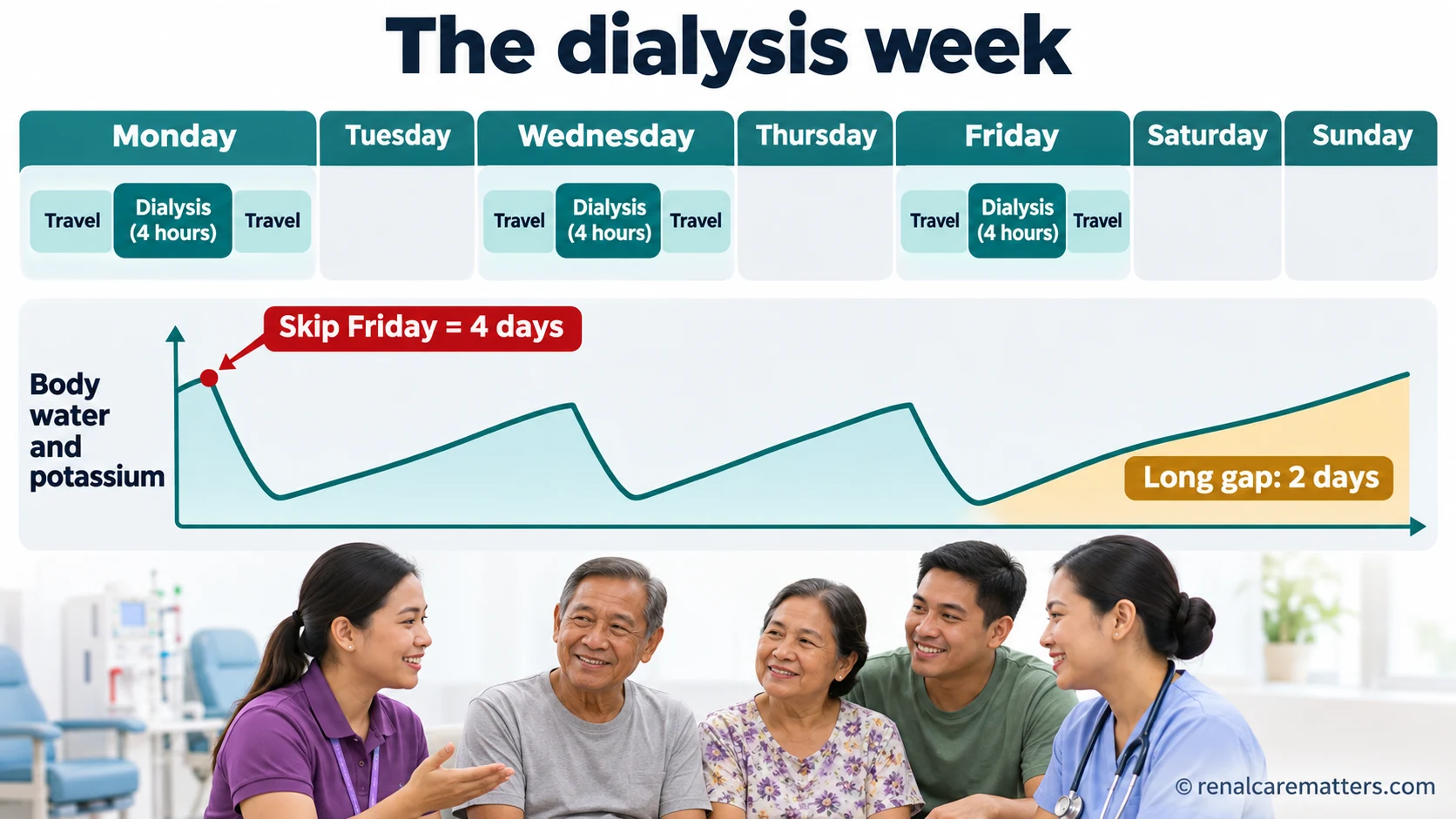
Figure 1. Dialysis is a schedule and a body. Fluid and potassium build up between sessions, most over the long weekend gap, which is why a missed session is dangerous.
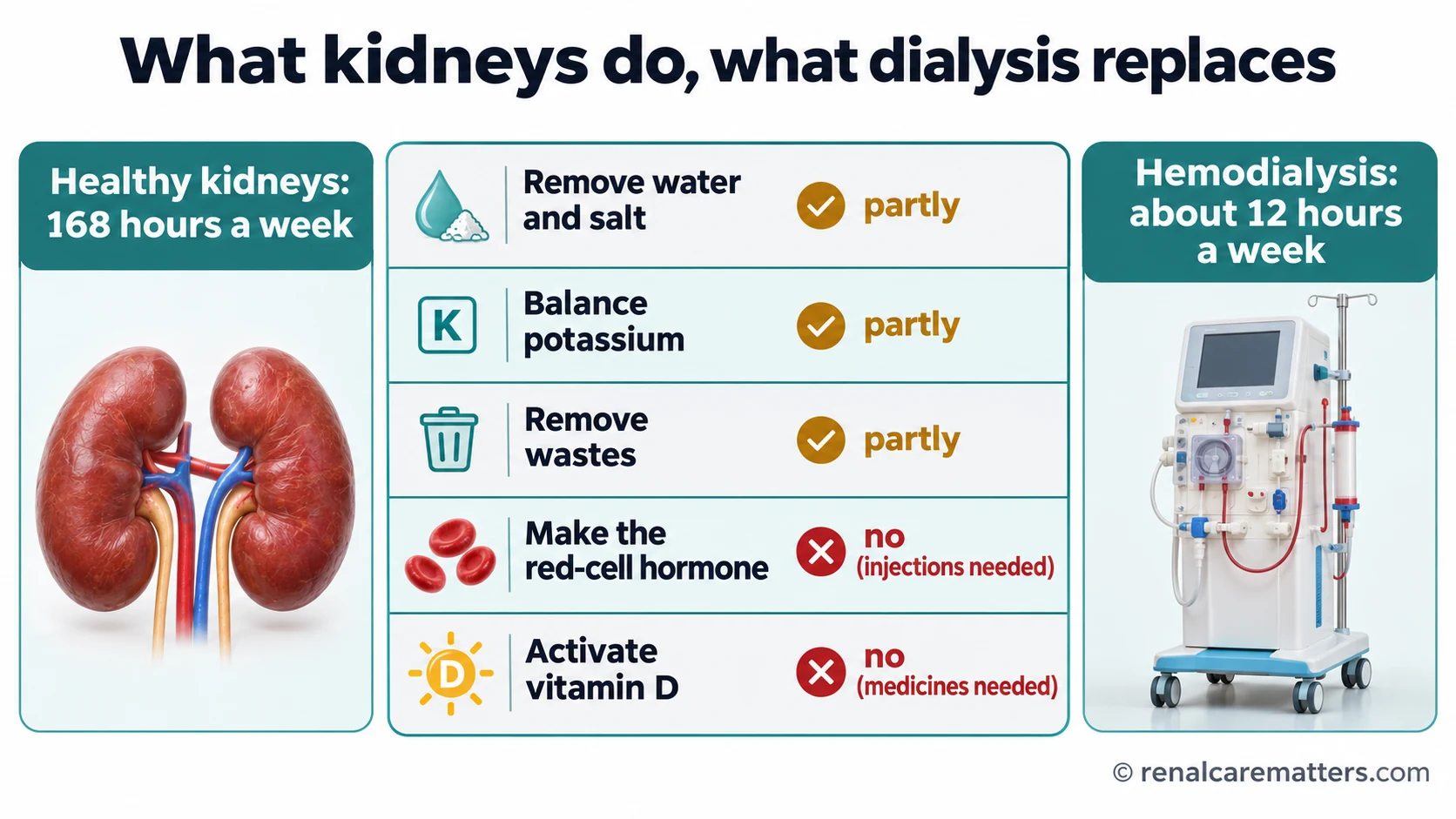
The picture has a limit. The kidneys also make hormones: one that tells the bone marrow to make red cells, and the active form of vitamin D that keeps bones strong. A tanker truck cannot do that, which is why people on dialysis also need injections for anemia and medicines for their bones. And the kidneys adjust their work to what you ate and drank today; dialysis follows a fixed schedule written in advance.
Why should a social worker know any of this? Because almost every social barrier you meet has a physiological edge. A fare that cannot be paid means a missed session, and a missed session means two or three more days of fluid and potassium building up in a body that cannot remove them. A family fiesta means salty food and extra drinks. A night shift means a patient who skips the morning session to keep a job. You do not treat any of these. You need to recognize when they have crossed from “social” to “clinical,” so that the right person hears in time.
Figure 2 · Key terms for this module
Kidney failureKidney function so low that dialysis, a transplant, or conservative kidney management is needed; also called end-stage kidney disease.
Hemodialysis (HD)Blood is cleaned through a machine and filter, usually 4 hours, 3 times a week, in a unit.
Peritoneal dialysis (PD)Fluid is placed in the belly and drained, several times a day or overnight by machine, usually at home.
Dry weightThe target weight after dialysis, when extra fluid has been removed. Set by the nephrologist.
Interdialytic weight gainWeight gained between sessions, mostly water.
Conservative kidney management (CKM)Planned care without dialysis, focused on symptoms and quality of life.
Opening case · fictional
Case: “Can he skip Saturday for his daughter’s graduation?”
It is Wednesday at 2:00 p.m. Mr. Eduardo Pascual, 54, a jeepney driver on hemodialysis every Monday, Wednesday, and Friday, catches you in the corridor after his session. His daughter graduates from nursing school in Iloilo on Saturday. The family wants to leave by bus Thursday night and come back Sunday night.
“I will just skip Friday,” he says. “Monday is only three days later. The nurse said I always gain a lot on weekends anyway. Can you tell the doctor it is fine? You know what it means for a father.”
His wife adds quietly that last month, after a long weekend, he was so short of breath on Monday morning that they took him to the emergency room.
Before reading on, decide:
Why is skipping Friday more dangerous than it sounds to Mr. Pascual, in terms a family can understand?
What is yours to decide, and what must go to the attending nephrologist?
What practical options could let him attend the graduation more safely?
Keep your answers in mind. The lesson gives you what you need, and the case review near the end shows one sound response.
Lesson · part 1
A plant that never closes
Healthy kidneys filter the whole blood plasma many times a day. They keep what the body needs and remove what it does not: urea and other wastes from protein, excess salt and water, excess potassium, and acid. They adjust minute by minute. Drink more and they make more urine; sweat in the heat and they save water.
Figure 3. Dialysis replaces part of the cleaning, not the kidney’s hormones.
When the kidneys fail, those jobs stop or slow. Water and salt stay in the body and collect in the legs and the lungs, which is why a person becomes breathless. Potassium rises, and a high potassium level can disturb the heart’s rhythm without warning symptoms. Acid builds up. Wastes cause nausea, itching, poor appetite, tiredness, and poor concentration. The hormone that drives red-cell production falls, so anemia makes people tired and pale.
Kidney job
When it fails
What the family notices
Why it matters to your work
Remove water and salt
Fluid builds up
Swollen legs, breathlessness lying flat
Food and drink limits feel harsh at fiestas and in the heat
Balance potassium
Potassium rises
Often nothing, until a dangerous rhythm
A missed session is risky even when the person “feels fine”
Low energy can look like low motivation or depression
Make the red-cell hormone
Anemia
Tiredness, pallor
Work capacity falls; injections add cost
Activate vitamin D, balance phosphate
Bone and vessel disease
Bone pain, itch
Binders with every meal are a daily burden and a cost
RememberMany symptoms of kidney failure (tiredness, poor appetite, poor sleep, poor focus) look like depression or “laziness.” Describe what you see; let the clinicians sort out the cause.
Lesson · part 2
Why the long gap matters
A healthy kidney works about 168 hours a week. A usual hemodialysis schedule is about 12 hours a week: three sessions of four hours. Dialysis is powerful during those hours, but between sessions the body has no way to remove water or potassium. So the body’s water and potassium rise and fall like a saw blade, highest just before each session.
On a Monday-Wednesday-Friday schedule, the gap from Friday to Monday is two days instead of one. In a study of 32,065 patients in the United States on this schedule, the death rate on the day after the two-day gap was 22.1 per 100 person-years, compared with 18.0 on other days; admissions for heart failure, heart attack, stroke, and rhythm problems were also more frequent on that day.1 The study was observational, so it shows a pattern, not proof that the gap alone caused the deaths. But the direction makes physiological sense, and it is why nephrologists worry about a skipped Friday.
Skipping makes the gap longer still. In the international Dialysis Outcomes and Practice Patterns Study (DOPPS), skipping one or more sessions a month was associated with higher mortality (relative risk 1.30).2 In records of 182,536 United States patients, the odds of hospital admission in the two days after a missed treatment were about four times those after an attended one; transport, weather, holidays, and psychiatric illness were linked to missed days.3 These are associations: people who miss sessions differ in many ways from those who do not. Still, every one of those reasons is a social one.
Social event
What happens in the body
Who must hear
A missed or shortened session
More fluid and potassium than the next session can safely remove
Nurse and attending nephrologist, the same day
A trip, a fiesta, a wake with salty food
Larger weight gain; more fluid to remove
Nurse and dietitian, before the event
No money for medicines or binders
Phosphate, potassium, or blood pressure drift
Nephrologist and pharmacist, this week
No food at home
Weight loss, weakness, low albumin, which is a warning sign
Dietitian and nephrologist, this week
The toolkit’s PhilHealth session balance tool shows when a person’s covered sessions will run out at their current schedule, so the financial cliff is planned for weeks ahead, not discovered on the day.
RememberA missed session is a clinical event with a social cause. Report it the same day, and find the cause.
Lesson · part 3
Four paths
There are four main paths for kidney failure. Each asks something different of the person and the household. You will help people see those demands clearly (Module 14), but first you must know them.
Path
What it is
What it asks of the household
In-center hemodialysis
Machine cleaning of the blood, usually 3 sessions of about 4 hours a week, through a fistula, graft, or catheter
Transport 3 times a week, often with a companion; time away from work; fixed fluid and potassium limits
Peritoneal dialysis
Fluid exchanges through a soft tube in the belly, by hand during the day or by machine at night
A clean space, storage for boxes of fluid, a trained person, daily routine; fewer trips
Kidney transplant
A kidney from a living or deceased donor, with lifelong medicines to prevent rejection
An evaluation, a possible donor with their own separate process, regular clinic visits and medicines for life
Conservative kidney management
Planned care without dialysis, focused on symptoms, function, and comfort
A care plan at home, regular contact with the team, and a family ready for decline
For most people who can have one, a transplant offers the best long-term outcome. A review of 110 cohort studies with 1,922,300 participants found that transplantation was associated with lower mortality, fewer cardiovascular events, and better quality of life than dialysis; no trial has randomized people between the two.4 That does not make transplant right for everyone, or possible for everyone. Conservative kidney management is real care, not the absence of care, and it is a reasonable choice for some older people with many other illnesses.5
Peritoneal dialysis versus hemodialysis is less settled. A 2024 Cochrane review found only two randomized trials and 82 observational studies; the benefits and harms of one over the other for most outcomes remain uncertain.6 In practice, that uncertainty makes the household’s situation and the person’s values carry more weight in the choice.
RememberKnow what each treatment asks of a household. That is the part of the decision you can help most with.
Lesson · part 4
Route the question, keep the person
Patients ask social workers clinical questions because they trust them and because the doctor is busy. “Can I skip Friday?” “Is it all right to stop my binders if I cannot buy them?” “My feet are swollen, should I come early?” You must not answer these as medical advice. You also must not leave the person with “ask your doctor” and nothing else.
Do three things: acknowledge what the question means to them, connect it to the right clinician now, and stay on the social part of the problem. A trip can be planned with temporary dialysis in another unit (Module 17). A medicine that cannot be bought is a cost problem you can work on while the doctor decides what is safe.
Figure 4 · Routing a clinical question
Hear the whole questionOften the real question is underneath: “Can I keep my job?” or “Can I be at my daughter’s graduation?”
Name who decides“That is a decision for your nephrologist, and I want you to get a clear answer today.”
Connect nowTell the nurse or call the nephrologist with the person’s question in their words.
Work the social partTransport, money, work, travel arrangements, family meeting.
Close the loopCheck the person got an answer and understands it.
Stop and callShortness of breath, chest pain, a fall, confusion, or a missed session with swelling: tell the nurse or attending physician immediately. Do not schedule it for later.
On the floor · The binder question
Mrs. Teresita Lim, on dialysis for two years, tells social worker Mr. Paolo Reyes that she stopped her phosphate binders because they cost more than her rice.
He does not tell her whether that is safe. He tells the nurse, who informs the nephrologist; the nephrologist reviews her latest results and adjusts the prescription to a cheaper option. Mr. Reyes works on the cost: he checks which of her medicines her government hospital’s pharmacy can supply.
The clinical decision went to the clinician; the cost problem stayed with the social worker. Both got solved.
Illustrative scenario. Names and details are invented.
On the floor
Real situations: problems and solutions
These are fictional but typical. For each one, cover the answer, decide what you would do, then compare. Where a step depends on local rules, your unit’s procedure and your supervisor’s direction come first.
Monday breathlessness
What you see
A patient tells you he is “a little short of breath” while you discuss his fare on a Monday morning.
What is likely going on
Fluid built up over the weekend gap.
What to do
Stop and tell the nurse now; continue the fare conversation after he is assessed.
Why it matters
Monday after the long gap is the riskiest day of the dialysis week.
The fiesta question
What you see
A family asks you whether their father can eat at the town fiesta.
What is likely going on
A diet and fluid question with a social heart.
What to do
Connect them to the dietitian before the fiesta, and help plan the day around his session.
Why it matters
You route clinical questions and keep the social part.
“Tamad daw”
What you see
A daughter says her mother is “lazy now” and sleeps all afternoon after dialysis.
What is likely going on
Post-dialysis fatigue, anemia, or depression, not laziness.
What to do
Describe what the daughter reports to the nurse and nephrologist; explain gently that fatigue is common in kidney failure.
Why it matters
Labels hide treatable causes.
Field notes
Ask a nurse to walk you through one full dialysis session in your first week.
Keep the four treatment options in plain words on one page you can show families.
Case review
Back to the case: “Can he skip Saturday for his daughter’s graduation?”
Why skipping Friday is risky. In family terms: the body cannot remove water or potassium between sessions, and the weekend is already the longest gap. Skipping Friday turns a two-day gap into four days. Last month he became breathless after an ordinary long weekend; four days would be far worse, and high potassium can stop the heart without warning. Studies associate the long gap and missed sessions with more deaths and hospital stays.1,2
Who decides. Whether, when, and where he can be dialyzed around the trip is the attending nephrologist’s decision. You do not tell the doctor “it is fine.” You bring the question today: “Mr. Pascual wants to attend his daughter’s graduation in Iloilo, leaving Thursday night. He is thinking of skipping Friday. His wife reports a recent ER visit after a long weekend. Can we plan a safe schedule?”
Practical options. Ask the nephrologist whether the Friday session can move to Thursday morning, before the bus; whether a temporary session in an Iloilo unit on Saturday or Sunday is possible; and what the dietitian advises for the trip. You can then do the social work: find Iloilo units, arrange the transfer papers (Module 17), and check the cost and Philippine Health Insurance Corporation (PhilHealth) session use. Celebrate the graduation with him. The goal is to get him there and back safely, not to stop him going.
Skills lab · with your preceptor
Skills checklist: Explaining the dialysis week and routing a question
With a nurse as co-teacher, explain the dialysis week to a simulated family and route a clinical question. Your preceptor rates each step as satisfactory, needs practice, or not observed. Steps marked Critical must all be satisfactory before sign-off. This checklist supports supervised learning; your unit’s own procedure and competency form are the authority. A printable version of every checklist is on the trainer page.
Explains in plain words what the kidneys do and what hemodialysis does and does not replace.
Explains why the long weekend gap and a missed session are risky, without frightening or blaming.
Describes what each of the four treatment paths asks of a household.
CriticalDeclines to give medical advice and connects a clinical question to the right clinician the same day.
CriticalRecognizes breathlessness, chest pain, confusion, or a missed session with swelling as immediate, and tells the nurse at once.
Identifies the social part of a clinical question and starts work on it.
Placement activity. Spend two hours on the dialysis floor with a nurse. Ask three patients (with permission) what their dialysis week costs them in time and money.
Self-assessment
Check your understanding
Each visit draws 5 questions at random from this module’s 10-question bank. Choose the single best answer for each, then select Check answers; an explanation appears under the best answer. Select New set of questions for a different mix. A good target is 4 of 5 on two different sets. Nothing you select is sent anywhere; scoring happens in your browser.
Foley, R. N., Gilbertson, D. T., Murray, T., & Collins, A. J. (2011). Long interdialytic interval and mortality among patients receiving hemodialysis. New England Journal of Medicine, 365(12), 1099–1107. https://doi.org/10.1056/NEJMoa1103313
Saran, R., Bragg-Gresham, J. L., Rayner, H. C., Goodkin, D. A., Keen, M. L., Van Dijk, P. C., Kurokawa, K., Piera, L., Saito, A., Fukuhara, S., Young, E. W., Held, P. J., & Port, F. K. (2003). Nonadherence in hemodialysis: Associations with mortality, hospitalization, and practice patterns in the DOPPS. Kidney International, 64(1), 254–262. https://doi.org/10.1046/j.1523-1755.2003.00064.x
Chan, K. E., Thadhani, R. I., & Maddux, F. W. (2014). Adherence barriers to chronic dialysis in the United States. Journal of the American Society of Nephrology, 25(11), 2642–2648. https://doi.org/10.1681/ASN.2013111160
Tonelli, M., Wiebe, N., Knoll, G., Bello, A., Browne, S., Jadhav, D., Klarenbach, S., & Gill, J. (2011). Systematic review: Kidney transplantation compared with dialysis in clinically relevant outcomes. American Journal of Transplantation, 11(10), 2093–2109. https://doi.org/10.1111/j.1600-6143.2011.03686.x
Davison, S. N., Levin, A., Moss, A. H., Jha, V., Brown, E. A., Brennan, F., Murtagh, F. E. M., Naicker, S., Germain, M. J., O’Donoghue, D. J., Morton, R. L., Obrador, G. T., & Kidney Disease: Improving Global Outcomes. (2015). Executive summary of the KDIGO Controversies Conference on Supportive Care in Chronic Kidney Disease: Developing a roadmap to improving quality care. Kidney International, 88(3), 447–459. https://doi.org/10.1038/ki.2015.110
Ethier, I., Hayat, A., Pei, J., Hawley, C. M., Johnson, D. W., Francis, R. S., Wong, G., Craig, J. C., Viecelli, A. K., Htay, H., Ng, S., Leibowitz, S., & Cho, Y. (2024). Peritoneal dialysis versus haemodialysis for people commencing dialysis. Cochrane Database of Systematic Reviews, 6(6), CD013800. https://doi.org/10.1002/14651858.CD013800.pub2
Educational material for social workers and navigation staff in kidney care. Completing it is an Academy learning record only. It is not a Professional Regulation Commission (PRC) license, a specialty credential, CPD units, or DOH or PhilHealth recognition, and it does not authorize anyone to practice beyond their own registration.