The Renal Social Worker: Role, Ethics, and Boundaries
Starting from the person’s purpose, regulated practice and its edges, ethics you can see, and who decides what.
PublishedNailathalaGipatikPepalwal:ReferencesMga SanggunianMga TinubdanReng Reperensya:6Audience: Registered social workers in dialysis units, hospital medical social work departments, and kidney transplant programs · medical social workers rotating into kidney care · navigation and support staff on the orientation pathRead timeOras ng pagbasaOras sa pagbasaOras ning pamamasa:
This module is study material for social workers and navigation staff in kidney care. It explains the reasoning behind social work decisions; it is not a facility procedure, legal advice, a benefits ruling, or a mental health diagnosis. Rules, assistance programs, and amounts change: confirm them against the current issuance and your facility’s approved policy. Medical treatment belongs to the nephrologist, benefits to PhilHealth, donation ethics to the ethics committee, and psychiatric diagnosis to the mental health team. Every case, name, and identifier is fictional.
Learning objectives
After this module you should be able to
Explain the renal social worker’s purpose in one sentence that starts from the person’s goal, not from an agency form.
Distinguish professional social work tasks from navigation and clerical support, and name who may do each.
Explain your role, the purpose of the conversation, and the limits of confidentiality before an interview begins.
Assign a kidney-care task to its accountable owner using a role map that includes absence cover.
Recognize a conflict of interest, such as a referral commission or a personal relationship, and route it to supervision.
Classroom 1 hSkills lab 1 hSupervised placement 1 h
Pre-testBefore you read, answer the 5 self-assessment questions and note your score. After the module, select New set of questions and compare. The difference is what you learned; the questions you still miss are what to reread.
Start here
The big picture, in plain words
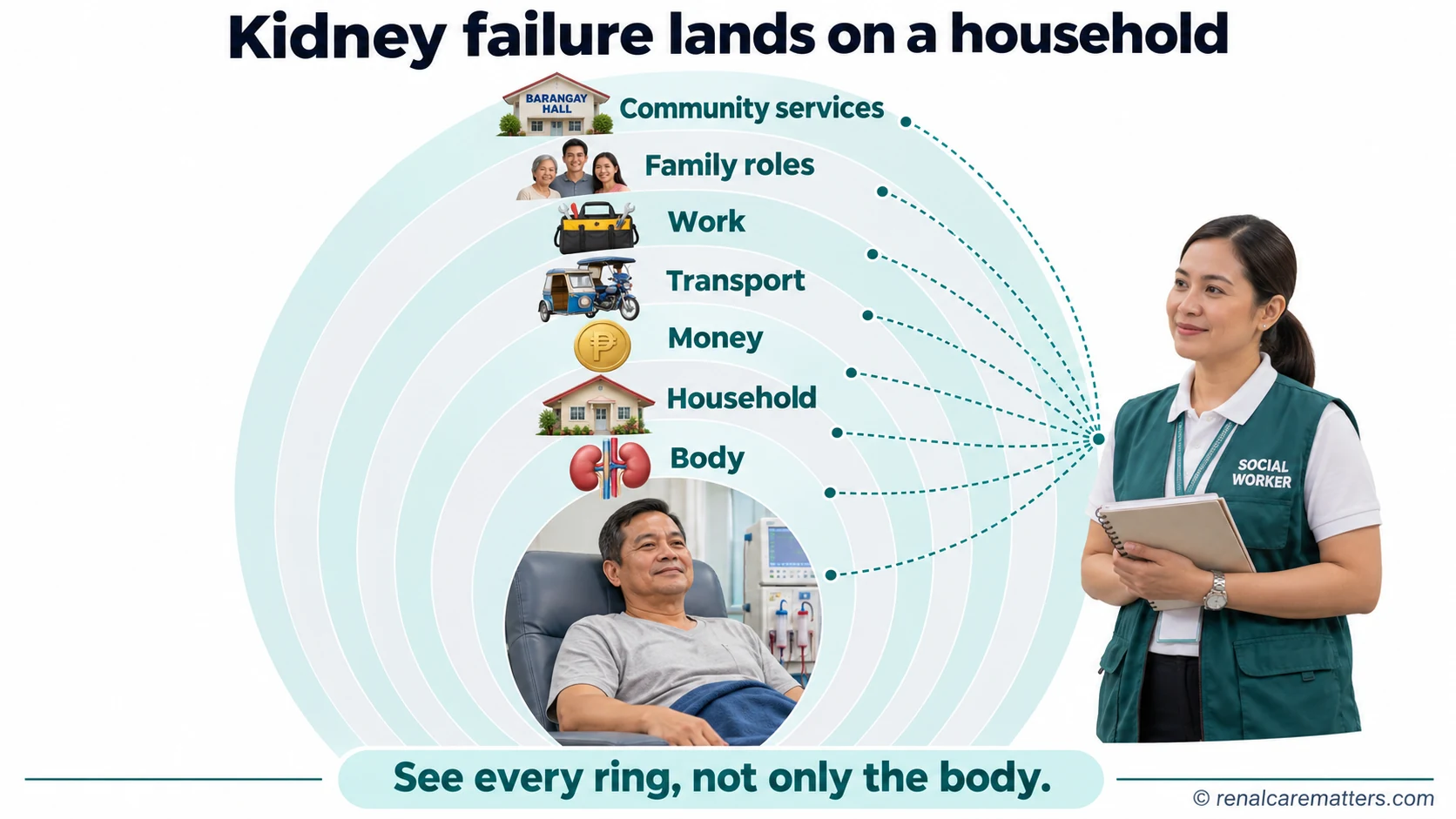
In plain wordsPicture a household as a small boat. Kidney failure is not a storm that hits only the person at the helm; it shifts the weight of everyone on board. Someone has to bail water three mornings a week. Someone loses the hands they needed for fishing. The renal social worker does not steer the boat, and does not fix the engine. The renal social worker helps the family see where the boat is taking on water, agree where they want to go, and find the help that keeps them afloat.
Figure 1. Kidney failure is a medical event that lands on a household. The social worker looks at every ring, not only the body.
The picture has a limit. A boat has one captain. A person with kidney failure is the captain of their own life, but the family, the dialysis team, Philippine Health Insurance Corporation (PhilHealth), and the assistance agencies all hold part of the rudder. Your work is not to take the helm from anyone. It is to make sure the person’s own goal is heard, that each decision is made by the person who has the authority to make it, and that what was promised actually reaches the household.
Most of your days will not be dramatic. A referral form that nobody signed. A wife who thinks the social worker is the person who “gets the guarantee letter.” A navigator asked to sign a social case study because you are on leave. Each of these is a boundary question, and each has the same answer: say what your role is, do what is yours to do, and hand the rest to its owner with a named person and a date.
Figure 2 · Key terms for this module
Renal social workerA registered social worker who assesses and addresses the psychosocial and social needs of people with kidney disease and their families, as a member of the kidney care team.
Registered social worker (RSW)A social worker licensed and registered by the Professional Regulation Commission (PRC) under the social work law as amended.
NavigatorA trained staff member who helps people move through steps (appointments, documents, checklists) under supervision, without professional social work authority.
FormulationA short explanation of why the person’s situation is the way it is, built from the assessment, that guides the plan.
Confidentiality limitsThe situations in which information may or must be shared, explained to the person before they speak.
Absence coverThe named professional who acts when the assigned social worker is away.
Opening case · fictional
Case: The navigator asked to sign
You are the only registered social worker for a 24-station hemodialysis unit in Bulacan. You are on approved leave this Thursday. At 9:20 a.m. the unit secretary calls your navigator, Mr. Jun Dela Rosa, who has worked with you for a year and is good with forms.
Mrs. Corazon Villamor, 61, has been on dialysis for eight months. Her PhilHealth sessions for the year are nearly used up, and her daughter has brought documents for a government assistance application that closes at noon. The receiving office needs a social case study signed by a social worker. “You know her story better than anyone,” the secretary tells Mr. Dela Rosa. “Just write it and sign it. The social worker can countersign Monday.”
At 9:45 a.m. the charge nurse adds that Mrs. Villamor told her this morning that she “cannot keep doing this” and cried in the chair.
Before reading on, decide:
What may Mr. Dela Rosa do this morning, and what may he not do?
Who should he call, and what should he say?
What does the charge nurse’s report change, and who must hear it today?
Keep your answers in mind. The lesson gives you what you need, and the case review near the end shows one sound response.
Lesson · part 1
What the job is for
Begin every new case with one question before any form: what matters most to you right now? Kidney disease disturbs work, income, relationships, identity, housing, and plans for the future. A person may want to keep a market stall, see a grandchild graduate, stop being a burden, or get a transplant. That goal is the anchor for everything else you do.
An application for assistance is one tool among many. It is not the profession. When a social worker is known only as “the person who processes the guarantee letter,” the rest of the work disappears: the assessment that finds the depression, the conversation that keeps a caregiver from collapsing, the plan that makes a session affordable every week, not only once.
The agency asks
The person may need
What you do
“Complete the social case study by noon.”
A way to keep dialysis going after the benefit sessions run out
Assess the whole financial picture; the case study is one action in a plan
“Counsel the noncompliant patient.”
Transport money, or a shift schedule that fits their job
Find the barrier first; the label explains nothing
“Get the family to agree to the transplant.”
Accurate information and time to decide freely
Support an informed decision; never persuade on the team’s behalf
“Tell her the sessions are used up.”
An explanation, the options left, and someone to stay with her
Explain by rule and date, then plan the next step with her
Write the person’s goal in their own words in the record. “Gusto ko pang makita ang apo ko na magtapos” (I want to see my grandchild graduate) tells the next worker more than “patient motivated.”
RememberStart with what the person wants. The form serves the goal; the goal does not serve the form.
Lesson · part 2
Who may do what
Social work is a regulated profession in the Philippines. The social work law, Republic Act No. 4373, as amended by Republic Act No. 10847, governs who may practice and use the title, and the PRC keeps the register.1,2 This course does not add to that authority. Completing it does not make anyone a social worker, and it does not give a registered social worker a specialty title.
The practical edge is simple. Professional assessment, the formulation, a professional report such as a social case study, and counseling within competence belong to the registered social worker responsible for the case. A navigator can do a great deal under supervision: book appointments, explain a published checklist, collect the documents the person agreed to share, and follow up a referral. A navigator must not sign as a social worker, interpret a screening score as a diagnosis, or decide anything that belongs to another professional.
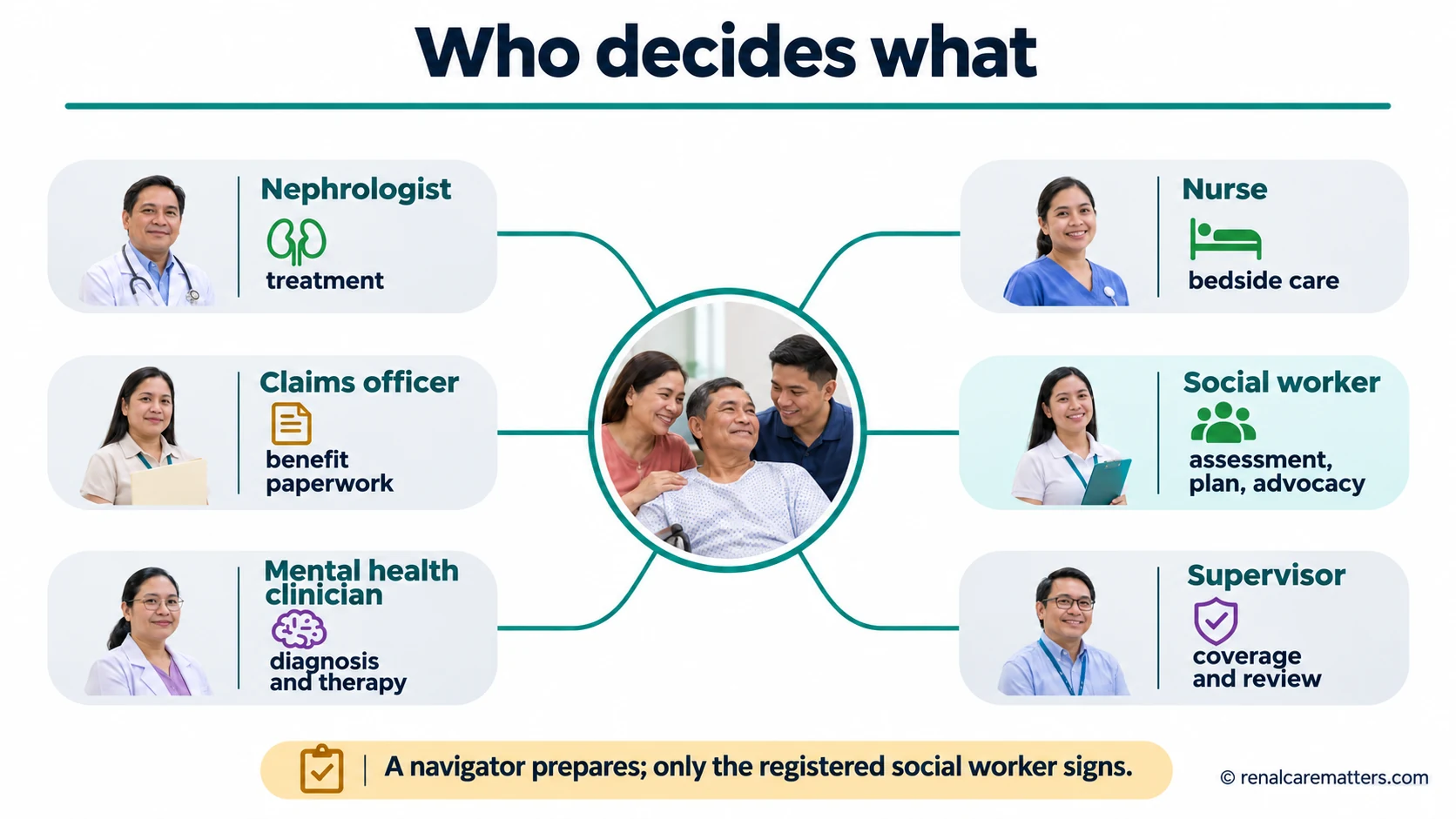
Figure 3. Who decides what. You coordinate many decisions and own a few; name the owner of each.
Decision or task
Owner
What the social worker does
Dialysis prescription, medicines, starting or stopping treatment
Attending nephrologist
Brings the person’s goals, barriers, and questions to the nephrologist
Bedside care and monitoring
Nursing team
Shares what affects care (transport, caregiver strain, distress)
Claims and benefit paperwork
Claims officer and PhilHealth
Explains the pathway; never decides eligibility
Psychiatric diagnosis and treatment
Psychiatrist or psychologist
Screens, supports, refers, and follows up
Psychosocial assessment, formulation, social case study
Registered social worker
Owns it, signs it, and keeps it current
Coverage when you are away
The named covering social worker or department head
Agrees it in writing before leave
Look at the comparison abroad to see how firmly the line is drawn elsewhere. In United States dialysis facilities, federal rules require a social worker with a clinically focused master’s degree in social work.3 That is a United States rule for that setting; it is not a Philippine requirement, and you should not borrow it to judge a Philippine colleague.
RememberA navigator can prepare almost everything. Only the responsible registered social worker can sign the assessment.
On the floor · The signature
Social worker Ms. Grace Mendoza returns from a seminar to find a social case study in her tray, already signed with her name by a clerk “to save time.”
She does not countersign it. She meets the patient that afternoon, completes her own assessment, writes and signs her report, and asks the department head to brief the clerk. She records what happened factually.
A signature is a statement that you did the assessment. It cannot be borrowed.
Illustrative scenario. Names and details are invented.
Lesson · part 3
Explain, ask, and decline
Ethics in social work is mostly done out loud. The PRC adopted the Philippine Social Work Code of Ethics in 2023.4 The full annex could not be retrieved when this module was written, so the habits below are general professional practice, not quotations of specific clauses. Check them against the code your supervisor uses.
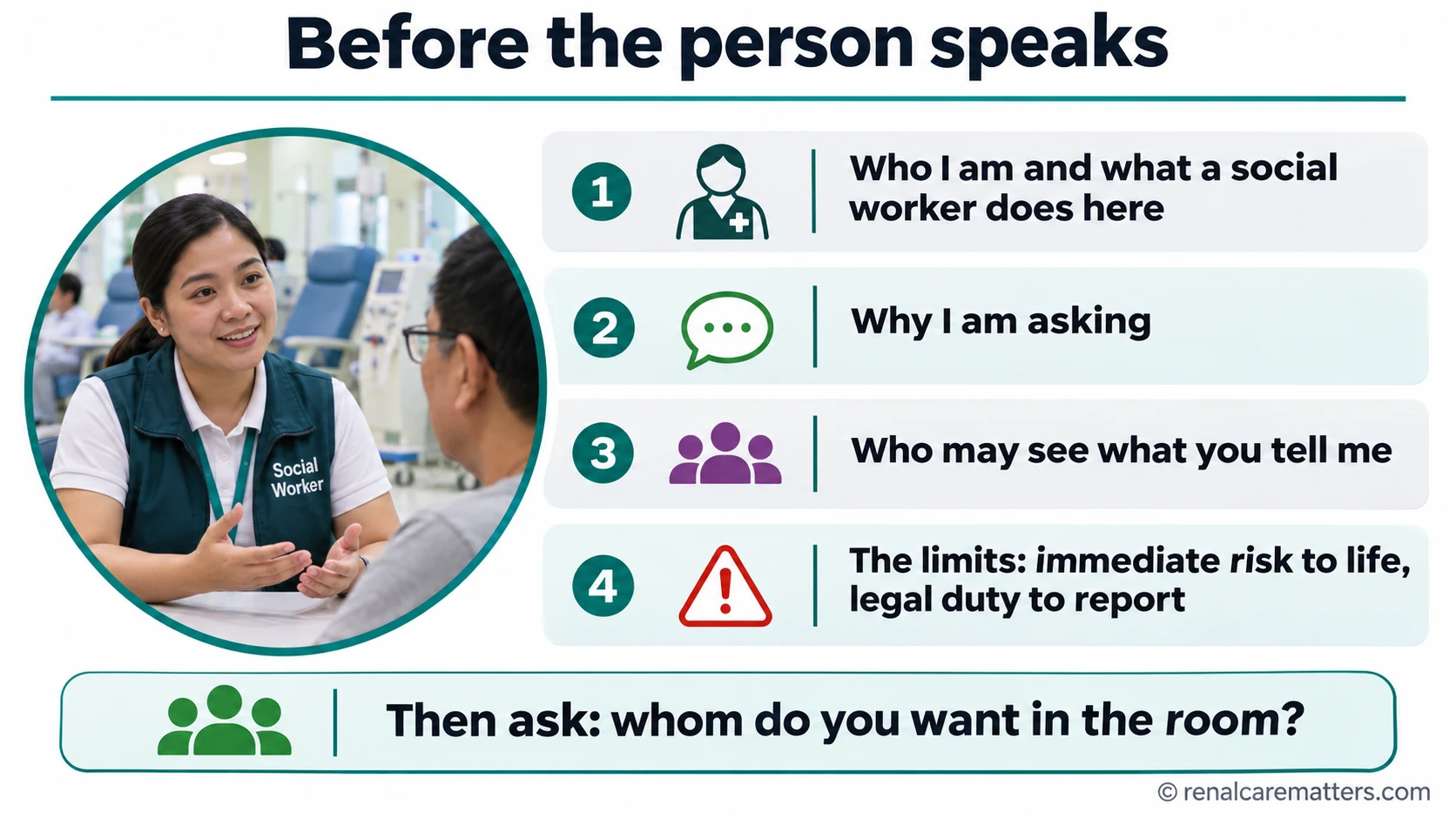
Figure 4. Say these four things before the first personal question.
Before the person tells you anything, say four things: who you are and what a social worker does here; why you are asking; who may see what they tell you; and the limits of confidentiality, such as an immediate risk to their life or someone else’s, or a legal duty to report. Then ask whom they want in the room. The nearest relative is not automatically the decision maker for an adult who can decide for themselves. A daughter who pays for the tricycle has no automatic right to her mother’s private answers.
Situation
The ethical risk
What you do
A pharmacy offers you a “token” for each patient you refer
Your referrals start serving you, not the patient
Decline, document, and tell your supervisor
The patient is your neighbor’s father
Divided loyalty; privacy in your community
Disclose to your supervisor; ask whether another worker should take the case
A family asks you to “not tell Papa” about his prognosis
The adult patient’s right to information is set aside by others
Explore the family’s fear; involve the nephrologist; ask the patient how much he wants to know
A politician’s office offers help in exchange for a photo with the patient
Dignity and consent
Ask the patient privately; no photo without free consent
Use the least information that serves the purpose. Write down the reason whenever you share something. When your own feelings, money, or relationships could bend your judgment, say so to your supervisor before you act.
RememberSay your role, your purpose, and the limits of confidentiality before the person speaks. Ask, do not assume, who may join.
Lesson · part 4
The role map
A unit runs safely on a role map that everyone can see: each recurring task, its owner, the backup, and the route when the owner is away. Without one, work flows to whoever is nearest, which is how a navigator ends up being asked to sign a professional report.
Build the role map before you need it
Figure 5 · Five steps to a working role map
List the recurring tasksIntake interviews, assessments, social case studies, benefit explanations, assistance applications, crisis response, family meetings, transfers.
Name the ownerOne role per task. If two roles share a task, write which part each owns.
Name the backupThe covering registered social worker or department head for professional tasks; another navigator for clerical tasks.
Write the urgent routeWho is called, in what order, when someone is at risk and you are away.
Review itAfter every incident that exposed a gap, and at least once a year.
Your role is one of several in kidney care. Philippine dialysis rules describe the facility’s duties to educate patients on treatment options and to link them to transplant services; the reviewed licensing order does not name a social worker post or a staffing ratio.5 Module 3 looks at what that silence does and does not mean. For now, notice that the duties exist whether or not your unit has a social worker. Someone owns them. Make sure the role map says who.
Clinical work on a dialysis floor depends on stable, rehearsed roles. A Department of Health (DOH) hospital social work department describes its own scope as assessment, counseling, resource linkage, referrals, discharge planning, and agency coordination.6 Use your own employer’s approved job description as the final word.
RememberEvery recurring task has one owner, one backup, and one urgent route, written down before anyone goes on leave.
On the floor · Leave week
Before her leave, social worker Ms. Lea Santos writes a one-page cover note: the covering social worker in the hospital’s social service department, her navigator’s tasks, and the crisis route through the attending nephrologist and the hospital’s psychiatric service.
On day two, a patient discloses thoughts of ending his life. The nurse follows the note, the patient is seen by the attending physician within the hour, and the covering social worker sees him that afternoon.
The plan worked because it was written before it was needed.
Illustrative scenario. Names and details are invented.
On the floor
Real situations: problems and solutions
These are fictional but typical. For each one, cover the answer, decide what you would do, then compare. Where a step depends on local rules, your unit’s procedure and your supervisor’s direction come first.
“Ikaw yung sa guarantee letter”
What you see
Patients greet you as “the one for the guarantee letter” and bring only forms.
What is likely going on
The service is known for one task, so other needs stay hidden.
What to do
At every first contact, explain the whole role in one sentence and ask what matters most before taking any form.
Why it matters
People bring you only the problems they think you solve.
The relative in the doorway
What you see
A son stands in the doorway during every interview and answers for his father.
What is likely going on
Love, worry, or control; you cannot tell which yet.
What to do
Apply the rule you use for everyone: a few minutes alone first, then invite him in.
Why it matters
A rule that applies to everyone protects privacy without accusing anyone.
The clerk’s shortcut
What you see
A clerk fills in social case studies from old templates “to help.”
What is likely going on
Work has drifted to the nearest person because roles were never written down.
What to do
Thank the clerk, explain that only the assessing social worker writes and signs, and add the task to the role map.
Why it matters
A template copied from another family is false documentation.
Field notes
Put your role sentence on a small card and use it until it is second nature.
Write your absence-cover note before every leave, even a single day.
Case review
Back to the case: The navigator asked to sign
What Mr. Dela Rosa may and may not do. He may organize the documents the daughter brought, check them against the receiving office’s current checklist, and call the office to ask whether a short extension or a covering social worker’s report is acceptable. He may not write or sign a social case study. A countersignature on Monday would not make Thursday’s report his; it would make it false.
Whom he calls. He follows your cover note and calls the covering registered social worker: “Mrs. Villamor, 61, on dialysis for eight months, needs a social case study for an assistance application that closes at noon. Her documents are complete. Can you assess her this morning, or tell me whom I should ask?” If no social worker can be reached, he tells the daughter honestly that the report cannot be signed today, asks the office about the next intake date, and records who he called and when.
What the nurse’s report changes. “I cannot keep doing this” may be exhaustion, a wish to stop dialysis, or thoughts of self-harm. It is not his to interpret, and it cannot wait for the application. He tells the charge nurse to inform the attending nephrologist now, and he tells the covering social worker in the same call. The safety question comes before the paperwork (Module 11).
None of these actions required professional authority. Each one made sure the person with that authority knew, in time.
Skills lab · with your preceptor
Skills checklist: A role map and a first introduction
Using a fictional unit, build a role map and deliver an opening introduction while your supervisor observes. Your preceptor rates each step as satisfactory, needs practice, or not observed. Steps marked Critical must all be satisfactory before sign-off. This checklist supports supervised learning; your unit’s own procedure and competency form are the authority. A printable version of every checklist is on the trainer page.
States the purpose of the renal social worker in one sentence that starts from the person’s goal.
CriticalIntroduces self, role, purpose, and the limits of confidentiality before asking any personal question.
CriticalAsks the patient privately whom they want present before inviting family into the interview.
Builds a role map with owner, backup, and urgent route for at least six recurring tasks.
CriticalDeclines to sign or countersign an assessment made by someone else, and arranges the correct route.
Identifies a conflict of interest in a scenario and states how it will be disclosed to the supervisor.
CriticalRecognizes a possible safety statement embedded in a routine request and escalates it the same day.
Placement activity. Spend one session with the unit’s head nurse and claims officer. List every task that reaches the social worker in a week and mark who owns each one.
Self-assessment
Check your understanding
Each visit draws 5 questions at random from this module’s 10-question bank. Choose the single best answer for each, then select Check answers; an explanation appears under the best answer. Select New set of questions for a different mix. A good target is 4 of 5 on two different sets. Nothing you select is sent anywhere; scoring happens in your browser.
Educational material for social workers and navigation staff in kidney care. Completing it is an Academy learning record only. It is not a Professional Regulation Commission (PRC) license, a specialty credential, CPD units, or DOH or PhilHealth recognition, and it does not authorize anyone to practice beyond their own registration.