Elicit–offer–check, teach-back, health literacy, household measures, recipe arithmetic, food exchange lists, eating on a budget, and fiestas.
PublishedNailathalaGipatikPepalwal:ReferencesMga SanggunianMga TinubdanReng Reperensya:6Audience: Registered nutritionist-dietitians entering adult kidney care · renal RND preceptors, nephrologists, and head nurses who orient themRead timeOras ng pagbasaOras sa pagbasaOras ning pamamasa:
This module is study material for dietitians in adult kidney care. It explains the reasoning behind common decisions; it is not a protocol. In practice, follow your facility’s policy and the responsible physician’s orders. Targets and cut-off values are set by your unit and the attending nephrologist. Every case is fictional.
Learning objectives
After this module you should be able to
Use an elicit, offer, check sequence to agree on one change the patient chooses.
Use teach-back to confirm that advice was understood.
Adapt teaching for low health literacy, language, and numeracy.
Calculate nutrients in a household recipe per serving, and say where the estimate may be wrong.
Use the Philippine Food Exchange Lists and the Pinggang Pinoy plate to build meals.
Plan for a tight budget and for fiestas without abandoning the plan.
Pre-testBefore you read, answer the 8 self-assessment questions and note your score. After the module, select New set of questions and compare. The difference is what you learned; the questions you still miss are what to reread.
Start here
The big picture, in plain words
In plain wordsCounseling is not pouring information into a bucket. It is helping someone carry one bucket at a time up a hill they already know. Ask what they already carry, offer one change that fits, and check that they can lift it. Five changes at once spill on the first step.
Figure 1 · Key terms for this module
Elicit, offer, checkAsk what the person knows and wants, offer information or options with permission, then check what they make of it.
Teach-backAsking the patient to explain or show, in their own words, what they will do.
Health literacyThe ability to find, understand, and use health information.
Food exchangeA portion of food with a set amount of energy, protein, carbohydrate, and fat, from the Philippine Food Exchange Lists.
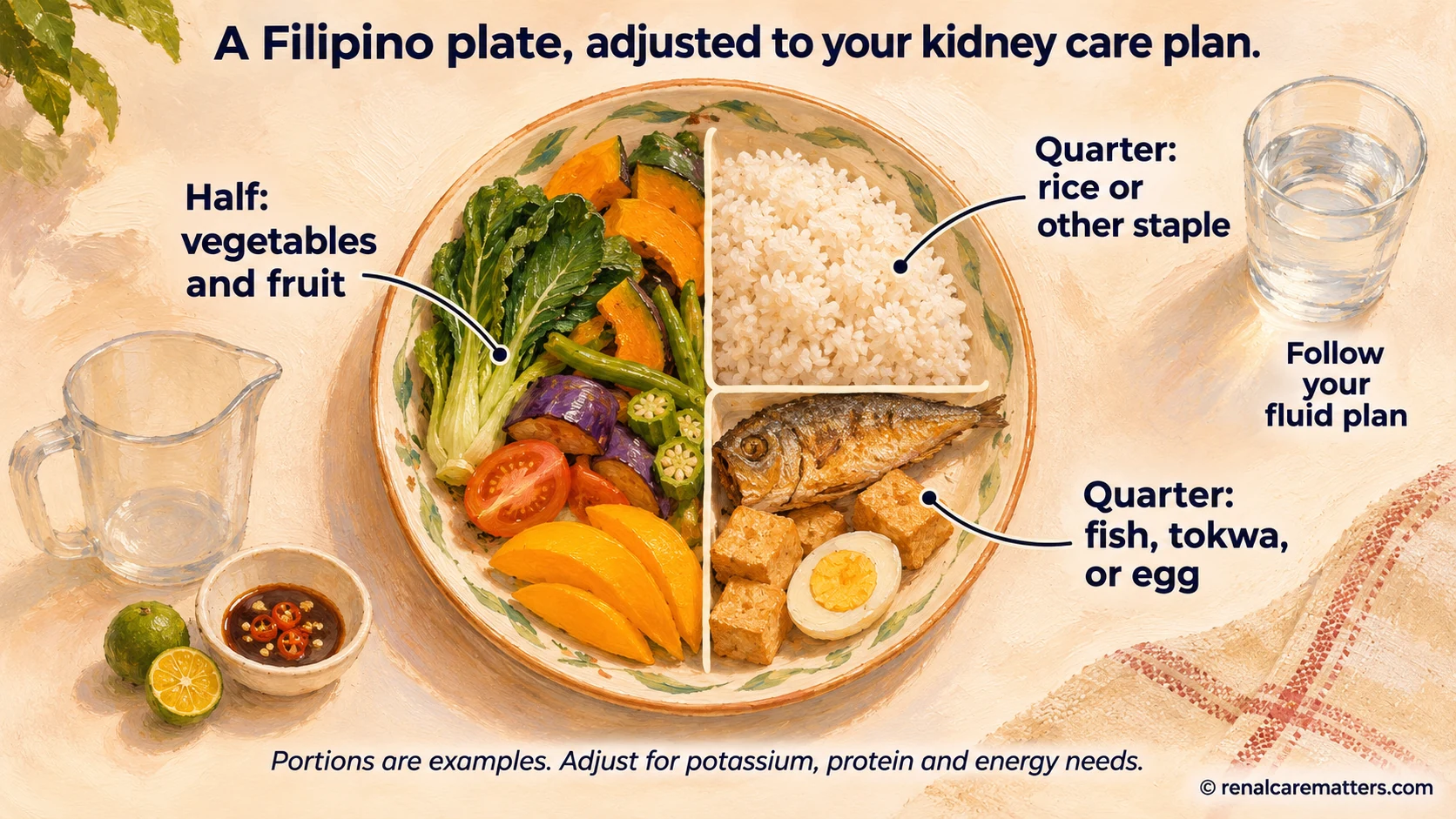
Pinggang PinoyThe Filipino healthy plate: half vegetables and fruits, a quarter rice or other energy food, a quarter fish, meat, or other protein food.
Recipe yieldHow many servings a pot makes.
Figure 2 · One counseling visit
Elicit“What have you been told about your diet? What is hardest?”
Offer“May I share two options?”
ChooseThe patient picks one change.
Teach-back“Show me how you will measure it.”
PlanWhen, a fallback, and a check-in date.
Opening case · fictional
Case: Tinola for four
Aling Rosa, 60, cooks for her family of four. Her husband, Mang Pedro, is on hemodialysis. She makes tinola twice a week: chicken, green papaya, malunggay, ginger, one bouillon cube, and patis.
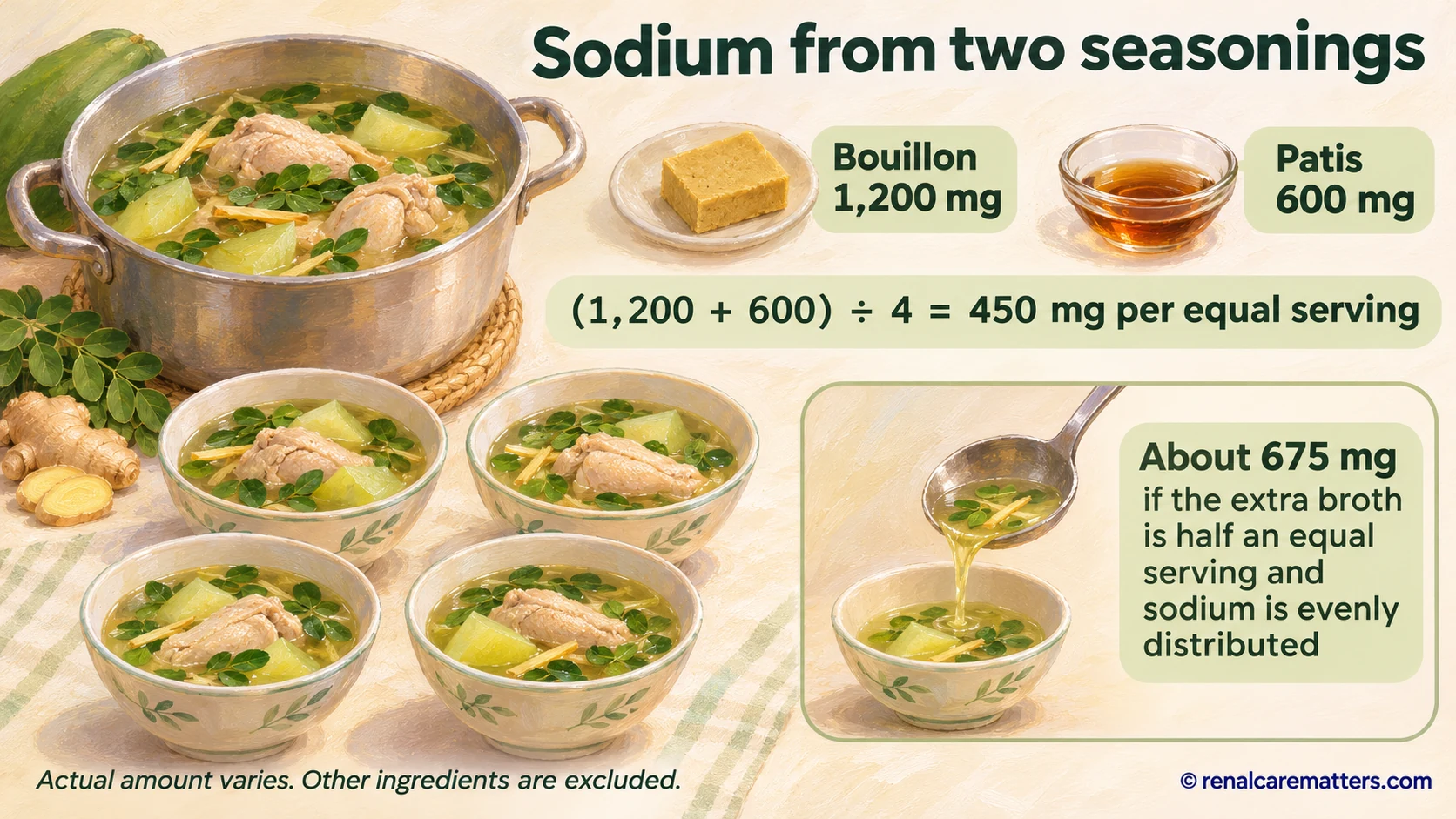
The bouillon cube (fictional label) contains 1,200 mg of sodium, and the patis she adds contains about 600 mg. The pot makes four equal servings. Mang Pedro usually takes an extra half bowl of broth. She says she cannot cook separately for him and that the family will complain if the tinola tastes “bland.” Money is tight.
Before reading on, decide:
How much sodium from the cube and patis is in one serving, and in Mang Pedro’s serving?
Why is your estimate uncertain?
What change might she accept, and how will you check that she understood?
Keep your answers in mind. The lesson gives you what you need, and the case review near the end shows one sound response.
Lesson · part 1
Elicit, offer, check
Advice that ignores what the patient already knows, believes, and can afford rarely survives the trip home. Start by asking. “What have you been told about food since dialysis started?” “What is the hardest part?” “Who cooks? Who shops? How much is the food budget?” Listen for mistaken rules, as these are common, and for what the person cares about.
Then ask permission before offering: “May I share two ideas?” Offer options, not orders. Let the patient choose one. A change chosen by the patient is more likely to happen than a change chosen for them. Agree on when it starts, what happens if it fails (a fallback), and when you will check.
The Academy of Nutrition and Dietetics and National Kidney Foundation standards place this kind of patient-centered counseling, with documented goals and follow-up, at the center of competent renal practice.1
RememberOne change the patient chose, done well, is worth more than ten changes you listed.
Lesson · part 2
Teach-back, language, and numbers
Many patients nod when they do not understand, out of respect or embarrassment. Teach-back checks your teaching, not the patient. Say: “I want to be sure I explained this clearly. Can you show me how you will measure the patis tomorrow?” If the answer is wrong, explain again, differently, and ask again.
Figure 3 · Making advice usable
Use the patient’s languageTagalog, Cebuano, Kapampangan, or other; use an interpreter or a family member the patient chooses.
Use objects, not numbersA teaspoon, a matchbox-size piece of fish, a marked cup of rice.
Show, do not only tellMeasure the patis together; read a label together.
Keep it shortTwo or three points per visit, written in large print or as pictures.
Involve the cookThe person who cooks often needs the teaching more than the patient.
Numbers are hard for many people. “Less than 2,000 mg of sodium” means little to most patients. “One level teaspoon of salt for the whole day, from everything” is clearer. “Two matchbox pieces of fish at lunch” is clearer than “20 g of protein.”
Lesson · part 3
Calculate a household recipe
Patients eat dishes, not nutrients. To estimate the sodium, potassium, or protein in a dish:
Figure 4 · Recipe calculation
ListEvery ingredient that adds the nutrient, with amounts.
Find valuesFrom the label, or the Philippine Food Composition Tables for the raw or cooked form used.
AddThe total for the pot.
DivideBy the number of equal servings.
AdjustFor the actual portion, extra broth, and table condiments.
State the uncertaintyWhat you assumed and could not measure.
Sodium per serving = (cube 1,200 mg + patis 600 mg) ÷ 4 servings = 450 mg. Mang Pedro’s serving with an extra half bowl of broth = about 450 × 1.5 = 675 mg, if the sodium is spread evenly in the broth.
The estimate is uncertain for several reasons. Sodium dissolves into the broth, so a serving heavy in broth carries more than one heavy in chicken. Servings are rarely equal. The chicken and vegetables add some sodium of their own. Patis at the table is not counted. Write down what you assumed. Use the Philippine Food Composition Tables (PhilFCT) for ingredient values and record the source and date.2 The site’s recipe analyzer and label scanner can help with the arithmetic. The Philippine Society of Nephrology also publishes patient nutrition materials you can use alongside your own.3
Figure 5. Recipe arithmetic: add the seasoning, divide by servings, then adjust for the real portion.
Lesson · part 4
Exchanges, the plate, budgets, and fiestas
Food exchanges. The Philippine Food Exchange Lists group foods by portions with similar energy and nutrients. One meat exchange, for example, is a portion of fish, chicken, or meat with about 8 g of protein.4 Exchanges let you turn a protein target into portions: 60 g of protein a day is roughly five to six meat exchanges plus the protein in rice and vegetables. They are approximate. Check sodium, potassium, and phosphorus separately, because the exchange lists were not designed for kidney disease.
The plate. Pinggang Pinoy shows a healthy Filipino plate: half vegetables and fruits, a quarter rice or other energy food, a quarter protein food.5 For energy and nutrient needs of healthy Filipinos, the reference is the Philippine Dietary Reference Intakes.6 The plate is a good starting picture for chronic kidney disease (CKD) stages 1 to 3, with portions adjusted for the patient’s protein target and potassium.
A tight budget. Eggs, tofu, monggo, and small fish are affordable protein. Rice and root crops supply cheap energy. Frozen and canned foods vary; read the sodium. Buy in season. Ask what the family already buys before suggesting anything new.
Fiestas and holidays. Banning party food fails. Plan it: a smaller plate, fresh-served food rather than leftovers, the patient’s favorite dish in a measured portion, broth and sawsawan left out, binders taken with the meal, and less salt in the meals before and after. Patients on dialysis should not skip a session for a party.
Figure 6. A healthy Filipino plate as the starting picture, adjusted to the patient’s targets.
On the floor
Real situations: problems and solutions
These are fictional but typical. For each one, cover the answer, decide what you would do, then compare. Where a step depends on local rules, your unit’s procedure and your supervisor’s direction come first.
Nodding but not understanding
What you see
A patient nods at everything. At teach-back, he cannot say what he will change.
What is likely going on
Low health literacy, a language gap, or embarrassment.
What to do
Re-explain with objects and his language. Ask him to show you with a spoon or a cup. Involve the person who cooks.
Why it matters
Nodding is politeness, not understanding.
The budget that will not stretch
What you see
A family says fresh fish is too expensive; they rely on canned sardines and instant noodles.
What is likely going on
Cost, not knowledge, is the barrier.
What to do
Find affordable swaps: eggs, tofu, monggo, small fresh fish in season; rinse canned fish; half the noodle seasoning. Ask about social work support.
Why it matters
Advice the family cannot afford is advice they will not follow.
Field notes
Ask the cook to show you how much patis goes into the pot.
Plan for the next fiesta instead of banning it.
Case review
Back to the case: Tinola for four
How much sodium? (1,200 + 600) ÷ 4 = 450 mg per equal serving from the cube and patis. With an extra half bowl of broth, Mang Pedro gets about 675 mg from those two seasonings alone. On a 2,000 mg day, that is a third of his allowance in one bowl.
Why is it uncertain? Servings are not exactly equal, sodium sits mostly in the broth, the chicken adds some sodium of its own, and any patis at the table is not counted. Say this when you write it down.
What might she accept? Ask her first what she thinks would work. Options to offer: use half a bouillon cube and add more ginger, onion, and garlic; add the patis at the table for the rest of the family and not to the pot; give Mang Pedro his serving before adding extra broth. Let her choose one. She keeps cooking one pot for everyone, and the family adds seasoning at the table.
How will you check? Teach-back: “Show me how much cube you will use next time.” Then a call or visit in a week: did the family accept it, did it cost more, did Mang Pedro’s weight gain change? The cook is often the real patient in a counseling visit. Teaching her well may do more than any diet sheet.
Skills lab · with your preceptor
Skills checklist: Counseling with recipe calculation and teach-back
The preceptor plays a family cook. Materials: a household recipe, two labels, measuring spoons. Your preceptor rates each step as satisfactory, needs practice, or not observed. Steps marked Critical must all be satisfactory before sign-off. This checklist supports supervised learning; your unit’s own procedure and competency form are the authority. A printable version of every checklist is on the trainer page.
Opens by asking what the person knows, what is hardest, and who cooks and shops.
Asks permission before offering options and offers at least two.
Lets the person choose one change and agrees on timing, a fallback, and follow-up.
Calculates a nutrient per serving from a recipe and adjusts for the actual portion.
States the assumptions and uncertainty in the estimate.
Uses household measures and objects instead of numbers.
CriticalUses teach-back and re-explains if needed.
Documents the goal, the change chosen, and the follow-up date.
Placement activity. Calculate sodium per serving for three dishes your patients commonly cook, using real labels and PhilFCT values.
Self-assessment
Check your understanding
Each visit draws 8 questions at random from this module’s 15-question bank. Choose the single best answer for each, then select Check answers; an explanation appears under the best answer. Select New set of questions for a different mix. A good target is 7 of 8 on two different sets. Nothing you select is sent anywhere; scoring happens in your browser.
Pace, R. C., & Kirk, J. (2021). Academy of Nutrition and Dietetics and National Kidney Foundation: Revised 2020 Standards of Practice and Standards of Professional Performance for registered dietitian nutritionists (competent, proficient, and expert) in nephrology nutrition. Journal of Renal Nutrition, 31(2), 100–115.e41. https://doi.org/10.1053/j.jrn.2020.12.001
Department of Science and Technology, Food and Nutrition Research Institute. (n.d.). Philippine food composition tables online database (PhilFCT). Retrieved November 23, 2026, from https://i.fnri.dost.gov.ph/login/fct
Department of Science and Technology, Food and Nutrition Research Institute. (2019). Food exchange lists for meal planning (4th ed.). DOST-FNRI. https://www.fnri.dost.gov.ph/
Department of Science and Technology, Food and Nutrition Research Institute. (2016). Pinggang Pinoy: Healthy food plate for Filipino adults. DOST-FNRI. https://www.fnri.dost.gov.ph/
Department of Science and Technology, Food and Nutrition Research Institute. (2015). Philippine dietary reference intakes 2015: Summary of recommendations. DOST-FNRI. https://www.fnri.dost.gov.ph/
Educational study material for registered nutritionist-dietitians. Does not replace the nephrologist’s orders, facility policy, the Nutrition Care Process documentation required by the Department of Health, or supervised practice.