Prehabilitation, the first weeks, lifting old dialysis restrictions, post-transplant diabetes, food safety, and foods and herbs that change tacrolimus levels.
PublishedNailathalaGipatikPepalwal:ReferencesMga SanggunianMga TinubdanReng Reperensya:6Audience: Registered nutritionist-dietitians entering adult kidney care · renal RND preceptors, nephrologists, and head nurses who orient themRead timeOras ng pagbasaOras sa pagbasaOras ning pamamasa:
This module is study material for dietitians in adult kidney care. It explains the reasoning behind common decisions; it is not a protocol. In practice, follow your facility’s policy and the responsible physician’s orders. Targets and cut-off values are set by your unit and the attending nephrologist. Every case is fictional.
Learning objectives
After this module you should be able to
Prepare a transplant candidate’s nutrition so they arrive at surgery strong, not merely lighter.
Explain why needs change from the first weeks to the first year after transplant.
Decide which dialysis-era restrictions to lift, based on current kidney function and results.
Recognize post-transplant diabetes and steroid-related high glucose, and coordinate with the team.
Teach food safety with familiar Filipino dishes.
Route questions about foods and herbs that change tacrolimus levels to the transplant pharmacist.
Pre-testBefore you read, answer the 8 self-assessment questions and note your score. After the module, select New set of questions and compare. The difference is what you learned; the questions you still miss are what to reread.
Start here
The big picture, in plain words
In plain wordsA new kidney is a working engine placed in a car that has been parked for years. The car runs again, but it needs new habits: the old dialysis rules may no longer fit, the medicines that protect the kidney change appetite, glucose, and blood fats, and the body’s defenses are lowered on purpose. Nutrition after transplant is mostly about helping the new engine last.
Figure 1 · Key terms for this module
Transplant candidateA person being evaluated for, or waiting for, a kidney transplant.
GraftThe transplanted kidney.
ImmunosuppressantA medicine that lowers the immune response so the graft is not rejected, such as tacrolimus, mycophenolate, and prednisone.
TacrolimusThe main anti-rejection medicine; its blood level must stay in a narrow range.
Cytochrome P450 3A4 (CYP3A4)An enzyme in the gut and liver that breaks down tacrolimus. Some foods block it.
Post-transplantation diabetes mellitus (PTDM)Diabetes that first appears after transplant.
Food safetyHandling food to prevent infection: clean, separate, cook, chill.
First weeksHealing, high protein, high glucose from steroids, food safety.
First monthsLift old dialysis rules carefully; watch potassium, phosphate, magnesium.
Long termWeight, blood pressure, lipids, diabetes, bone.
Opening case · fictional
Case: The fiesta two weeks out
Mr. Domingo, 45, received a kidney from his sister two weeks ago. His creatinine is improving. He takes tacrolimus, mycophenolate, and prednisone. His appetite is poor, and his glucose readings have been 220 to 260 mg/dL in the afternoon.
His family is planning a homecoming party with kinilaw, lechon, and fruit. He asks whether he can eat the kinilaw, whether he can have pomelo, and whether an herbal tonic a relative sent from abroad is safe. He also asks if he must still avoid bananas and keep drinking only a liter a day, as he did on dialysis.
Before reading on, decide:
What would you say about the kinilaw and the pomelo?
Who should check the herbal tonic, and why?
Should he keep his dialysis restrictions?
Keep your answers in mind. The lesson gives you what you need, and the case review near the end shows one sound response.
Lesson · part 1
Arrive at surgery strong
Candidates are often weak after years of dialysis. Frailty and low muscle mass before transplant are linked to longer hospital stays and more complications. The Kidney Disease: Improving Global Outcomes (KDIGO) candidate guideline advises assessing nutrition and frailty during evaluation and addressing them before surgery.1
Some programs ask candidates with obesity to lose weight. KDIGO advises against excluding candidates on body mass index alone, and when weight loss is advised, the goal is less fat with muscle kept.1 Fast weight loss on dialysis often takes muscle. The candidate should keep dialysis-level protein (1.0 to 1.2 g/kg/day), reduce energy modestly, and stay active. Measure grip strength or a chair-stand test along with weight. Tell the transplant team what is happening to strength, not only to the scale.
RememberThe goal before transplant is a stronger patient, not just a lighter one.
Lesson · part 2
The first weeks and the first year
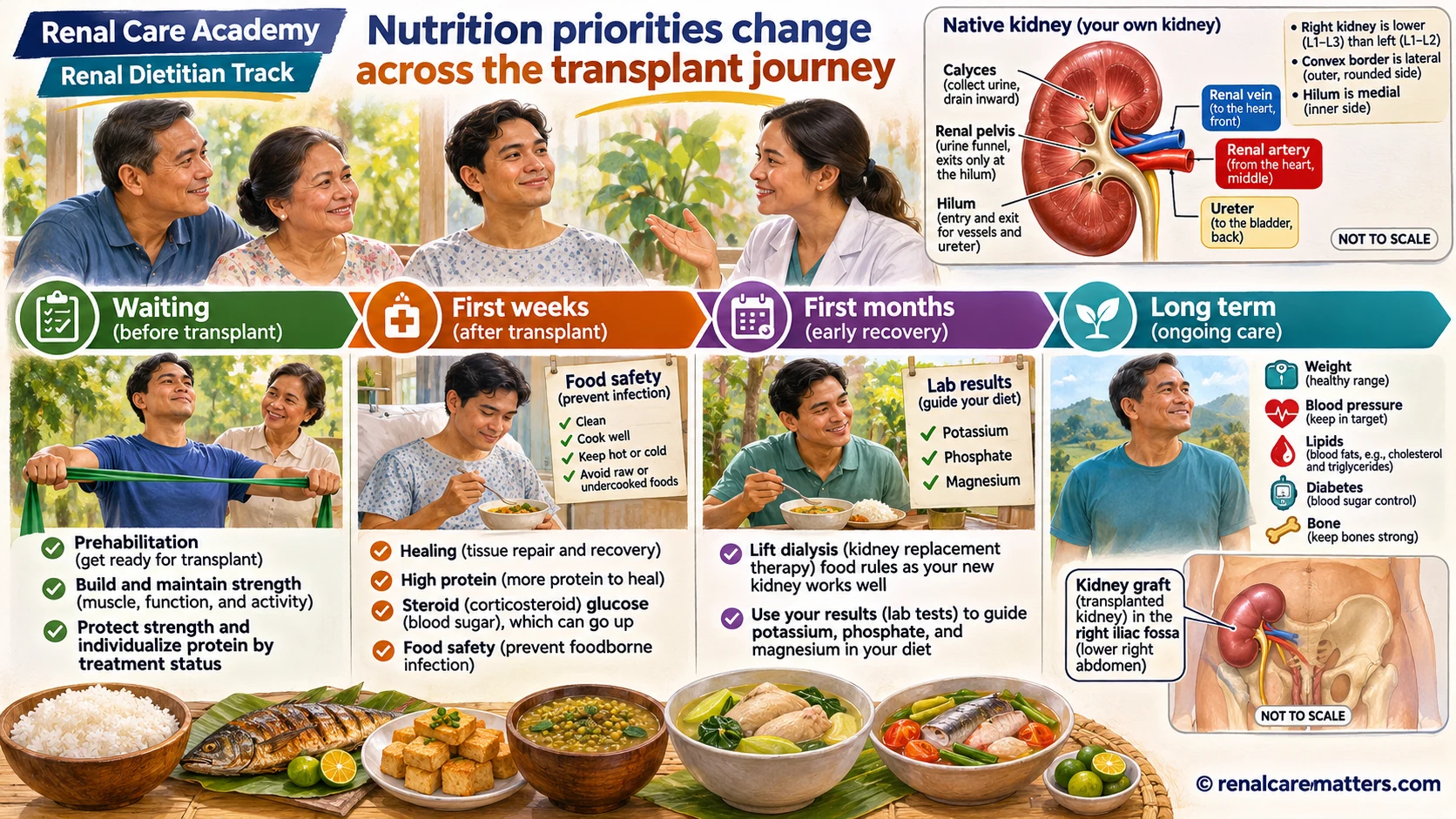
In the first weeks, the body is healing from surgery, and high-dose steroids break down muscle and raise glucose. Protein needs are high, often around 1.3 to 1.5 g/kg/day in the early period, a common practice figure rather than a graded recommendation. Appetite can be poor. Small, frequent meals and an oral supplement may help.
Lifting the old rules. With a working graft, most patients no longer need the dialysis diet. But do not lift every restriction on day one. Tacrolimus can raise potassium and lower magnesium. A delayed or poorly working graft may still need potassium and fluid limits. Phosphate often falls after transplant, sometimes very low, as the new kidney and high parathyroid hormone pass it out. Read the current results, ask the transplant team what they want, and lift restrictions one at a time.
Glucose. Steroids raise glucose in the afternoon and evening. Tacrolimus reduces insulin release. Post-transplant diabetes is common, and an international consensus advises screening and treating it with lifestyle measures and medicines chosen with the team.2 Your part: carbohydrate spread over the day, fewer sweet drinks, a meal pattern that matches the steroid dose, and readings with times passed to the team.
Long term. After the first months, the risks shift to weight gain, high blood pressure, high blood fats, diabetes, and bone loss. The KDIGO recipient guideline advises managing these as cardiovascular risk factors.3 Many patients gain weight in the first year. Plan for it early.
Figure 3. Nutrition priorities change across the transplant journey.
Lesson · part 3
Food safety with familiar meals
Immunosuppressants make infections from food more likely and more serious. The United States Food and Drug Administration lists transplant recipients among people at higher risk and teaches four steps: clean, separate, cook, and chill.4 The transplant program sets the specific rules and how long they last.
Usual dish
The risk
A safer choice
Kinilaw, sushi, raw oysters
Raw fish and shellfish; vinegar does not kill all bacteria or parasites
Fish cooked through, such as paksiw or sinigang
Soft-boiled or raw egg in drinks or desserts
Salmonella
Eggs cooked until the yolk is firm
Rare or undercooked meat
Bacteria in the center
Meat cooked through; no pink
Fiesta food left out for hours
Bacteria grow at room temperature
Eat it freshly served; chill leftovers within two hours
Unpasteurized milk, street ice, unsafe water
Bacteria and parasites
Pasteurized milk, boiled or bottled water, ice from safe water
Teach the family too, because they shop and cook. Use teach-back: ask the patient to tell you which dishes he will choose at the party.
Lesson · part 4
Foods, herbs, and tacrolimus
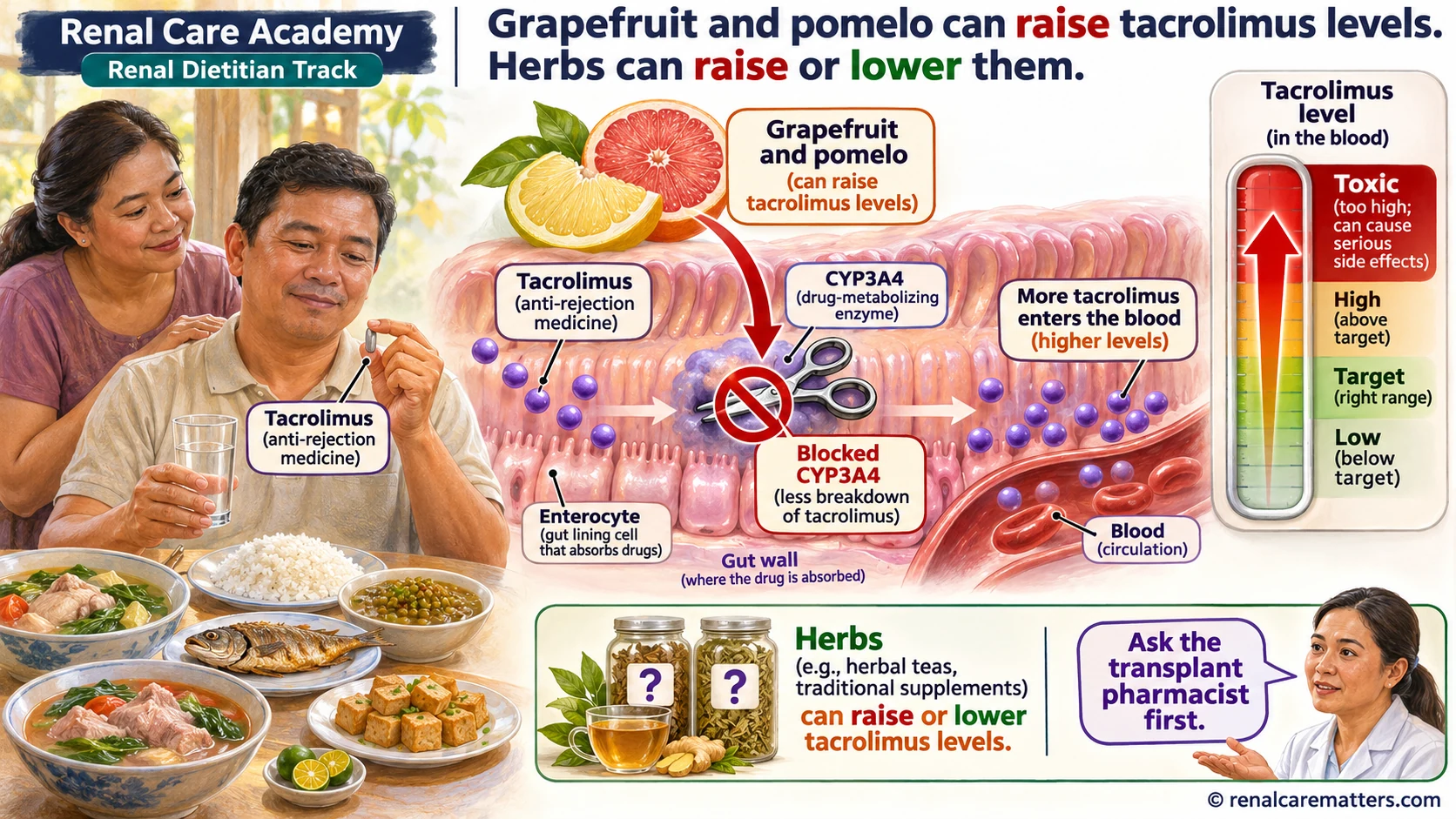
Tacrolimus is broken down by an enzyme, CYP3A4, in the gut and liver. Grapefruit juice blocks this enzyme, so tacrolimus levels can rise and cause toxicity. Pomelo, a close relative of grapefruit and common in the Philippines, contains similar compounds. Evidence for pomelo comes mainly from laboratory and animal studies, including one in rats in which pomelo juice raised tacrolimus levels, and from reviews of food interactions.5,6 That is weaker evidence than for grapefruit, but the mechanism is the same, so most programs advise avoiding both.
Herbal products are a larger unknown. Many contain several plants in unknown amounts, and some, such as St. John’s wort, lower tacrolimus levels and can lead to rejection. Others raise them. You cannot judge a product from its label.
Stop and callAny herbal product, tonic, or supplement in a transplant recipient: ask the patient to bring it in and not to start it, and send the question to the transplant pharmacist or physician before use. Do not judge it safe yourself.
Figure 4. Grapefruit and pomelo can raise tacrolimus levels. Herbs can raise or lower them.
On the floor
Real situations: problems and solutions
These are fictional but typical. For each one, cover the answer, decide what you would do, then compare. Where a step depends on local rules, your unit’s procedure and your supervisor’s direction come first.
The grapefruit juice at breakfast
What you see
A transplant recipient drinks a glass of grapefruit juice every morning. His tacrolimus level was unexpectedly high.
What is likely going on
Grapefruit is blocking the enzyme that breaks down tacrolimus.
What to do
Tell the transplant team about the juice now. Advise stopping it and explain why. The team decides about the dose.
Why it matters
A food can change a drug level as much as a dose change can.
Still on the dialysis diet a year later
What you see
A recipient with excellent graft function still avoids all fruits and drinks only one liter a day.
What is likely going on
Nobody told him the old rules ended.
What to do
Check current results with the team, then lift the restrictions in steps, and plan for weight and heart health.
Why it matters
Old restrictions after transplant cost quality of life for no benefit.
Field notes
Ask about pomelo as well as grapefruit.
Plan for weight gain in the first year before it happens.
Case review
Back to the case: The fiesta two weeks out
The kinilaw and the pomelo? Not the kinilaw, not now. It is raw fish in vinegar, and vinegar does not make it safe for someone on three immunosuppressants. Offer a cooked fish dish the family enjoys, such as paksiw or sinigang. No pomelo either: it acts like grapefruit on the enzyme that breaks down tacrolimus. Lechon is fine to eat freshly served, in a sensible portion; the skin and fat are heavy, and his glucose is already high. Fruit other than pomelo and grapefruit, washed and peeled, is fine.
The herbal tonic? Ask him to bring it, not to start it, and send it to the transplant pharmacist or physician. Herbs can raise or lower tacrolimus levels, and the label will not tell you which. Explain why, so he does not feel his relative’s gift is being dismissed.
The dialysis restrictions? Probably not all of them, but check first. His creatinine is improving. Look at his current potassium, phosphate, and magnesium, and ask the transplant team about fluid; many recipients are asked to drink more, not less, in the early weeks. Lift restrictions one at a time with the team’s agreement.
And the glucose? Afternoon readings of 220 to 260 mg/dL fit steroid-related high glucose. Pass the readings and times to the team. Spread his carbohydrate through the day, swap sweet drinks for water, and plan party portions with him. After transplant, the dietitian helps the patient follow new rules that keep the graft working.
Skills lab · with your preceptor
Skills checklist: Post-transplant nutrition visit
Use a fictional recipient two to six weeks after surgery, with a medicine list and current results. Your preceptor rates each step as satisfactory, needs practice, or not observed. Steps marked Critical must all be satisfactory before sign-off. This checklist supports supervised learning; your unit’s own procedure and competency form are the authority. A printable version of every checklist is on the trainer page.
Reviews current kidney function, potassium, phosphate, magnesium, and glucose before changing any restriction.
Confirms with the transplant team which dialysis-era restrictions to lift.
Teaches the four food safety steps and suggests cooked versions of familiar raw dishes.
Uses teach-back with the patient or family member who cooks.
Advises against grapefruit and pomelo and explains why.
CriticalRoutes every herbal or supplement question to the transplant pharmacist or physician before use.
Reports glucose readings with times and plans carbohydrate around the steroid dose.
For a candidate, plans weight change that keeps protein and measures strength.
Placement activity. Attend one transplant clinic or pre-transplant evaluation and review the program’s food safety handout.
Self-assessment
Check your understanding
Each visit draws 8 questions at random from this module’s 15-question bank. Choose the single best answer for each, then select Check answers; an explanation appears under the best answer. Select New set of questions for a different mix. A good target is 7 of 8 on two different sets. Nothing you select is sent anywhere; scoring happens in your browser.
Chadban, S. J., Ahn, C., Axelrod, D. A., Foster, B. J., Kasiske, B. L., Kher, V., Kumar, D., Oberbauer, R., Pascual, J., Pilmore, H. L., Rodrigue, J. R., Segev, D. L., Sheerin, N. S., Tinckam, K. J., Wong, G., & Knoll, G. A. (2020). KDIGO clinical practice guideline on the evaluation and management of candidates for kidney transplantation. Transplantation, 104(4S1), S11–S103. https://doi.org/10.1097/TP.0000000000003136
Sharif, A., Chakkera, H., de Vries, A. P. J., Eller, K., Guthoff, M., Haller, M. C., Hornum, M., Nordheim, E., Kautzky-Willer, A., Krebs, M., Kukla, A., Kurnikowski, A., Schwaiger, E., Montero, N., Pascual, J., Jenssen, T. G., Porrini, E., & Hecking, M. (2024). International consensus on post-transplantation diabetes mellitus. Nephrology Dialysis Transplantation, 39(3), 531–549. https://doi.org/10.1093/ndt/gfad258
Kidney Disease: Improving Global Outcomes (KDIGO) Transplant Work Group. (2009). KDIGO clinical practice guideline for the care of kidney transplant recipients. American Journal of Transplantation, 9(Suppl. 3), S1–S155. https://doi.org/10.1111/j.1600-6143.2009.02834.x
Egashira, K., Sasaki, H., Higuchi, S., & Ieiri, I. (2012). Food-drug interaction of tacrolimus with pomelo, ginger, and turmeric juice in rats. Drug Metabolism and Pharmacokinetics, 27(2), 242–247. https://doi.org/10.2133/dmpk.dmpk-11-rg-105
Tolou-Ghamari, Z. (2025). Tacrolimus, cytochrome P450, interactions with food variables in organ transplant recipients; a current and comprehensive review. Current Drug Metabolism, 25(8), 547–553. https://doi.org/10.2174/0113892002328742241210102522
Educational study material for registered nutritionist-dietitians. Does not replace the nephrologist’s orders, facility policy, the Nutrition Care Process documentation required by the Department of Health, or supervised practice.