Conservative kidney management, eating for comfort and function, frailty and sarcopenia, kidney stones, polycystic kidney disease, and when to refer children and pregnant patients.
PublishedNailathalaGipatikPepalwal:ReferencesMga SanggunianMga TinubdanReng Reperensya:5Audience: Registered nutritionist-dietitians entering adult kidney care · renal RND preceptors, nephrologists, and head nurses who orient themRead timeOras ng pagbasaOras sa pagbasaOras ning pamamasa:
This module is study material for dietitians in adult kidney care. It explains the reasoning behind common decisions; it is not a protocol. In practice, follow your facility’s policy and the responsible physician’s orders. Targets and cut-off values are set by your unit and the attending nephrologist. Every case is fictional.
Learning objectives
After this module you should be able to
Set nutrition goals with a patient choosing conservative kidney management, starting from what matters to the patient.
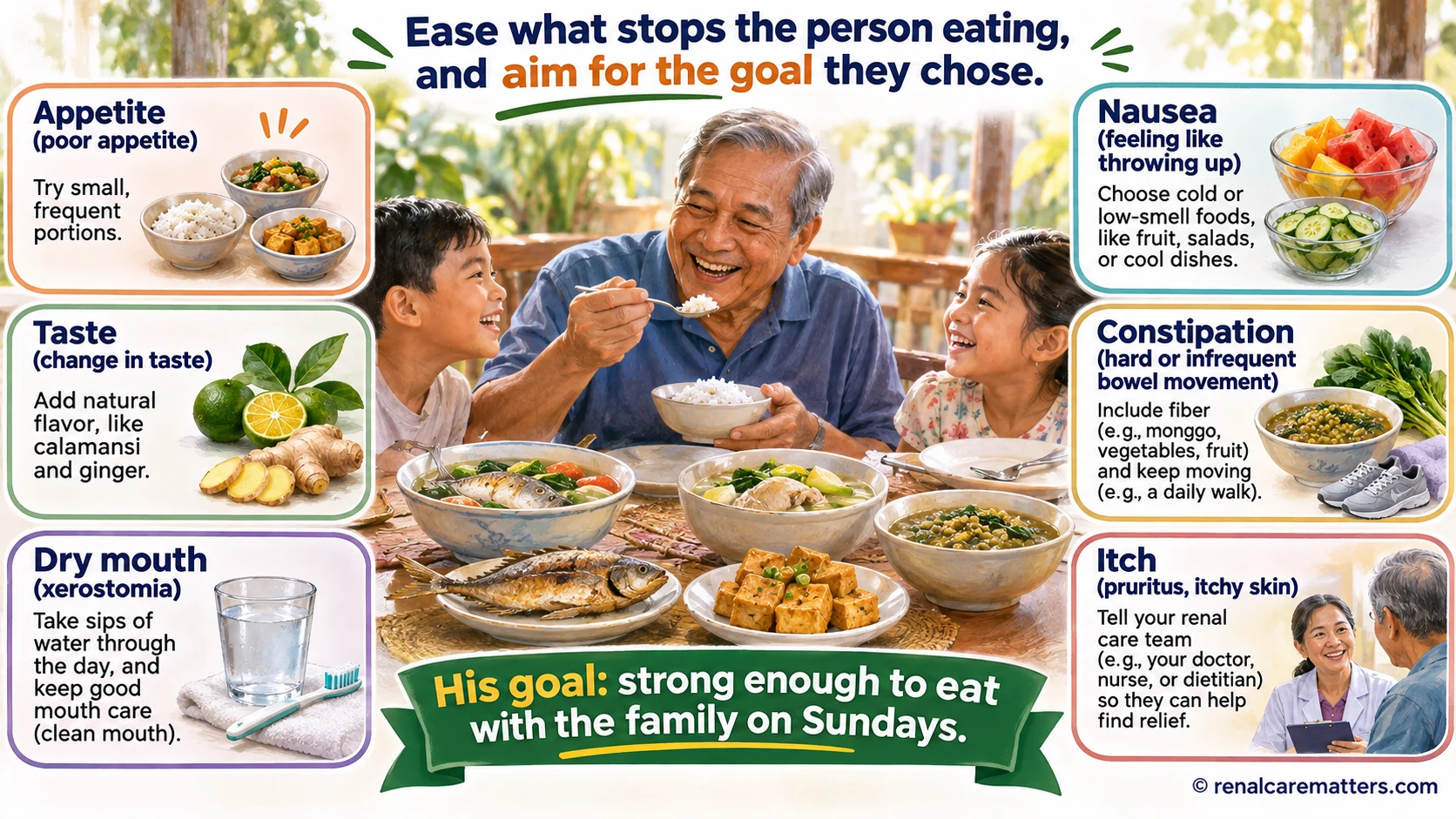
Ease symptoms that stop people eating: poor appetite, altered taste, dry mouth, nausea, constipation, and itch.
Recognize frailty and sarcopenia and change the priority from restriction to function.
Give stone-prevention advice that depends on the stone type.
Coordinate fluid advice in polycystic kidney disease with the kidney team.
Recognize children and pregnant patients as needing specialist care, and refer them.
Pre-testBefore you read, answer the 8 self-assessment questions and note your score. After the module, select New set of questions and compare. The difference is what you learned; the questions you still miss are what to reread.
Start here
The big picture, in plain words
In plain wordsFor most patients, the renal diet is like a long-distance plan: small sacrifices now to protect the kidneys for years. For a patient choosing comfort over dialysis, the distance is shorter and the plan changes. The question is no longer “What will slow the kidney?” but “What will help this person eat with the family, sleep, and feel well?” Restrictions stay only if they still earn their place.
Figure 1 · Key terms for this module
Conservative kidney management (CKM)Planned, active care for kidney failure without dialysis, focused on symptoms and quality of life.
Kidney supportive careCare for symptoms, distress, and advance planning, for any patient with kidney disease, alongside other treatment.
FrailtyLow strength, endurance, and reserve; small stresses cause large setbacks.
SarcopeniaLoss of muscle mass and strength.
HypercalciuriaToo much calcium in the urine, a common cause of calcium stones.
Autosomal dominant polycystic kidney disease (ADPKD)An inherited disease in which fluid-filled cysts grow in the kidneys.
Figure 2 · Order of work in supportive care
AskWhat matters most to you now?
SymptomsWhat stops you eating?
RulesWhich restrictions still help, and which only cost?
Small trialOne change, a review date.
TeamShare the plan with the supportive care team and family.
Opening case · fictional
Case: Strong enough to eat with the family
Lolo Ernesto, 83, has chronic kidney disease (CKD) G5 and has chosen conservative management after long talks with his nephrologist and family. In two months his weight fell from 52 to 48 kg. He tires walking to the bathroom. His mouth is dry, food tastes “like metal,” and he has itchy skin.
His daughter stopped giving him fish and monggo because a neighbor said “all protein is poison for the kidneys.” He eats mostly lugaw and crackers. When you ask what he wants, he says: “To be strong enough to sit at the table with my grandchildren on Sundays.”
Before reading on, decide:
What is the nutrition goal here?
Which restrictions would you review first?
What would make you call the team the same day?
Keep your answers in mind. The lesson gives you what you need, and the case review near the end shows one sound response.
Lesson · part 1
Start from what matters to the person
The International Society of Nephrology describes conservative kidney management as planned, holistic care for people with kidney failure who choose not to have dialysis. It focuses on symptoms, function, and the person’s goals, and kidney supportive care brings the same focus to people on any treatment.1
For a dietitian, that changes the first question. Instead of “What is the estimated glomerular filtration rate (eGFR)?” ask “What matters most to you now?” Answers are often simple and concrete: eating with family, less thirst, fewer trips to clinic, not being a burden, getting to church. A diet plan that serves that goal is the right plan.
Some restrictions still help. A moderate protein intake may reduce uremic symptoms such as nausea and poor appetite in advanced CKD; keeping potassium safe prevents sudden deterioration; limiting salt can ease swelling and breathlessness. Others only cost: strict rules that shrink intake, hard-to-follow fluid limits, or foods banned years ago that are not needed now. Weigh each one with the patient and the supportive care team. Agree on a short trial, two to four weeks, and a date to review.
RememberIn supportive care, a restriction must earn its place by making the person feel better, not by improving a laboratory number.
Lesson · part 2
Ease what stops people eating
Symptom
What you can try
Tell the team
Poor appetite
Small portions often; favorite foods; most food at the best time of day
Weight loss; a review of medicines that blunt appetite
Possible zinc deficiency or uremia; the physician decides on tests or dialysis questions
Dry mouth
Sips, ice chips counted as fluid, sour candy if glucose allows, mouth care
Medicines that dry the mouth
Nausea
Dry crackers, cold foods with little smell, smaller meals
Persistent nausea; anti-nausea medicine
Constipation
Fiber from tolerated fruits and vegetables, oats, movement
Laxatives; iron or binder side effects
Itch
Check phosphorus sources if phosphorus is high
Itch has several causes; treatment is medical
Ask about the caregiver too. A daughter who cooks three different meals a day for three family members will burn out. Simple plans that fit the family’s food work better than perfect plans that do not.
Figure 3. Ease what stops the person eating, and aim for the goal they chose.
Lesson · part 3
Frailty and sarcopenia: protect function first
Screen every older patient for frailty: unintended weight loss, weakness, slow walking, low activity, and exhaustion. A short tool such as the Strength, Assistance with walking, Rise from a chair, Climb stairs, Falls (SARC-F) questionnaire, grip strength, or a chair-stand test takes minutes. When frailty or sarcopenia is present, the Kidney Disease: Improving Global Outcomes (KDIGO) 2024 guideline advises considering higher protein and energy targets rather than lower ones (advice without a formal grade).2 Observational data in older adults with mild to moderate CKD point the same way.3
Protein helps muscle most when spread across meals and paired with movement. Even simple activity, such as standing from a chair ten times or a short daily walk, works with the diet. Ask a physical therapist to help if one is available.
Stop and reportNew confusion, severe breathlessness, chest pain, vomiting with inability to keep food down, or a sudden fall in alertness is an acute change, not progression of frailty. Call the physician or follow the urgent pathway.
Lesson · part 4
Stones, polycystic kidneys, children, and pregnancy
Kidney stones. Advice depends on the type of stone and the urine tests, so ask for the stone analysis and any 24-hour urine results first. The American Urological Association (AUA) guideline advises fluid enough to make at least 2.5 liters of urine a day for stone formers, limiting sodium, and, for calcium stones, normal dietary calcium of about 1,000 to 1,200 mg a day rather than restriction, because dietary calcium binds oxalate in the gut. Oxalate-rich foods are limited only when urine oxalate is high, and animal protein is limited for some stone types.4 A high fluid goal must fit the rest of the patient’s health; it may be unsafe in heart failure, low serum sodium, or advanced CKD.
Polycystic kidney disease. The KDIGO 2025 ADPKD guideline covers diet and fluid, including water intake and sodium.5 Fluid advice in ADPKD depends on kidney function, medicines (tolvaptan causes heavy urine output and thirst), and other conditions. Follow the kidney team’s plan rather than giving a fixed number yourself.
Children and pregnancy. Adult targets in this course do not apply. Children need growth-based assessment by a pediatric renal team. Pregnancy in a woman with CKD or on dialysis needs joint care by nephrology, obstetrics, and a dietitian experienced in both. Recognize them and refer.
RememberWhen a case falls outside adult kidney care, the safest action is a clear, prompt referral, not an adapted adult plan.
On the floor
Real situations: problems and solutions
These are fictional but typical. For each one, cover the answer, decide what you would do, then compare. Where a step depends on local rules, your unit’s procedure and your supervisor’s direction come first.
“He should eat more meat to be strong”
What you see
A family insists on large meat portions for an older patient on conservative care, who now has nausea and itching.
What is likely going on
Uremic symptoms may be worsening; protein load can add to nausea.
What to do
Tell the supportive care team about the symptoms. Discuss smaller, frequent portions of favored protein foods that he can enjoy without nausea.
Why it matters
In supportive care, comfort guides how much is enough.
High fluid advice for a stone former with heart failure
What you see
A patient with calcium stones was told to drink three liters a day. He also has heart failure and swollen ankles.
What is likely going on
Two pieces of advice conflict.
What to do
Tell the physicians involved about the conflict and ask them to agree on a single fluid plan. Focus your advice on sodium and normal calcium intake meanwhile.
Why it matters
Advice that is right for one problem can be wrong for the person.
Field notes
Write the patient’s goal in his or her own words.
Refer children and pregnant patients early.
Case review
Back to the case: Strong enough to eat with the family
What is the goal? His own: to be strong enough to sit with his grandchildren on Sundays. Write it in the plan. Every change should help him reach it. A protein cap that leaves him too weak to sit up fails that goal.
Which restrictions first? The neighbor’s protein ban. Fish and monggo are among the foods he can still enjoy and that help him keep strength. Bring them back in small, soft portions: flaked fish in lugaw, egg, tofu, monggo soup. Explain to his daughter, kindly, that the advice she heard was wrong for him. For the metallic taste, try calamansi, ginger, and garlic. For the dry mouth, sips and mouth care. Agree on a two-week trial.
What else? A 4 kg loss in two months and new weakness need the nephrologist and supportive care team this week, with the numbers. Ask about the itch and the taste: they may be signs of advancing uremia that the team should weigh. Ask how his daughter is managing.
What would make you call today? New confusion, severe breathlessness, vomiting with no food staying down, or a sudden drop in alertness. In supportive care, the dietitian often helps a family learn that feeding someone well can look different from following the old rules.
Skills lab · with your preceptor
Skills checklist: Supportive care nutrition visit
The preceptor plays an older patient choosing conservative management, with a family member present. Your preceptor rates each step as satisfactory, needs practice, or not observed. Steps marked Critical must all be satisfactory before sign-off. This checklist supports supervised learning; your unit’s own procedure and competency form are the authority. A printable version of every checklist is on the trainer page.
Asks the patient what matters most and records the answer as the goal.
Reviews each restriction and keeps only those that help the patient feel better.
Asks about appetite, taste, dry mouth, nausea, constipation, itch, and caregiver burden.
Screens for frailty with a short tool or strength test.
Agrees on a short trial with a review date shared with the supportive care team.
CriticalRecognizes an acute change and routes it to the physician or urgent pathway.
CriticalRefers children and pregnant patients to specialist care instead of adapting adult targets.
Placement activity. Join one supportive care or home visit and write down the patient’s stated goal in his or her own words.
Self-assessment
Check your understanding
Each visit draws 8 questions at random from this module’s 15-question bank. Choose the single best answer for each, then select Check answers; an explanation appears under the best answer. Select New set of questions for a different mix. A good target is 7 of 8 on two different sets. Nothing you select is sent anywhere; scoring happens in your browser.
Davison, S. N., Pommer, W., Brown, M. A., Douglas, C. A., Gelfand, S. L., Gueco, I. P., Hole, B. D., Homma, S., Kazancıoğlu, R. T., Kitamura, H., Koubar, S. H., Krause, R., Li, K. C., Lowney, A. C., Nagaraju, S. P., Niang, A., Obrador, G. T., Ohtake, Y., Schell, J. O., . . . Brennan, F. P. (2024). Conservative kidney management and kidney supportive care: Core components of integrated care for people with kidney failure. Kidney International, 105(1), 35–45. https://doi.org/10.1016/j.kint.2023.10.001
Kidney Disease: Improving Global Outcomes (KDIGO) CKD Work Group. (2024). KDIGO 2024 clinical practice guideline for the evaluation and management of chronic kidney disease. Kidney International, 105(4S), S117–S314. https://doi.org/10.1016/j.kint.2023.10.018
Carballo-Casla, A., Avesani, C. M., Beridze, G., Ortolá, R., García-Esquinas, E., Lopez-Garcia, E., Dai, L., Dunk, M. M., Stenvinkel, P., Lindholm, B., Carrero, J. J., Rodríguez-Artalejo, F., Vetrano, D. L., & Calderón-Larrañaga, A. (2024). Protein intake and mortality in older adults with chronic kidney disease. JAMA Network Open, 7(8), Article e2426577. https://doi.org/10.1001/jamanetworkopen.2024.26577
Pearle, M. S., Goldfarb, D. S., Assimos, D. G., Curhan, G., Denu-Ciocca, C. J., Matlaga, B. R., Monga, M., Penniston, K. L., Preminger, G. M., Turk, T. M., White, J. R., & American Urological Association. (2014). Medical management of kidney stones: AUA guideline. The Journal of Urology, 192(2), 316–324. https://doi.org/10.1016/j.juro.2014.05.006
Kidney Disease: Improving Global Outcomes (KDIGO) ADPKD Work Group. (2025). KDIGO 2025 clinical practice guideline for the evaluation, management, and treatment of autosomal dominant polycystic kidney disease (ADPKD). Kidney International, 107(2S), S1–S239. https://doi.org/10.1016/j.kint.2024.07.009
Educational study material for registered nutritionist-dietitians. Does not replace the nephrologist’s orders, facility policy, the Nutrition Care Process documentation required by the Department of Health, or supervised practice.