Acute Kidney Injury and Inpatient Nutrition Support
Protein by illness severity and kidney replacement modality, the weight to calculate from, enteral and parenteral feeding, refeeding syndrome, and energy hidden in fluids.
PublishedNailathalaGipatikPepalwal:ReferencesMga SanggunianMga TinubdanReng Reperensya:3Audience: Registered nutritionist-dietitians entering adult kidney care · renal RND preceptors, nephrologists, and head nurses who orient themRead timeOras ng pagbasaOras sa pagbasaOras ning pamamasa:
This module is study material for dietitians in adult kidney care. It explains the reasoning behind common decisions; it is not a protocol. In practice, follow your facility’s policy and the responsible physician’s orders. Targets and cut-off values are set by your unit and the attending nephrologist. Every case is fictional.
Learning objectives
After this module you should be able to
Explain why critical illness and acute kidney injury (AKI) raise protein needs instead of lowering them.
Choose a defensible weight for calculation when the patient is swollen with fluid.
Match protein to illness severity and the type of kidney replacement therapy (KRT), using the European Society for Clinical Nutrition and Metabolism (ESPEN) ranges.
Identify refeeding risk and follow the hospital’s protocol.
Count energy from non-food sources such as dextrose and propofol.
Write a clear inpatient handoff and a discharge plan.
Pre-testBefore you read, answer the 8 self-assessment questions and note your score. After the module, select New set of questions and compare. The difference is what you learned; the questions you still miss are what to reread.
Start here
The big picture, in plain words
In plain wordsA critically ill patient is a house on fire. The body burns its own muscle to supply amino acids for repair and immunity, whatever you feed it. Feeding cannot stop the fire, but it can stop the house from being burned to the frame. A kidney diet built for a quiet house, low in protein, is the wrong plan during a fire. The analogy has a limit: feeding too much, too fast, in the first days can also do harm, so the plan rises in steps.
Figure 1 · Key terms for this module
Acute kidney injury (AKI)A fall in kidney function over hours to days, measured by rising creatinine or falling urine output.
Kidney replacement therapy (KRT)Dialysis in any form: intermittent hemodialysis (HD), prolonged intermittent, or continuous.
Continuous kidney replacement therapy (CKRT)Dialysis run 24 hours a day in the intensive care unit (ICU); also called CRRT.
CatabolismBreakdown of body tissue, mainly muscle, for fuel and amino acids.
Refeeding syndromeDangerous shifts of phosphate, potassium, and magnesium into cells when feeding restarts after starvation.
Enteral nutritionFeeding into the gut, by mouth or tube.
Parenteral nutritionFeeding into a vein.
Figure 2 · Order of work at the bedside
Before illnessUsual weight and intake; days without food.
NowIllness severity, fluid status, KRT type.
RiskRefeeding risk; swallowing; gut function.
TargetsWeight basis, protein range, energy.
RouteMouth, tube, or vein.
DeliveryPrescribed versus delivered, every day.
Opening case · fictional
Case: The old order
Mr. Navarro, 61, is in the ICU with pneumonia and septic shock. He has had almost nothing to eat for six days. He developed AKI and started CKRT this morning. Before illness he weighed 69 kg. Today he weighs 78 kg with swollen legs and arms after large volumes of intravenous fluid.
His chart still carries an outpatient order: “Low-protein renal diet, 0.6 g/kg.” His phosphate has fallen from 3.8 to 2.1 mg/dL over two days. He is on a propofol infusion for sedation. The ICU team asks you to “start renal feeds.”
Before reading on, decide:
Which weight will you calculate from, and why?
What protein range fits him now, and what about the old order?
What risk must be managed before feeds are increased?
Keep your answers in mind. The lesson gives you what you need, and the case review near the end shows one sound response.
Lesson · part 1
Critical illness turns protein needs upside down
In stable chronic kidney disease (CKD), protein is kept moderate. In critical illness, stress hormones and inflammation drive rapid muscle breakdown, and the patient can lose a large share of muscle in the first week in the ICU. Kidney replacement therapy adds another loss: CKRT removes amino acids continuously, on the order of 10 to 15 g a day, along with water-soluble vitamins and trace elements.1
So the outpatient instinct to restrict protein “for the kidneys” is wrong here. ESPEN advises against reducing protein intake in order to avoid or delay dialysis in hospitalized patients.2 Kidney function will be supported by the machine if needed. Muscle cannot be replaced that way.
RememberAn outpatient low-protein order should not follow a patient into the ICU. Flag it on the first day and ask the team to cancel it.
Lesson · part 2
Choose the weight, then the range
The weight. Fluid given during resuscitation can add many kilograms. Calculating from the swollen weight overfeeds; calculating from an ideal weight may underfeed a large patient. Use the most recent dry or usual weight before illness when you can find it, from the family, clinic records, or the last dialysis chart, and write down where it came from. For obesity, follow your hospital’s adjusted-weight method and say so.
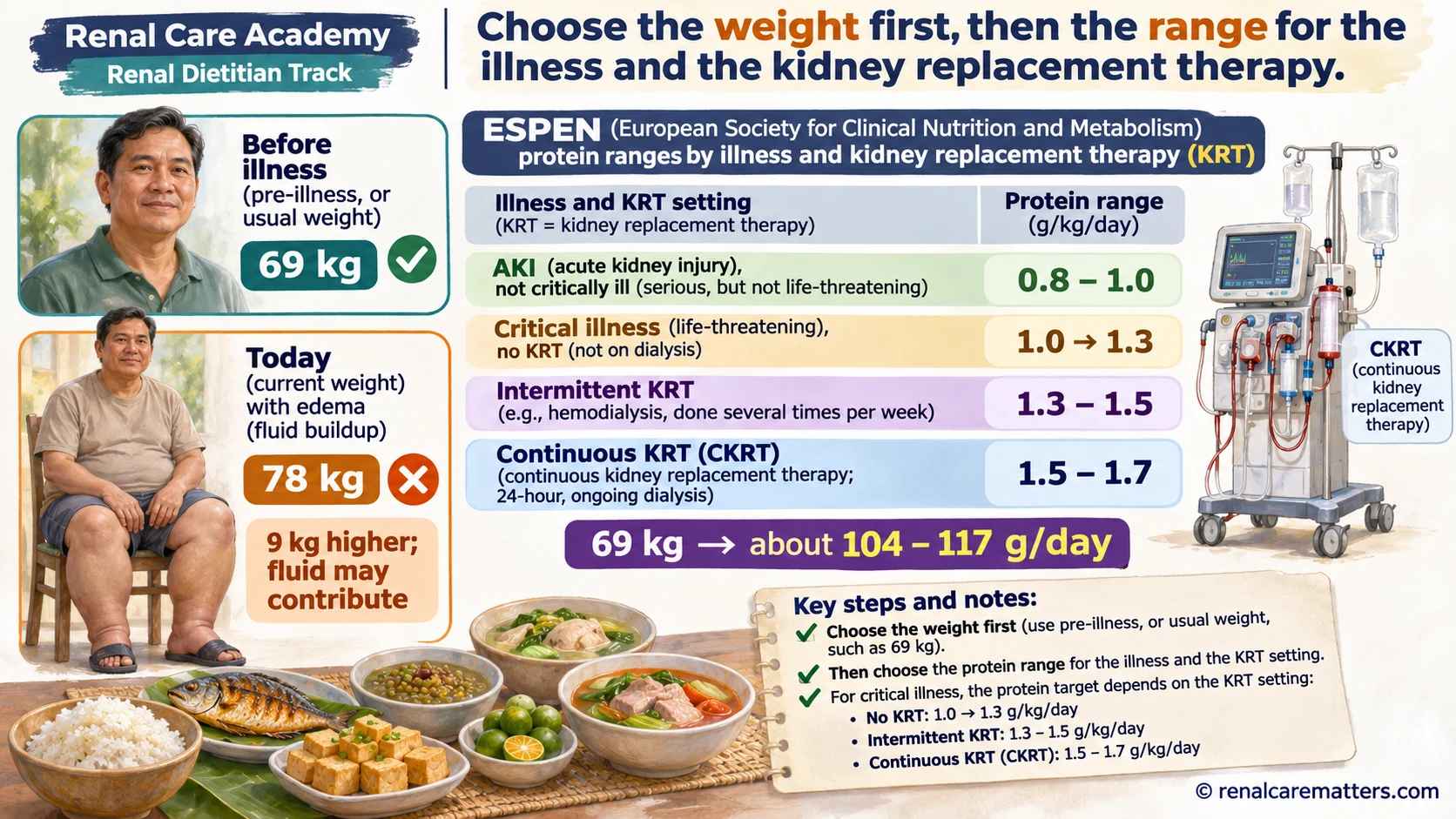
The protein range. ESPEN gives starting ranges by setting. They are expert-based reference values, not doses proven in trials, so adjust them to tolerance and to the team’s plan.2
Setting
Protein (g/kg/day)
Hospitalized with AKI, not acutely or critically ill
0.8 to 1.0
Critically ill, no KRT
Start at 1.0, rise toward 1.3 as tolerated
Critically ill on intermittent KRT
1.3 to 1.5
Critically ill on continuous or prolonged intermittent KRT
1.5 to 1.7
Energy. In the first days of critical illness, the body makes much of its own glucose, and full feeding can add to that rather than replace it. Most ICU teams therefore build up energy over several days rather than giving the full target at once, and use indirect calorimetry when it is available. Follow your ICU’s protocol. Count energy that is not food: dextrose in intravenous fluids and CKRT solutions, and propofol, which is given in a fat emulsion that supplies about 1.1 kcal per mL.1
Figure 3. Choose the weight first, then the range for the illness and the kidney replacement therapy.
Lesson · part 3
Refeeding risk: start low, watch phosphate
After days without food, the body switches to burning fat, and stores of phosphate, potassium, magnesium, and thiamine run down. When carbohydrate arrives, insulin rises and drives these minerals into cells to build new tissue and make energy. Blood levels can fall within hours. Severe low phosphate weakens the breathing muscles and the heart.
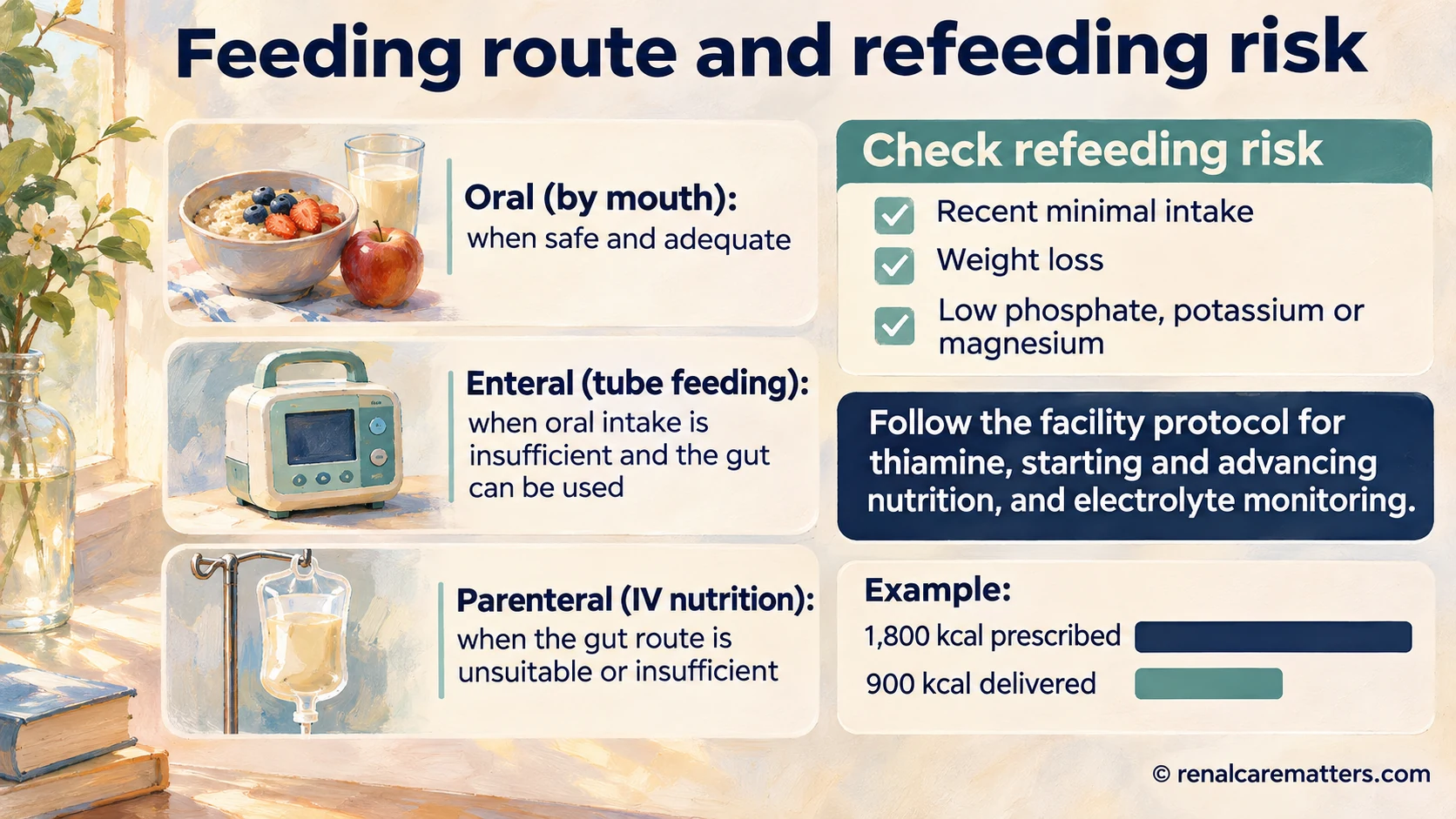
The American Society for Parenteral and Enteral Nutrition (ASPEN) consensus lists risk factors that include little or no intake for five to six days or more, recent weight loss, low body mass index, and low potassium, phosphate, or magnesium before feeding. For patients at risk, it advises starting feeding at a low level and building up over several days, giving thiamine before feeding begins, and checking potassium, magnesium, and phosphate often in the first days.3 These are consensus recommendations, not trial results. Your hospital’s protocol sets the numbers. Thiamine and electrolyte replacement are medical orders.
Stop and reportA patient with several days of minimal intake and a falling phosphate is at refeeding risk now. Tell the ICU team before feeds are increased, and ask that the refeeding protocol be started.
CKRT adds its own phosphate loss, because most CKRT fluids contain little or none. A falling phosphate in a patient on CKRT may come from both causes at once.
Lesson · part 4
Route, delivery, and handoff
Feed by mouth when the patient can swallow safely and eat enough. When the gut works but intake falls short, a feeding tube is usually the next step. Parenteral nutrition is for patients whose gut cannot be used or cannot meet needs; the choice and timing belong to the team. Standard tube-feeding formulas are suitable for most patients with AKI. Specialized “renal” formulas are concentrated and lower in potassium and phosphate; they suit patients with fluid limits or high electrolytes, but on CKRT, where electrolytes are being removed, a standard formula is often better.1
Every day, compare what was prescribed with what was delivered. Feeds stop for procedures, scans, and turning. A patient prescribed 1,800 kcal who receives 900 is underfed, whatever the order says.
Figure 4 · A good inpatient handoff includes
Weight basisWhich weight and where it came from.
KRT typeIntermittent, prolonged, or continuous, and recent changes.
TargetsProtein range and energy with the guideline named.
DeliveryPercentage of target delivered and the reasons for gaps.
DischargeKidney recovery trend, intake, and when the outpatient plan must be rewritten.
At discharge, kidney function may recover fully, partly, or not at all. Do not let the hospital plan simply carry over. Write down that the diet must be reassessed when the patient is seen as an outpatient, with the latest kidney function.
Figure 5. Feed by the gut when you can, and start low when refeeding risk is high.
On the floor
Real situations: problems and solutions
These are fictional but typical. For each one, cover the answer, decide what you would do, then compare. Where a step depends on local rules, your unit’s procedure and your supervisor’s direction come first.
The tube feed that never runs
What you see
A patient’s tube feed is prescribed at full rate, but the chart shows it stopped for most of the last two days.
What is likely going on
Procedures, scans, and gut concerns interrupted feeding.
What to do
Report delivered versus prescribed intake at the next round. Ask about volume-based feeding or catch-up within the ICU protocol.
Why it matters
The prescription does not feed the patient; the delivered volume does.
The swollen weight in the formula
What you see
A colleague calculated protein from today’s weight, 15 kg above the patient’s usual weight.
What is likely going on
Fluid inflated the calculation.
What to do
Recalculate from the usual weight, explain the difference, and update the note.
Why it matters
A swollen weight can overfeed energy and make protein targets meaningless.
Field notes
Count propofol and dextrose as energy.
On CKRT, ask about phosphate every day.
Case review
Back to the case: The old order
Which weight? The 69 kg before illness, not the 78 kg today. He has about 9 kg of resuscitation fluid on board. Write down where the 69 kg came from, and that it is an estimate.
What protein range? He is critically ill and on continuous KRT, so ESPEN’s reference is 1.5 to 1.7 g/kg/day. At 69 kg, that is about 104 to 117 g a day. That is the range to reach as tolerated over the coming days, not on day one. The outpatient order of 0.6 g/kg would give him 41 g, less than half his need while he loses amino acids to the machine and muscle to sepsis. Ask the ICU team to cancel it today.
What must be managed first? Refeeding risk. Six days without food and a phosphate already falling from 3.8 to 2.1 mg/dL, with CKRT removing more. Tell the team before feeds go up, and ask for the refeeding protocol: thiamine before feeding, a low starting rate, and frequent checks of phosphate, potassium, and magnesium. The physician orders the replacement.
And “start renal feeds”? Talk it through. On CKRT, a standard formula may be the better choice. Count the propofol as fat energy. Then track every day how much of the prescription he actually receives. In the ICU, the dietitian’s plan is only as good as the feed that reaches the patient, and you are the one who checks.
Skills lab · with your preceptor
Skills checklist: ICU nutrition assessment and handoff
Use a fictional ICU chart with a fluid balance, KRT orders, and three days of laboratory results. Your preceptor rates each step as satisfactory, needs practice, or not observed. Steps marked Critical must all be satisfactory before sign-off. This checklist supports supervised learning; your unit’s own procedure and competency form are the authority. A printable version of every checklist is on the trainer page.
Finds and documents a pre-illness weight and explains why the current weight is not used.
Identifies the KRT type and matches the ESPEN protein range.
CriticalFlags any outpatient protein restriction for cancellation.
CriticalRecognizes refeeding risk from intake history and falling phosphate, and asks for the protocol before feeds increase.
Counts energy from dextrose and propofol.
Recommends a route and formula and explains the choice for a patient on CKRT.
Compares prescribed and delivered intake and lists reasons for gaps.
Writes a handoff with weight basis, KRT type, targets, refeeding status, delivery, and discharge plan.
Placement activity. Join one ICU or nutrition support team round and calculate prescribed versus delivered intake for two patients.
Self-assessment
Check your understanding
Each visit draws 8 questions at random from this module’s 15-question bank. Choose the single best answer for each, then select Check answers; an explanation appears under the best answer. Select New set of questions for a different mix. A good target is 7 of 8 on two different sets. Nothing you select is sent anywhere; scoring happens in your browser.
Fiaccadori, E., Sabatino, A., Barazzoni, R., Carrero, J. J., Cupisti, A., De Waele, E., Jonckheer, J., Singer, P., & Cuerda, C. (2021). ESPEN guideline on clinical nutrition in hospitalized patients with acute or chronic kidney disease. Clinical Nutrition, 40(4), 1644–1668. https://doi.org/10.1016/j.clnu.2021.01.028
Sabatino, A., Fiaccadori, E., Barazzoni, R., Carrero, J. J., Cupisti, A., De Waele, E., Jonckheer, J., Cuerda, C., & Bischoff, S. C. (2024). ESPEN practical guideline on clinical nutrition in hospitalized patients with acute or chronic kidney disease. Clinical Nutrition, 43(9), 2238–2254. https://doi.org/10.1016/j.clnu.2024.08.002
da Silva, J. S. V., Seres, D. S., Sabino, K., Adams, S. C., Berdahl, G. J., Citty, S. W., Cober, M. P., Evans, D. C., Greaves, J. R., Gura, K. M., Michalski, A., Plogsted, S., Sacks, G. S., Tucker, A. M., Worthington, P., Walker, R. N., Ayers, P., & Parenteral Nutrition Safety and Clinical Practice Committees, American Society for Parenteral and Enteral Nutrition. (2020). ASPEN consensus recommendations for refeeding syndrome. Nutrition in Clinical Practice, 35(2), 178–195. https://doi.org/10.1002/ncp.10474
Educational study material for registered nutritionist-dietitians. Does not replace the nephrologist’s orders, facility policy, the Nutrition Care Process documentation required by the Department of Health, or supervised practice.