Organic, plant, and additive phosphorus, binder timing, calcium load, what the HiLo trial did and did not show, and protecting protein intake.
PublishedNailathalaGipatikPepalwal:ReferencesMga SanggunianMga TinubdanReng Reperensya:5Audience: Registered nutritionist-dietitians entering adult kidney care · renal RND preceptors, nephrologists, and head nurses who orient themRead timeOras ng pagbasaOras sa pagbasaOras ning pamamasa:
This module is study material for dietitians in adult kidney care. It explains the reasoning behind common decisions; it is not a protocol. In practice, follow your facility’s policy and the responsible physician’s orders. Targets and cut-off values are set by your unit and the attending nephrologist. Every case is fictional.
Learning objectives
After this module you should be able to
Explain why phosphorus control on dialysis depends on diet, binders, and dialysis together.
Rank phosphorus sources by absorption and find phosphate additives on an ingredient list.
Use the phosphorus-to-protein ratio to lower phosphorus without lowering protein.
Teach binder timing and find the practical reasons binders are missed, without changing a dose.
Describe what the guidelines recommend, with grades, and what the HiLo trial did and did not show.
Account for calcium from food, binders, and supplements, and for vitamin D status.
Pre-testBefore you read, answer the 8 self-assessment questions and note your score. After the module, select New set of questions and compare. The difference is what you learned; the questions you still miss are what to reread.
Start here
The big picture, in plain words
In plain wordsPhosphorus is like dust in a house with a weak vacuum. Dialysis is the vacuum and it runs only a few hours a week. Binders are doormats that trap dust at the door, but only if they are in place when someone walks in, which means with food. Diet is how much dust is carried in. No single one of the three keeps the house clean. The comparison misses one thing: the body also moves phosphorus in and out of bone, so the blood level can rise from bone even when intake is modest.
Figure 1 · Key terms for this module
Phosphorus and phosphatePhosphorus is the element in food tables; phosphate is its form in blood and in additives. In practice the words are used together.
Phosphate binderA medicine taken with food that traps phosphate in the gut so it leaves in the stool.
Phosphate additiveAn inorganic phosphate salt added to processed food for texture, moisture, or shelf life. Nearly all of it is absorbed.
Phosphorus-to-protein ratioMilligrams of phosphorus per gram of protein in a food. Lower is better when protein must be kept high.
Secondary hyperparathyroidismOveractive parathyroid glands driven by kidney disease.
Calcium loadTotal elemental calcium from food, calcium-based binders, and supplements.
25-hydroxyvitamin DThe blood test for vitamin D stores.
Figure 2 · Where phosphorus control fails
IntakeAdditives and large portions of processed food.
BindersNot taken, taken late, or not matched to meals and snacks.
DialysisMissed or shortened sessions.
Bone and hormonesHigh parathyroid hormone (PTH) releasing phosphorus from bone; vitamin D medicines raising absorption.
Opening case · fictional
Case: The workday binder
Ms. Aquino, 46, has been on hemodialysis for two years. Her phosphorus was 6.4 mg/dL last month and is 6.7 mg/dL now. Calcium is 9.6 mg/dL and intact PTH is 580 pg/mL, rising over six months. She takes sevelamer, “one with each meal.”
She works in a call center. On workdays she skips the binder because she is unsure whether to take it before or after eating and does not like colleagues to see her pills. Lunch is usually a hotdog or tocino meal with a cola, and she drinks three sachets of 3-in-1 coffee a shift. Her appetite is poor; she eats about 0.9 g/kg/day of protein.
Before reading on, decide:
Which of the three controls (diet, binders, dialysis) is failing, and where exactly?
Which food changes lower phosphorus without lowering her protein?
What do you ask the pharmacist or nephrologist, and what do you not change yourself?
Keep your answers in mind. The lesson gives you what you need, and the case review near the end shows one sound response.
Lesson · part 1
Three controls, none sufficient alone
A typical mixed diet supplies about 1,000 to 1,400 mg of phosphorus a day, of which well over half is absorbed. A standard hemodialysis session removes on the order of 800 mg, three times a week. The arithmetic does not close: over a week, absorption exceeds removal for most patients who eat adequately, which is why most people on dialysis are prescribed binders and why adequate protein intake and a normal phosphorus are in tension.1
High phosphorus is associated with vascular calcification, fractures, and death in observational studies of people on dialysis, and it drives PTH upward. On that basis Kidney Disease: Improving Global Outcomes (KDIGO) suggests lowering elevated phosphate toward the normal range in chronic kidney disease (CKD) G3a to G5D (a weak suggestion, grade 2C), basing treatment on serial measurements of phosphate, calcium, and PTH considered together, and on progressively or persistently elevated phosphate (both advice without a formal grade).2 A KDIGO conference in 2023 judged these recommendations still consistent with the evidence and called for more personalized care.3
What has not been shown. No randomized trial has yet shown that lowering phosphorus to a particular target reduces death or hospital admission. The HiLo trial set out to compare a higher target (6.5 mg/dL or above) with a lower one (below 5.5 mg/dL) in people on in-center hemodialysis. It was stopped early after enrolling 793 of a planned 4,400 patients, with too little difference in phosphate between the groups; the primary outcome did not differ (win ratio 0.97; 95% confidence interval, 0.55 to 1.71), and the investigators concluded that no inference about phosphate targets could be drawn.4 The trial neither supports strict control nor shows that loosening it is safe. Until better evidence arrives, follow your unit’s target, and never pursue it at the cost of the patient’s protein and energy intake.
RememberA normal phosphorus is a laboratory goal. How the body works and observational studies suggest it helps, but no trial has proven it. Losing muscle is a harm we know is real. When the two pull against each other, protect intake and go after the phosphorus that brings no protein.
Lesson · part 2
Find phosphorus that carries no protein
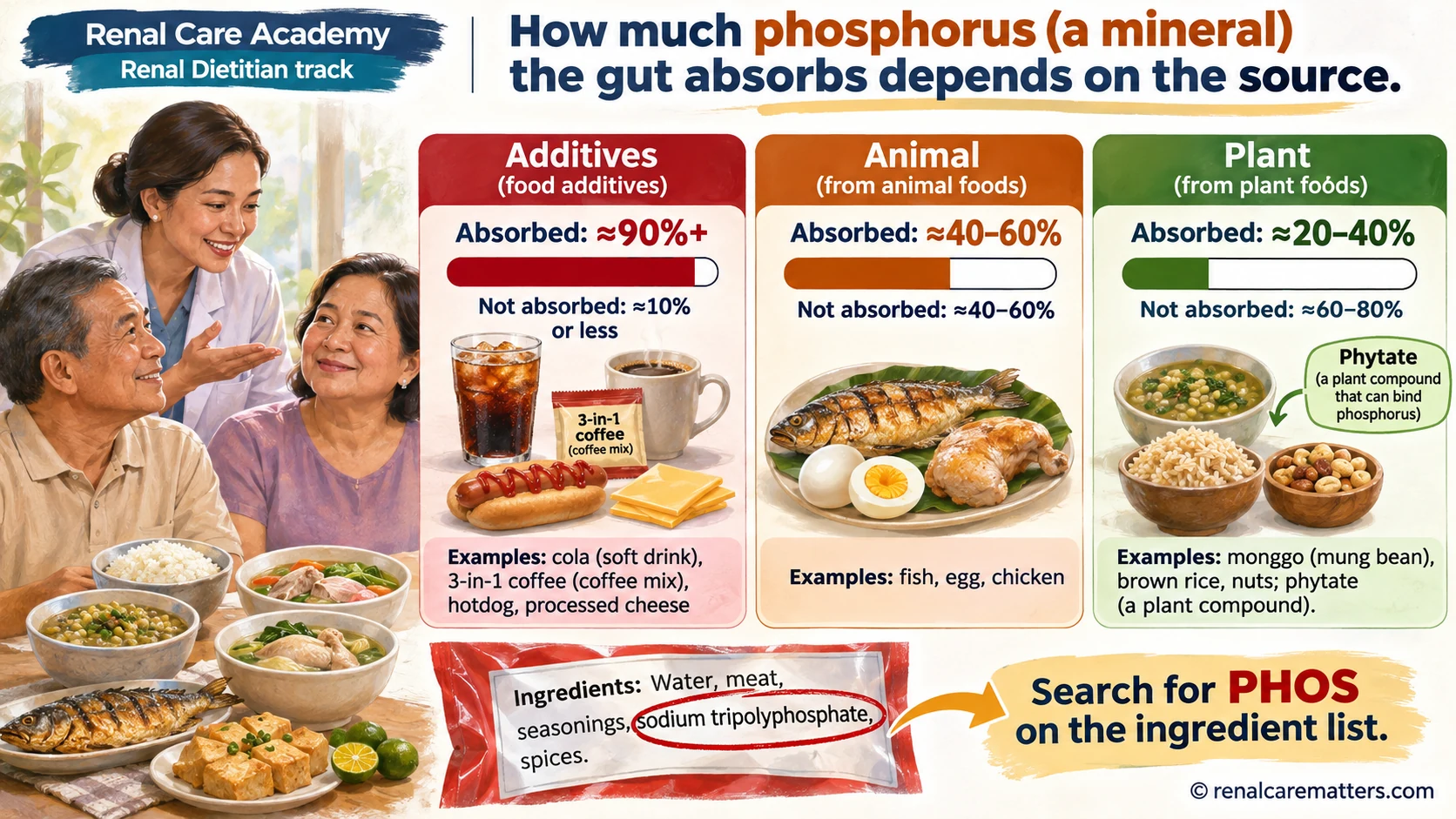
Kidney Disease Outcomes Quality Initiative (KDOQI) recommends adjusting dietary phosphorus to keep serum phosphate in the normal range (a firm recommendation, grade 1B) and says it is reasonable to consider how much of each source the body absorbs (expert opinion). KDIGO suggests limiting dietary phosphate, alone or with other treatments (a weak suggestion, grade 2D), and considering the source (advice without a formal grade).5,2 The source matters because absorption differs so much.
Source
Approximate absorption
Examples
What to do
Inorganic additives
About 90% or more
Processed meats, “enhanced” frozen chicken and seafood, colas, 3-in-1 coffee and non-dairy creamers, processed cheese, instant noodles, baking powder
Reduce first. They add phosphorus with little or no useful protein.
Animal foods
About 40% to 60%
Fish, meat, egg, milk
Keep for protein; choose by phosphorus-to-protein ratio.
Plant foods
About 20% to 40%
Beans, nuts, whole grains (phytate)
Usually no need to restrict.
Absorption figures are approximate.1 Labels in the Philippines list ingredients but seldom the amount of phosphorus, so teach patients to search the ingredient list for the letters “phos”: phosphoric acid, sodium tripolyphosphate, dipotassium phosphate, calcium phosphate, pyrophosphate.
The phosphorus-to-protein ratio. When a patient needs 1.0 to 1.2 g/kg/day of protein, choose protein foods with less phosphorus per gram. Egg white is the lowest (about 1 to 2 mg per gram of protein). Most fresh fish, chicken, pork, and beef fall around 8 to 12 mg/g. Milk, cheese, egg yolk, organ meats, and small fish eaten with bones (dilis, sardines) are higher, and processed meats with additives are highest. A target below about 12 mg/g for the day’s diet has been proposed; it is a planning aid, not a validated threshold.1
Boiling meat or fish in water and discarding the liquid lowers its phosphorus somewhat while keeping most of the protein. That makes nilaga a useful method, provided the patient does not then drink all the broth.
Figure 3. How much phosphorus the gut absorbs depends on the source.
Lesson · part 3
Binders: timing is the dietitian’s business, the dose is not
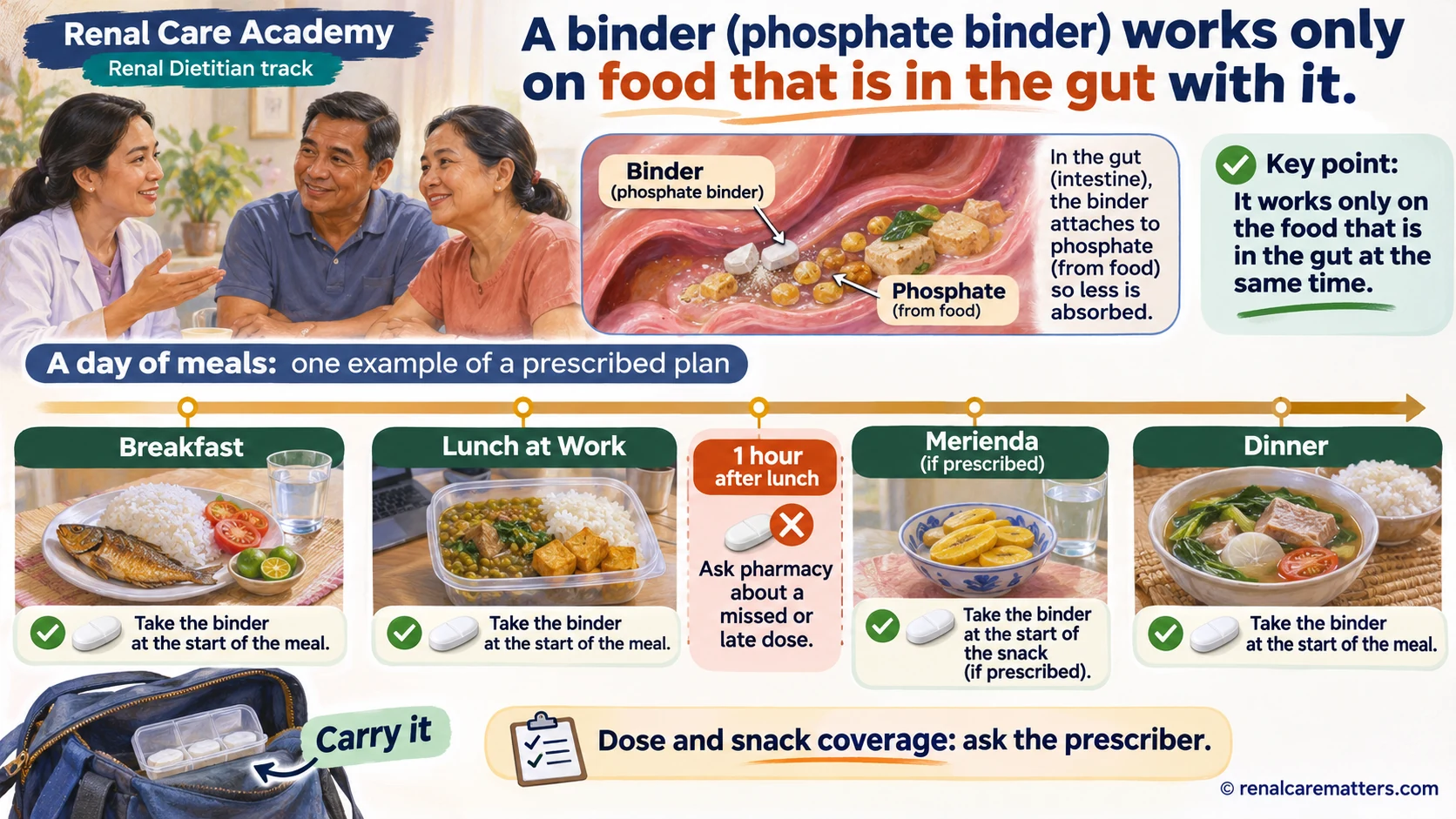
A binder works only on the food that is in the gut with it. Taken an hour after the meal, it binds little. Taken with a cup of coffee and no food, it binds nothing useful. Teach the timing written on the prescription, usually with the first bites or during the meal, and ask the questions that find out why doses are missed.
Figure 4 · Why binders are missed
Timing unclear“Before or after?” Nobody showed her.
Meals away from homeThe pills stay in the bathroom cabinet. A small container in the bag solves it.
EmbarrassmentTaking several tablets in front of colleagues.
Snacks and meriendaA burger at 3 p.m. has more phosphorus than a light breakfast, but the binder is tied to “three meals.”
Side effects and sizeLarge tablets, bloating, constipation.
CostFewer tablets taken to make the box last.
Report what you find to the prescriber or pharmacist. Whether the dose should be spread differently across meals and snacks, changed to another binder, or increased is their decision. KDIGO suggests restricting the dose of calcium-based binders in adults receiving phosphate-lowering treatment (a weak suggestion, grade 2B) and avoiding high blood calcium (a weak suggestion, grade 2C), which is why the type of binder and the calcium level belong in your handoff.2
Stop and reportDo not tell a patient to take extra binder for a large meal, to skip a binder, or to switch products. Reinforce the written instructions and ask the prescriber. A calcium above the laboratory range, or a patient taking calcium supplements in addition to a calcium-based binder, should be reported.
Lesson · part 4
Count calcium, and ask about vitamin D
Calcium balance in CKD is narrow. Too little worsens PTH; too much, especially with low PTH and little bone turnover, may deposit in blood vessels. KDOQI suggests a total elemental calcium intake of 800 to 1,000 mg a day, counting food, supplements, and calcium-based binders, for adults with CKD stages 3 to 4 not taking active vitamin D analogs (a weak suggestion, grade 2B), and individualized adjustment on dialysis in light of vitamin D analogs and calcimimetics (expert opinion).5
Calcium load (mg/day) = dietary calcium + elemental calcium in binders + elemental calcium in supplements. Calcium carbonate is 40% elemental calcium: a 500 mg tablet of calcium carbonate supplies 200 mg.
Patients often take over-the-counter calcium “for the bones” without telling anyone, on top of a calcium-based binder. Add it up and report it.
Vitamin D. Two different things share the name. Nutritional vitamin D (cholecalciferol or ergocalciferol) fills the body’s stores, measured as 25-hydroxyvitamin D. Active vitamin D and its analogs (calcitriol, paricalcitol) are medicines for secondary hyperparathyroidism that raise calcium and phosphorus absorption. KDOQI suggests supplementing nutritional vitamin D to correct deficiency or insufficiency (a weak suggestion, grade 2C).5 Both are prescribed by the physician. Your part is to ask what the patient takes, including high-dose products bought online, and to know that a rising phosphorus after an active vitamin D dose increase may not be dietary at all.
Figure 5. A binder works only on food that is in the gut with it.
On the floor
Real situations: problems and solutions
These are fictional but typical. For each one, cover the answer, decide what you would do, then compare. Where a step depends on local rules, your unit’s procedure and your supervisor’s direction come first.
The binder in the bathroom
What you see
A patient takes binders only at home. She eats lunch and merienda at work.
What is likely going on
The binders miss the largest phosphorus loads of the day.
What to do
Suggest a small pill case for her bag. Ask the prescriber whether a dose should cover the afternoon snack.
Why it matters
Timing failures look like dietary failures on the laboratory sheet.
“No more fish”
What you see
A patient with high phosphorus says he has stopped eating fish and eggs. His protein intake is now 0.7 g/kg/day.
What is likely going on
He removed protein instead of additives.
What to do
Restore fresh fish and egg whites; remove processed meats, cola, and 3-in-1 sachets instead. Tell the nephrologist about the low protein.
Why it matters
The aim is less phosphorus that brings no protein, not less protein.
Field notes
Search ingredient lists for “phos.”
Add up calcium from binders and supplements; patients rarely mention the over-the-counter ones.
Case review
Back to the case: The workday binder
Which control is failing? Two of the three, and maybe a third. The binder is skipped on workdays, which is most days. The diet carries a lot of phosphorus that brings no protein: the hotdog or tocino, the cola with phosphoric acid, and three sachets of 3-in-1 coffee with phosphate salts in the creamer. Confirm with the nurse that she attends and completes her dialysis. Her rising PTH is also releasing phosphorus from bone, and that is a medical matter.
Can you lower her phosphorus without lowering her protein? Yes, and you must. She eats only about 0.9 g/kg/day of protein, below what dialysis needs, so do not remove protein foods. Swap the processed-meat lunch for fresh fish, chicken, or egg with rice from the same canteen, or a packed meal. That lowers phosphorus and raises usable protein at the same time. Replace the cola with water. Move from 3-in-1 sachets to brewed or plain instant coffee, no creamer, with a little sugar if her glucose allows. Add egg whites, which carry almost no phosphorus.
Is the binder yours to fix? The timing is yours to teach. The dose is not yours to change. Ask the pharmacist to confirm exactly when the prescription says to take it, and to help make it work on her shift: a pill case in her bag, and whether a dose should cover her afternoon snack.
What do you tell the nephrologist? Phosphorus 6.4 then 6.7 mg/dL, calcium 9.6 mg/dL, PTH 580 pg/mL and rising, binders missed on workdays, the additive sources you found and are changing, and protein intake below target. Review her intake and next month’s results together. A patient told only to “avoid phosphorus” usually ends up eating less protein. Finding the phosphorus that brings no protein is the dietitian’s particular skill.
Skills lab · with your preceptor
Skills checklist: Phosphorus review that protects protein
Materials: three ingredient lists, a fictional monthly laboratory sheet, and a binder prescription. Your preceptor rates each step as satisfactory, needs practice, or not observed. Steps marked Critical must all be satisfactory before sign-off. This checklist supports supervised learning; your unit’s own procedure and competency form are the authority. A printable version of every checklist is on the trainer page.
Reviews phosphorus with calcium and PTH trends, not as a single value.
Finds phosphate additives on ingredient lists by searching for “phos.”
CriticalProposes swaps that lower phosphorus while keeping or raising protein.
Asks when, where, and with what the binder is taken, and why doses are missed.
CriticalTeaches binder timing exactly as prescribed and does not alter the dose.
Adds up calcium from food, binders, and supplements and reports the total.
Asks about vitamin D products, including those bought without prescription.
Confirms dialysis attendance and delivered time with the nurse.
Hands off to the pharmacist or nephrologist with numbers and a specific question.
Placement activity. At a supermarket or sari-sari store, photograph the ingredient lists of ten commonly eaten processed foods and mark every phosphate additive.
Self-assessment
Check your understanding
Each visit draws 8 questions at random from this module’s 15-question bank. Choose the single best answer for each, then select Check answers; an explanation appears under the best answer. Select New set of questions for a different mix. A good target is 7 of 8 on two different sets. Nothing you select is sent anywhere; scoring happens in your browser.
Kalantar-Zadeh, K., Gutekunst, L., Mehrotra, R., Kovesdy, C. P., Bross, R., Shinaberger, C. S., Noori, N., Hirschberg, R., Benner, D., Nissenson, A. R., & Kopple, J. D. (2010). Understanding sources of dietary phosphorus in the treatment of patients with chronic kidney disease. Clinical Journal of the American Society of Nephrology, 5(3), 519–530. https://doi.org/10.2215/CJN.06080809
Kidney Disease: Improving Global Outcomes (KDIGO) CKD-MBD Update Work Group. (2017). KDIGO 2017 clinical practice guideline update for the diagnosis, evaluation, prevention, and treatment of chronic kidney disease–mineral and bone disorder (CKD-MBD). Kidney International Supplements, 7(1), 1–59. https://doi.org/10.1016/j.kisu.2017.04.001
Ketteler, M., Evenepoel, P., Holden, R. M., Isakova, T., Jørgensen, H. S., Komaba, H., Nickolas, T. L., Sinha, S., Vervloet, M. G., Cheung, M., King, J. M., Grams, M. E., Jadoul, M., Moysés, R. M. A., & Conference Participants. (2025). Chronic kidney disease–mineral and bone disorder: Conclusions from a Kidney Disease: Improving Global Outcomes (KDIGO) Controversies Conference. Kidney International, 107(3), 405–423. https://doi.org/10.1016/j.kint.2024.11.013
Edmonston, D., Isakova, T., Dember, L. M., Waymyers, S., Andersen, D., Chan, K. E., Chakraborty, H., & Wolf, M. (2025). Higher versus lower phosphate targets for patients undergoing in-center hemodialysis: A randomized controlled trial. Journal of the American Society of Nephrology, 36(12), 2445–2455. https://doi.org/10.1681/ASN.0000000765
Ikizler, T. A., Burrowes, J. D., Byham-Gray, L. D., Campbell, K. L., Carrero, J. J., Chan, W., Fouque, D., Friedman, A. N., Ghaddar, S., Goldstein-Fuchs, D. J., Kaysen, G. A., Kopple, J. D., Teta, D., Yee-Moon Wang, A., & Cuppari, L. (2020). KDOQI clinical practice guideline for nutrition in CKD: 2020 update. American Journal of Kidney Diseases, 76(3, Suppl. 1), S1–S107. https://doi.org/10.1053/j.ajkd.2020.05.006
Educational study material for registered nutritionist-dietitians. Does not replace the nephrologist’s orders, facility policy, the Nutrition Care Process documentation required by the Department of Health, or supervised practice.