Causes of high potassium other than food, when to restrict and when to liberalize, fruits and vegetables for acidosis, constipation, and low potassium.
PublishedNailathalaGipatikPepalwal:ReferencesMga SanggunianMga TinubdanReng Reperensya:5Audience: Registered nutritionist-dietitians entering adult kidney care · renal RND preceptors, nephrologists, and head nurses who orient themRead timeOras ng pagbasaOras sa pagbasaOras ning pamamasa:
This module is study material for dietitians in adult kidney care. It explains the reasoning behind common decisions; it is not a protocol. In practice, follow your facility’s policy and the responsible physician’s orders. Targets and cut-off values are set by your unit and the attending nephrologist. Every case is fictional.
Learning objectives
After this module you should be able to
Work through the non-diet causes of a high potassium before changing food.
Distinguish highly absorbed potassium (additives, salt substitutes, juices) from potassium in whole plant foods.
Decide when potassium restriction is justified, how tight, and when to lift it.
Explain how fruits and vegetables correct metabolic acidosis, and which patients need caution.
Use fiber and bowel regularity as part of potassium management.
Recognize low potassium as a problem in its own right and report it.
Pre-testBefore you read, answer the 8 self-assessment questions and note your score. After the module, select New set of questions and compare. The difference is what you learned; the questions you still miss are what to reread.
Start here
The big picture, in plain words
In plain wordsSerum potassium is the water level in a small basin with one tap and three drains. Food is the tap. The drains are the cells (opened by insulin), the kidney (opened by aldosterone), and the bowel. When the level rises, most people reach for the tap. Often a drain is blocked: a new medicine, constipation, a missed dialysis, or acidosis. Turning down the tap while a drain is blocked helps little and costs the patient vegetables. The basin is close to the truth, with one caution: the level that matters to the heart can change in hours, so a high result is first a safety question.
Figure 1 · Key terms for this module
HyperkalemiaSerum potassium above the laboratory’s upper limit, commonly 5.0 or 5.5 mmol/L.
HypokalemiaSerum potassium below the lower limit, commonly 3.5 mmol/L.
PseudohyperkalemiaA falsely high result from red cells breaking in the sample (hemolysis), a tight tourniquet, or a delayed sample.
renin-angiotensin-aldosterone system (RAAS) inhibitorsRenin–angiotensin–aldosterone system blockers: ACE inhibitors, angiotensin receptor blockers, and mineralocorticoid receptor antagonists. They protect the kidney and heart and raise potassium.
Potassium binderA medicine that traps potassium in the gut. Prescribed by the physician.
Metabolic acidosisToo much acid in the body, seen as a low serum bicarbonate.
LeachingSoaking or boiling cut vegetables in plenty of water and discarding the water to remove some potassium.
Figure 2 · When potassium is high
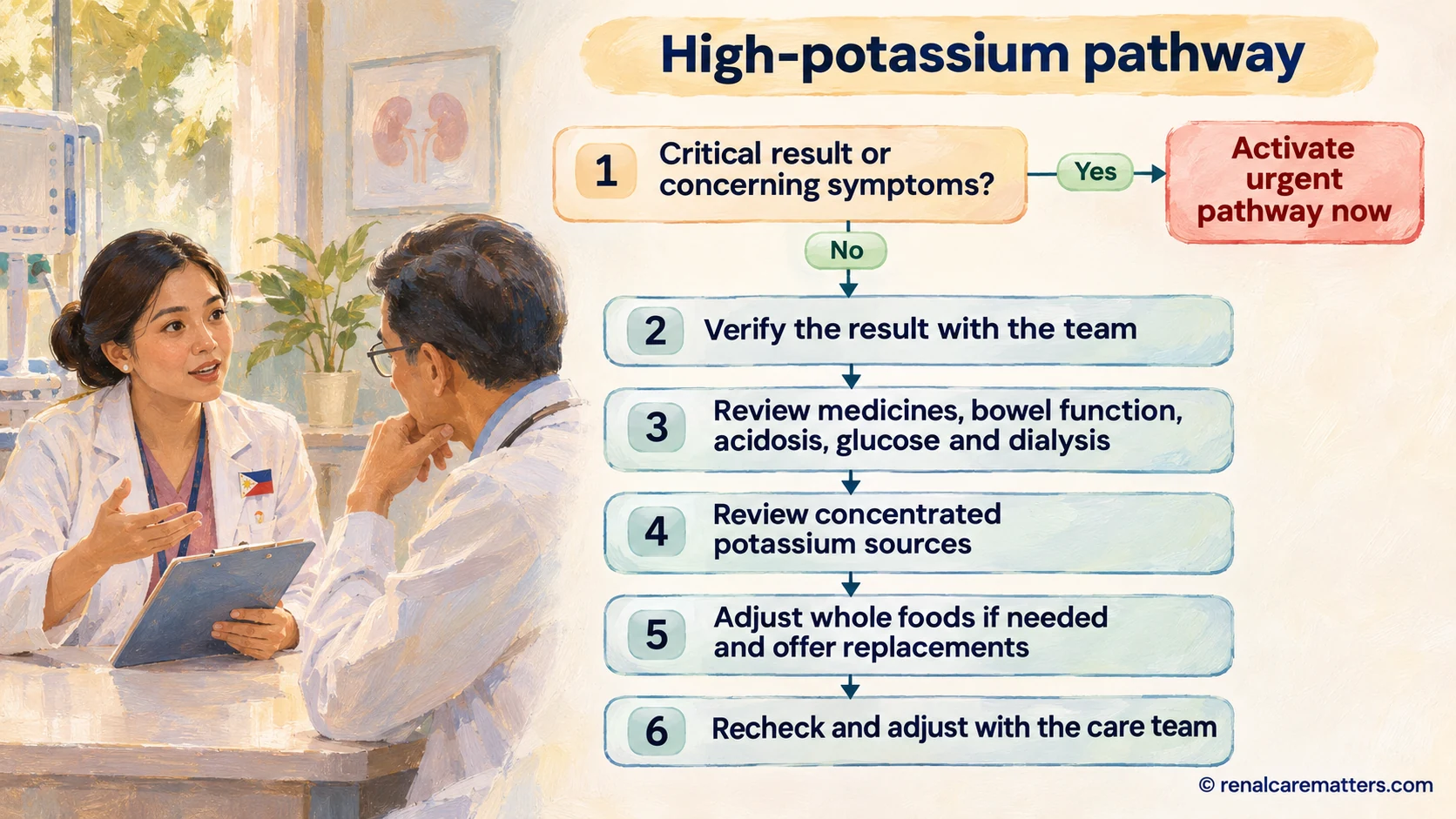
SafetyCritical or with symptoms? Urgent pathway.
Is it real?Hemolysis, sampling, timing after dialysis.
Only thenAdjust portions of whole foods, as little as needed.
Opening case · fictional
Case: No more vegetables
Mrs. Garcia, 64, has diabetic kidney disease, chronic kidney disease (CKD) G4. Her potassium was 5.7 mmol/L last month and 5.6 mmol/L this week; neither was flagged critical, and she has no symptoms. Her bicarbonate is 18 mmol/L. She takes telmisartan. A relative told her to stop all fruits and vegetables, and she has. She now opens her bowels every four or five days.
She drinks a glass of buko juice most afternoons “for the kidneys,” uses a “low-sodium salt” her daughter bought, and takes ibuprofen for knee pain. Her fasting glucose readings have been above 200 mg/dL.
Before reading on, decide:
List every likely contributor to her potassium. Which are diet, and which are not?
Which two food-related changes would lower potassium most, at the least nutritional cost?
What do you report to the physician, and what do you leave to the physician?
Keep your answers in mind. The lesson gives you what you need, and the case review near the end shows one sound response.
Lesson · part 1
Look for the blocked drain first
Kidney Disease: Improving Global Outcomes (KDIGO)’s conference on potassium concluded that hyperkalemia in CKD is usually the result of several factors together, and that diet is seldom the only one.1 Kidney Disease Outcomes Quality Initiative (KDOQI) likewise asks clinicians to adjust dietary potassium to maintain a normal serum level, and on purpose it sets no single number for everyone.2 Start with a checklist that puts diet last.
Question
Why it raises potassium
Who acts
Is the result real? Hemolyzed sample, long tourniquet time, sample taken soon after dialysis
Potassium leaks from blood cells in the tube
Physician decides on a repeat
New or increased RAAS inhibitor, potassium-sparing diuretic, trimethoprim, nonsteroidal anti-inflammatory drug, potassium supplement
Less kidney excretion, or added load
Physician; you report what the patient takes, including over-the-counter pain relievers
Constipation
Less colonic excretion
You: fiber, fluid within allowance, activity; physician: laxatives
Metabolic acidosis (low bicarbonate)
Potassium moves out of cells
Physician treats; diet contributes
High glucose or missed insulin; prolonged fasting
Less insulin-driven shift into cells
Diabetes team; you address meal timing
Missed, shortened, or inefficient dialysis
Less removal
Nephrologist and nurse
Concentrated potassium sources
Large, rapidly absorbed load
You
RAAS inhibitors deserve a special note. They slow CKD progression and protect the heart, and stopping them for a mildly high potassium may cost the patient more than it gains. Your contribution is to remove other causes so the physician can keep the medicine going. Never advise a patient to stop one.
Stop and reportA potassium flagged critical, or any high potassium with weakness, palpitations, or a slow or irregular pulse, goes to the physician at once. Do not send the patient home with a diet sheet.
Lesson · part 2
Not all dietary potassium is equal
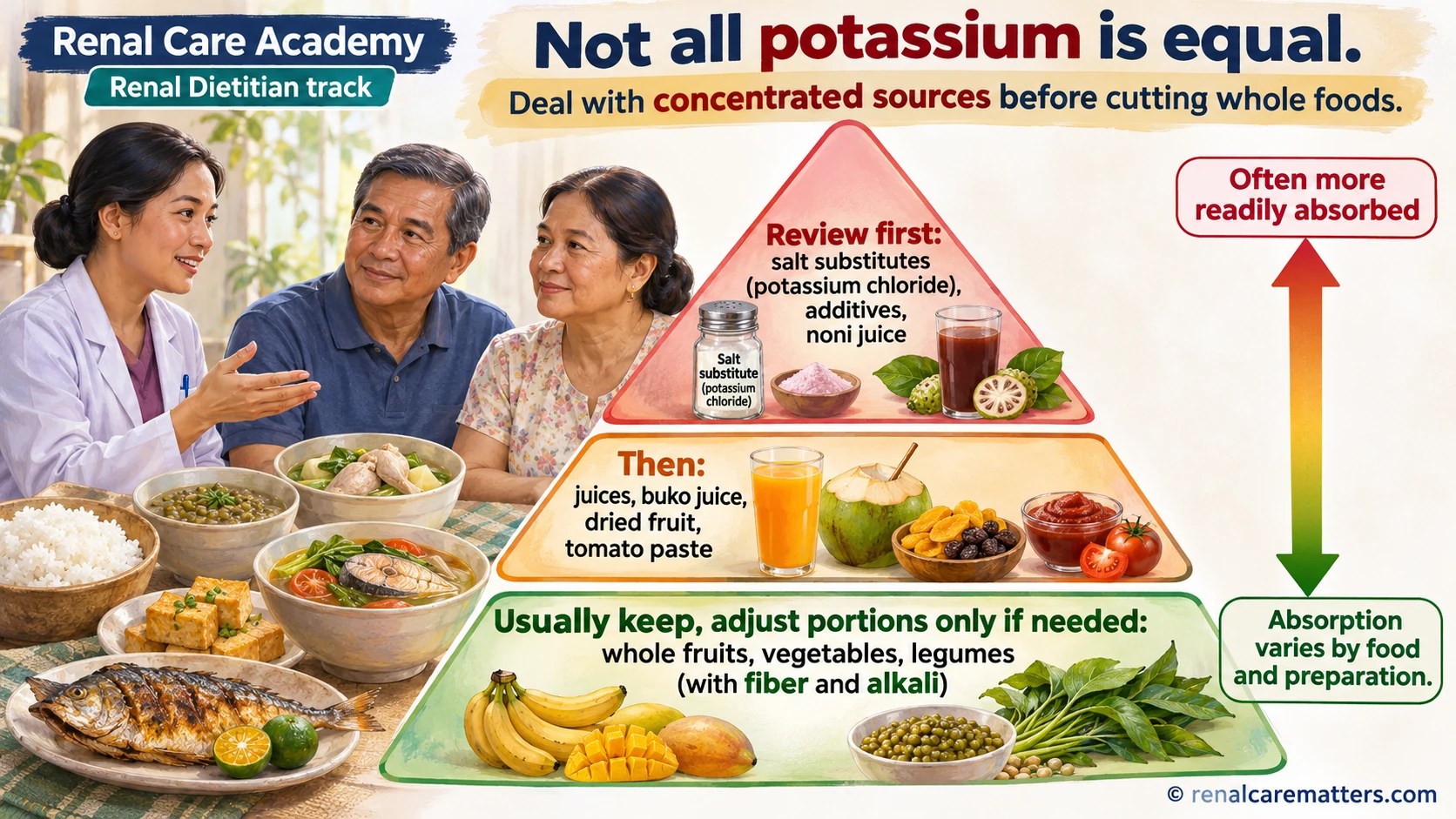
Potassium from different foods does not reach the blood equally. Potassium salts added to food and potassium chloride in salt substitutes are absorbed almost completely and quickly. Juices and coconut water deliver a large amount in a few swallows, without fiber. Whole fruits, vegetables, and legumes release potassium more slowly, bring fiber that speeds its exit through the bowel, and bring alkali that helps move potassium into cells.1 That is why KDIGO advises limiting foods whose potassium the body absorbs easily, such as processed foods, for people with CKD G3 to G5 who have a history of hyperkalemia (advice without a formal grade).3
Figure 3 · Review these before touching vegetables
Salt substitutes“Low-sodium” or “lite” salts with potassium chloride.
AdditivesPotassium chloride, potassium lactate, potassium phosphate, and potassium sorbate on ingredient lists of processed meats, sauces, and “reduced-sodium” products.
DrinksBuko juice, fruit juices, vegetable juices, malunggay or other leaf “shots,” some sports and herbal drinks.
Dried and concentrated foodsDried fruit, tomato paste, chocolate and cocoa drinks, large portions of nuts.
SupplementsMultivitamin-minerals with potassium, herbal products such as noni juice.
If potassium stays high after the drains and the concentrated sources are dealt with, adjust whole foods with the lightest touch that works: smaller portions of the highest-potassium items the patient eats often (banana, avocado, ripe mango, kamote and other root crops, tomato sauce, legumes), with replacements, not gaps. Boiling cut root crops and vegetables in plenty of water and discarding the water lowers their potassium, at the cost of water-soluble vitamins. Where a number is needed, units commonly work to about 2,000 to 3,000 mg (50 to 75 mmol) a day; this range is convention, not a graded recommendation, and it should be lifted when the potassium is controlled or a binder is started.
The evidence that restricting whole-food potassium improves outcomes is thin. In the largest cohort on hemodialysis, reported potassium intake was not associated with serum potassium, hyperkalemia, or death.4 This is observational and questionnaire-based; it does not license unlimited intake for an individual with repeated high values, but it does mean that a blanket ban on fruits and vegetables has no outcome evidence behind it and has known costs in fiber, alkali, and enjoyment.
Figure 4. Not all potassium is equal. Deal with concentrated sources before cutting whole foods.
Lesson · part 3
Acidosis, fruits and vegetables, and the bowel
As Module 2 described, animal protein and grains produce acid, and fruits and vegetables supply alkali. KDOQI states that it is reasonable to keep serum bicarbonate at 24 to 26 mmol/L (expert opinion), and suggests reducing net acid production with more fruits and vegetables (a weak suggestion, grade 2C) or bicarbonate supplementation (a firm recommendation, grade 1C) in adults with CKD stages 1 to 4.2 KDIGO advises considering treatment, with or without dietary change, to prevent acidosis with clinical consequences, for example a bicarbonate below 18 mmol/L (advice without a formal grade).3
In a one-year randomized trial in 71 people with stage 4 hypertensive kidney disease, fruits and vegetables dosed to halve dietary acid raised blood bicarbonate and lowered urinary markers of kidney injury, as sodium bicarbonate did, and plasma potassium did not rise in either group.5 Now look at who was in it. Patients were chosen for a low risk of hyperkalemia, and the outcomes were laboratory markers, not kidney failure. The trial shows that the approach can be safe in selected patients with close monitoring. It does not show that it is safe for someone like Mrs. Garcia while her potassium is 5.6.
Fiber and the bowel. The colon becomes an important exit for potassium as kidney function falls, so constipation matters. It is common in CKD because of fluid limits, binders, iron tablets, low activity, and the very restriction of fruits and vegetables meant to help. Restoring fiber, from vegetables, lower-potassium fruits, oats, and whole grains as phosphorus allows, is potassium management. Increase gradually and tell the physician if bowel habit does not improve; laxative choice is a medical decision.
RememberA patient who stops all fruits and vegetables loses fiber and alkali, becomes constipated and more acidotic, and may end with a higher potassium than before. Liberalize safely instead of restricting widely.
Lesson · part 4
The other direction: low potassium
Low potassium is less discussed and also dangerous: it causes weakness, cramps, constipation, and rhythm disturbances. In kidney care it appears with poor intake, vomiting or diarrhea, loop or thiazide diuretics, and in peritoneal dialysis, where potassium is removed continuously by fluid that contains none (Module 10). On hemodialysis, a patient who eats poorly and dialyzes against a low-potassium dialysis fluid can leave the session with a low level.
A low or falling potassium is a prompt to ask about intake and losses and to tell the physician, who decides on supplements or a change in dialysis fluid. It is also the moment to cancel an old potassium restriction that nobody lifted. Old restrictions are among the most common findings in a first renal consult.
Figure 5 · When to lift a potassium restriction
Potassium normal on repeated checksEspecially after a cause was corrected.
A potassium binder was startedThe physician may want diet liberalized.
Intake or weight is fallingProtecting intake comes first.
Peritoneal dialysis, or low potassiumRestriction is usually wrong.
After transplant with good functionReassess from current results (Module 12).
Figure 6. The high-potassium pathway. Diet comes last, and every restriction needs an end date.
On the floor
Real situations: problems and solutions
These are fictional but typical. For each one, cover the answer, decide what you would do, then compare. Where a step depends on local rules, your unit’s procedure and your supervisor’s direction come first.
Potassium 6.2 after a fiesta
What you see
A patient on hemodialysis (HD) has potassium 6.2 mmol/L flagged by the laboratory and says he feels fine.
What is likely going on
This may be the fiesta food, the long gap, or something else; he may feel fine and still be in danger.
What to do
Tell the physician on duty now; a high potassium can cause rhythm problems without symptoms. Review the food only after the team has acted.
Why it matters
Absence of symptoms does not make a high potassium safe.
The vegetables nobody eats anymore
What you see
A family stopped all vegetables after a high potassium a year ago. The patient is constipated, and the last six results were normal.
What is likely going on
An old restriction outlived its reason.
What to do
Lift the ban in steps, starting with lower-potassium vegetables, and recheck potassium in a month with the team.
Why it matters
Unlifted restrictions cost fiber, flavor, and sometimes potassium control itself.
Field notes
Ask about pain relievers bought without prescription.
Ask about bowel habit at every potassium review.
Case review
Back to the case: No more vegetables
What is raising her potassium? Several things, and most are not food. Telmisartan is one; it protects her kidneys and heart, and stopping it is not your call. Ibuprofen is another: it lowers potassium excretion and can harm kidney function. Her bicarbonate of 18 mmol/L means acidosis, which pushes potassium out of cells. Her glucose is high, so less potassium is driven into cells. Constipation has closed part of the bowel route. On the food side, there are two concentrated sources: the salt substitute and the daily buko juice.
Was stopping all vegetables a good idea? No. She has already stopped them, and her potassium has not come down. She has lost fiber and alkali, and she is more constipated and more acidotic than before. The restriction may be making the problem worse.
Which two changes help most for the least cost? Stop the salt substitute, and replace the buko juice with water. Both deliver potassium that is absorbed almost completely and brings nothing she needs. Then bring vegetables and lower-potassium fruits back in measured portions, to restore fiber and alkali and to ease the constipation.
What do you report, and what do you leave? Report to the physician: potassium 5.7 then 5.6 mmol/L, bicarbonate 18, daily ibuprofen, fasting glucose above 200 mg/dL, constipation, and the two food sources you have stopped. Leave to the physician: whether to repeat the potassium, the pain reliever, treatment of acidosis, the telmisartan, a potassium binder, laxatives, and her glucose medicines. Agree on a recheck date, and plan to lift any restriction once her potassium is controlled. Finding the blocked drains is often the most useful thing a dietitian does for a high potassium.
Skills lab · with your preceptor
Skills checklist: Working up a high potassium from the nutrition side
Use a fictional card with two potassium results, a medicine list, a bowel history, and a food recall. Your preceptor rates each step as satisfactory, needs practice, or not observed. Steps marked Critical must all be satisfactory before sign-off. This checklist supports supervised learning; your unit’s own procedure and competency form are the authority. A printable version of every checklist is on the trainer page.
CriticalChecks first whether the result is critical or accompanied by symptoms, and escalates if so.
Asks about sample quality and timing, and leaves the decision to repeat to the physician.
CriticalReviews medicines, including over-the-counter pain relievers and supplements, and reports them without advising the patient to stop a prescribed medicine.
Asks about bowel habit, glucose control, and dialysis attendance.
Identifies salt substitutes, additives, juices, and coconut water before whole foods.
If whole foods are adjusted, names specific items and portions and gives replacements.
Protects fiber, energy, and protein intake in the plan.
States the conditions under which the restriction will be lifted and sets a recheck date with the team.
Placement activity. Review the potassium results of ten patients with your preceptor. For each value above range, list the non-diet causes you can find in the record.
Self-assessment
Check your understanding
Each visit draws 8 questions at random from this module’s 15-question bank. Choose the single best answer for each, then select Check answers; an explanation appears under the best answer. Select New set of questions for a different mix. A good target is 7 of 8 on two different sets. Nothing you select is sent anywhere; scoring happens in your browser.
Clase, C. M., Carrero, J. J., Ellison, D. H., Grams, M. E., Hemmelgarn, B. R., Jardine, M. J., Kovesdy, C. P., Kline, G. A., Lindner, G., Obrador, G. T., Palmer, B. F., Cheung, M., Wheeler, D. C., Winkelmayer, W. C., Pecoits-Filho, R., & Conference Participants. (2020). Potassium homeostasis and management of dyskalemia in kidney diseases: Conclusions from a Kidney Disease: Improving Global Outcomes (KDIGO) Controversies Conference. Kidney International, 97(1), 42–61. https://doi.org/10.1016/j.kint.2019.09.018
Ikizler, T. A., Burrowes, J. D., Byham-Gray, L. D., Campbell, K. L., Carrero, J. J., Chan, W., Fouque, D., Friedman, A. N., Ghaddar, S., Goldstein-Fuchs, D. J., Kaysen, G. A., Kopple, J. D., Teta, D., Yee-Moon Wang, A., & Cuppari, L. (2020). KDOQI clinical practice guideline for nutrition in CKD: 2020 update. American Journal of Kidney Diseases, 76(3, Suppl. 1), S1–S107. https://doi.org/10.1053/j.ajkd.2020.05.006
Kidney Disease: Improving Global Outcomes (KDIGO) CKD Work Group. (2024). KDIGO 2024 clinical practice guideline for the evaluation and management of chronic kidney disease. Kidney International, 105(4S), S117–S314. https://doi.org/10.1016/j.kint.2023.10.018
Bernier-Jean, A., Wong, G., Saglimbene, V., Ruospo, M., Palmer, S. C., Natale, P., Garcia-Larsen, V., Johnson, D. W., Tonelli, M., Hegbrant, J., Craig, J. C., Teixeira-Pinto, A., & Strippoli, G. F. M. (2021). Dietary potassium intake and all-cause mortality in adults treated with hemodialysis. Clinical Journal of the American Society of Nephrology, 16(12), 1851–1861. https://doi.org/10.2215/CJN.08360621
Goraya, N., Simoni, J., Jo, C. H., & Wesson, D. E. (2013). A comparison of treating metabolic acidosis in CKD stage 4 hypertensive kidney disease with fruits and vegetables or sodium bicarbonate. Clinical Journal of the American Society of Nephrology, 8(3), 371–381. https://doi.org/10.2215/CJN.02430312
Educational study material for registered nutritionist-dietitians. Does not replace the nephrologist’s orders, facility policy, the Nutrition Care Process documentation required by the Department of Health, or supervised practice.