Comparable weights, intake, nutrition-focused examination, handgrip strength, protein-energy wasting, and a problem–etiology–signs statement.
PublishedNailathalaGipatikPepalwal:ReferencesMga SanggunianMga TinubdanReng Reperensya:6Audience: Registered nutritionist-dietitians entering adult kidney care · renal RND preceptors, nephrologists, and head nurses who orient themRead timeOras ng pagbasaOras sa pagbasaOras ning pamamasa:
This module is study material for dietitians in adult kidney care. It explains the reasoning behind common decisions; it is not a protocol. In practice, follow your facility’s policy and the responsible physician’s orders. Targets and cut-off values are set by your unit and the attending nephrologist. Every case is fictional.
Learning objectives
After this module you should be able to
Build a weight timeline from comparable weights and calculate percent weight change correctly.
Collect intake with a method suited to the question, and check it against an objective marker when one is available.
Perform and record a basic nutrition-focused physical examination and handgrip strength test.
Explain why serum albumin alone cannot diagnose malnutrition.
Apply the criteria for protein-energy wasting (PEW) and the Global Leadership Initiative on Malnutrition (GLIM) criteria, and say how they differ.
Write a problem, etiology, signs and symptoms (PES) statement with a measurable monitoring plan.
Pre-testBefore you read, answer the 8 self-assessment questions and note your score. After the module, select New set of questions and compare. The difference is what you learned; the questions you still miss are what to reread.
Start here
The big picture, in plain words
In plain wordsAssessing nutrition in kidney disease is like weighing a sponge. The sponge (muscle and fat) and the water it holds are on the scale together. A patient can lose three kilograms of muscle and gain three liters of fluid, and the scale will not move. Your work is to separate the sponge from the water, using the timing of the weight, the examination, and how the person functions.
Figure 1 · Key terms for this module
Dry weight (target weight)The weight after dialysis at which the patient has no excess fluid and no symptoms of too little. Set by the nephrologist.
Protein-energy wasting (PEW)Loss of body protein and energy stores in kidney disease, from low intake plus inflammation, acidosis, and catabolism.
Subjective Global Assessment (SGA)A structured bedside rating of nutrition from history and examination; the 7-point version is used in dialysis.
Malnutrition-Inflammation Score (MIS)A 10-item score for dialysis patients that adds laboratory values and body mass index to the SGA items.
Handgrip strengthPeak grip force measured with a dynamometer; a quick measure of muscle function.
PES statementProblem, etiology, signs and symptoms: the format of a nutrition diagnosis.
Normalized protein catabolic rate (nPCR)An estimate of protein intake from urea, valid only when the patient is stable.
Figure 2 · The assessment sequence
HistoryWeight timeline, intake, appetite, gut symptoms, function, food access.
ExaminationMuscle, fat, edema, mouth and teeth, grip strength.
DiagnosisA PES statement with a cause you can act on.
PlanOne intervention, one measure, one date, one owner.
Opening case · fictional
Case: The denture
Mr. Reyes, 67, has been on hemodialysis for three years. His post-dialysis weight was 62.0 kg six weeks ago and 58.0 kg this week. Today, before dialysis, he weighs 61.0 kg, and the nurse remarks that “his weight is about the same.”
He tells you he has eaten about half his usual portions since a new lower denture began rubbing. His serum albumin fell from 3.9 to 3.3 g/dL during a chest infection last month. His temples look hollow, and his grip feels weak.
Before reading on, decide:
Which two weights should be compared, and what is the percent loss?
What can and cannot be concluded from the albumin?
Write a PES statement with a cause you can act on this week.
Keep your answers in mind. The lesson gives you what you need, and the case review near the end shows one sound response.
Lesson · part 1
Build a timeline from comparable weights
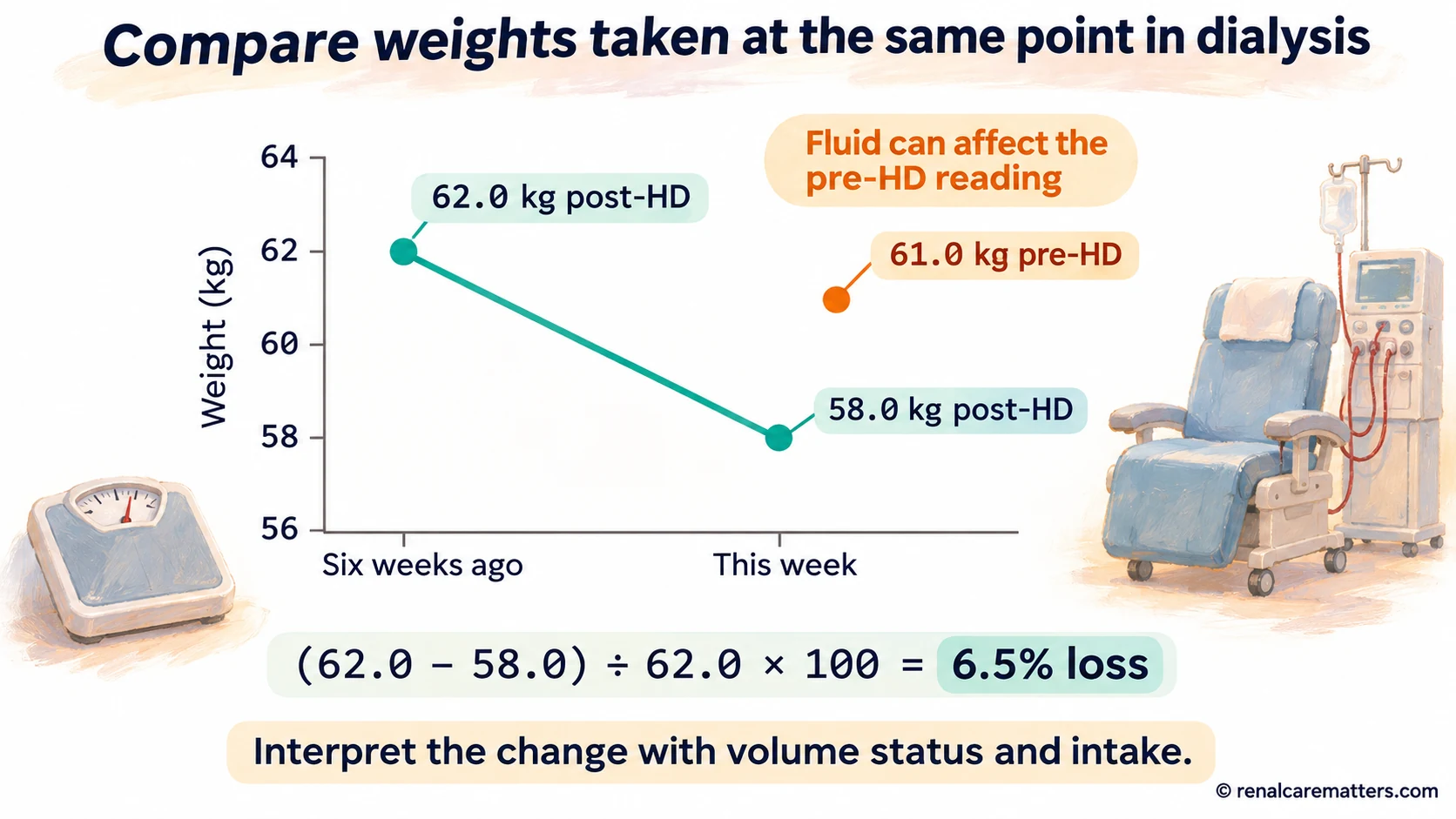
Weight in kidney disease is tissue plus fluid, and the fluid part can change by several kilograms in two days. Compare only like with like: post-dialysis with post-dialysis, a peritoneal dialysis weight taken the same way each time (drained or filled, stated in the note), or in chronic kidney disease (CKD), morning weights with a note on edema. Record the date, the timing, and the source of every weight.1
Percent weight change = (earlier weight − current weight) ÷ earlier weight × 100. Example: (62.0 − 58.0) ÷ 62.0 × 100 = 6.5% loss in six weeks.
Unintentional loss of 5% in three months or 10% in six months is one of the criteria for protein-energy wasting, and loss of more than 5% within six months is a GLIM phenotypic criterion.2,3 A falling post-dialysis weight with normal blood pressure and no cramps is likely tissue loss. A stable weight with rising blood pressure, new edema, or breathlessness can hide tissue loss replaced by fluid, and that should be raised with the nephrologist as a possible need to lower the dry weight.
Which weight goes into the calculations in later modules? Kidney Disease Outcomes Quality Initiative (KDOQI) does not name one formula; it asks for clinical judgment that accounts for edema and body composition.1 In practice, use the edema-free weight (post-dialysis or target weight) for most patients, and say in the note when you have used an adjusted or ideal weight for someone with obesity or severe wasting, and why.
Figure 3. Compare like with like. Post-dialysis weights show tissue change; pre-dialysis weights carry fluid.
Lesson · part 2
Measure intake, then check it
Choose the method for the question. A 24-hour recall is quick and shows pattern and timing. A three-day food record that includes a dialysis day and a weekend day is the method KDOQI prefers for estimating energy and protein intake, because single days vary widely.1 A food frequency list finds habits such as daily instant noodles or sweetened drinks. Ask about condiments at the table, broth, and food eaten outside the home; these carry most of the sodium.
All self-report under-counts. Where you can, check it. In a stable patient on dialysis, the nPCR estimates protein intake from urea; in CKD, a 24-hour urine urea nitrogen does the same.4 Both are wrong when the patient is catabolic or building tissue, because urea then reflects more or less than intake. An nPCR of 0.8 g/kg/day in a patient who reports eating well is a prompt to ask again, not a verdict.
Figure 4 · Questions that find the cause
AppetiteIs food unappealing all day or only after dialysis? Has taste changed? Any nausea or early fullness?
Mouth and gutDentures, sores, swallowing, constipation, diarrhea.
Access to foodWho shops and cooks? What is the food budget? Is there refrigeration?
RestrictionsWhich foods has the patient stopped, and who advised it? Old or mistaken rules are a common cause of low intake.
Mood and burdenLow mood, fatigue after dialysis, pill burden, time lost to treatment.
Lesson · part 3
Examine, measure function, and read laboratory results in context
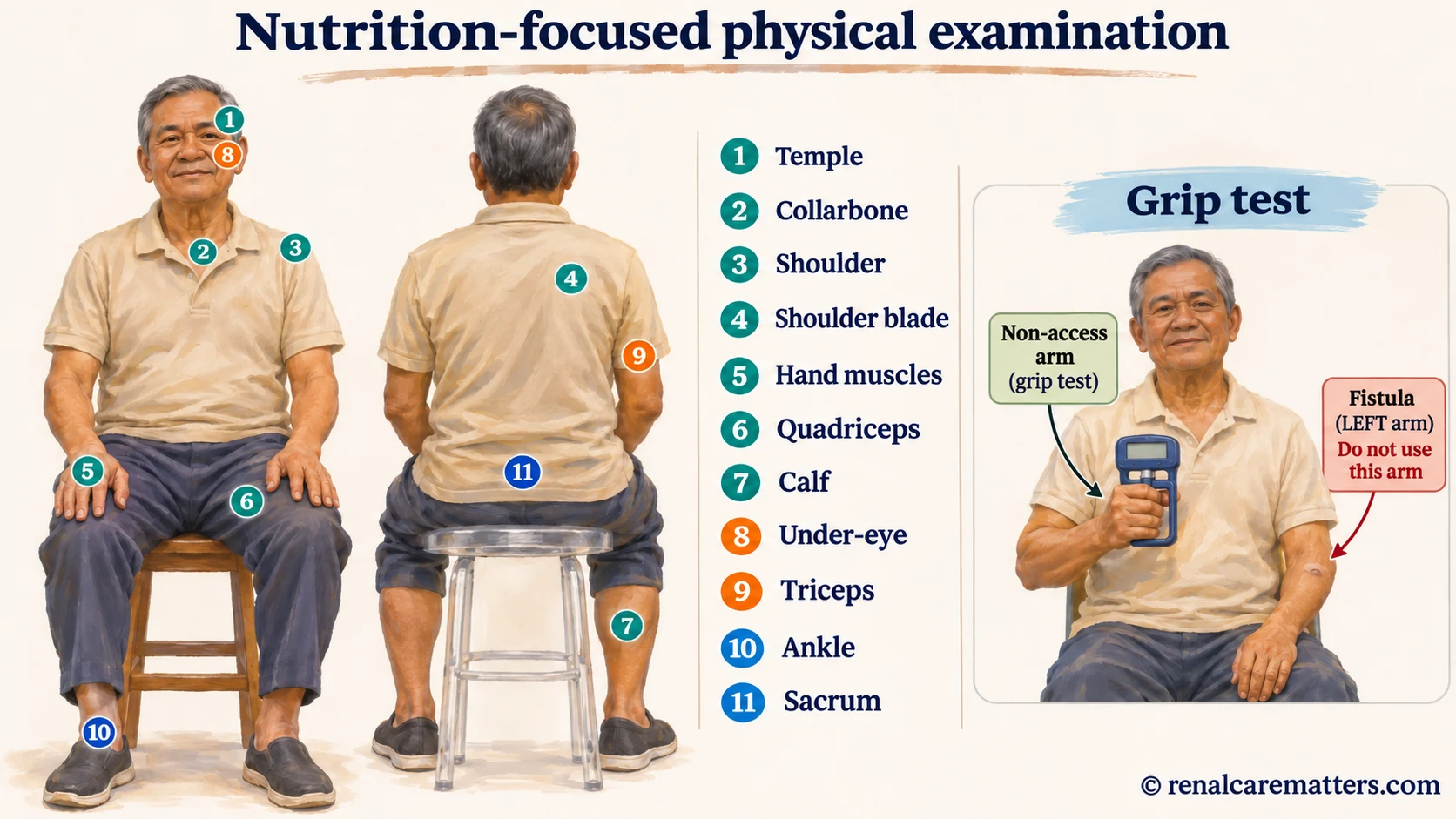
A nutrition-focused physical examination takes five minutes. Look and feel for muscle loss at the temples, the collarbones, the shoulders, the shoulder blades, the back of the hand between thumb and forefinger, the thigh, and the calf. Check fat at the triceps and under the eyes. Press for edema at the ankles and, in a patient who lies in bed, over the sacrum. Look in the mouth. Examine after dialysis when possible, when fluid hides less.
Handgrip strength measures function, which often falls before body measurements do. KDOQI suggests it as an indicator of protein-energy status and functional status when baseline data are available for comparison (a weak suggestion, grade 2B).1 Measure on the arm without a fistula, seated, elbow at 90 degrees, best of three attempts, and compare the patient with himself over time.
Structured tools. KDOQI recommends the 7-point Subjective Global Assessment as a valid and reliable tool for assessing nutritional status in adults with CKD stage 5 on dialysis (a firm recommendation, grade 1B), and says the Malnutrition-Inflammation Score may be used in maintenance hemodialysis and after transplantation (a weak suggestion, grade 2C).1,5 Routine screening at least twice a year for patients with CKD stages 3 to 5 and on dialysis is an expert-opinion statement.1
Albumin. Serum albumin falls with inflammation, infection, fluid overload, protein lost in urine or dialysate, and liver disease. Inflammation both lowers its production and moves it out of the bloodstream. A low albumin predicts death and hospitalization on dialysis, so it must never be ignored, but it does not tell you how much the patient eats, and feeding alone often does not correct it while inflammation continues.1 Read it as a marker of risk that asks “why?”
Figure 5. Nutrition-focused physical examination sites, and grip strength on the arm without the fistula.
Lesson · part 4
Name the problem, then make the note actionable
Two sets of criteria are in use. They overlap, and you should know which one your unit records.
Protein-energy wasting (ISRNM, 2008)
GLIM malnutrition (2019)
Built for
Acute and chronic kidney disease
All adult patients, any setting
Rule
At least one item in three of four categories
At least one phenotypic and one etiologic criterion
Body mass
Body mass index below 23 kg/m²; unintentional weight loss of 5% in 3 months or 10% in 6 months; body fat below 10%
Weight loss above 5% in 6 months or above 10% beyond 6 months; low body mass index (Asia: below 18.5, or below 20 from age 70)
Muscle
Reduced muscle mass (5% in 3 months or 10% in 6 months); reduced mid-arm muscle circumference
Reduced muscle mass by a validated method
Intake
Unintended protein intake below 0.8 g/kg/day on dialysis (below 0.6 in CKD stages 2 to 5) or energy below 25 kcal/kg/day, for at least 2 months
Sources: International Society of Renal Nutrition and Metabolism (ISRNM) expert panel; GLIM consensus.2,3 The body mass index cut-off of 23 in the PEW criteria came from mortality data in dialysis populations; many healthy Filipino adults are below it, so do not label a stable, well, small-framed patient on that item alone.
The PES statement. A nutrition diagnosis links a nutrition problem to a cause the dietitian can influence, with evidence. “Hemodialysis” and “low albumin” are not etiologies you can treat; “pain on chewing” and “misses lunch on dialysis days” are. Then write a plan that another person could carry out: one intervention the patient chose, one measure, one date, and who is responsible.6
Stop and reportIntake falling together with unintentional weight loss, or weight loss with new weakness or infection, is not a routine finding. Report it to the nephrologist and nurse the same day, with the numbers, even while you start the nutrition plan.
On the floor
Real situations: problems and solutions
These are fictional but typical. For each one, cover the answer, decide what you would do, then compare. Where a step depends on local rules, your unit’s procedure and your supervisor’s direction come first.
The pre-dialysis weight in the note
What you see
A colleague recorded weight loss using a pre-dialysis weight one month and a post-dialysis weight the next.
What is likely going on
The weights are not comparable; the change may be mostly fluid.
What to do
Recalculate with post-dialysis weights at the same point in the week, and correct the note with the source of each weight.
Why it matters
Wrong comparisons cause both missed wasting and false alarms.
Albumin 3.2, eating well
What you see
A patient reports eating well, has stable weight and strong grip, but albumin is 3.2 g/dL and C-reactive protein is high.
What is likely going on
Inflammation is lowering albumin.
What to do
Do not label malnutrition on albumin alone. Tell the nephrologist about the inflammation marker, keep monitoring intake and weight, and look for an infection or access problem with the team.
Why it matters
Albumin is a warning light, not a food gauge.
Field notes
Weigh, examine, and test grip after dialysis when possible; there is less fluid to fool you.
Write the PES etiology as something you can change this month.
Case review
Back to the case: The denture
Which weights should be compared? The two post-dialysis weights: (62.0 − 58.0) ÷ 62.0 × 100 = 6.5% in six weeks. Today’s pre-dialysis weight of 61.0 kg includes about 3 kg of fluid, and that is what made the nurse think nothing had changed. Tell the nephrologist: his dry weight may now be too high for the tissue he has left.
What does the albumin tell you? Less than it seems. It fell during a chest infection. It marks him as a patient at high risk and fits the picture, but it is not proof that he eats too little, and it will not be your measure of whether the plan works over the next two weeks.
What is the PES statement? “Inadequate oral intake related to pain on chewing from an ill-fitting denture, as evidenced by reported half portions for six weeks, 6.5% loss on comparable post-dialysis weights, and visible muscle loss at the temples.” He meets the protein-energy wasting criteria for body mass, intake, and biochemistry. The cause is one you can act on this week.
What is the plan? Ask for a dental review. Agree on soft protein foods he likes: lugaw with egg and flaked fish, tofu, soft-cooked fish, taho without the syrup if his glucose allows. If his intake has not recovered in one to two weeks, discuss an oral supplement with the team. Check portions eaten and chewing pain by telephone at one week, and his post-dialysis weight and grip strength at two and four weeks. Report the weight loss to the nephrologist today. A scale reading the same number is the easiest place for wasting to hide, and the dietitian is often the one who finds it.
Skills lab · with your preceptor
Skills checklist: Renal nutrition assessment and documentation
Materials: a fictional chart with six weeks of weights, a tape measure, and a handgrip dynamometer if the unit has one. Your preceptor rates each step as satisfactory, needs practice, or not observed. Steps marked Critical must all be satisfactory before sign-off. This checklist supports supervised learning; your unit’s own procedure and competency form are the authority. A printable version of every checklist is on the trainer page.
Selects comparable weights, states their timing, and calculates percent change correctly.
CriticalRecognizes when a stable scale weight may hide tissue loss and says what to report to the nephrologist.
Takes a recall that includes a dialysis day, condiments, broth, and food eaten outside the home.
Asks about appetite, mouth and gut symptoms, food access, self-imposed restrictions, and mood.
Examines at least five muscle sites and checks for edema, and records findings in plain terms.
Measures handgrip strength on the non-access arm, best of three, and records the position used.
Explains to the preceptor why albumin alone does not diagnose malnutrition.
Writes a PES statement whose etiology the plan can address, with one measure, one date, and one owner.
CriticalReports combined intake decline and weight loss to the team the same day.
Placement activity. Complete one full assessment under supervision, using your unit’s screening tool, and compare your SGA rating with your preceptor’s.
Self-assessment
Check your understanding
Each visit draws 8 questions at random from this module’s 15-question bank. Choose the single best answer for each, then select Check answers; an explanation appears under the best answer. Select New set of questions for a different mix. A good target is 7 of 8 on two different sets. Nothing you select is sent anywhere; scoring happens in your browser.
Ikizler, T. A., Burrowes, J. D., Byham-Gray, L. D., Campbell, K. L., Carrero, J. J., Chan, W., Fouque, D., Friedman, A. N., Ghaddar, S., Goldstein-Fuchs, D. J., Kaysen, G. A., Kopple, J. D., Teta, D., Yee-Moon Wang, A., & Cuppari, L. (2020). KDOQI clinical practice guideline for nutrition in CKD: 2020 update. American Journal of Kidney Diseases, 76(3, Suppl. 1), S1–S107. https://doi.org/10.1053/j.ajkd.2020.05.006
Fouque, D., Kalantar-Zadeh, K., Kopple, J., Cano, N., Chauveau, P., Cuppari, L., Franch, H., Guarnieri, G., Ikizler, T. A., Kaysen, G., Lindholm, B., Massy, Z., Mitch, W., Pineda, E., Stenvinkel, P., Treviño-Becerra, A., & Wanner, C. (2008). A proposed nomenclature and diagnostic criteria for protein-energy wasting in acute and chronic kidney disease. Kidney International, 73(4), 391–398. https://doi.org/10.1038/sj.ki.5002585
Cederholm, T., Jensen, G. L., Correia, M. I. T. D., Gonzalez, M. C., Fukushima, R., Higashiguchi, T., Baptista, G., Barazzoni, R., Blaauw, R., Coats, A., Crivelli, A., Evans, D. C., Gramlich, L., Fuchs-Tarlovsky, V., Keller, H., Llido, L., Malone, A., Mogensen, K. M., Morley, J. E., . . . GLIM Working Group. (2019). GLIM criteria for the diagnosis of malnutrition: A consensus report from the global clinical nutrition community. Clinical Nutrition, 38(1), 1–9. https://doi.org/10.1016/j.clnu.2018.08.002
Maroni, B. J., Steinman, T. I., & Mitch, W. E. (1985). A method for estimating nitrogen intake of patients with chronic renal failure. Kidney International, 27(1), 58–65. https://doi.org/10.1038/ki.1985.10
Kalantar-Zadeh, K., Kopple, J. D., Block, G., & Humphreys, M. H. (2001). A malnutrition-inflammation score is correlated with morbidity and mortality in maintenance hemodialysis patients. American Journal of Kidney Diseases, 38(6), 1251–1263. https://doi.org/10.1053/ajkd.2001.29222
Educational study material for registered nutritionist-dietitians. Does not replace the nephrologist’s orders, facility policy, the Nutrition Care Process documentation required by the Department of Health, or supervised practice.