After this module you should be able to
- Distinguish the roles of the Professional Regulation Commission (PRC) and Board of Nursing, the Department of Health (DOH) and its Health Facilities and Services Regulatory Bureau (HFSRB), Philippine Health Insurance Corporation (PhilHealth), and professional societies in a Philippine peritoneal dialysis (PD) program.
- Support PhilHealth PD Z-benefit documentation within your scope, routing eligibility and payment decisions to authorized staff.
- Calculate peritonitis and exit-site infection rates, months between episodes, percentage of patients peritonitis-free and culture-negative percentage, and compare them with International Society for Peritoneal Dialysis (ISPD) targets.
- Apply the 2026 ISPD framework for tracking loss from PD therapy.
- Design a small, measurable improvement with a run chart and a balancing measure.
The big picture, in plain words
A PD program is more than a group of patients doing exchanges. It is licensed, contracted, staffed, audited and, ideally, improving. Your daily documentation is what lets the program prove eligibility, receive payment, meet standards and see its own performance. Your work is to keep records that are complete and honest, to know which authority governs which question, and to turn the numbers into one improvement at a time.
The picture has a limit. Patients are not passengers who can switch routes easily, and quality numbers are not just compliance. A peritonitis rate is a count of people who suffered. Treat it with that weight.
Case: A year of numbers
The PD unit at a provincial hospital has 32 patients. Nurse coordinator Mylene reviews last year: 9 peritonitis episodes over 28.5 patient-years; 3 culture-negative; 24 of 32 patients peritonitis-free; exits: 2 transplants, 4 transfers to hemodialysis, 3 deaths.
Before reading on, decide:
- Is the unit within the ISPD targets?
- Which indicator needs work first?
- What would you change, and how would you know it did not cause harm?
Keep your answers in mind. The lesson gives you what you need, and the case review near the end shows one sound response.
Who governs what (verify current issuances)
Use REQUIREMENTS.md, dated 24 November 2026, with your unit’s credentialing and benefits leads. Summary:
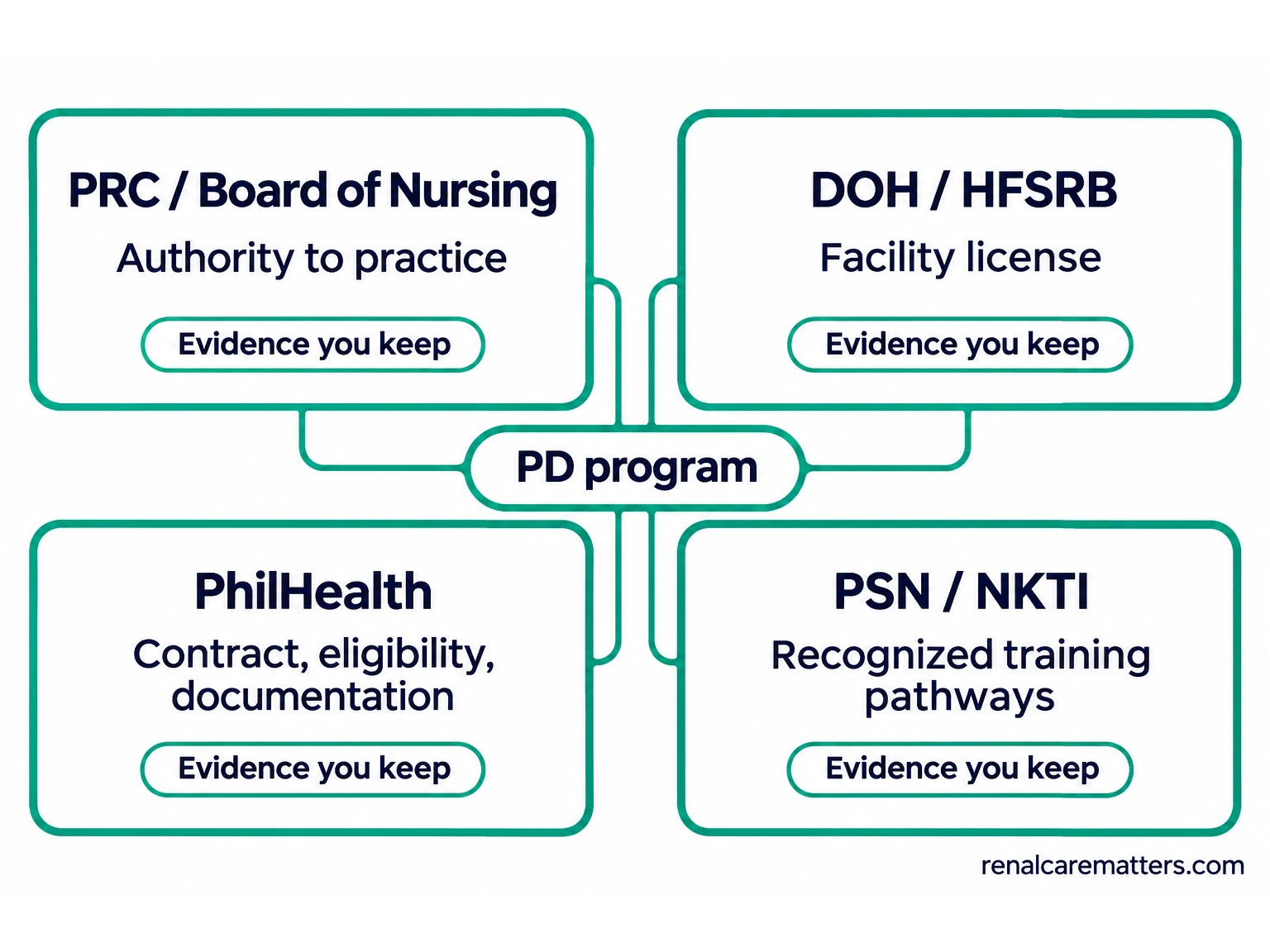
| Authority | Question it answers | Your evidence |
|---|---|---|
| PRC / Board of Nursing (Republic Act 9173) | Are you lawfully authorized to practice nursing? | Current PRC license and facility privilege record |
| DOH / HFSRB | Is the facility licensed for the service it provides? | Facility license to operate or written applicability determination; PD-specific licensing route confirmed with HFSRB or the regional Center for Health Development |
| PhilHealth PD Z-benefit contracting (Circular 2024-0036 and current annexes) | Is the facility contracted, the patient eligible, the episode documented? | Contract, self-assessment tool, rosters, training certificates, patient records per current annexes |
| PhilHealth PD First self-assessment tool | Staffing and training standard | At least one full-time PD nurse; nurse-to-patient ratio stated as 1:20; PRC licensure; recognized PD training per listed pathways; head validation |
| Philippine Society of Nephrology, National Kidney and Transplant Institute | Recognized training pathways | Course title, dates, duration, continuing professional development (CPD) listing, acceptance for the specific setting |
Benefit amounts and coverage change. Press reports in 2024 described a PD First Z-benefit package of ₱270,000 per year covering solutions, accessories and 90 to 120 exchanges a month depending on the prescription. Confirm the current amount, inclusions and annexes with the PhilHealth Regional Office before counseling a patient.
Scope. You help patients and the team assemble documentation, check chronic kidney disease (CKD) stage 5 and PhilHealth Dialysis Database status as instructed, and record initiation, follow-up, infection episodes, and exit or transfer. Eligibility determinations and payment decisions remain with authorized personnel.
Measuring infection
Peritonitis rate (episodes per year at risk) = number of episodes ÷ total patient-years at risk.
Patient-years at risk = sum of each patient’s days on PD in the period ÷ 365.25. Count time from the start of PD training or treatment; report pre-PD peritonitis (after insertion but before PD starts) separately per the 2022 definitions. Count relapsing peritonitis as one episode, per ISPD counting conventions.1
Months between episodes = 12 ÷ rate.
Percentage of patients peritonitis-free = patients with no episode in the period ÷ patients at risk in the period × 100.
Culture-negative percentage = culture-negative episodes ÷ all episodes × 100.
Exit-site infection rate = episodes ÷ patient-years at risk.
| Indicator | ISPD target |
|---|---|
| Peritonitis rate | ≤ 0.40 episodes per year at risk (2022) |
| Patients peritonitis-free per year | > 80% (2022) |
| Culture-negative peritonitis | < 15% of episodes (2022, GRADE 1C) |
| Exit-site infection rate | ≤ 0.40 episodes per year at risk (2023) |
- 6 episodes over 20 patient-years: 6 ÷ 20 = 0.30 episodes per patient-year; 12 ÷ 0.30 = 40 months between episodes. Below the 0.40 target.
- 4 episodes over 8 patient-years: 4 ÷ 8 = 0.50 per patient-year; 12 ÷ 0.50 = 24 months between episodes. Above target.
- 3 of 14 episodes culture-negative: 3 ÷ 14 × 100 = 21%. Above the 15% target; review sampling and laboratory methods.
Small numbers mislead. A unit with 25 patients may see the rate jump from 0.20 to 0.60 because of two extra episodes. Report confidence intervals where possible, look at trends over 12 months, and read each episode’s root cause.
International comparison. In Peritoneal Dialysis Outcomes and Practice Patterns Study (PDOPPS), crude peritonitis rates were 0.28 episodes per patient-year overall, ranging from 0.26 in the United States to 0.40 in Thailand, and 10% of facilities exceeded 0.50. These are observational data from seven countries, not including the Philippines.2
Tracking loss from PD
The 2026 ISPD position statement notes that nearly half of people who start PD are no longer on it at two years. The most common causes are transfer to hemodialysis, death and kidney transplantation; others include recovery of kidney function, transfer to another dialysis program and loss to follow-up. The statement replaces the inconsistently defined term "technique failure" with standardized definitions of causes of loss, recommendations on measurement, analysis and reporting, and key performance indicators for benchmarking and improvement.3
For your program: record the date and cause of every exit using the agreed definitions; distinguish clinically different outcomes (transplant is a success; death and hemodialysis transfer need review); and review hemodialysis transfers for preventable causes such as peritonitis, catheter dysfunction, inadequate fluid removal, burnout or caregiver loss.
Improving one thing at a time
- Pick a problem with data. For example, culture-negative rate 21%, or median time from cloudy-fluid call to first antibiotic dose of 9 hours.
- Write an aim. "Reduce median call-to-antibiotic time from 9 hours to under 4 hours within 6 months."
- Choose measures. Outcome (peritonitis cure without catheter loss), process (time stamps from call to sample to dose), balancing (after-hours staff workload, unnecessary emergency visits).
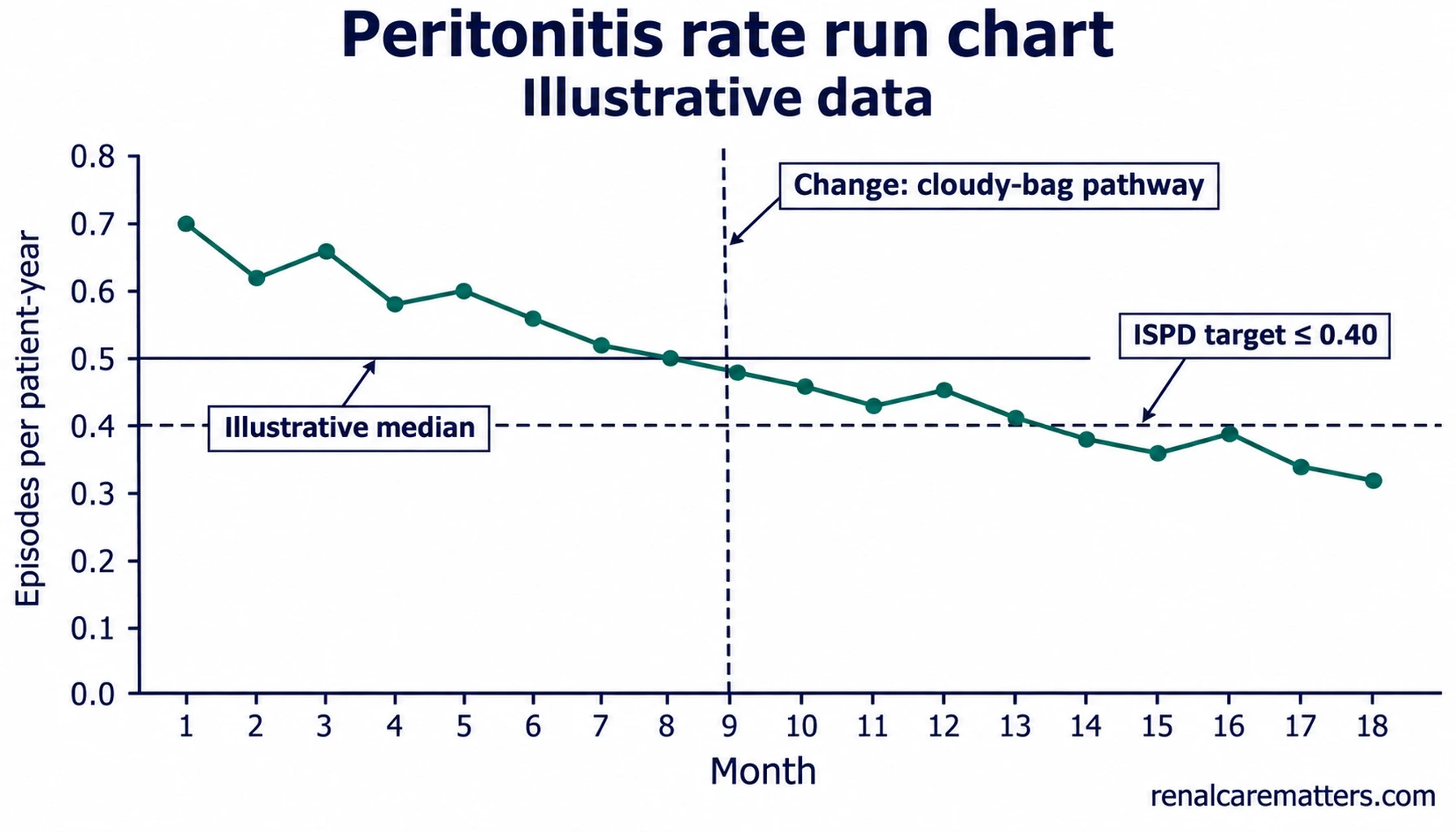
- Test a change. A one-page cloudy-bag pathway, a pre-labeled sample kit at home, an after-hours phone tree.
- Plot a run chart. Monthly values, a median line, and the date of each change.
- Review and adapt.
Back to the case: A year of numbers
Mylene’s calculations. Rate 9 ÷ 28.5 = 0.32 per patient-year (≈ 38 months between episodes), under target. Peritonitis-free 24 ÷ 32 = 75%, under the >80% target. Culture-negative 3 ÷ 9 = 33%, well above the 15% target.
Mylene’s plan. She reviews the three culture-negative episodes: two had antibiotics before sampling after emergency department visits, and one sample sat for 14 hours before reaching the laboratory. Her aim: culture-negative below 15% within 12 months. Change: an emergency-department alert card carried by every patient ("Send PD effluent for cell count, Gram stain and culture before antibiotics when feasible; call the PD unit") and a courier arrangement with the laboratory. Balancing measure: time to first antibiotic dose, so that sampling does not delay treatment. She plots both monthly.
She also reviews the four hemodialysis transfers using the 2026 definitions: two after refractory peritonitis, one for inadequate fluid removal, one after caregiver loss.
Skills checklist: Practice drill
Build a mock contracted-provider document packet (facility record, nurse qualifications, eligibility workflow per current annexes). Then calculate peritonitis rate, months between episodes, percentage peritonitis-free and culture-negative percentage for a supplied data set, and propose one improvement aim with a numerator, denominator, reporting interval, owner and balancing measure. Your preceptor rates each step as satisfactory, needs practice, or not observed. Steps marked Critical must all be satisfactory before sign-off. This checklist supports supervised learning; your unit’s own procedure and competency form are the authority. A printable version of every checklist is on the trainer page.
- Build a mock contracted-provider document packet (facility record, nurse qualifications, eligibility workflow per current annexes).
- Then calculate peritonitis rate, months between episodes, percentage peritonitis-free and culture-negative percentage for a supplied data set, and propose one improvement aim with a numerator, denominator, reporting interval, owner and balancing measure.
Check your understanding
Each visit draws 5 questions at random from this module’s 15-question bank. Choose the single best answer for each, then select Check answers; an explanation appears under the best answer. Select New set of questions for a different mix. A good target is 4 of 5 on two different sets. Nothing you select is sent anywhere; scoring happens in your browser.
Read next on this site
- Roadmap to Adding a Peritoneal Dialysis Program — A Staged Implementation GuideStarting and running a PD program.
- Dialysis Center Quality ManagementQuality assessment and improvement in dialysis.