
After this module you should be able to
- Apply adult-learning principles, health-literacy practice and teach-back to peritoneal dialysis (PD) training.
- Describe what the International Society for Peritoneal Dialysis (ISPD) 2025 position paper on teaching PD recommends and how strong that evidence is.
- Build an individualized training plan that names who performs each task.
- Judge readiness by independent return demonstration of critical steps and correct responses to common problems.
- Identify retraining triggers and schedule reassessment.
The big picture, in plain words
A PD nurse trainer is the single most important safety device in a home program. The patient will perform hundreds of exchanges alone; the technique they leave training with is the technique they will use at 3 AM when they are tired. Your work is not to deliver information. It is to produce safe, durable performance, verify it, and come back when it drifts.
The picture has a limit. A driving license lasts years. PD technique drifts within months, especially after illness, a new caregiver or a new device. Readiness is renewed, not awarded once.
Case: Two reminders
Liza, 35, is learning cycler setup so she can run her father Ernesto’s automated peritoneal dialysis (APD) each night (see PD02). Nurse Joy trains her over evenings.
Before reading on, decide:
- Is Liza ready to do this alone at home?
- What do you do right now, and when do you check again?
- What teach-back question would you ask?
Keep your answers in mind. The lesson gives you what you need, and the case review near the end shows one sound response.
What the evidence shows
The ISPD 2025 position paper on teaching PD builds on two earlier ISPD publications, including the 2016 syllabus for teaching PD to patients and caregivers. It acknowledges a lack of high-certainty evidence in teaching PD and provides practice points across five areas: the PD nurse trainer’s education, knowledge, skills and attributes; preparation for training; methods of training and educational interventions; post-training follow-up; and measures of outcomes. Treat its advice as expert consensus, carefully assembled, not as trial-proven.1,2
Training duration. In PDOPPS (7,051 adults, 209 facilities, seven countries), facilities whose PD training lasted 6 or more days had lower peritonitis risk than those with shorter training (rate ratio 0.81, 95% CI 0.68–0.96). This is observational and facility-level; longer training may mark better-resourced programs rather than cause fewer infections. It is still a useful benchmark when a unit is under pressure to shorten training.3
Training and reassessment. The 2022 ISPD peritonitis recommendations revised their guidance on PD training and reassessment. In the United States, federal conditions for dialysis facilities require home-training programs to cover technique, emergency procedures and retraining, delivered by a qualified registered nurse; these do not bind Philippine units but offer a documented comparison.4
Principles that work
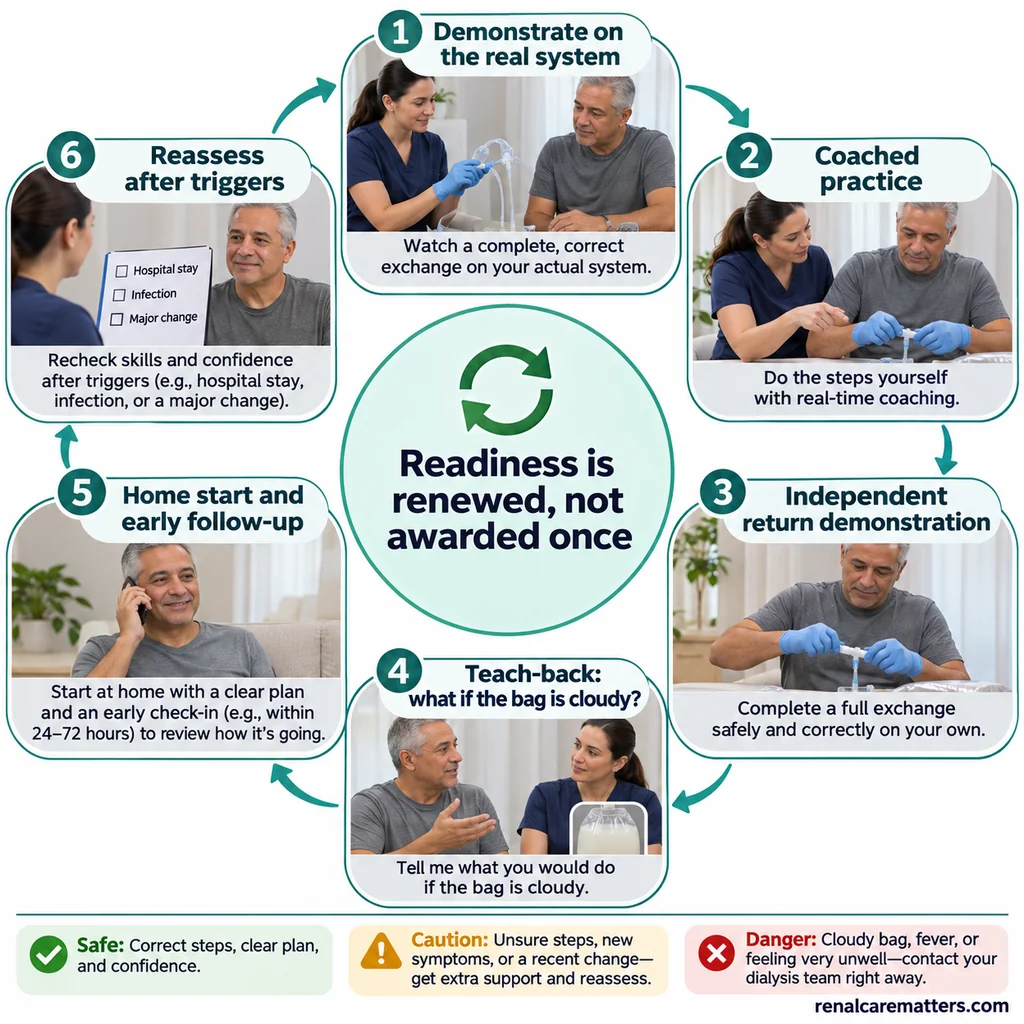
| Principle | In practice |
|---|---|
| Adults learn for a purpose | Link each skill to what the person wants: "This is how you keep the catheter that lets you keep working." |
| Small chunks | One goal per session; build the sequence over days |
| Demonstrate on the real system | Use the device they will use at home, or an equivalent training model |
| Practice with coaching, then without | Prompts fade as competence grows |
| Teach-back | "Tell me in your own words what you would do if the bag is cloudy." Not "Do you understand?" |
| Return demonstration | Full exchange or cycler setup with no prompts, observed |
| Health literacy | Plain words, pictures, numbers kept simple; Tagalog or local language; interpreters when needed |
| Accessibility | Large print, high contrast, audio, tactile cues for low vision; adapted grips for weak hands |
| Emotional safety | Mistakes in training are expected and welcome; hiding errors at home is the real danger |
Build the plan
- Who does each task? Patient, caregiver, both, or an assistant. Train the person who will actually do it.
- Assess the learner. Language, reading, vision, hearing, dexterity, memory, prior experience, confidence, schedule, stress.
- Set session goals. For example: Day 1, hand hygiene and the clean area; Day 2, supply check and connection; Day 3, full exchange with prompts.
- Teach the problems, not only the routine. Cloudy effluent, contamination, poor drain, leak, fever, missed therapy, power failure, supply delay.
- Plan the home start. First home exchange observed or followed by an early call; home visit when feasible.
Judge readiness
Check that the learner can, without prompting:
- Verify the order and supplies, and reject a defective bag.
- Perform hand hygiene and prepare the area.
- Protect critical connections throughout.
- Complete the exchange or cycler setup and disconnection.
- Inspect effluent and record volumes and observations.
- State the action for cloudy fluid, contamination, poor drain and missed therapy, including whom to call.
Require independently safe execution of every critical step before home readiness sign-off, under program policy. Record what was performed, cues needed, gaps, supports and the reassessment date.
Retraining triggers
Reassess technique and retrain when any of these occur:
- Peritonitis or exit-site infection
- Contamination event
- Observed technique drift at a visit
- Change of device or system
- Change of caregiver or assistant
- Hospitalization or major illness
- Major change in vision, cognition, dexterity or home situation
- Return after a long break from PD
- At the program’s scheduled interval even without problems
Back to the case: Two reminders
On the third session, Liza completes the setup correctly but only after Joy reminds her twice not to let the connector touch the table. Joy acknowledges the steps Liza did well, then demonstrates the critical step once more slowly, has Liza practice it alone three times, and schedules another unprompted full setup two evenings later. She does not sign Liza off as independent that night.
At the next session Liza completes the setup unprompted. Joy asks: "What would you do if the morning drain bag is cloudy?" Liza: "Keep the bag, call the PD unit right away, and bring Papa in." Joy documents independent performance, the teach-back, the adaptations (lamp, picture checklist), and a reassessment at the first home visit.
Skills checklist: Teaching a learner with limited vision (OSCE station 5)
Teach a simulated patient with limited reading fluency using demonstration and a picture checklist. Ask them to explain what they would do if effluent becomes cloudy. Faculty scores against objective structured clinical examination (OSCE) station 5. Your preceptor rates each step as satisfactory, needs practice, or not observed. Steps marked Critical must all be satisfactory before sign-off. This checklist supports supervised learning; your unit’s own procedure and competency form are the authority. A printable version of every checklist is on the trainer page.
- Assesses barriers and preferences.
- Demonstrates and adapts instruction.
- Observes an independent return demonstration.
- CriticalWithholds readiness sign-off after unsafe performance.
- Specifies coaching, support and a reassessment date.
Check your understanding
Each visit draws 5 questions at random from this module’s 15-question bank. Choose the single best answer for each, then select Check answers; an explanation appears under the best answer. Select New set of questions for a different mix. A good target is 4 of 5 on two different sets. Nothing you select is sent anywhere; scoring happens in your browser.
Read next on this site
- Peritoneal DialysisThe patient guide to peritoneal dialysis your learners will reinforce.


