After this module you should be able to
- Explain what "goal-directed PD" means and why the 2020 International Society for Peritoneal Dialysis (ISPD) recommendations moved away from a single clearance target.
- Describe what the ADEMEX and Hong Kong randomized trials showed about increasing peritoneal small-solute clearance.
- Explain what a peritoneal equilibration test (PET) measures, when it is done, and how fast solute transfer and low ultrafiltration capacity change management.
- Collect timed effluent, urine and blood samples so that the results can be trusted.
- Prepare a structured nursing review that puts trends, delivered therapy and the person’s goals in one picture for the team.
The big picture, in plain words
For years, PD quality was judged by one number: weekly Kt/V urea. Randomized trials showed that pushing that number higher did not help people live longer. The field moved to a broader question: is this person feeling well, in fluid balance, eating, functioning and living the life they want, with the safest prescription that achieves it? Your work is to bring the evidence for that question to every review: trends, delivered therapy, symptoms, nutrition, residual urine, and test results that were collected properly.
The picture has a limit. A dashboard reports a machine. A person on PD has a membrane that changes with time and infection, kidneys that lose function, appetite that waxes and wanes, and goals that shift. The readings must be interpreted against that person, not against a fixed specification.
Case: The first PET
Mr. Benjamin Cruz, 52, has been on continuous ambulatory peritoneal dialysis (CAPD) for 10 weeks. Nurse Hazel is preparing his first PET and a nursing review.
PET day. Hazel confirms the protocol and solution strength with the order. The night dwell was done as instructed. The pre-test drain is complete. Samples are drawn at the ordered times. The final 4-hour drain measures 2,350 mL from 2,000 mL of 2.27% glucose solution: net ultrafiltration (UF) +350 mL. D/P creatinine at 4 hours is reported as high relative to the unit’s reference ranges.
Trend data. Over five days, his weight rises from 68.0 to 70.0 kg, daily UF falls from about 750 to 450 mL, and urine falls from about 600 to 350 mL. He reports mild exertional breathlessness. All exchanges were done. His night dwell drains less than it was filled most days.
Before reading on, decide:
- Is the PET result valid? What could have spoiled it?
- What does the five-day trend show?
- What do you bring to the nephrologist, and what do you leave to them?
Keep your answers in mind. The lesson gives you what you need, and the case review near the end shows one sound response.
What the evidence showed about clearance
ADEMEX (Mexico, 2002) randomized 965 CAPD patients either to continue four 2-liter exchanges daily or to a modified prescription aimed at a higher peritoneal creatinine clearance. Peritoneal clearance rose and stayed higher in the intervention group, but survival was the same (relative risk of death 1.00, 95% CI 0.80–1.24). Two-year survival was about 68% in the control group and 69% in the intervention group.1
The Hong Kong trial (2003) randomized 320 new CAPD patients with little residual function to total weekly Kt/V targets of 1.5–1.7, 1.7–2.0 or above 2.0. Two-year survival did not differ significantly (87%, 86% and 82%). More patients in the lowest-target group were withdrawn by their physicians for clinical problems, and more needed erythropoietin. The authors recommended a minimum total Kt/V above 1.7.2
What this means. Above a modest floor, more small-solute clearance does not buy survival. Kt/V is a surrogate: a laboratory measure of dose, not an outcome patients feel. The 2020 ISPD practice recommendations on prescribing high-quality goal-directed PD therefore treat Kt/V and creatinine clearance as one input among several, not as the definition of adequate dialysis. These recommendations are practice points, not graded recommendations, because the evidence base is limited.3
Goal-directed PD
The 2020 ISPD recommendations describe care goals agreed through shared decision-making between the person and the team, aiming both to let the person achieve their own life goals and to deliver high-quality care. In practice, the review covers:3
| Domain | What you bring to the review |
|---|---|
| Person’s goals and symptoms | Energy, sleep, appetite, nausea, itch, restless legs, mood, ability to work or care for family |
| Fluid status | Weight trend, blood pressure, edema, breathlessness, daily UF, urine volume |
| Residual kidney function | Urine volume trend; timed urine collection when ordered |
| Delivered therapy | Exchanges done versus ordered, cycler completion, missed treatments |
| Nutrition | Appetite, weight change, diet history; the 2026 joint International Society of Renal Nutrition and Metabolism (ISRNM)–ISPD nutrition recommendations emphasize screening and monitoring nutrition status, managing protein-energy wasting, and education to build food literacy |
| Metabolic | Potassium (hypokalemia is common in PD and is a modifiable peritonitis risk factor in the 2022 ISPD recommendations), glucose in people with diabetes |
| Solute clearance | Kt/V and creatinine clearance results, interpreted with the rest |
| Membrane function | PET results and UF capacity |
The peritoneal equilibration test
What it measures. The PET characterizes how quickly small solutes cross the membrane (peritoneal solute transfer rate, peritoneal solute transfer rate (PSTR)) and how much water a standard dwell removes.
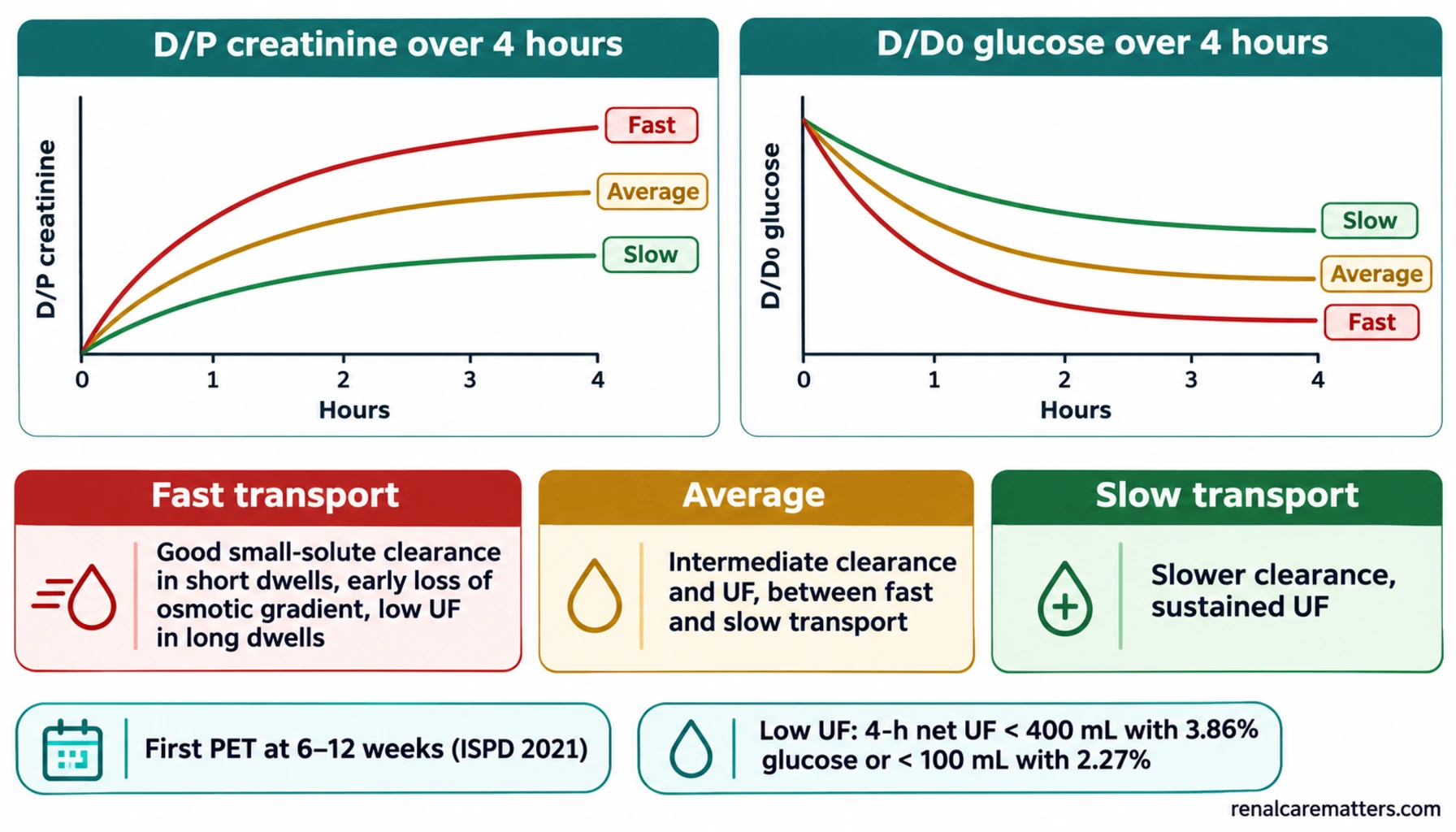
How it is done (ISPD 2021). A 4-hour dwell with either 2.27% glucose (2.5% dextrose) or 3.86% glucose (4.25% dextrose), using creatinine as the index solute. The key result is the dialysate-to-plasma creatinine ratio at 4 hours (D/P creatinine). Higher values mean faster transfer.4
When. Early, between 6 and 12 weeks after starting PD (GRADE 1A for timing), and later when clinically indicated, for example after a fall in UF or after severe peritonitis.4
- A faster PSTR is associated with lower survival on PD (GRADE 1A in the 2021 recommendations). Part of the reason is lower UF and more fluid reabsorption in long dwells.
- That fluid problem can be mitigated by shortening glucose dwells, using icodextrin, or using higher glucose concentrations (GRADE 1A). Icodextrin, compared with glucose, can improve fluid status and reduce episodes of fluid overload (GRADE 1A).
- Low UF capacity should be suspected when net UF from a 4-hour PET is less than 400 mL with 3.86% glucose (4.25% dextrose) or less than 100 mL with 2.27% glucose (2.5% dextrose) (GRADE 1B), or when daily UF is not enough to keep the person euvolemic (practice point). Low UF can also come from mechanical problems or leaks.
- When low UF is suspected, a 3.86% PET with measurement of the sodium dip at 1 hour helps identify intrinsic membrane dysfunction (reduced aquaporin-mediated water transport).
The nurse’s part is accuracy. The result is only as good as the timing of the samples, the completeness of the drain, the dwell length and the solution strength actually used.
| Step | What can spoil it |
|---|---|
| Overnight dwell before the test | Wrong solution or length per protocol |
| Drain before the test dwell | Incomplete drain leaves residual fluid that dilutes results |
| Infusion | Wrong strength; slow infusion shifts timing |
| Samples at specified times | Missed or late samples |
| Blood sample | Not drawn at the specified time |
| Final drain | Incomplete; drain volume not measured accurately |
| Glucose correction for creatinine assay | Some laboratory methods need correction for high dialysate glucose; confirm with the laboratory |
Adequacy collections
Weekly Kt/V and creatinine clearance in PD combine a 24-hour effluent collection, a 24-hour urine collection and a blood sample. Teach the patient exactly how to collect: start and end times, all bags or a measured aliquot per protocol, urine container, storage and transport. Document missed samples. Ask the team whether an incomplete collection should be repeated. An invalid collection is worse than none, because it looks like evidence.
Reading trends
State the baseline, the interval and the current value. Then give context: missed exchanges, changes in intake, falling urine, measurement changes, intercurrent illness, symptoms. A trend over a week is more informative than a single day.
Back to the case: The first PET
Hazel’s review. She screens for emergency signs (none at rest), records the trends with dates, notes that the long night glucose dwell is net-negative most days, and presents the PET result with the observation that the pattern fits faster solute transfer with fluid reabsorption in the long dwell. She does not suggest a specific prescription. The nephrologist reviews and considers changes to the long dwell. Hazel teaches salt restriction and arranges a weight and symptom check in three days.
Skills checklist: Practice drill
Using the trend table in WORKSHEETS.md, plot seven days of weight, UF and urine. Mark the missed dwell. Write a five-line handoff that states what can be inferred, what needs verification and what needs escalation. Your preceptor rates each step as satisfactory, needs practice, or not observed. Steps marked Critical must all be satisfactory before sign-off. This checklist supports supervised learning; your unit’s own procedure and competency form are the authority. A printable version of every checklist is on the trainer page.
- Using the trend table in WORKSHEETS.md, plot seven days of weight, UF and urine.
- Mark the missed dwell.
- Write a five-line handoff that states what can be inferred, what needs verification and what needs escalation.
Check your understanding
Each visit draws 5 questions at random from this module’s 15-question bank. Choose the single best answer for each, then select Check answers; an explanation appears under the best answer. Select New set of questions for a different mix. A good target is 4 of 5 on two different sets. Nothing you select is sent anywhere; scoring happens in your browser.
Read next on this site
- Dialysis AdequacyDialysis adequacy measures and their limits.
- Eating on Dialysis: What the Evidence Actually SaysNutrition on dialysis.