After this module you should be able to
- Explain how an automated peritoneal dialysis (APD) prescription (total volume, fill volume, number of cycles, tidal mode, last fill, day dwell) shapes clearance and fluid removal.
- Cross-check a programmed cycler against the written order and stop on any mismatch.
- Read a cycler treatment record (or remote-monitoring summary) for completion, drain patterns, ultrafiltration and alarms.
- Respond safely to drain alarms, interruptions and power failure, using only device-permitted checks.
- Recognize when an alarm is a symptom of a clinical problem that needs urgent assessment.
The big picture, in plain words
APD moves dialysis into the night. That brings freedom in the day and a new set of risks at 2 AM: a machine programmed differently from the order, a drain alarm that wakes the patient five times, a brownout in the middle of a cycle, a long day dwell that quietly absorbs fluid back. Your work is to make sure that what the cycler does is exactly what the nephrologist ordered, to read its record like a nursing note, and to treat repeated alarms as clinical information.
The picture has a limit. A recipe does not change the cook. The cycler’s record, though, tells you about the patient: how well the catheter drains, whether the abdomen tolerates the fill volume, whether the person stayed connected. The machine is both a delivery device and a monitoring device.
Case: Six alarms by morning
Kristine, 29, public-school teacher in Pampanga, has been on APD for three months with a night program and an icodextrin day dwell. Nurse Arnel reviews her cycler summary.
Night 1–5. Therapy completes. Initial drain of the day dwell is about 2,100 mL from a 2,000 mL last fill. Total ultrafiltration (UF) is about 800 mL a night.
Night 6. Four low-drain alarms between 1 and 4 AM; therapy runs 70 minutes longer. Initial drain is 1,600 mL.
Night 7. Six alarms; total UF about 300 mL.
Before reading on, decide:
- What does the pattern in the cycler record tell you?
- What is the most likely cause, and what makes peritonitis less likely?
- What do you report, and to whom?
Keep your answers in mind. The lesson gives you what you need, and the case review near the end shows one sound response.
The physiology of an APD prescription
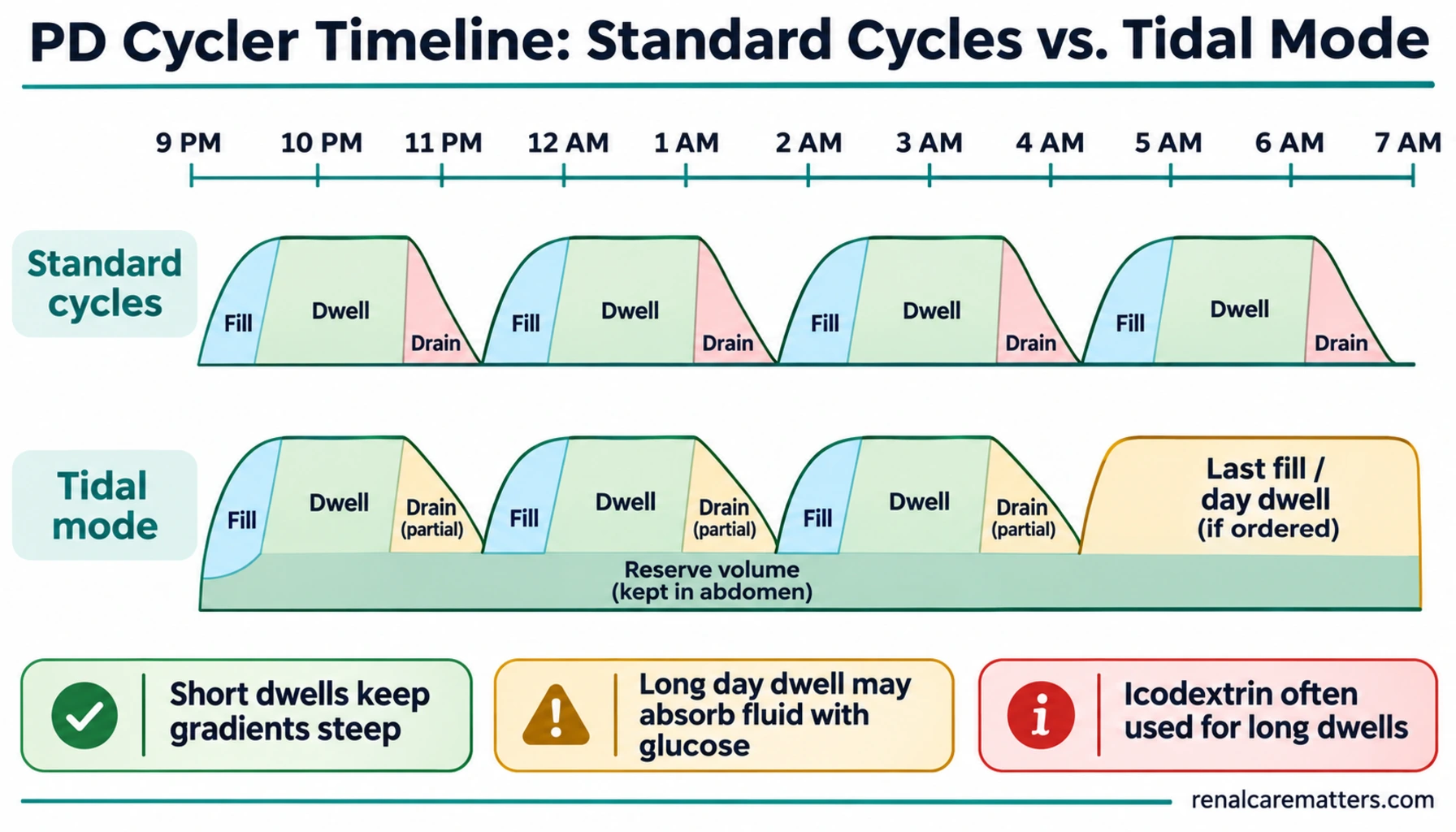
APD usually delivers several short exchanges overnight. Short dwells keep the diffusion gradient steep (PD01), which helps small-solute clearance, and keep the glucose gradient strong, which helps fluid removal during the night. The trade-offs come in the day:
| Prescription element | What it does | What can go wrong |
|---|---|---|
| Total night volume and cycle count | Sets night clearance | Too many short cycles waste time draining and filling |
| Fill volume | Larger fills increase membrane contact | Discomfort, breathlessness, leak, hernia |
| Tidal mode (partial drain each cycle) | Keeps some fluid in; reduces drain pain and alarms | Fluid accumulation if UF is not accounted for |
| Last fill / day dwell | Adds clearance and middle-molecule removal over the day | A long glucose day dwell may become net-positive; icodextrin is often used |
| Midday exchange | Splits a long day dwell | Adds a manual connection |
| No day dwell ("dry day") | Comfort, less glucose | Less clearance; may be insufficient once urine falls |
The prescription is the nephrologist’s. Your role is to know what each element does so you can spot when the record and the patient do not match.
What the evidence shows
In Peritoneal Dialysis Outcomes and Practice Patterns Study (PDOPPS), an observational cohort of 7,051 adults across seven countries, facilities with higher APD use had lower peritonitis risk (rate ratio 0.95 per 10-percentage-point higher APD use, 95% CI 0.91–1.00). This is an association at the facility level, at the margin of statistical significance, and does not show that switching any individual to APD prevents peritonitis.1
The 2021 International Society for Peritoneal Dialysis (ISPD) membrane recommendations note that APD and icodextrin may mitigate the mortality risk associated with fast peritoneal solute transfer; that statement is a practice point, not a graded recommendation.2
Prepare and verify
Before the first setup and after any order change:
- Confirm the patient and the current written order.
- Cross-check on the cycler: therapy type, total volume, fill volume, number of cycles, therapy time, tidal settings if used, last fill volume and solution, patient weight if entered, and any UF limits set by the team.
- Check solutions: type, strength, volume, expiry, integrity, and that the bags placed on the cycler match the program.
- Escalate any mismatch before initiation. Do not "correct" a program to match your guess of what was meant.
- Prepare the space: clean, stable surface, cycler at the height the manufacturer specifies relative to the patient, drain line positioned to a toilet, drain or collection container as the unit approves.
- Set up, prime and connect using the model-specific instructions, protecting sterile connections.
Read the treatment record
A cycler record or remote-monitoring summary is a nursing assessment tool. Review:
| Item | What to look for |
|---|---|
| Completion | Full therapy delivered? Early stops? Bypassed drains? |
| Therapy time | Much longer than prescribed suggests slow drains |
| Initial drain | Volume of the day dwell drained at night start; low values suggest day-dwell absorption or catheter problems |
| Cycle-by-cycle drain | Progressive fall suggests catheter malposition, constipation, fibrin |
| Total UF | Trend over days against weight and urine |
| Alarms | Type, phase, frequency, time of night |
| Manual interventions | Bypasses, skipped cycles |
Compare changes with symptoms, morning weights, blood pressure and urine trend. Obtain device logs only with consent and through the approved data system.
Respond to alarms and interruptions
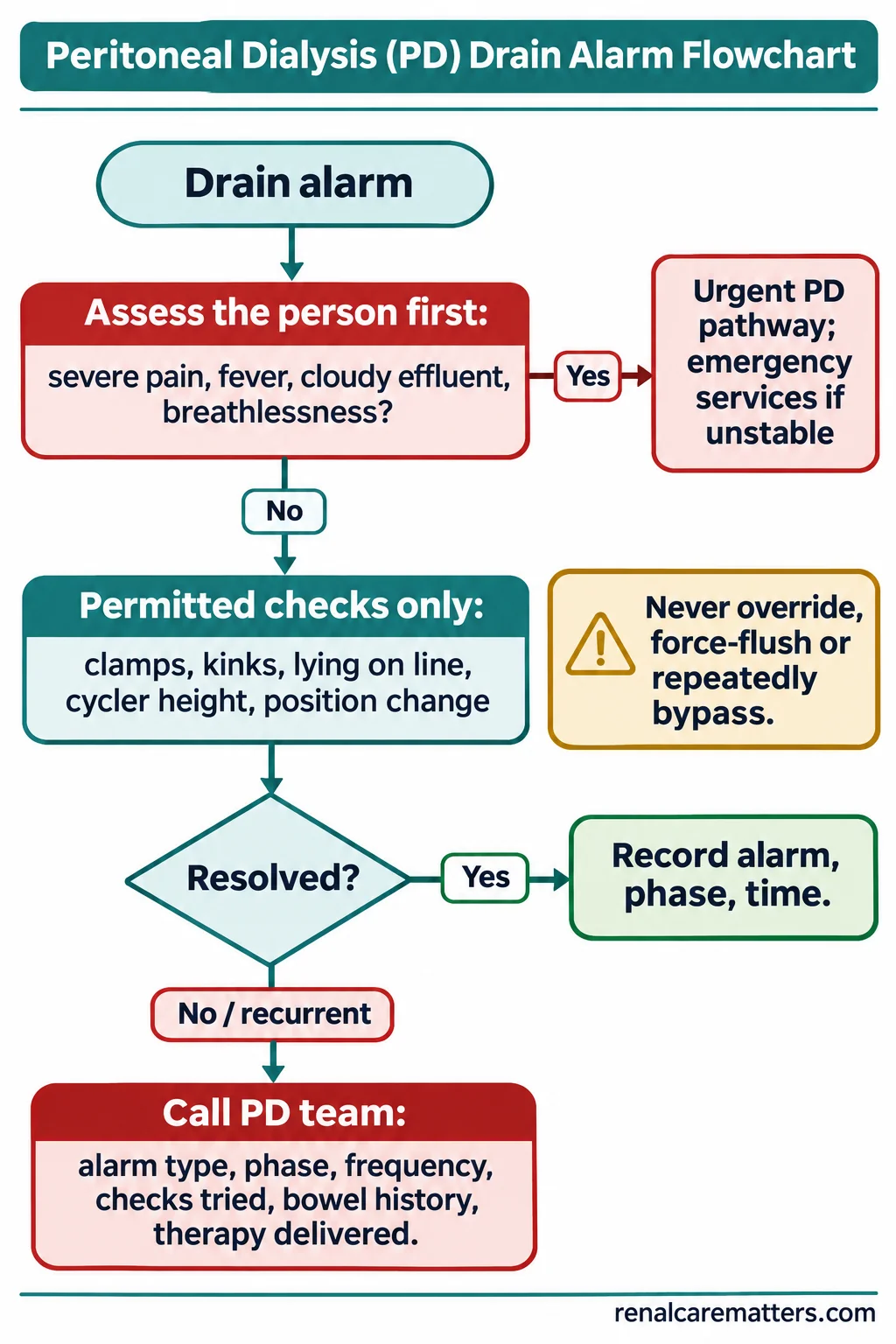
Assess the person first. A drain alarm in a patient with severe abdominal pain is not a machine problem.
Then:
- Record the alarm, the phase, recurrence, time and symptoms.
- Use only checks permitted by the device and the local plan: closed clamps, kinked lines, the patient lying on the line, cycler height, position change if the patient’s condition allows.
- Never override, bypass repeatedly or silence alarms outside the trained plan.
- Follow the trained safe-disconnection and power-failure plan.
- Backup continuous ambulatory peritoneal dialysis (CAPD) is used only when there is a prescribed backup regimen, suitable supplies at home, and validated competence.
- Repeated unresolved alarms or lost therapy require a call to the peritoneal dialysis (PD) team.
| Alarm pattern | Likely mechanisms | Red flags that change urgency |
|---|---|---|
| Low drain, every cycle, from the start | Catheter malposition, kink, constipation, fibrin, omental wrap | Severe pain, fever, cloudy effluent |
| Low drain, worsening over nights | Constipation, migration, rising fluid absorption | Breathlessness, weight gain |
| Drain pain at end of drain | Catheter tip against bowel or bladder | Persistent pain, cloudy effluent |
| Fill alarm | Clamp closed, kink, solution bag issue | Leak at exit site or swelling of genitals or abdominal wall |
| Repeated power interruptions | Unstable supply | Lost therapy plus rising weight |
Red flags in this module
- Severe abdominal pain with any alarm: urgent assessment through the PD pathway; emergency services if unstable.
- Cloudy effluent in the drain bag or line in the morning.
- Swelling of the abdominal wall, groin or genitals during therapy (possible leak).
- Breathlessness after the last fill (possible hydrothorax or overfill; urgent).
Back to the case: Six alarms by morning
Arnel calls Kristine. She has had no bowel movement for four days since starting iron tablets. No fever, no abdominal pain, effluent clear, weight up 0.8 kg.
Arnel’s reasoning. The alarm pattern is progressive and started with constipation, a common cause of catheter malfunction because a loaded bowel displaces the catheter tip. Clear effluent and no pain make peritonitis unlikely now. He reports the full pattern (alarm count, phase, timing, therapy delivered, initial drain trend, UF trend, bowel history, weight) to the nephrologist the same day. Bowel management is ordered. He arranges a review and an abdominal X-ray if drain does not recover, as the team decides. He teaches Kristine to report constipation early.
Take-home. Repeated drain alarms are symptoms. Read them with the bowel, the weight and the effluent.
Skills checklist: APD setup with a scripted alarm (OSCE station 2)
Compare a mock written order against a programmed training cycler. Identify a deliberately mismatched last-fill volume and solution. Simulate an unresolved drain alarm and deliver an escalation call with exact alarm, phase, frequency, checks tried, symptoms, effluent and therapy delivered. Your preceptor rates each step as satisfactory, needs practice, or not observed. Steps marked Critical must all be satisfactory before sign-off. This checklist supports supervised learning; your unit’s own procedure and competency form are the authority. A printable version of every checklist is on the trainer page.
- CriticalVerifies the cycler program against the written order.
- CriticalPrevents a contaminated connection.
- Identifies the external checks the device allows.
- CriticalEscalates an unresolved alarm without overriding it.
- Records completed and missed treatment.
Check your understanding
Each visit draws 5 questions at random from this module’s 15-question bank. Choose the single best answer for each, then select Check answers; an explanation appears under the best answer. Select New set of questions for a different mix. A good target is 4 of 5 on two different sets. Nothing you select is sent anywhere; scoring happens in your browser.
Read next on this site
- Fluid Management Between Dialysis SessionsFluid balance on dialysis.
- Typhoon and Disaster Preparedness in DialysisPreparing dialysis patients for typhoons and outages.