
After this module you should be able to
- Explain why the "flush before fill" step in a twin-bag (double-bag) system protects the peritoneum, and the trial evidence behind it.
- Verify an exchange against the written order and reject a compromised supply.
- Demonstrate a continuous ambulatory peritoneal dialysis (CAPD) exchange in simulation using the unit’s approved checklist for the actual device.
- Calculate and interpret net ultrafiltration for an exchange and for a day, including the measurement errors that distort it.
- Classify a contamination event as dry or wet, and run the contamination call with the details the team needs.
The big picture, in plain words
A CAPD patient performs more than a thousand exchanges a year. Each one is a moment when the sterile inside of the system is briefly opened to the room. Nearly all peritonitis from touch contamination starts with one lapse in one of those moments. Your work is to teach a technique that is the same every time, to make measurement honest, and to make sure that when a lapse happens, the patient stops and calls rather than hoping it will be fine.
The picture has a limit. peritoneal dialysis (PD) solution is not just water: it is a warm, glucose-rich fluid, an excellent culture medium. A few bacteria introduced at connection can multiply during a four-hour dwell inside the abdomen. That is why a single touch matters and why the response is time-sensitive.
Case: A sleeve and a connector
Tita Carmen, 63, is in her second week of CAPD training. Nurse Bea observes.
Carmen checks her bag, washes her hands and connects. During the drain phase she reaches to scratch her nose and her sleeve brushes the open connector of the new bag line before she connects it. She pauses, then reaches for an alcohol swab.
Before reading on, decide:
- What kind of contamination is this, dry or wet?
- What do you do with the bag and the exchange?
- What do you say to Carmen so she keeps reporting?
Keep your answers in mind. The lesson gives you what you need, and the case review near the end shows one sound response.
The physiology and the engineering
Why "flush before fill" works. Modern CAPD uses a Y-shaped twin-bag system: one tube to a fresh bag, one to a drainage bag, joined to the patient’s transfer set. After connecting, the patient first drains the abdomen, then flushes a small amount of fresh solution directly into the drainage bag. Any bacteria introduced at the moment of connection are washed out to the drain bag instead of being pushed into the peritoneum. Only then does fresh solution fill the abdomen.
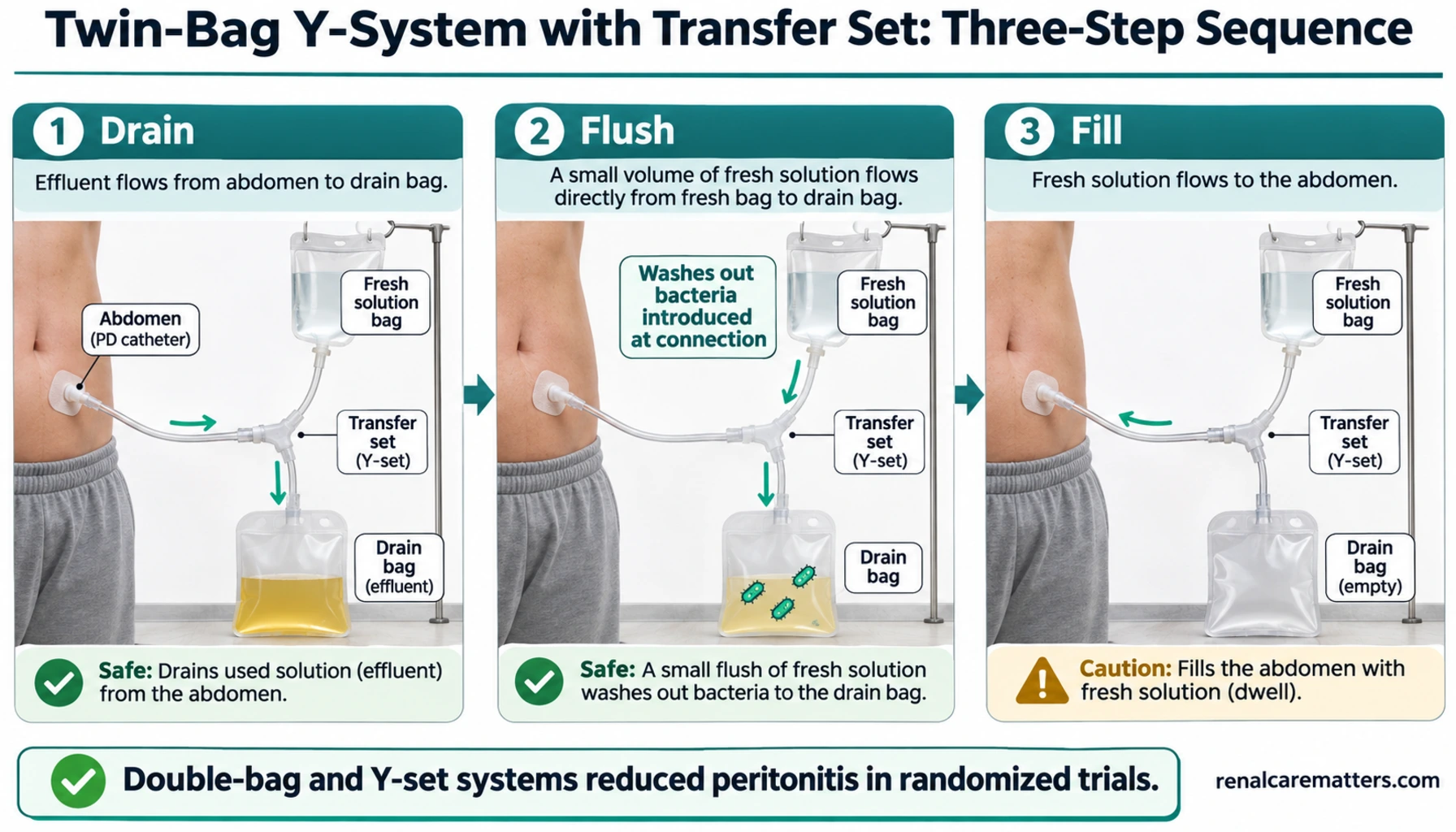
The evidence. A Cochrane systematic review of 12 randomized or quasi-randomized trials (991 patients) found that Y-set or double-bag systems reduced the proportion of patients who developed peritonitis compared with older standard spike systems (odds ratio 0.33, 95% CI 0.24–0.46). Double-bag systems also outperformed Y-sets (odds ratio 0.44, 95% CI 0.27–0.71). This is strong, replicated randomized evidence on a patient-important outcome, and it is why twin-bag systems are the standard. The trials are old and conducted mostly in high-income settings, but the mechanism is direct and the effect large.1
What the patient controls. Hand hygiene, a clean surface, no fan or open window blowing toward the connection, no pets in the room, a mask if the program requires one, never touching the connector tips, and checking every bag before using it.
Before the exchange
Use the approved checklist for the system the patient actually has. The steps below are principles, not a procedure.
| Check | Why |
|---|---|
| Patient identity and current written order | Orders change; an outdated card at home is a common error |
| Solution type and strength (for example 1.5%, 2.5% or 4.25% dextrose, or icodextrin) | Wrong strength changes fluid removal; wrong product can cause harm |
| Fill volume and dwell timing | Prescribed by the nephrologist |
| Expiry, clarity, seals, pull rings, package integrity | A leaking or cloudy bag may be contaminated |
| Warming method | Only approved dry warming methods; never a microwave or hot water bath unless the device instructions allow it |
| Environment and hand hygiene | Clean, closed room; hands washed and dried per program |
During and after
Follow the device instructions for connection, drain, flush, fill and disconnection. Protect critical parts from touch. Observe comfort and flow. Look at the drained effluent against a printed text or a white background: you should be able to read through it. Cloudy effluent is a same-day call (PD07).
Record actual fill and drain volumes, dwell timing, effluent appearance, symptoms, and any deviation.
Measuring ultrafiltration honestly
Net ultrafiltration (UF) for one exchange = drained volume − instilled volume. A positive number means fluid was removed; a negative number means fluid was absorbed.
Most errors come from measurement, not physiology:
| Source of error | Effect | Fix |
|---|---|---|
| Bag overfill (manufacturers may add volume beyond the labeled fill) | Overestimates or distorts UF depending on method | Use the unit’s standard method (weighing bags, or labeled volume) consistently |
| Flush volume going to drain bag | Inflates "drain" if not accounted for | Teach the unit’s convention |
| Incomplete drain | Underestimates UF; leaves fluid in abdomen | Check position, drain time; report persistent incomplete drain |
| Spills or leaks | Unknown loss | Record as a deviation |
| Different scales or methods day to day | False trends | Same scale, same method, same time |
Worked calculation. Fill 2,000 mL, drain 2,350 mL: net UF = +350 mL. Fill 2,000 mL, drain 1,850 mL: net UF = −150 mL (fluid absorbed). A negative long dwell may be expected physiology with glucose (PD01) or may signal a problem; trend it and report it.
Contamination: dry or wet
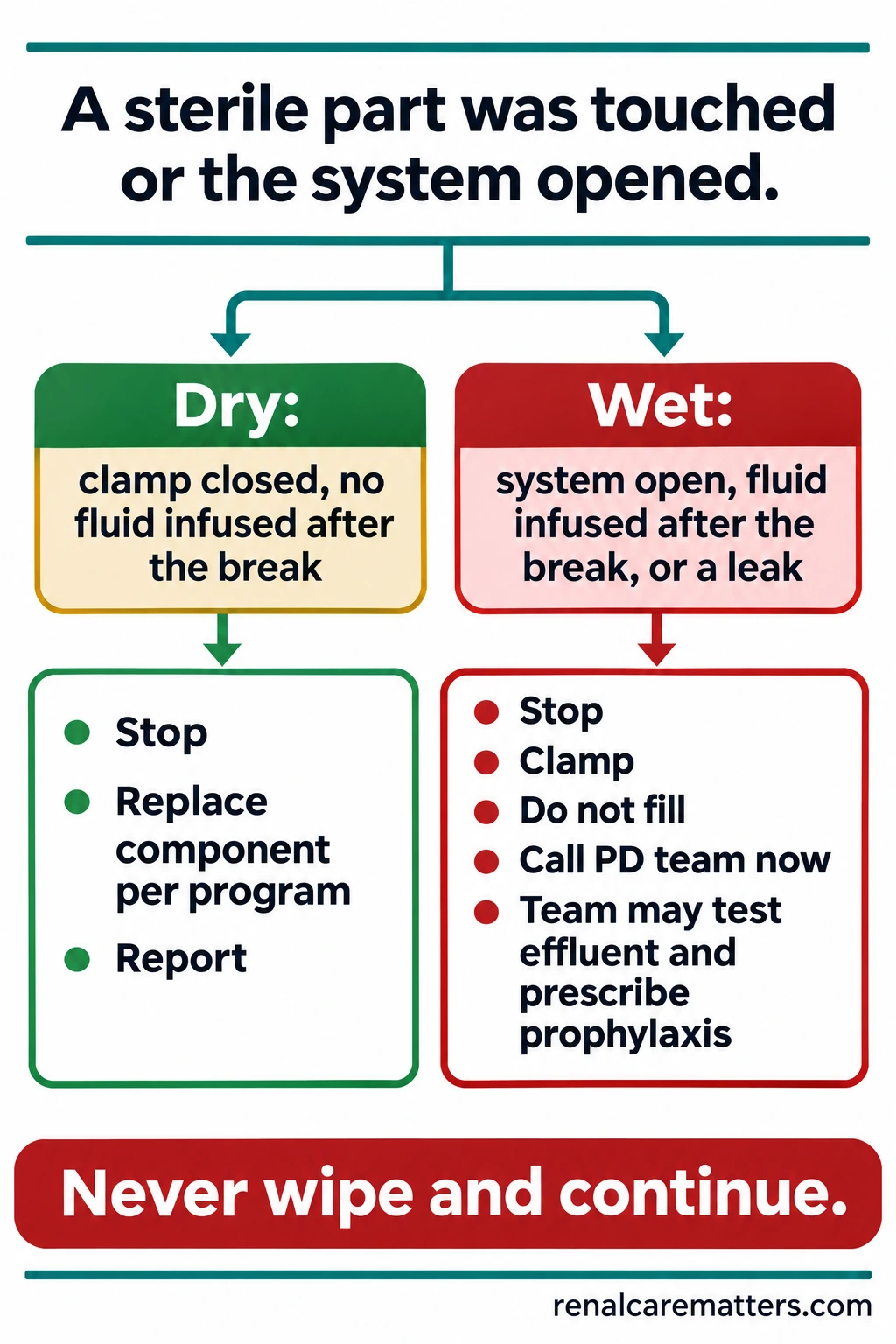
The 2022 International Society for Peritoneal Dialysis (ISPD) peritonitis recommendations revised the guidance on managing contamination of the PD system. Programs commonly classify events this way:2
| Type | What happened | Typical program response (per protocol and prescriber) |
|---|---|---|
| Dry contamination | A break in sterile technique occurred but the system was closed (clamp shut) and no fluid was infused after the break | Stop. Do not proceed with that connection. Replace the affected component (for example cap or transfer set) as the program directs. Report. |
| Wet contamination | The system was open, or fluid was infused after the break, or there is a leak in the system | Stop. Clamp. Do not fill (or stop filling). Call the PD team at once. The team may send effluent for testing and may prescribe prophylactic antibiotics. |
The contamination call. State exactly what touched what, when, whether the clamp was closed, whether any fluid entered after the touch, whether the transfer set or catheter is damaged, and whether there are any symptoms. Record the time of the call, who accepted it, and the instructions given, read back.
The teaching message. "If anything touches the tip, stop and call. Do not wipe it and continue." Patients who fear blame hide contamination. Make calling feel safe.
Red flags in this module
- Cloudy effluent at any exchange.
- Fluid leaking around the exit site during fill.
- Severe pain on inflow or outflow.
- A cracked transfer set or catheter.
Back to the case: A sleeve and a connector
Bea stops the exchange. The clamp on the new line is closed and no fresh fluid has been infused. This is dry contamination of the new bag’s connector. Bea discards that bag, has Carmen re-wash her hands, uses a fresh bag and completes the exchange. She records the event and tells the PD nurse coordinator. Then she uses the moment: "You did the right thing by stopping. Next time, call me before you swab anything."
Later in the week the drained volume of Carmen’s exchange reads 2,350 mL from a 2,000 mL fill: net UF +350 mL, clear effluent. Bea asks her to say aloud what she would do if the drained fluid were cloudy. Carmen: "Save the bag and call the PD unit today."
Skills checklist: CAPD exchange with a compromised bag (OSCE station 1)
Using a mock order and a training kit, identify a seeded packaging defect, perform the exchange with the approved checklist, and rehearse both a dry and a wet contamination call with your preceptor acting as the on-call nurse. Your preceptor rates each step as satisfactory, needs practice, or not observed. Steps marked Critical must all be satisfactory before sign-off. This checklist supports supervised learning; your unit’s own procedure and competency form are the authority. A printable version of every checklist is on the trainer page.
- CriticalVerifies patient identity and the written prescription.
- CriticalRejects a compromised supply.
- CriticalProtects critical parts and stops at a breach.
- Demonstrates the device-specific flow using the approved checklist.
- Records volumes and effluent appearance.
Check your understanding
Each visit draws 5 questions at random from this module’s 15-question bank. Choose the single best answer for each, then select Check answers; an explanation appears under the best answer. Select New set of questions for a different mix. A good target is 4 of 5 on two different sets. Nothing you select is sent anywhere; scoring happens in your browser.
Read next on this site
- Peritoneal DialysisWhat patients learn about exchanges at home.


