After this module you should be able to
- Explain diffusion, osmotic ultrafiltration and fluid reabsorption across the peritoneal membrane, and why each changes during a dwell.
- Explain why water removal and small-solute clearance can move in different directions in the same patient.
- Explain the role of residual kidney function in volume and solute control, and why its loss changes how you read a PD record.
- Distinguish continuous ambulatory PD (CAPD) and automated PD (APD) by workflow, dwell pattern, equipment and failure modes.
- Separate what you observe, record and teach from what requires a prescriber’s order, and state when to escalate.
The big picture, in plain words
Most of what goes wrong in peritoneal dialysis (PD) is slow and quiet. A drain volume falls by a few hundred milliliters a day. Urine output halves over two months. Ankles swell a little more each week. Very little of it announces itself as an emergency. Your work is to understand the physiology well enough that small numbers mean something to you, to put the pieces together before the patient becomes unwell, and to bring the whole pattern to the nephrologist early.
The picture has a limit. A tea bag does not pull water. PD solution does: its glucose (or icodextrin) draws water out of the blood by osmosis. And unlike a tea bag, the abdomen keeps absorbing fluid back into the body through lymphatics and tissue the whole time the solution sits there. So a PD dwell has three processes running at once: solute diffusion, osmotic water removal, and constant fluid reabsorption.
Case: Positive numbers, rising weight
Aling Rosario, 58, has been on CAPD for seven months with four 2-liter exchanges a day. Nurse Paolo reviews her diary at a routine visit. Each exchange shows positive net ultrafiltration (drain greater than fill), totaling about 600 mL a day, much as it did three months ago. But her morning weight has climbed 2.4 kg over five weeks, her ankles pit to mid-shin, and her urine diary has gone from about 700 mL to about 250 mL a day.
Before reading on, decide:
- Is a positive ultrafiltration total enough to call her volume status stable?
- What four questions would you ask before you call?
- What belongs to you, and what belongs to the nephrologist?
Keep your answers in mind. The lesson gives you what you need, and the case review near the end shows one sound response.
The physiology
The membrane is not a single sheet. The peritoneum is a large, folded serous membrane lining the abdominal wall and the bowel. What actually limits transport is the wall of the peritoneal capillaries, which behaves as if it has pores of three sizes. Large numbers of small pores let water and small solutes pass. A few large pores let proteins leak out, which is why PD patients lose albumin into the effluent every day. Water-only channels (aquaporin-1) in the capillary endothelium let water cross without sodium. This is established physiology.1
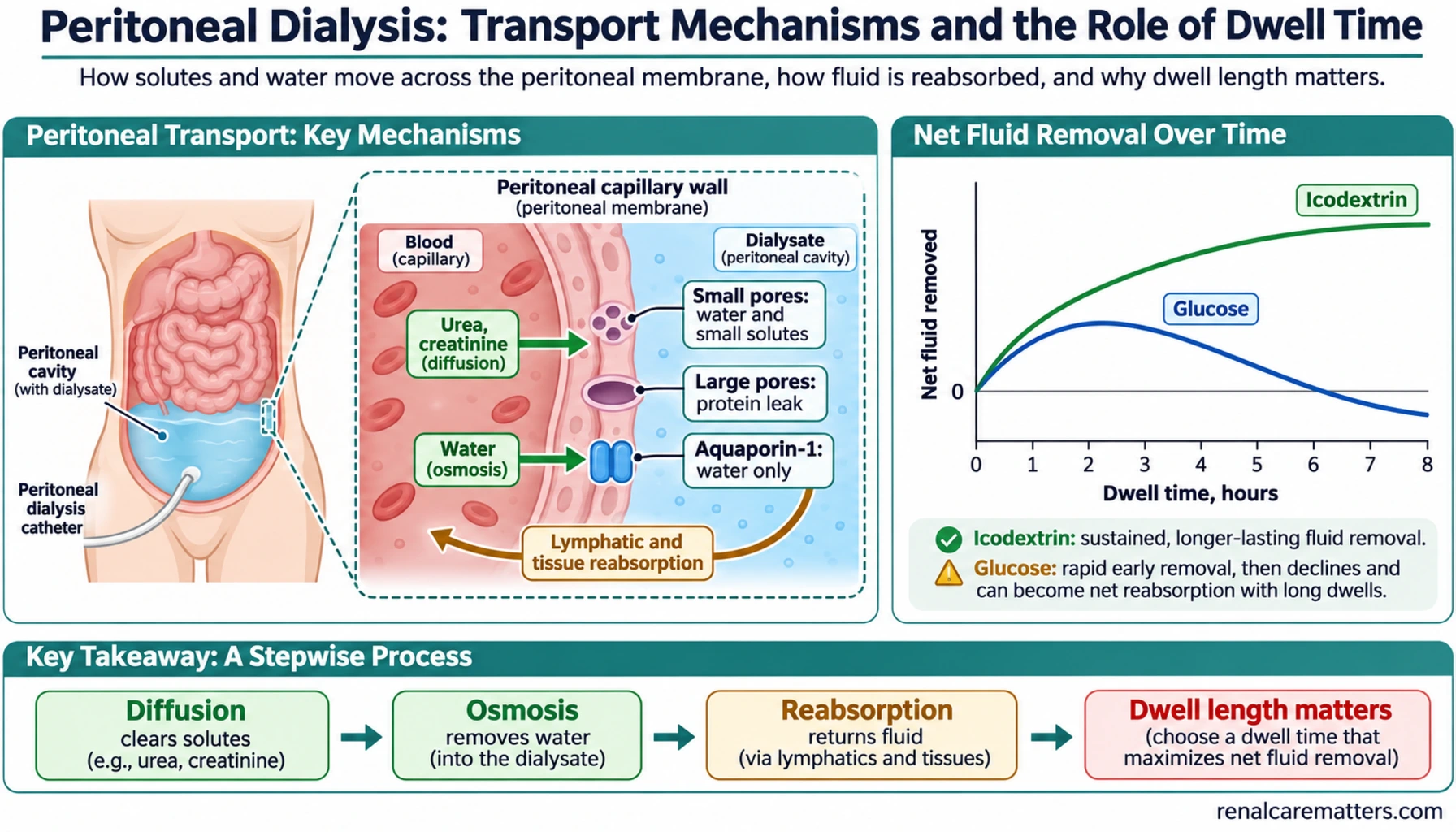
Diffusion runs down a gradient that dissipates. At the start of a dwell the urea concentration in dialysate is near zero, so the gradient is steep. Within a few hours the dialysate approaches the plasma value and transport slows. Larger molecules diffuse more slowly and keep gaining for longer. This is why the prescriber chooses dwell length and number of exchanges deliberately.
Osmotic ultrafiltration also fades. Glucose draws water, but glucose itself is absorbed across the membrane into the blood. The osmotic gradient therefore falls during the dwell. Early in a glucose dwell, about half the water moves through the aquaporins, leaving sodium behind. This produces the "sodium sieving" seen at one hour of a hypertonic dwell. As the gradient fades, net water removal slows and eventually reverses: fluid reabsorption continues while osmotic pull has disappeared. A long glucose dwell can end with less fluid out than went in. Icodextrin is a large glucose polymer that is absorbed slowly, so it keeps pulling water through the small pores over a long dwell. That is why it is often prescribed for the long night dwell in CAPD or the long day dwell in APD.1
Water removal and clearance can diverge. A patient can have good urea removal and poor fluid removal, or the reverse. Fast transporters equilibrate small solutes quickly (good clearance in short dwells) but also absorb glucose quickly and lose their osmotic gradient early (poor ultrafiltration in long dwells). Slow transporters keep their glucose gradient longer but clear small solutes more slowly. You will meet the formal measurement of this, the peritoneal equilibration test, in PD06.
Residual kidney function carries more weight in PD than most nurses expect. Many people start PD still passing several hundred milliliters of urine a day. That urine removes sodium, water and middle molecules continuously, and in observational studies its preservation is associated with better survival in PD. When urine output falls, the patient loses a fluid-removal route that the PD prescription was never designed to replace. The same drain volumes that kept them euvolemic last quarter may no longer be enough. Whenever you read a PD record, ask what the kidneys are still contributing.2
What this means at the bedside
| Process | What normally happens | What weakens it | What you may notice |
|---|---|---|---|
| Diffusion of small solutes | Gradient steep early, flattens over hours | Missed exchanges, short total therapy time, membrane change, low drain volume | Fatigue, poor appetite, nausea, itch; laboratory trends the team reviews |
| Osmotic ultrafiltration | Strong early, fades as glucose is absorbed | Long glucose dwell, fast transport, peritonitis, wrong solution strength | Falling drain volumes, rising weight, edema, dyspnea |
| Fluid reabsorption | Continuous through lymphatics and tissue | Increases in some patients; makes long dwells net-positive | Drain less than fill after a long dwell |
| Residual urine | Removes sodium and water daily | Nephrotoxins, hypotension, infection, time | Falling urine volume in the diary, new edema despite unchanged PD |
CAPD and APD
Continuous ambulatory PD (CAPD) uses manual exchanges, usually three to five times a day, with dialysate in the abdomen almost continuously. Each exchange is drain, then fill, then dwell. The patient is free between exchanges but must stop for each one. Failure modes are human: rushed technique, missed exchanges, touch contamination, mislabeled solution strength.
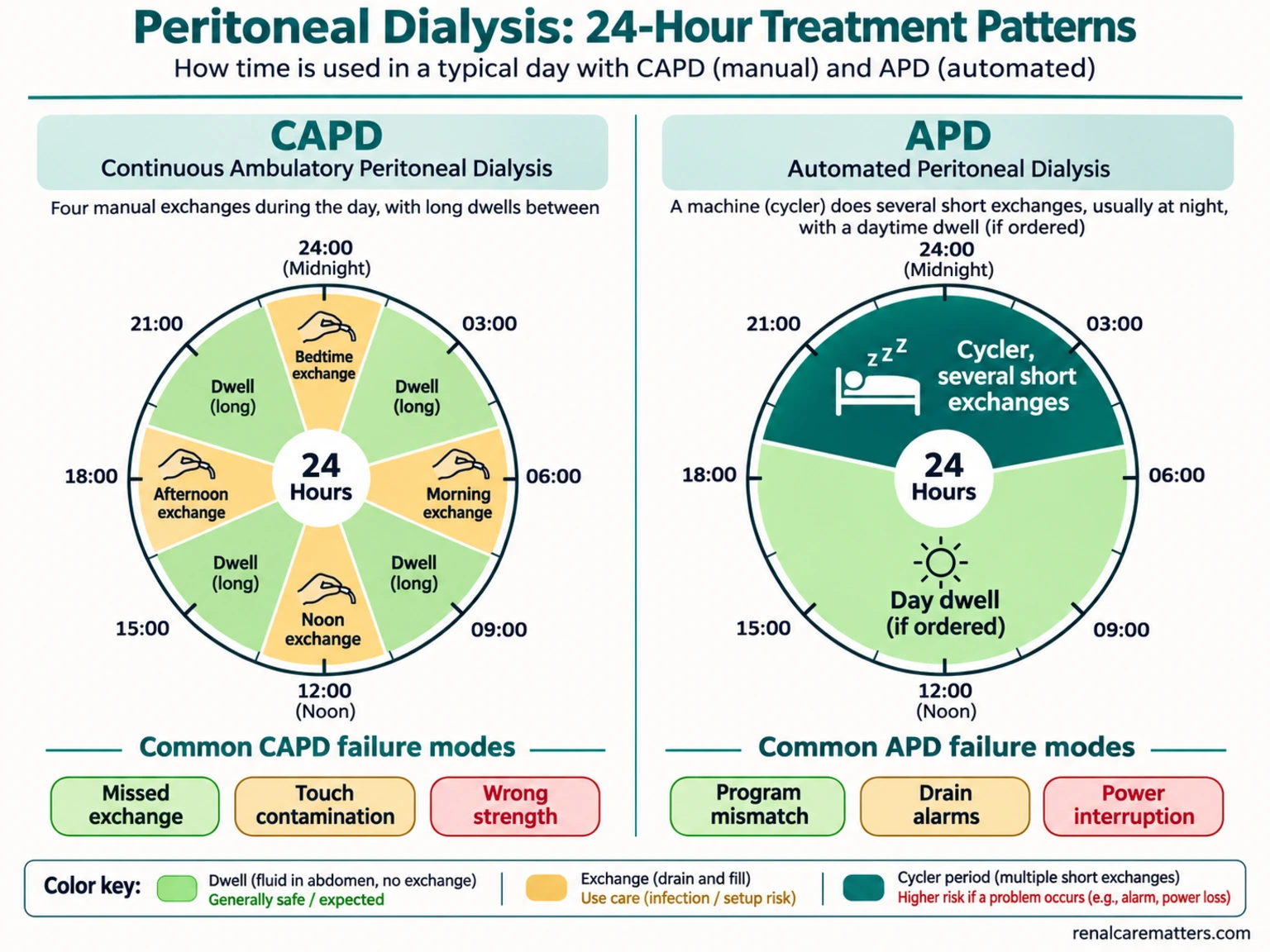
Automated PD (APD) uses a cycler, usually overnight, to perform several short exchanges while the patient sleeps. Many prescriptions add a long day dwell ("last fill") or a midday exchange. Daytime is free, which suits work and school. Failure modes add the machine: programming mismatches with the order, drain alarms that interrupt sleep, power interruption, and a long day dwell that may absorb fluid back if the wrong solution is used.
Neither modality is "better" for every person. Choice depends on the person’s life, home, transport, electricity, storage and their membrane characteristics. The prescriber selects the regimen; you make sure the person can carry it out safely and that what is delivered matches what is ordered.
What the PD nurse does, and where the line sits
Under the Philippine Nursing Act (Republic Act 9173), nursing practice includes assessment, health teaching, collaboration with the team, and carrying out written orders. In PD that becomes a clear division:3
| You do | You route to the prescriber |
|---|---|
| Verify patient, modality, solution, strength and volumes against the written order | Any change in solution strength, dwell, cycler program, icodextrin use |
| Compare what was actually delivered with what was ordered | Any medication start, stop or dose change, including antibiotics |
| Assess volume status, symptoms, exit site and effluent | Interpretation of peritoneal equilibration test (PET) and adequacy results for prescription change |
| Teach, observe return demonstration, judge readiness under program criteria | Modality change, catheter procedures, admission decisions |
| Triage calls, activate the PD pathway, document closed-loop handoff | Diagnosis of peritonitis and treatment choice |
The line is not about importance. Your observations are often the first warning the team gets. Report a pattern with numbers, times and what has already been checked; leave the decision on the prescription with the prescriber.
Red flags in this module
- Positive ultrafiltration on paper, yet weight rising and urine falling: the total fluid picture is worsening.
- New breathlessness at rest, orthopnea or chest pain: emergency pathway, not routine review.
- Any cloudy effluent, even with no pain: same-day PD team contact (PD07).
Back to the case: Positive numbers, rising weight
Paolo does not stop at "ultrafiltration (UF) is positive." He asks four questions. Is she breathless lying flat? (Mildly, two pillows now instead of one.) Are all four exchanges being done? (Yes, she has not missed any.) Has her fluid and salt intake changed? (She admits more sabaw since the rains started.) Are drain volumes measured the same way? (Same bathroom scale, same method.)
What the pattern means. The PD prescription has not changed, but one of her fluid-removal routes, her own kidneys, has. Positive exchange UF alone told an incomplete story. Paolo records weight, blood pressure, edema, urine trend and diary totals, screens for emergency features (none at rest), and calls the nephrologist the same day with the full pattern. The decision about solution strength, icodextrin or diuretics belongs to the nephrologist. The teaching about salt and fluid is his.
Skills checklist: Practice drill
Using a simple drawing, explain fill, dwell and drain to a peer acting as a new patient. Include why the long dwell may return less fluid than it received.Sort ten statements supplied by your preceptor into "nursing observation to record and report" and "change that requires a new order." Your preceptor rates each step as satisfactory, needs practice, or not observed. Steps marked Critical must all be satisfactory before sign-off. This checklist supports supervised learning; your unit’s own procedure and competency form are the authority. A printable version of every checklist is on the trainer page.
- Using a simple drawing, explain fill, dwell and drain to a peer acting as a new patient. Include why the long dwell may return less fluid than it received.
- Sort ten statements supplied by your preceptor into "nursing observation to record and report" and "change that requires a new order."
Check your understanding
Each visit draws 5 questions at random from this module’s 15-question bank. Choose the single best answer for each, then select Check answers; an explanation appears under the best answer. Select New set of questions for a different mix. A good target is 4 of 5 on two different sets. Nothing you select is sent anywhere; scoring happens in your browser.
Read next on this site
- Peritoneal DialysisThe patient-facing guide to PD that your patients may read.
- Dialysis AdequacyHow dialysis dose is measured and why it is only part of the picture.