After this module you should be able to
- Conduct a modality conversation that starts from the person’s life goals, not from the machine.
- Explain the evidence comparing peritoneal dialysis (PD) and in-center hemodialysis honestly, including what observational data can and cannot show.
- Assess physical, cognitive, sensory, emotional, social and environmental readiness for home PD.
- Separate remediable barriers from clinical suitability questions that belong to the nephrologist.
- Write a readiness plan with named owners, observable criteria and a reassessment date, including assisted PD where self-care is not feasible.
The big picture, in plain words
In the Philippines, most people with kidney failure start dialysis in a center, often after an urgent hospital admission, and many never hear PD described properly. Local reports suggest that well over 90% of Filipinos on dialysis receive in-center hemodialysis; registry-grade national figures should be confirmed with the Philippine Renal Disease Registry before you quote a number to a patient. Your work is to make sure the choice is real: the person understands both paths, the team knows what matters to them, and the barriers that can be fixed get fixed before they are mistaken for unsuitability.
The picture has a limit. A house is fixed; people change. Vision, strength, caregivers, jobs and homes change over months. Readiness is a judgment at a point in time, so every readiness plan needs a reassessment date.
Case: Mang Ernesto wants to stay home
Mang Ernesto, 71, retired jeepney driver from Malolos, has diabetic kidney disease and is approaching dialysis. He wants to keep tending his small sari-sari store. His near vision is poor and he has mild tremor. His daughter Liza works days in Manila and returns at 8 preventive maintenance (PM). Nurse Joy leads the readiness assessment.
Before reading on, decide:
- Which of his barriers can be fixed, and which belong to the nephrologist?
- Who should be trained for each task?
- What would you need to see before you sign readiness?
Keep your answers in mind. The lesson gives you what you need, and the case review near the end shows one sound response.
What the evidence actually says
Survival. Many registry comparisons show similar survival on PD and hemodialysis, with PD sometimes better in the first one to two years and hemodialysis sometimes better later. These are observational comparisons. People who choose PD differ from those who start hemodialysis urgently, and that selection explains much of the apparent difference. No large randomized trial has settled the question, and one is unlikely. The honest summary is that, for people eligible for both, survival is broadly similar, and the decision rests on lifestyle, values, home and the person’s own priorities.
What PD offers. Treatment at home, fewer trips, more control over the day, no needles, steadier fluid and potassium shifts than intermittent in-center sessions, and, in observational studies, slower loss of residual urine. The 2024 International Society for Peritoneal Dialysis (ISPD) position paper on assisted PD states that PD should be offered to every eligible person considering maintenance dialysis, noting similar health outcomes and often lower cost than in-center hemodialysis.1
What PD asks. Daily treatment, a catheter in the abdomen, storage for supplies, a clean space, the discipline of technique every single exchange, and a risk of peritonitis that technique and training reduce but never eliminate. About half of people who start PD are no longer on it at two years, according to the 2026 ISPD position statement on loss from PD therapy, most often because of transfer to hemodialysis, death or transplantation. Some of that loss is preventable, and much of it begins with readiness that was assumed rather than observed.2
Shared decision-making is the method, not a courtesy. The 2020 ISPD practice recommendations on goal-directed prescribing put shared decision-making at the center of PD care. These recommendations are labeled practice points, not graded recommendations, because the underlying evidence is limited.3
The conversation
Start with the person, not the modality:
- "What does a good week look like for you right now?"
- "What would you most want to keep doing?" (work, church, caring for grandchildren, farming, travel to the province)
- "Who lives with you, and who helps when you are sick?"
- "What have you heard about PD? About hemodialysis?" (correct myths gently: PD is not a "lesser" dialysis, and it is not only for the young)
- "What worries you most?"
Record the person’s words. Revisit after hospital stays, after a caregiver change and when the person asks.
Cover transplant early: being on PD does not close the door to transplantation, and the transplant evaluation can run in parallel.
The readiness assessment
Readiness has six domains. For each one, the question is what the person can actually do under realistic conditions, not what the chart says.
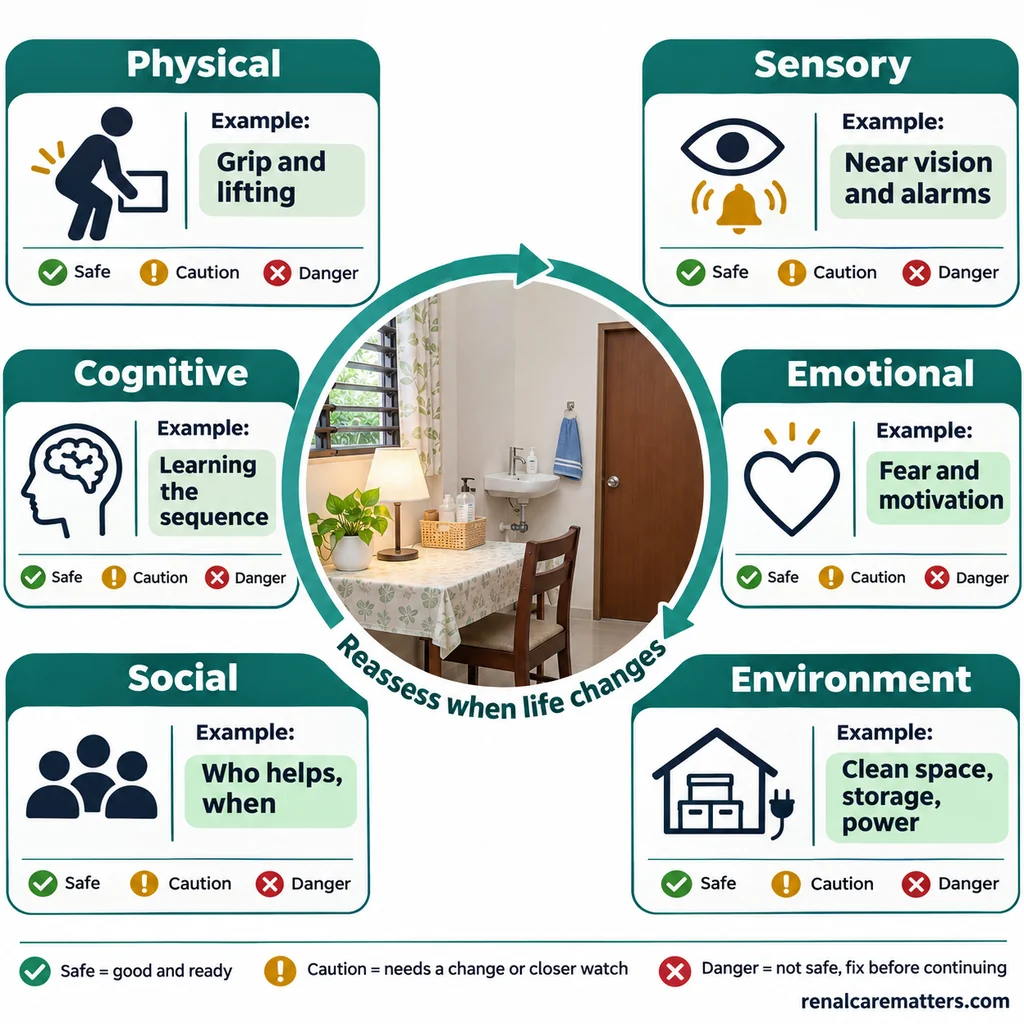
| Domain | What you assess | Common remediable barrier | Possible support |
|---|---|---|---|
| Physical | Grip, fine finger movement, lifting a 2-liter bag, bending | Arthritis, tremor, weakness | Assistive devices, cycler instead of manual, caregiver for lifting |
| Sensory | Near vision for labels and clamps, hearing alarms | Poor near vision, glare | Task lighting, magnifier, high-contrast labels, alarm volume |
| Cognitive | Learning, memory for sequence, problem solving | Uremic slowing, low literacy | Staged training, picture checklists, teach-back, delay until dialysis improves cognition |
| Emotional | Distress, depression, fear, motivation | Grief, anxiety about infection | Counseling, peer contact, gradual exposure |
| Social | Caregiver availability, family dynamics, finances | Caregiver works days | Reassign tasks to available person, automated peritoneal dialysis (APD) at night, assisted PD |
| Environmental | Clean exchange area, water, hand hygiene, storage, pets, electricity, waste, transport | Small home, shared bathroom, power interruptions | Dedicated corner with a door, clean table, scheduled deliveries, backup plan for power |
The home visit is an assessment, not an inspection. Many Filipino homes are small and shared. The question is whether one clean, closable, well-lit area can be set up, whether hands can be washed and dried properly, whether pets can be kept out during exchanges (the 2022 ISPD peritonitis recommendations added specific guidance on domestic pets), where 30 or more boxes a month will be stored away from heat and floodwater, and whether the electricity is reliable enough for a cycler.4
Suitability is the nephrologist’s call. Prior major abdominal surgery, large hernias, severe lung disease, very large body size or a recent abdominal catastrophe may make PD difficult. Your job is to document the facts and route them.
Assisted PD
When the person cannot safely perform self-care PD and family support is missing or insufficient, assisted PD may be the path. The 2024 ISPD position paper defines assistance broadly: a family member, a paid caregiver, a home-care nurse or community health worker, temporary or long term. In observational comparisons, older and frailer people on assisted PD have had broadly similar peritonitis-free survival to self-care PD, though these studies are small and selected. PD11 covers assisted PD in detail.1
Back to the case: Mang Ernesto wants to stay home
What Joy finds. With a desk lamp and a 3× magnifier, Ernesto reads the solution strength and expiry correctly. He opens a clamp slowly but safely. He forgets the sequence once without a checklist and never with a picture checklist. His home has a small back room with a door; the family’s cat sleeps there.
| Barrier | Owner | Action | Observable criterion | Reassess |
|---|---|---|---|---|
| Near vision | Joy, Ernesto | Lamp and magnifier at exchange table; high-contrast checklist | Reads strength, volume, expiry correctly 3 of 3 times | Training day 3 |
| Daytime support | Team, Liza | Discuss APD with night setup by Liza, or assisted continuous ambulatory peritoneal dialysis (CAPD); nephrologist to advise | Liza completes cycler setup independently | Before home start |
| Cat in exchange room | Family | Move cat’s sleeping area; door closed during exchanges | Home visit confirms | Home visit |
| Storage | Joy, supplier | Raised shelving away from floor and heat | 30 boxes stored off floor | Home visit |
Joy documents that the decision between self-care CAPD and APD with Liza’s setup is pending nephrology review, and that readiness will be signed off only after observed independent performance.
Skills checklist: Practice drill
Role-play a modality conversation with a peer as a 45-year-old tricycle driver who fears losing income. Produce a readiness plan with at least two barriers, two named owners, observable criteria, a backup contact and a reassessment date. Your preceptor rates each step as satisfactory, needs practice, or not observed. Steps marked Critical must all be satisfactory before sign-off. This checklist supports supervised learning; your unit’s own procedure and competency form are the authority. A printable version of every checklist is on the trainer page.
- Role-play a modality conversation with a peer as a 45-year-old tricycle driver who fears losing income.
- Produce a readiness plan with at least two barriers, two named owners, observable criteria, a backup contact and a reassessment date.
Check your understanding
Each visit draws 5 questions at random from this module’s 15-question bank. Choose the single best answer for each, then select Check answers; an explanation appears under the best answer. Select New set of questions for a different mix. A good target is 4 of 5 on two different sets. Nothing you select is sent anywhere; scoring happens in your browser.
Read next on this site
- Peritoneal DialysisPlain-language PD explanation to use in modality conversations.
- Why Starting Dialysis Is Not a Death Sentence, but a New BeginningHelping patients face the start of dialysis.
- Incremental Dialysis: Starting With the Kidney Function You Still HaveStarting with the kidney function the patient still has.