Nephrology Nursing specialty subtrack for pediatric dialysis
This module is study material for registered nurses in pediatric dialysis. It explains the reasoning behind common nursing decisions; it is not a procedure. Exact steps follow your unit’s pediatric protocol and the device instructions; treatment parameters follow the written order of the pediatric nephrologist. Nurses assess, verify, teach, document and escalate; they do not prescribe, choose antibiotics, change doses or adjust anticoagulation. Every case is fictional and every value in a case is illustrative. Pending review by a pediatric nephrologist and a senior pediatric dialysis nurse.
Learning objectives
After this module you should be able to
Describe pediatric peritoneal dialysis (PD) catheter design and exit-site placement, and why diapers, gastrostomies and ostomies change the plan.
Perform and teach exit-site care consistent with the 2024 International Society for Peritoneal Dialysis (ISPD) pediatric guideline and the unit protocol.
Score an exit site and recognize infection signs that need same-day escalation.
Work through poor drainage from simple external causes inward, and know when to stop and call.
Classroom 2 hSkills lab 2 hSupervised placement 4 h
Pre-testBefore you read, answer the 5 self-assessment questions and note your score. After the module, select New set of questions and compare. The difference is what you learned; the questions you still miss are what to reread.
Start here
The big picture, in plain words
A PD catheter is a child’s lifeline for months or years. It leaves the body through a small exit site and runs through a tunnel under the skin, anchored by cuffs that tissue grows into. Most catheter trouble falls into two families: infection along the tunnel and exit site, and mechanical failure when fluid will not flow.
Your work in this module is to keep the exit site healthy, to notice the first signs of trouble, and to solve simple drainage problems without causing new ones.
In plain wordsThink of the exit site as a gate in a fence. The cuffs are the posts that hold the fence tight. If the gate stays clean and dry and the posts stay firm, nothing gets through. If the gate is wet, rubbed or pulled, dirt gets in along the fence line.
The picture has a limit. A gate is fixed; a child is not. Children grow, crawl, pull at tubes and wear diapers. The exit site must be placed and protected for the child’s life stage, and the catheter must be secured so play does not tug on it.
Figure 1 · Key terms for this module
CuffA felt ring on the catheter that tissue grows into, anchoring it and sealing the tunnel.
TunnelThe path of the catheter under the skin between the cuffs.
Exit siteWhere the catheter leaves the skin.
Exit-site scoreA points system for redness, swelling, crusting, pain and drainage.
Outflow failureFluid runs in but does not drain out well.
Opening case · fictional
Case: He drains half
Jun-jun Bautista, 5, 18 kilograms, has been on PD for three weeks. His father, Arnel, calls at 9 p.m.: the cycler keeps alarming, and Jun-jun drained only about half of the 700 mL fill. He has not had a bowel movement for three days. He has no fever, the fluid looks clear, and he says his tummy is “a little full”. Nurse Ivy takes the call.
Before reading on, decide:
What simple causes should Ivy check first?
What would make this an urgent call instead of a troubleshooting call?
What should Arnel not do?
Keep your answers in mind. The lesson gives you what you need, and the case review near the end shows one sound response.
Lesson · part 1
Catheter design and exit-site placement
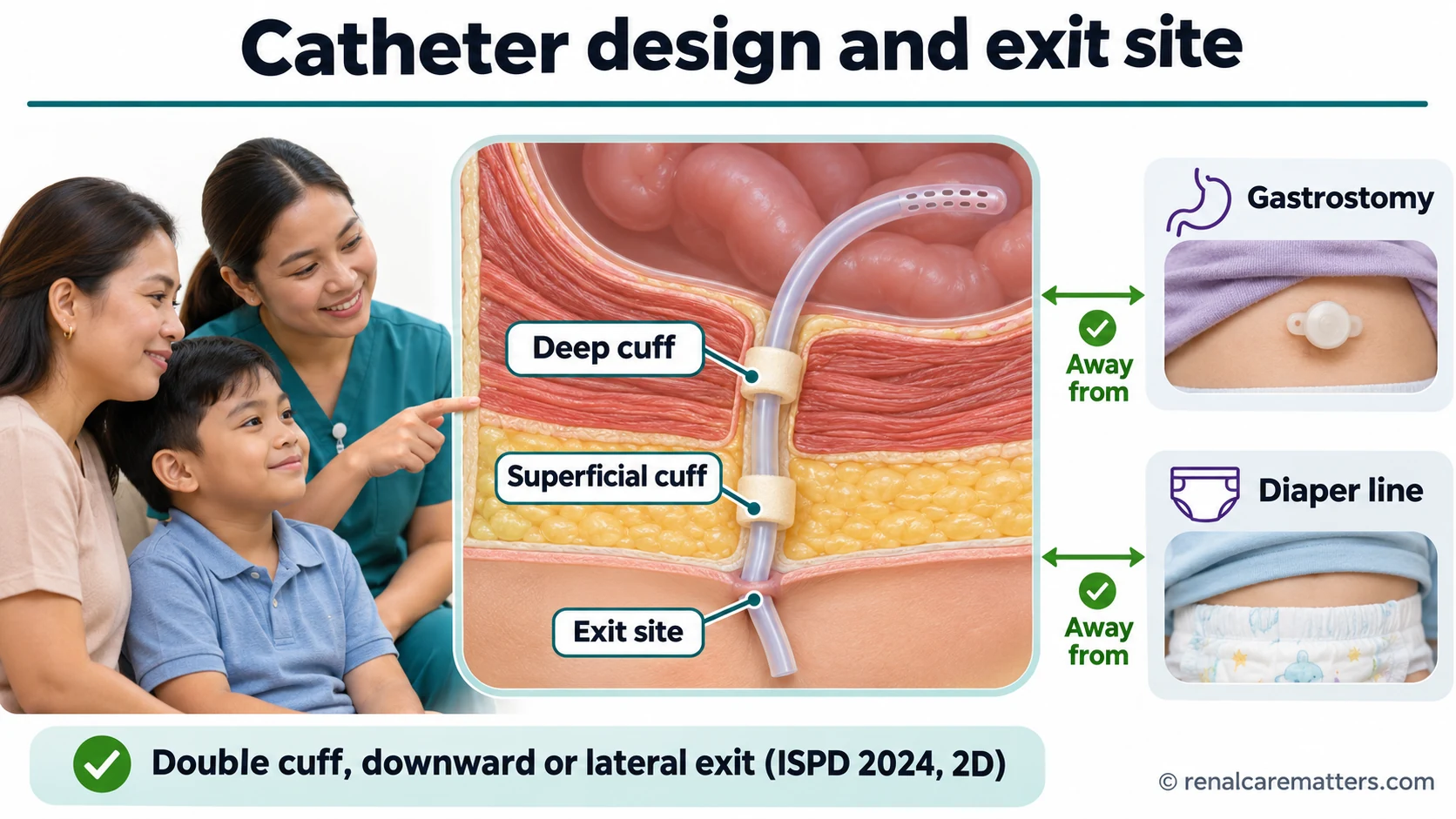
The 2024 ISPD pediatric guideline suggests a double-cuff PD catheter with a downward or lateral exit-site orientation (2D), and perioperative intravenous antibiotics before insertion (2C).1 A downward exit lets sweat and debris drain away from the tunnel. The exit site is placed away from the diaper line in infants and away from a gastrostomy or ostomy; in children with a colostomy, the guideline’s rationale discusses alternatives such as a chest-wall exit.
Figure 2. Catheter design and exit site. The 2024 pediatric guideline suggests a double-cuff catheter with a downward or lateral exit.
Catheters fail more often in children than many expect. In the International Pediatric Peritoneal Dialysis Network (IPPN) registry, 13% of 2,453 children needed at least one access revision, an overall rate of 0.14 per treatment year; among new patients, catheter survival was 84% at 12 months and 73% at 48 months. Mechanical malfunction caused 60% of revisions, peritonitis 16%, exit-site infection 12% and leakage 6%. Younger age, congenital anomalies of the kidney and urinary tract (CAKUT) and ostomies were associated with revision, and a revision was associated with a higher risk of technique failure or death.2 These are registry associations, but they make the point: protecting the catheter protects the modality.
RememberDownward or lateral exit, away from diapers and stomas, catheter secured against tugs. Protect the catheter and you protect PD.
Lesson · part 2
Exit-site care
A new exit site is left undisturbed to heal, with dressing changes only as the surgical team orders, usually by trained staff. After healing, routine care begins.
ISPD 2024 pediatric statement
Grade
Routine exit-site care with a sterile cleansing solution 2 to 3 times per week
2D
A topical antibiotic applied to the exit site whenever exit-site care is performed
2D
Topical gentamicin may be considered as an alternative to mupirocin
Rationale text, not a graded statement
Grade 2D means a weak suggestion on very low-certainty evidence; your unit’s protocol decides the agent and frequency.1 Whatever the protocol, the technique is the same: hand hygiene, a clean surface, look before you clean, clean from the exit outward, dry, apply the ordered agent, secure the catheter so it does not pull, and record what you saw.
Scoring what you see
Exit-site scores give points for swelling, crust, redness, tenderness and discharge. The guideline’s rationale says an exit-site infection should be assumed with a cumulative score of 4 or more, and purulent discharge alone is diagnostic (19.4, 2C).1 Score the same way every time so the trend means something, and photograph only if your unit’s consent and privacy rules allow it.
RememberLook, score, then clean. Purulent discharge alone means infection; call the PD team the same day.
Lesson · part 3
When it will not drain
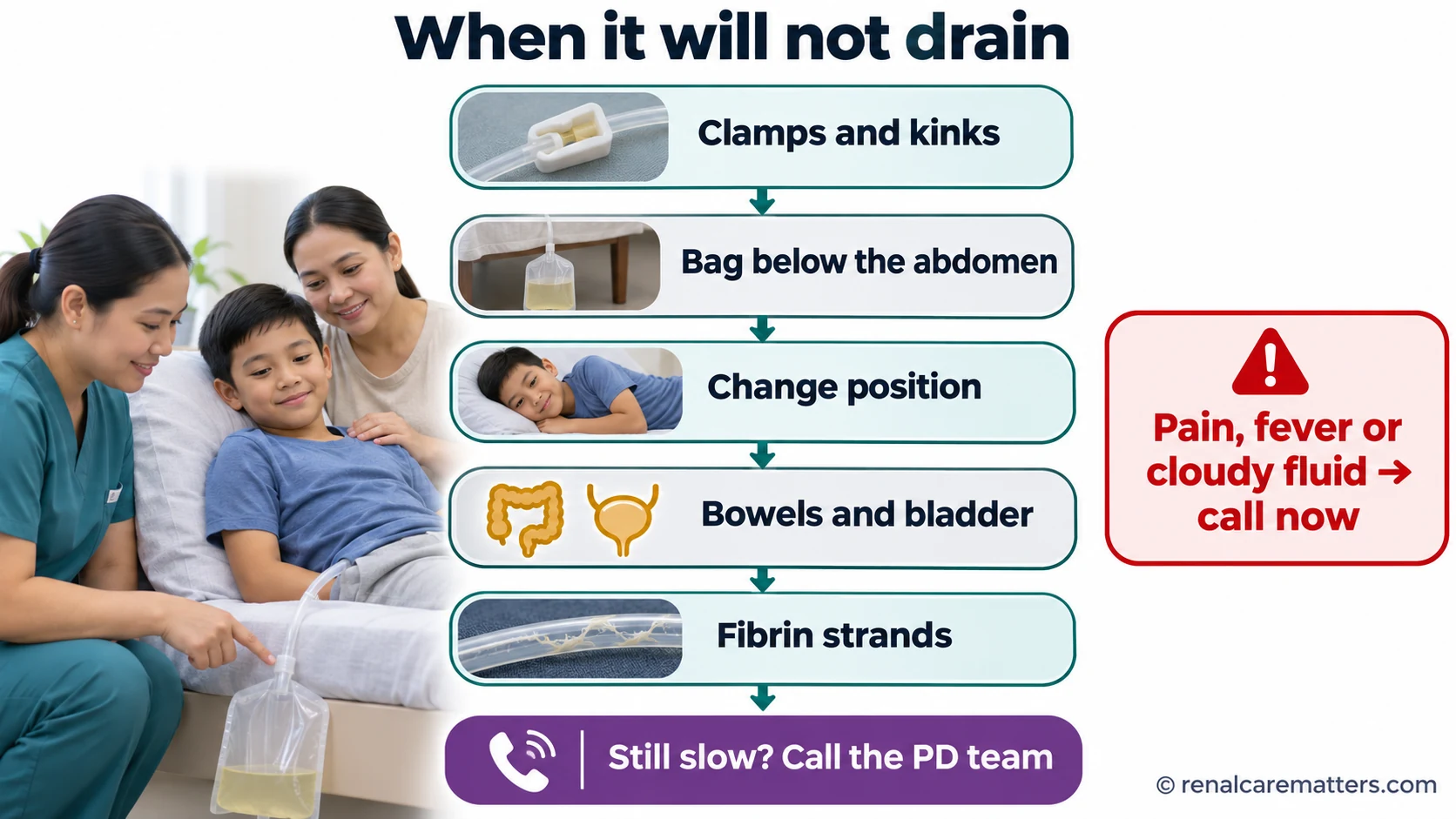
Outflow failure means fluid runs in but drains slowly or incompletely. Most causes are outside the catheter or easily reversible. Work from the outside in.
Figure 3. When it will not drain. Work from simple external causes inward, and stop if the child has pain, fever or cloudy fluid.
Check
Why
What the caregiver can do
Clamps open, lines not kinked, bag below the abdomen
Simple obstruction
Check every clamp and the line path
Position
The catheter tip may lie against bowel
Change position, sit up, turn
Constipation and full bladder
A loaded bowel pushes on the catheter tip or kinks it
Report; laxatives only as ordered
Fibrin (white strands in the fluid)
Fibrin can block the catheter
Report; heparin in the bag only as ordered
Catheter migration or omental wrap
Needs imaging or a procedure
None; the team decides
Stop and callStop troubleshooting and call the PD team at once, per unit protocol, if drainage problems come with abdominal pain, fever, cloudy fluid, vomiting, a swollen or tender exit site, leakage at the exit site, or breathing difficulty. Never flush a PD catheter forcefully or use a syringe on it unless your unit protocol and training allow it.
RememberClamps, kinks, position, bowels, fibrin, then call. Pain, fever or cloudy fluid turns a drainage problem into an urgent one.
On the floor
Real situations: problems and solutions
These are fictional but typical. For each one, cover the answer, decide what you would do, then compare. Where a step depends on local rules, your unit’s procedure and your supervisor’s direction come first.
The red ring
What you see
A faint red ring around the exit site, no discharge.
What is likely going on
Early irritation or early infection.
What to do
Score it, record it, increase observation, report per protocol.
Why it matters
Trends catch infections early.
Pus at the exit
What you see
A drop of yellow discharge at the exit site.
What is likely going on
Exit-site infection by definition.
What to do
Call the PD team the same day; swab per protocol.
Why it matters
Purulent discharge alone is diagnostic.
Constipated and slow
What you see
A child drains slowly after several days without stool.
What is likely going on
Constipation compressing the catheter tip.
What to do
Check external causes, report for a bowel plan.
Why it matters
Most outflow problems are simple.
Field notes
Secure the catheter so play cannot tug it.
Look before you clean.
Case review
Back to the case: He drains half
Simple causes first. Ivy asks Arnel to check every clamp and the line path, to sit Jun-jun up and turn him, and to look for white strands in the bag. Three days without a bowel movement makes constipation the likely cause.
What would make it urgent. Pain, fever, cloudy fluid, vomiting, leakage or breathing difficulty. None is present now, so Ivy reports to the PD nephrologist the same evening for a constipation plan and a review of how to continue the night.
What not to do. No forceful flushing, no syringe on the catheter, no stronger dextrose bag to “pull more”, and no skipping the rest of the night without the team’s advice. Ivy documents the call and the plan.
Skills lab · with your preceptor
Skills checklist: Exit site and drainage
Use a training catheter and photographs. Your preceptor rates each step as satisfactory, needs practice, or not observed. Steps marked Critical must all be satisfactory before sign-off. This checklist supports supervised learning; your unit’s own procedure and competency form are the authority. A printable version of every checklist is on the trainer page.
CriticalPerforms exit-site care with hand hygiene, assessment before cleaning, and catheter securing
Scores exit sites from photographs consistently with a colleague
CriticalRecognizes purulent discharge as infection and escalates the same day
Talks a caregiver through external drainage checks by telephone
CriticalStops troubleshooting and escalates when pain, fever or cloudy fluid appear
Self-assessment
Check your understanding
Each visit draws 5 questions at random from this module’s 15-question bank. Choose the single best answer for each, then select Check answers; an explanation appears under the best answer. Select New set of questions for a different mix. A good target is 4 of 5 on two different sets. Nothing you select is sent anywhere; scoring happens in your browser.
Warady, B. A., Same, R., Borzych-Duzalka, D., Neu, A. M., El Mikati, I., Mustafa, R. A., Begin, B., Nourse, P., Bakkaloglu, S. A., Chadha, V., Cano, F., Yap, H. K., Shen, Q., Newland, J., Verrina, E., Wirtz, A. L., Smith, V., & Schaefer, F. (2024). Clinical practice guideline for the prevention and management of peritoneal dialysis associated infections in children: 2024 update. Peritoneal Dialysis International, 44(5), 303–364. https://doi.org/10.1177/08968608241274096
Borzych-Duzalka, D., Aki, T. F., Azocar, M., White, C., Harvey, E., Mir, S., Adragna, M., Serdaroglu, E., Sinha, R., Samaille, C., Vanegas, J. J., Kari, J., Barbosa, L., Bagga, A., Galanti, M., Yavascan, O., Leozappa, G., Szczepanska, M., Vondrak, K., . . . Warady, B. A. (2017). Peritoneal dialysis access revision in children: Causes, interventions, and outcomes. Clinical Journal of the American Society of Nephrology, 12(1), 105–112. https://doi.org/10.2215/CJN.05270516
Educational material for registered nurses. Completing it is an Academy learning record only. It does not confer CPD units, PSN or National Kidney and Transplant Institute (NKTI) training recognition, PhilHealth staffing credit, or clinical privileges, and it does not replace your facility’s protocols, device instructions, or written orders.