Talking while connecting
- What you see
- A caregiver chats while the transfer set is uncapped.
- What is likely going on
- Droplet and touch contamination risk.
- What to do
- Teach a silent connection rule.
- Why it matters
- Connection is the riskiest moment.
Preparing the space and the child, the exchange step by step, small-volume measurement, and dry versus wet contamination.

This module is study material for registered nurses in pediatric dialysis. It explains the reasoning behind common nursing decisions; it is not a procedure. Exact steps follow your unit’s pediatric protocol and the device instructions; treatment parameters follow the written order of the pediatric nephrologist. Nurses assess, verify, teach, document and escalate; they do not prescribe, choose antibiotics, change doses or adjust anticoagulation. Every case is fictional and every value in a case is illustrative. Pending review by a pediatric nephrologist and a senior pediatric dialysis nurse.
The steps of a manual exchange are the same for a child as for an adult: drain, flush, fill. What makes pediatric continuous ambulatory PD (CAPD) different is the small volume, the child who may not hold still, and the measurement errors that matter more when every bag is small. A 50 mL measuring error is trivial in a 2,000 mL adult exchange; in a 300 mL infant exchange it is one-sixth of the bag.
Your work in this module is to perform and teach an exchange that is clean, accurate and calm, and to recognize and report a contamination honestly.
The picture has a limit. A plane’s passengers sit belted. A toddler does not. Plan the child’s position, comfort and distraction before you open anything, and have a second pair of hands if the child may move.
Figure 1 · Key terms for this module
Nurse Tess is supervising Lola Pilar, 62, who is learning to do exchanges for her grandson Kiko, 4, 16 kilograms. Kiko wriggles as Lola Pilar opens the new bag. The transfer-set cap slips from her fingers to the floor while the line is open to the patient side. Lola Pilar quickly picks up a new cap and says, “No harm done.”
Before reading on, decide:
Keep your answers in mind. The lesson gives you what you need, and the case review near the end shows one sound response.
Most errors are prevented before the bag is opened.
Follow the device’s instructions and the unit procedure. The physiology behind the steps does not change.
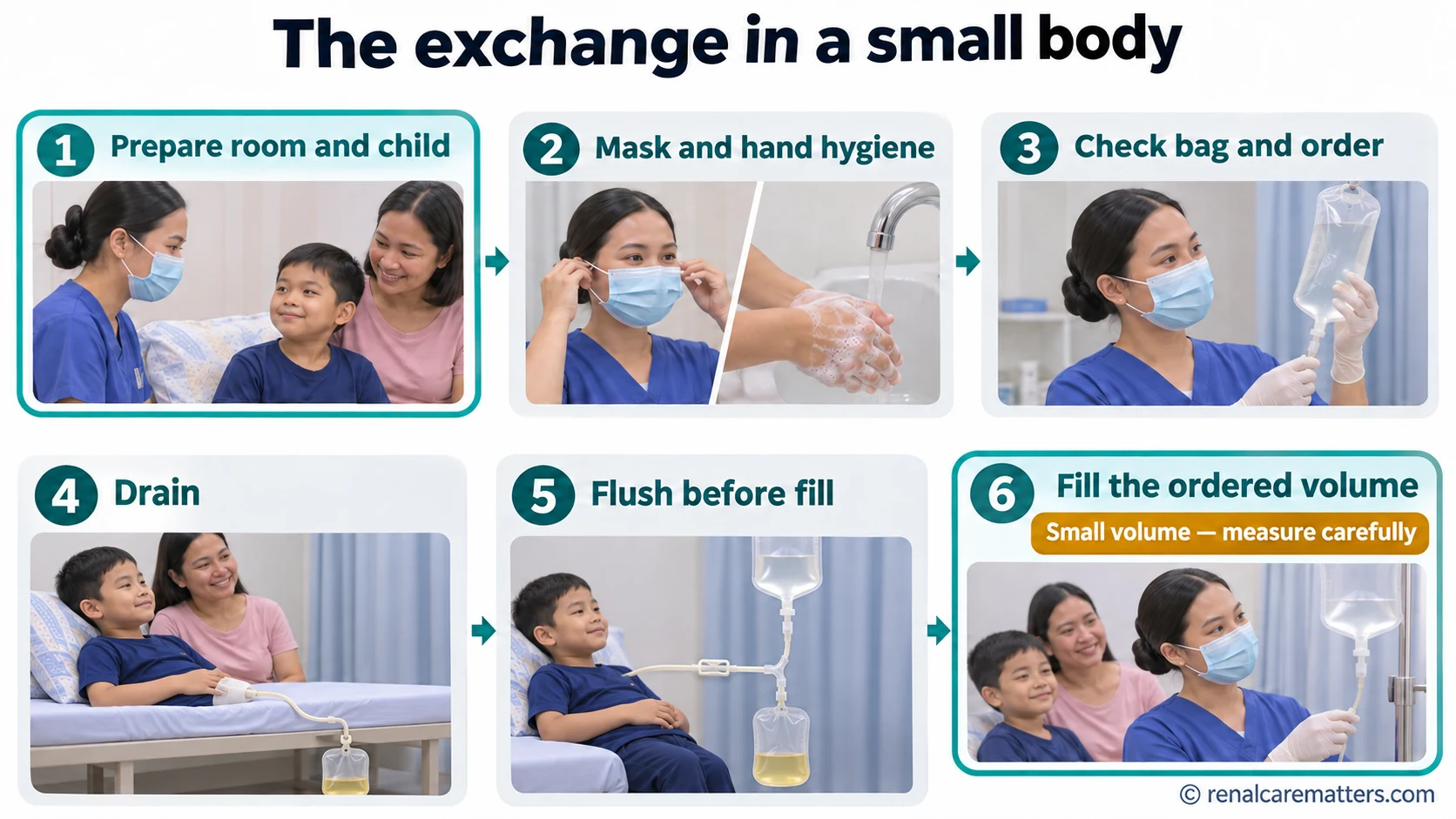
| Step | Why it matters |
|---|---|
| Connect without touching key parts | Connection is the main contamination point |
| Drain fully, with the child lying or reclining | Incomplete drains leave fluid that adds to the next fill and raises pressure |
| Flush before fill | Washes contamination at the connection into the drain bag, not the abdomen |
| Fill only the ordered volume | In small bags, measure by weight or graduated markings as the protocol says |
| Disconnect and cap without touching key parts | The second high-risk moment |
| Inspect and measure the effluent | Cloudiness, fibrin, blood; net ultrafiltration |
Measure small volumes the way your unit validated: weighing bags (1 gram of fluid is about 1 mL) is usually more accurate than reading markings on a soft bag. Record drained volume, filled volume, net ultrafiltration, appearance and time.
A contamination is a break in technique that may have let organisms into the system. What happens next depends on whether fluid flowed.
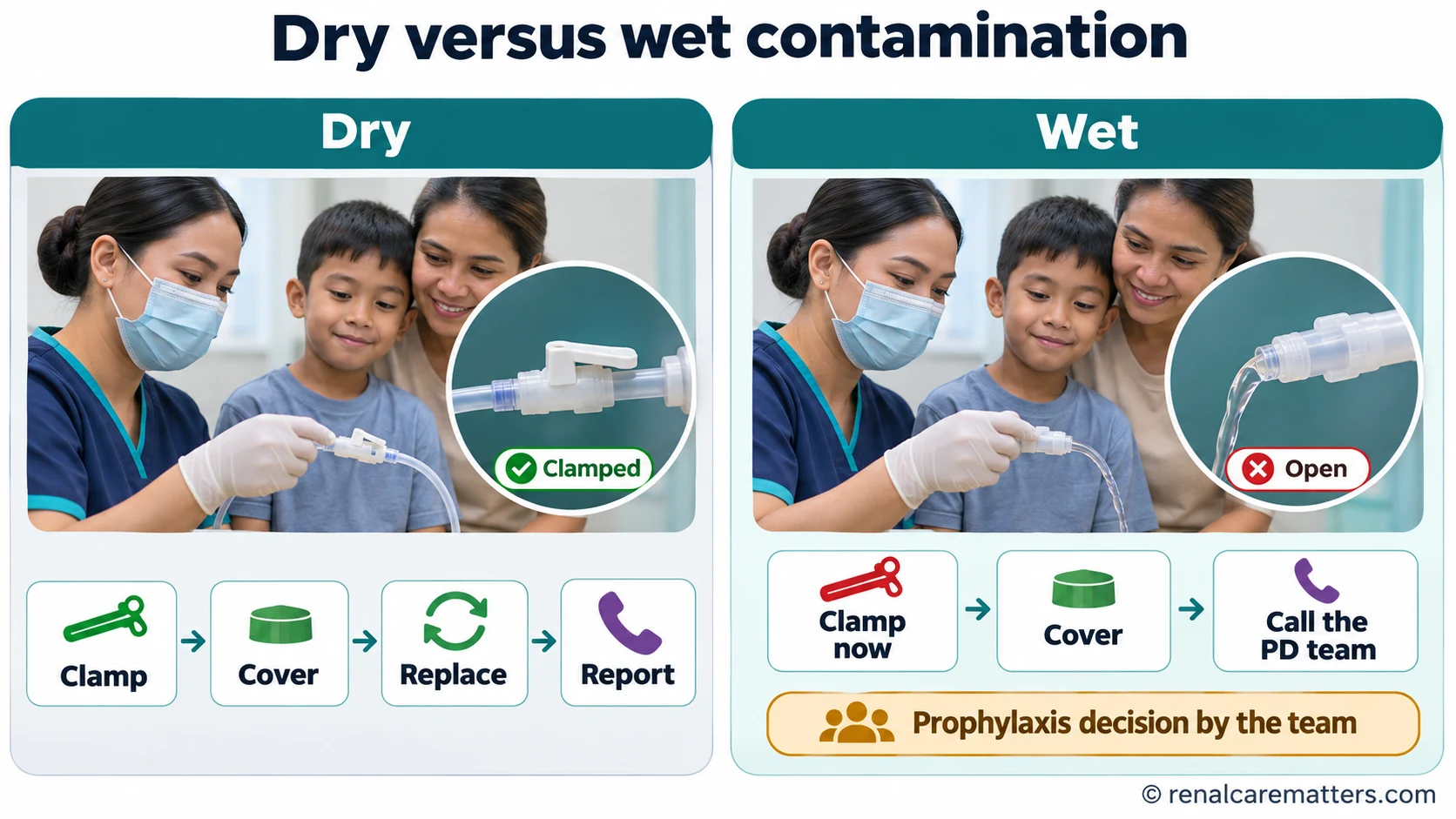
| Type | What happened | Usual next step (per protocol) |
|---|---|---|
| Dry | Break with the system clamped and no fluid flow, for example touching a connector before connection | Clamp, cover, replace the contaminated part as the protocol says, report |
| Wet | Break while fluid was flowing or the system was open to the patient, for example a disconnection with an open transfer set | Clamp at once, cover, call the PD team for transfer-set change and the prophylaxis decision |
The 2024 International Society for Peritoneal Dialysis (ISPD) pediatric guideline suggests prophylactic antibiotics after wet contamination of the PD system (7.4, 2D), and its rationale describes a single intraperitoneal dose of cefazolin as reasonable for most patients.1 The choice and dose are the team’s. Your job is to recognize the event, stop, protect the line and report it honestly, without blame, so the caregiver keeps reporting.
Tess says calmly, “Let’s stop and clamp.” She clamps the transfer set, covers the end with a sterile cap from her kit, and explains that because the line was open to Kiko, this counts as a wet contamination. She calls the PD nephrologist for the transfer-set change and prophylaxis decision, then praises Lola Pilar for saying what happened.
A contamination reported is a contamination managed. Thank the person who reports it.
Illustrative scenario. Names and details are invented.
These are fictional but typical. For each one, cover the answer, decide what you would do, then compare. Where a step depends on local rules, your unit’s procedure and your supervisor’s direction come first.
Type. The transfer set was open to the patient side when the cap fell, so it is a wet contamination, which carries more risk than a dry one.
The next five minutes. Clamp, cover with a sterile cap, call the PD team for the transfer-set change and the prophylaxis decision, document the time and event, and watch Kiko for fever, pain or cloudy fluid in the coming days.
Prevention. A second adult to comfort and steady Kiko, a distraction ready before opening, and supplies laid out within reach so no hand leaves the line. Lola Pilar’s training continues until she shows a clean exchange with a moving child.
Simulation on a training model first, then supervised practice. Your preceptor rates each step as satisfactory, needs practice, or not observed. Steps marked Critical must all be satisfactory before sign-off. This checklist supports supervised learning; your unit’s own procedure and competency form are the authority. A printable version of every checklist is on the trainer page.
Each visit draws 5 questions at random from this module’s 15-question bank. Choose the single best answer for each, then select Check answers; an explanation appears under the best answer. Select New set of questions for a different mix. A good target is 4 of 5 on two different sets. Nothing you select is sent anywhere; scoring happens in your browser.
Module 9 of 2011 modules to go

Internal Medicine · Nephrology · Nutrition · Philippines · PRC 0105184
Educational material for registered nurses. Completing it is an Academy learning record only. It does not confer CPD units, PSN or National Kidney and Transplant Institute (NKTI) training recognition, PhilHealth staffing credit, or clinical privileges, and it does not replace your facility’s protocols, device instructions, or written orders.

Scan and save