Nephrology Nursing specialty subtrack for pediatric dialysis
This module is study material for registered nurses in pediatric dialysis. It explains the reasoning behind common nursing decisions; it is not a procedure. Exact steps follow your unit’s pediatric protocol and the device instructions; treatment parameters follow the written order of the pediatric nephrologist. Nurses assess, verify, teach, document and escalate; they do not prescribe, choose antibiotics, change doses or adjust anticoagulation. Every case is fictional and every value in a case is illustrative. Pending review by a pediatric nephrologist and a senior pediatric dialysis nurse.
Learning objectives
After this module you should be able to
Explain how the peritoneal membrane works in a child, and why fill volume is scaled to body surface area rather than weight alone.
Calculate body surface area and express an ordered fill volume in mL/m² and mL/kg, and recognize a value outside the usual band.
Describe intraperitoneal pressure, its signs at the bedside, and its link to leaks, hernias and breathing.
Read a pediatric peritoneal dialysis (PD) order element by element and verify it against today’s weight and height.
Classroom 2 hSkills lab 2 hSupervised placement 4 h
Pre-testBefore you read, answer the 5 self-assessment questions and note your score. After the module, select New set of questions and compare. The difference is what you learned; the questions you still miss are what to reread.
Start here
The big picture, in plain words
The peritoneum is the same living membrane in a child and an adult: blood vessels on one side, dialysis fluid on the other, solutes moving down their gradients and water drawn by glucose. What changes is the surface available and how much fluid the abdomen tolerates. A child’s peritoneal surface is large compared with body weight, but the abdomen is small, and an infant breathes mainly with the diaphragm that the fluid pushes against.
Your work in this module is to read a pediatric PD order with the eyes of someone who knows what each number does to the child.
In plain wordsThink of the peritoneum as a folded tablecloth inside the abdomen. Pour in a little fluid, and only part of the cloth gets wet. Pour in more, and more of the cloth unfolds and joins the exchange, until the cloth is fully spread. Pour in still more, and you do not wet more cloth; you only press on the table.
The picture has a limit. The “cloth” is not passive: its blood flow, the number of working pores and the child’s position all change how much of it works. Lying down recruits more surface than sitting. That is why the same fill feels different at night than during the day.
Figure 1 · Key terms for this module
Body surface area (BSA)Skin area in square meters, estimated from height and weight.
Fill volumeThe volume of dialysate run into the abdomen per exchange.
Intraperitoneal pressure (IPP)The pressure the fluid creates inside the abdomen, measured in cmH₂O.
Dwell timeHow long the fluid stays in before draining.
RecruitmentMore membrane joining the exchange as fill volume rises.
Opening case · fictional
Case: A 900 that looked like a 300
Rhea Aquino, 1 year, length 75 cm, weight 9 kilograms, is starting automated PD at home after training. The discharge order transcribed into the clinic record reads a fill volume of 900 mL per cycle. Her mother, Joy, mentions that in the hospital “the bag looked much smaller”. Nurse Lorna prepares the first home cycler program.
Before reading on, decide:
What is the ordered fill volume in mL/m² and mL/kg?
Is it inside the usual band for Rhea’s age?
What does Lorna do before programming the cycler?
Keep your answers in mind. The lesson gives you what you need, and the case review near the end shows one sound response.
Lesson · part 1
The peritoneum in a child
Three processes work across the membrane. Diffusion moves urea, creatinine, potassium and phosphate from blood to fluid. Osmosis, driven by glucose, pulls water into the abdomen (ultrafiltration). Convection drags solutes along with that water. The three-pore model describes the routes: tiny water-only channels (aquaporins), abundant small pores for solutes, and few large pores that leak protein.1
Dwell time trades one goal against another. Short dwells favor water removal and urea clearance, because the glucose gradient is still strong. Long dwells favor creatinine and phosphate clearance; reaching a given dialysate-to-plasma ratio for phosphate takes three to four times longer than for urea.1 A child who needs phosphate removal may need some long dwells, at the cost of less ultrafiltration.
Children also lose protein into the dialysate, which is one reason their energy and protein needs are adjusted by the renal dietitian (Module 17).2
RememberShort dwells remove water and urea; long dwells remove phosphate. The order’s dwell times are a deliberate trade.
Lesson · part 2
Fill volume and intraperitoneal pressure
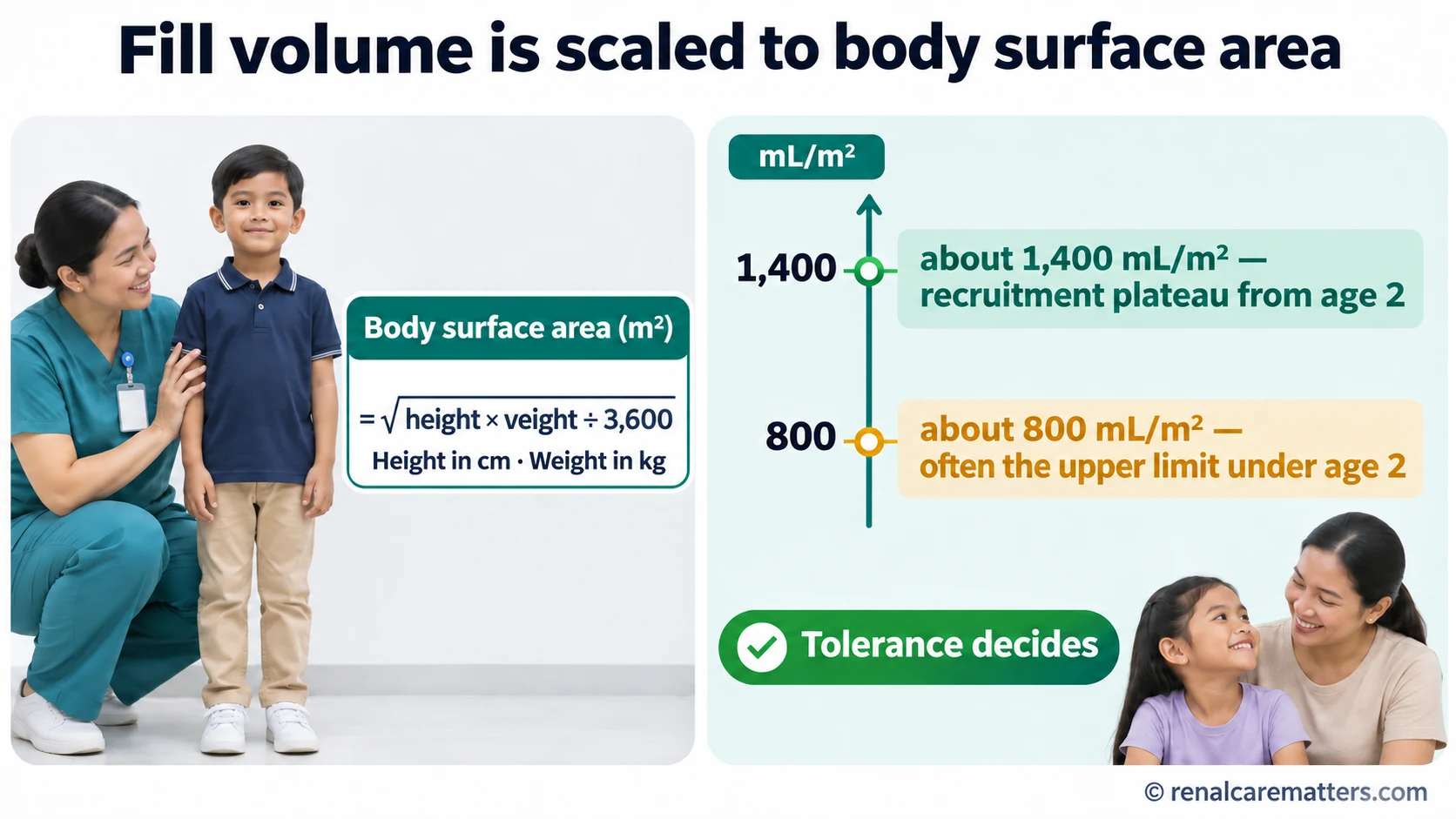
Pediatric fill volumes are scaled to body surface area. In children 2 years and older, the membrane keeps recruiting as fill volume rises toward about 1,400 mL/m²; above that, more fluid adds pressure without adding exchange. Under 2 years, fill volume is set more by tolerance, and about 800 mL/m² (or 30 to 50 mL/kg) is often suggested as an upper limit, with individual assessment most important.1
Figure 2. Fill volume is scaled to body surface area. Under age 2 tolerance limits the volume; from age 2 the membrane recruits up to about 1,400 mL/m².
BSA (m²) = √(height in cm × weight in kg ÷ 3,600) (Mosteller) Fill volume per BSA (mL/m²) = fill volume (mL) ÷ BSA (m²) Example: 110 cm, 18 kg → BSA √(110 × 18 ÷ 3,600) = 0.74 m²; a 1,000 mL fill = about 1,350 mL/m² and 56 mL/kg
Intraperitoneal pressure (IPP) is the pressure the fill creates, measured at rest lying flat. In one published series of children over 2 years, IPP averaged about 5 cmH₂O at 600 mL/m² and about 14 cmH₂O at 1,400 mL/m², similar to adults at their usual fills.1 High pressure is linked to discomfort, breathing difficulty, leaks and hernias. You see high IPP as a child who is breathless, grunting, refusing to lie down, vomiting, or complaining of fullness after the fill.
RememberA fill outside the usual band for the child’s age is a question to ask, never a value to correct yourself.
Lesson · part 3
Reading a pediatric PD order
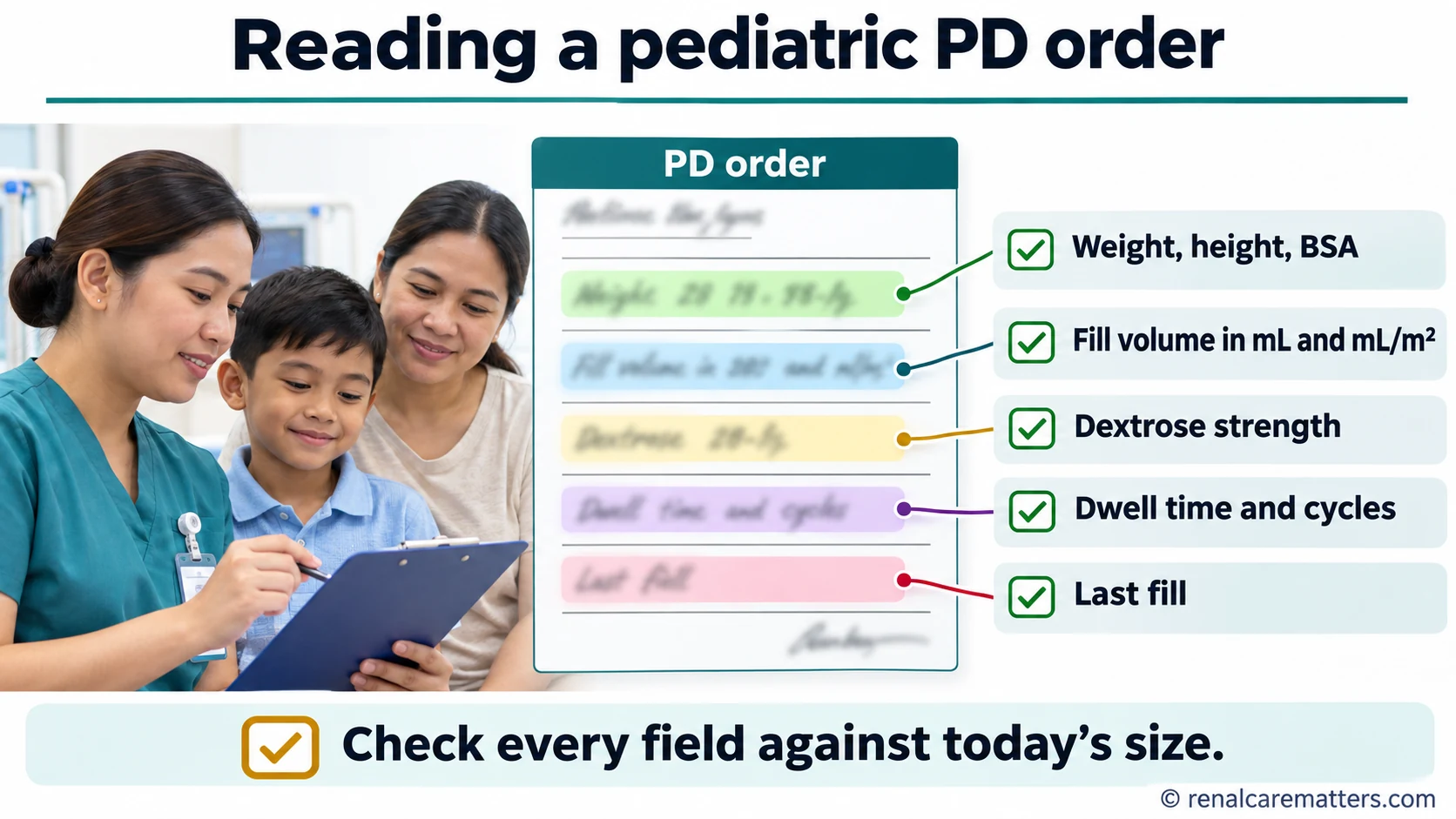
Every element of the order connects to a physiological job. Check each one against today’s weight and height.
Figure 3. Reading a pediatric PD order. Check each element against the child’s current weight and body surface area.
Element
Its job
Your check
Weight, height, BSA
Basis for scaling
Measured recently; BSA recalculated after growth
Fill volume (mL)
Membrane recruitment and comfort
Convert to mL/m² and mL/kg; compare with the age band
Dextrose strength
Ultrafiltration
Matches the order; stronger bags not substituted without an order
Dwell time and number of cycles
Clearance and water removal
Total therapy time fits the order and the family’s night
Last fill (day dwell)
Daytime clearance
Volume and solution, or “dry day”, as ordered
Tidal or minimum drain settings, where used
Comfort and alarm reduction
Match the order and the device instructions
Readiness for home PD includes more than the order: a trained caregiver who has shown the skills, a clean space, storage for supplies, reliable electricity or a backup plan for a cycler, and a way to reach the team at night (Module 18). The 2020 International Society for Peritoneal Dialysis (ISPD) pediatric acute PD guideline notes that automated PD is not suitable for newborns because their fill volumes are too small for current machines (1D).3
On the floor · Lorna and the 900
Lorna calculates. Rhea’s BSA is √(75 × 9 ÷ 3,600) = 0.43 m². A 900 mL fill is about 2,080 mL/m² and 100 mL/kg, far above the usual band for a 1-year-old. She does not program the cycler. She checks the original hospital order, which reads 300 mL (about 690 mL/m²), and calls the pediatric nephrologist to confirm and correct the transcription.
Converting the fill to mL/m² turned a plausible-looking number into an obvious stop.
Illustrative scenario. Names and details are invented.
RememberConvert every fill to mL/m² and mL/kg before you program it. The conversion is where transcription errors show themselves.
On the floor
Real situations: problems and solutions
These are fictional but typical. For each one, cover the answer, decide what you would do, then compare. Where a step depends on local rules, your unit’s procedure and your supervisor’s direction come first.
The adult default
What you see
A cycler template from an adult patient is loaded for a child.
What is likely going on
Template shortcut.
What to do
Clear it; program from the child’s order and check with a second person.
Why it matters
Adult fills can overfill a child.
The grunting infant
What you see
An infant grunts and refuses to lie flat after each fill.
What is likely going on
Possible high intraperitoneal pressure.
What to do
Report to the nephrologist with fill volume in mL/m² and the symptoms.
Why it matters
High pressure causes breathing problems and leaks.
The old height
What you see
BSA was calculated from a height measured a year ago.
What is likely going on
Growth changes BSA.
What to do
Remeasure and recalculate; report if the fill per m² has changed.
Why it matters
Scaling depends on current size.
Field notes
Convert every fill to mL/m².
Ask families what the bag looks like at home.
Case review
Back to the case: A 900 that looked like a 300
The arithmetic. BSA √(75 × 9 ÷ 3,600) = 0.43 m². 900 mL ÷ 0.43 m² ≈ 2,080 mL/m²; 900 ÷ 9 = 100 mL/kg.
The band. Under 2 years, about 800 mL/m² (30 to 50 mL/kg) is often the upper limit, by tolerance. 2,080 mL/m² is far outside it, and Joy’s memory of a smaller bag fits a transcription error.
Before programming. Lorna stops, compares with the source order, and has the nephrologist confirm the correct value. She documents the discrepancy and reports it as a near miss so the transcription step can be fixed.
Skills lab · with your preceptor
Skills checklist: Reading a pediatric PD order
Use fictional orders. Your preceptor rates each step as satisfactory, needs practice, or not observed. Steps marked Critical must all be satisfactory before sign-off. This checklist supports supervised learning; your unit’s own procedure and competency form are the authority. A printable version of every checklist is on the trainer page.
CriticalCalculates BSA (Mosteller) with units and an independent check
CriticalConverts a fill volume to mL/m² and mL/kg and compares with the age band
Identifies each order element and its physiological job
Recognizes signs of high intraperitoneal pressure in a child
CriticalStops and escalates when a fill volume is outside the usual band or differs from the source order
Self-assessment
Check your understanding
Each visit draws 5 questions at random from this module’s 15-question bank. Choose the single best answer for each, then select Check answers; an explanation appears under the best answer. Select New set of questions for a different mix. A good target is 4 of 5 on two different sets. Nothing you select is sent anywhere; scoring happens in your browser.
Fischbach, M., & Warady, B. A. (2009). Peritoneal dialysis prescription in children: Bedside principles for optimal practice. Pediatric Nephrology, 24(9), 1633–1642. https://doi.org/10.1007/s00467-008-0979-7
Shaw, V., Polderman, N., Renken-Terhaerdt, J., Paglialonga, F., Oosterveld, M., Tuokkola, J., Anderson, C., Desloovere, A., Greenbaum, L., Haffner, D., Nelms, C., Qizalbash, L., Vande Walle, J., Warady, B., Shroff, R., & Rees, L. (2020). Energy and protein requirements for children with CKD stages 2–5 and on dialysis: Clinical practice recommendations from the Pediatric Renal Nutrition Taskforce. Pediatric Nephrology, 35(3), 519–531. https://doi.org/10.1007/s00467-019-04426-0
Nourse, P., Cullis, B., Finkelstein, F., Numanoglu, A., Warady, B., Antwi, S., & McCulloch, M. (2021). ISPD guidelines for peritoneal dialysis in acute kidney injury: 2020 update (paediatrics). Peritoneal Dialysis International, 41(2), 139–157. https://doi.org/10.1177/0896860820982120
Educational material for registered nurses. Completing it is an Academy learning record only. It does not confer CPD units, PSN or National Kidney and Transplant Institute (NKTI) training recognition, PhilHealth staffing credit, or clinical privileges, and it does not replace your facility’s protocols, device instructions, or written orders.