Ancillary Staff Track · Module 16 of 20

Mental Health, Work and Supportive Kidney Care

Depression and symptom burden, returning to work around dialysis, and rehabilitation goals in conservative and end-of-life care.

PublishedNailathalaGipatikPepalwal: ReferencesMga SanggunianMga TinubdanReng Reperensya: 5 Audience: Philippine-registered occupational therapists and physical therapists who see people with kidney disease · rehabilitation leads, physiatrists and renal teams who refer to them · students on an observer pathway Read timeOras ng pagbasaOras sa pagbasaOras ning pamamasa:
An occupational therapist and a man in work clothes reviewing a shift schedule beside a dialysis calendar.
Renal Care Academy›Ancillary Staff Track›Occupational and Physical Therapist›Module 16 of 20 Renal rehabilitation track for licensed occupational and physical therapists
🦵

Renal rehabilitation track for licensed occupational and physical therapists

Study material for licensed occupational therapists (RA 11241) and physical therapists (RA 5680) working with people who have kidney disease. It explains the reasoning behind renal rehabilitation; it is not a hospital protocol. It never authorizes changes to dialysis settings, handling of a needled access or catheter, medicine decisions or benefit promises. Exercise parameters come from the referring physician and your unit’s agreed sheet: per unit protocol, but always ask the attending nephrologist’s guidance. Every case, name and number in the cases is fictional and illustrative.

After this module you should be able to

Classroom 2 hSkills lab 2 hSupervised placement 1 h
Pre-testBefore you read, answer the 5 self-assessment questions and note your score. After the module, select New set of questions and compare. The difference is what you learned; the questions you still miss are what to reread.

The big picture, in plain words

In plain wordsRehabilitation runs on hope the way an engine runs on fuel. A patient who believes tomorrow can be better does the exercises; a patient who has lost that belief does not, however good the plan.

The picture has a limit. Hope cannot be poured in from outside, and depression is not a lack of willpower. It is a common, treatable illness that drains energy, concentration and motivation, the very things rehabilitation needs. Sometimes the most important rehabilitation step is to notice it and get it treated. And sometimes the goal is not to get back to where the person was, but to live as well as possible with what time and function remain.

Depression is common in kidney disease. In a meta-analysis of 249 populations, depression diagnosed by clinical interview affected 22.8 percent of people on dialysis; self-report scales gave higher estimates (39.3 percent) and may overstate it.1 Symptom burden is heavy: a review of 59 studies found average prevalences of 71 percent for fatigue and 47 percent for pain in dialysis.2

Figure 1 · Key terms for this module

DepressionA treatable illness of low mood or lost interest with physical and thinking symptoms.
Patient Health Questionnaire-9 (PHQ-9)A nine-item depression questionnaire, validated in dialysis.
Return to workA planned, graded return to employment or another productive role.
Conservative kidney managementActive care for kidney failure without dialysis, focused on symptoms and quality of life.
Goals of careWhat matters most to the person, used to shape treatment.

Case: Back from Riyadh

Wednesday, 4:00 p.m. Mr. Rodel Santos, 44, worked as an electrician in Saudi Arabia for twelve years until kidney failure brought him home eight months ago. He now dialyzes Monday, Wednesday and Friday mornings. He tells occupational therapist (OT) Bea Santiago he has no energy, sleeps badly, “doesn’t enjoy anything,” and feels he has “failed the family.” His wife works at a mall; their two teenagers are in school. A cousin has offered him a job at a small electrical repair shop.

In the same week, Bea sees Lola Remedios, 84, who chose conservative kidney management rather than dialysis. Her daughter asks: “Is there any point in therapy if she is not getting better?”

Before reading on, decide:

Keep your answers in mind. The lesson gives you what you need, and the case review near the end shows one sound response.

Depression: recognize, screen, refer

Depression in kidney failure has several roots: loss of role and income, the burden of treatment, symptoms such as pain and poor sleep, inflammation and the effects of uremia on the brain. It overlaps with fatigue, so it is easy to miss. Signs you may notice in therapy include loss of interest in goals the person once valued, hopelessness, withdrawal, poor sleep and a flat response to progress.

If your service uses a screening tool, use it as part of the team’s process. The Patient Health Questionnaire-9 (PHQ-9) was validated in 62 dialysis patients against a structured psychiatric interview: at a score of 10 or more, sensitivity and specificity were both 92 percent.3,4 A positive screen is not a diagnosis; it is a reason to refer to the physician or mental-health service.

Stop and callIf a patient talks about not wanting to live, about suicide, or about a plan to harm themselves, stay with them, do not promise secrecy, and follow your facility’s urgent mental-health pathway at once: tell the nurse and physician now. Item 9 of the PHQ-9 asks about these thoughts; any positive answer needs same-day clinical review.

Rehabilitation can help mood. Activity, restored roles and visible progress are part of recovery from depression, and in the Exercise Introduction to Enhance Performance in Dialysis (EXCITE) walking trial, kidney-specific quality-of-life scores for cognitive function and social interaction improved with exercise.5 But exercise is not a substitute for depression treatment when depression is present.

RememberWhen motivation fails, ask about mood before you change the exercise plan.

Work around dialysis

Work brings income, identity and structure. Many people stop working when dialysis starts, often because nobody helped them plan how to keep going. The OT’s job is to analyze the work and the week and find a fit.
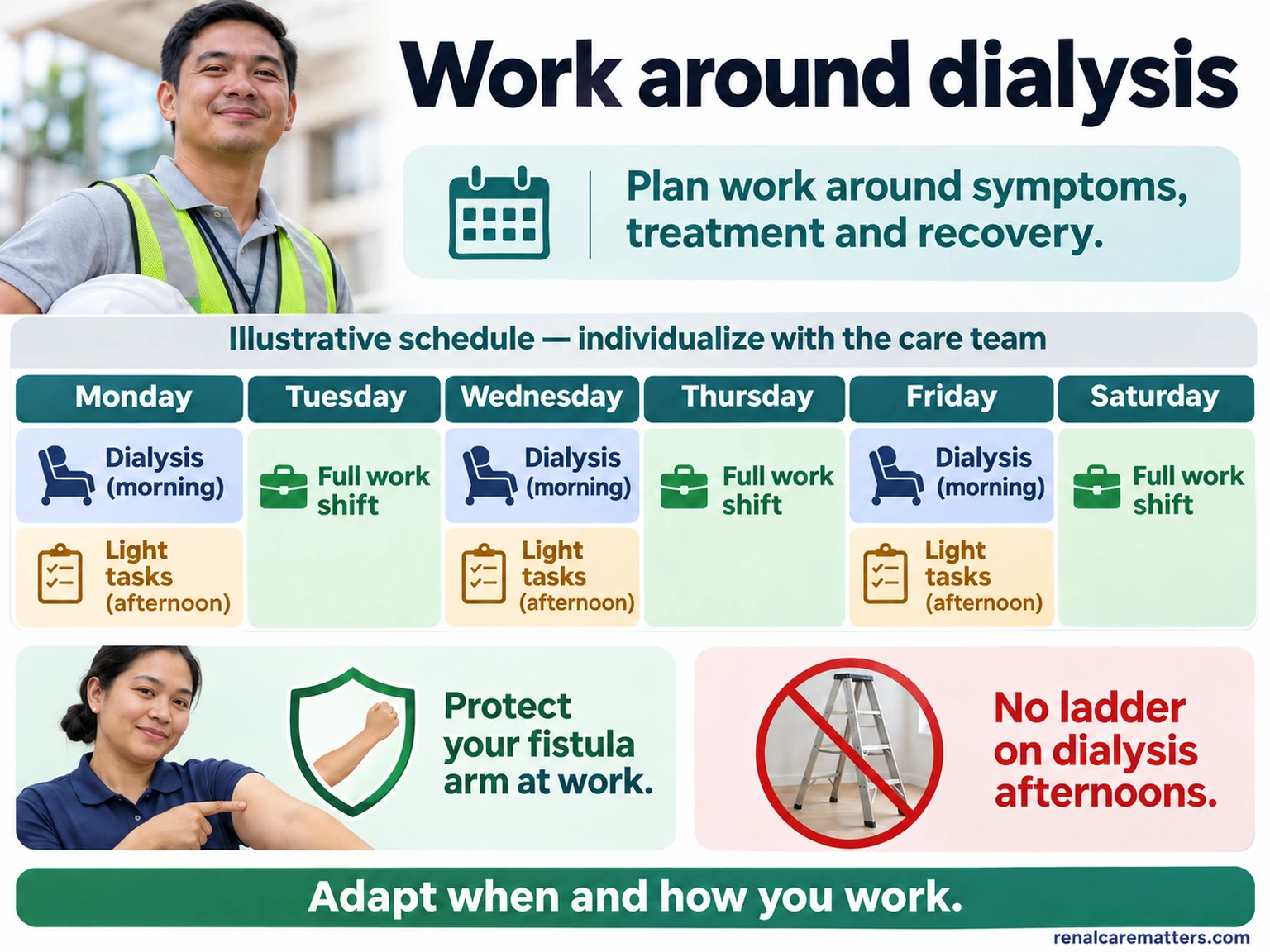
A weekly work schedule fitted around three dialysis sessions, with shifts moved to non-dialysis days and lighter tasks after sessions.
Figure 2. Work around dialysis. Most people who keep working change when, not whether.
Illustrative return-to-work plan for Mr. Santos (with his consent, his physician’s and the employer’s agreement). Job analysis: repair-shop work with standing, ladders up to 2 meters, carrying tools up to 10 kilograms, some outdoor house calls. Fit: work Tuesday, Thursday and Saturday full days; Monday, Wednesday and Friday afternoons light bench repairs only, after rest, or not at all for the first month. Protect the fistula arm (no heavy carrying with that arm, gloves for sharp work). No ladder work on dialysis afternoons. physical therapist (PT): strength and endurance program for standing tolerance and carrying (Module 9). Review at 4 weeks: hours worked, fatigue, any missed dialysis.

Talk with the person about disclosure: what the employer needs to know (the schedule and any limits) and what is private. Respect their choice, within safety.

Rehabilitation in conservative care and toward the end of life

Some people with kidney failure choose conservative kidney management instead of dialysis, often older people with many conditions. Others stop dialysis near the end of life. Rehabilitation still has a role, but the goals change: comfort, safety, independence in what matters most, energy for family, and support for carers.

RememberIn supportive care, rehabilitation measures success by what the person can still do that matters to them, not by test scores going up.

Real situations: problems and solutions

These are fictional but typical. For each one, cover the answer, decide what you would do, then compare. Where a step depends on local rules, your unit’s procedure and your supervisor’s direction come first.

Flat after good news

What you see
A patient shows no reaction to clear progress.
What is likely going on
Possible depression.
What to do
Screen with the team’s tool if used; refer.
Why it matters
Depression blocks rehabilitation and is treatable.

“I’m a burden”

What you see
A patient says the family would be better off without him.
What is likely going on
Possible suicidal thoughts.
What to do
Ask directly; stay with him; follow the urgent pathway now.
Why it matters
Asking does not cause harm; missing it can.

Back to work, too fast

What you see
A returning worker takes full shifts on dialysis afternoons.
What is likely going on
Poor fit with the schedule.
What to do
Rebuild the schedule around sessions.
Why it matters
Sustainable work beats a short, exhausting return.
Field notes
  • Ask about mood when motivation drops.
  • Never promise secrecy about self-harm.
  • Do a job analysis before return to work.
  • Set supportive-care goals from what matters now.

Back to the case: Back from Riyadh

Mr. Santos’s mood. Low energy, poor sleep, loss of enjoyment and feelings of failure suggest depression. Bea uses the service’s screening tool if it has one, asks gently about thoughts of self-harm, and refers to his physician and the mental-health pathway. She continues rehabilitation, because restored roles help, but does not treat it as a substitute for depression care.

Return to work. As above: a job analysis, a schedule built around dialysis mornings, light or no work on dialysis afternoons, fistula-arm protection, no ladders after sessions, a PT strength and endurance program, and a four-week review.

Lola Remedios. “Yes, there is a point. Therapy won’t cure her kidneys, but it can help her stay safe, comfortable and as independent as she wants to be, and help you care for her without hurting yourselves. Tell me what matters most to her now.”

Skills checklist: Mood screening, work planning and supportive goals

Role-play a conversation with a simulated patient with low mood, then a carer in conservative care. Your preceptor rates each step as satisfactory, needs practice, or not observed. Steps marked Critical must all be satisfactory before sign-off. This checklist supports supervised learning; your unit’s own procedure and competency form are the authority. A printable version of every checklist is on the trainer page.

Placement activity. For one working-age patient, complete a job analysis and draft a return-to-work plan; review it with the patient and your preceptor.

Check your understanding

Each visit draws 5 questions at random from this module’s 10-question bank. Choose the single best answer for each, then select Check answers; an explanation appears under the best answer. Select New set of questions for a different mix. A good target is 4 of 5 on two different sets. Nothing you select is sent anywhere; scoring happens in your browser.

Question 1 of 10A patient prioritizes a family gathering over longer walks. What is appropriate?
Question 2 of 10What is needed before contacting an employer about accommodations?
Question 3 of 10A patient expresses immediate self-harm danger during a visit. What is appropriate?
Question 4 of 10How should supportive care activity be selected?
Question 5 of 10Which barrier calls for social work collaboration?
Question 6 of 10In a meta-analysis, interview-diagnosed depression affected about what share of people on dialysis?
Question 7 of 10A PHQ-9 of 10 or more in dialysis patients had what sensitivity and specificity against interview?
Question 8 of 10A patient says his family would be better off without him. What do you do?
Question 9 of 10Which return-to-work plan element best fits the dialysis schedule?
Question 10 of 10In conservative kidney management, what is the main measure of rehabilitation success?

Read next on this site

Glossary & abbreviationsTalahulugan at mga daglatTalaan sa mga pulong ug daglatTalatinigan ampo reng daglat terms used on this page

Abbreviations

CKD
Chronic kidney disease.
EXCITE
Exercise Introduction to Enhance Performance in Dialysis — An Italian randomized trial of home walking.
OT
Occupational therapist — Also occupational therapy: the profession that helps people do the daily activities that matter to them.
PHQ-9
Patient Health Questionnaire-9 — A nine-item depression symptom questionnaire.
PT
Physical therapist — Also physical therapy: the profession that restores movement, strength, balance and endurance.

Terms in plain words

Depression
A treatable illness of low mood or lost interest.
PHQ-9
A depression questionnaire validated in dialysis.
Conservative kidney management
Care without dialysis, focused on symptoms and quality of life.
Goals of care
What matters most, used to guide treatment.
ReferencesMga SanggunianMga TinubdanReng Reperensya 5 sources
  1. Palmer, S., Vecchio, M., Craig, J. C., Tonelli, M., Johnson, D. W., Nicolucci, A., Pellegrini, F., Saglimbene, V., Logroscino, G., Fishbane, S., & Strippoli, G. F. M. (2013). Prevalence of depression in chronic kidney disease: Systematic review and meta-analysis of observational studies. Kidney International, 84(1), 179–191. https://doi.org/10.1038/ki.2013.77
  2. Murtagh, F. E., Addington-Hall, J., & Higginson, I. J. (2007). The prevalence of symptoms in end-stage renal disease: A systematic review. Advances in Chronic Kidney Disease, 14(1), 82–99. https://doi.org/10.1053/j.ackd.2006.10.001
  3. Watnick, S., Wang, P.-L., Demadura, T., & Ganzini, L. (2005). Validation of 2 depression screening tools in dialysis patients. American Journal of Kidney Diseases, 46(5), 919–924. https://doi.org/10.1053/j.ajkd.2005.08.006
  4. Kroenke, K., Spitzer, R. L., & Williams, J. B. (2001). The PHQ-9: Validity of a brief depression severity measure. Journal of General Internal Medicine, 16(9), 606–613. https://doi.org/10.1046/j.1525-1497.2001.016009606.x
  5. Manfredini, F., Mallamaci, F., D’Arrigo, G., Baggetta, R., Bolignano, D., Torino, C., Lamberti, N., Bertoli, S., Ciurlino, D., Rocca-Rey, L., Barillà, A., Battaglia, Y., Rapanà, R. M., Zuccalà, A., Bonanno, G., Fatuzzo, P., Rapisarda, F., Rastelli, S., Fabrizi, F., … Zoccali, C. (2017). Exercise in patients on dialysis: A multicenter, randomized clinical trial. Journal of the American Society of Nephrology, 28(4), 1259–1268. https://doi.org/10.1681/ASN.2016030378
Dr. William Gregory M. Rivero, MD

William Gregory Rivero, MD, FPCP, DPSN

Internal Medicine · Nephrology · Nutrition · Philippines · PRC 0105184

Educational material for licensed occupational and physical therapists. Completing it is an Academy learning record only. It is not a PRC, DOH, PhilHealth or PSN credential, not CPD units, and not a workplace privilege. Your license, your referral or prescription, your employer’s privileges and the renal team’s plan govern what you may do.

QR code — scan to save Dr. Rivero's contact info

Scan and save