The towel rail
- What you see
- A patient uses a towel rail to pull up from the toilet.
- What is likely going on
- An unsafe grab point.
- What to do
- Recommend a commode with arms or a proper rail.
- Why it matters
- Towel rails pull out of walls.
The person–environment fit: stairs, toilets, bathing, commuting to dialysis, and equipment that costs little and helps a lot.

Study material for licensed occupational therapists (RA 11241) and physical therapists (RA 5680) working with people who have kidney disease. It explains the reasoning behind renal rehabilitation; it is not a hospital protocol. It never authorizes changes to dialysis settings, handling of a needled access or catheter, medicine decisions or benefit promises. Exercise parameters come from the referring physician and your unit’s agreed sheet: per unit protocol, but always ask the attending nephrologist’s guidance. Every case, name and number in the cases is fictional and illustrative.
The picture has a limit. A key either fits or not. Function has degrees: a person may manage the stairs on a non-dialysis morning and fail them on a dialysis afternoon. So the home plan must work on the worst day of the dialysis week, not the best. This module is occupational therapist (OT)-led, with PT input on mobility aids and stair technique.
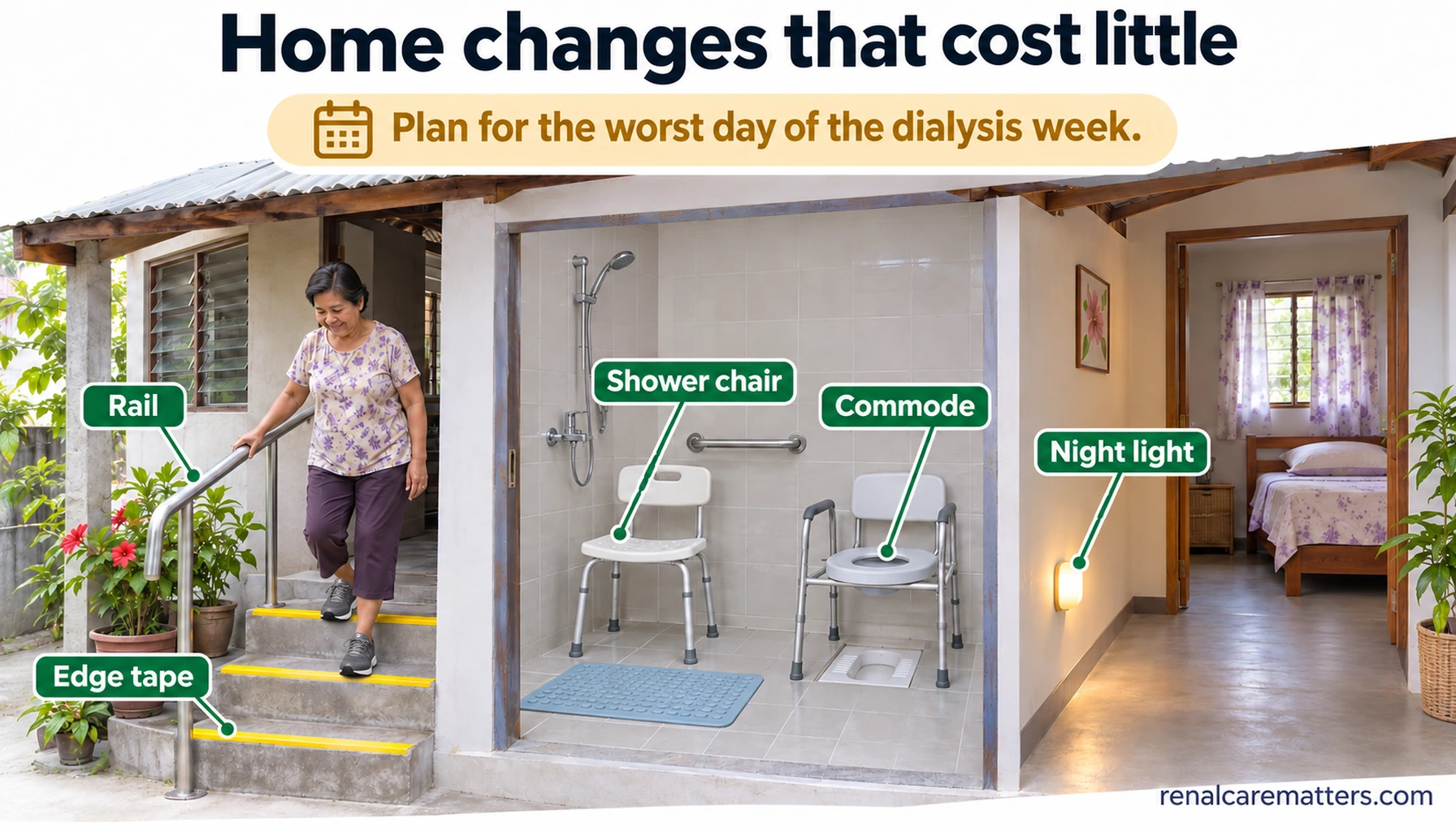
Figure 2 · Key terms for this module
Saturday, 9:00 a.m. OT Bea Santiago visits Mrs. Erlinda Pascual, 72, on hemodialysis Tuesday, Thursday and Saturday afternoons. She lives with her son’s family on the third floor of a walk-up in Caloocan: 42 steps with a rail on one side, a bathroom with a squat toilet and a 15-centimeter threshold, and a pail-and-dipper bath. She takes two jeepneys and walks 200 meters to reach the dialysis center, and has fallen once on the bathroom floor.
Her son says: “We can spend maybe 3,000 pesos. We rent; the landlord will not allow big changes.” Her PT has noted Short Physical Performance Battery (SPPB) 7 and dizziness after sessions.
Before reading on, decide:
Keep your answers in mind. The lesson gives you what you need, and the case review near the end shows one sound response.
Walk the routine, not just the floor plan. Ask the person to show you a dialysis-day evening and a non-dialysis morning: coming home, the stairs, the toilet, bathing, cooking, sleeping and getting up at night. Watch, measure and ask.
| Area | What to check | Why it matters in dialysis |
|---|---|---|
| Entrance and stairs | Number of steps, rails (one or both sides), lighting, step height and edges | Stairs after a session may coincide with low pressure and fatigue |
| Bathroom | Threshold, wet floor, toilet type and height, bathing method, grab points, hot water | Warm water and standing worsen post-dialysis dizziness; wet floors and neuropathy cause falls |
| Bedroom | Bed height, path to the toilet at night, light switches | Night-time toileting with fluid shifts and diuretics |
| Kitchen | Working height, reach, seating | Fatigue; fistula arm protection when carrying |
| Storage for dialysis supplies (PD) | Clean, dry, reachable | Heavy boxes and infection control (Module 11) |
Many effective changes are inexpensive and removable, which matters for renters and tight budgets.
Ask the social worker or local government unit about assistive-device assistance; Module 18 explains what Philippine Health Insurance Corporation (PhilHealth)’s rehabilitation pathway does and does not cover. Never promise that a device will be paid for.
Three trips a week, often in heat, crowds and traffic, after or before a draining session, is one of the heaviest tasks in a patient’s week. Missing sessions because of transport is a real cause of harm. Assess it like any other task: distances, steps up into vehicles, waiting, shade, the walk from the stop, and what happens after a session when the person is dizzy.
These are fictional but typical. For each one, cover the answer, decide what you would do, then compare. Where a step depends on local rules, your unit’s procedure and your supervisor’s direction come first.
Hardest on a dialysis day. The 42 steps on returning home in the evening, after fluid removal and with post-dialysis dizziness; bathing standing with warm water on the wet floor where she fell; and the night-time trip to the squat toilet.
Within 3,000 pesos and the landlord’s limits. A shower chair, nonslip mats, a commode chair usable over the squat toilet and at night, night lights, reflective step-edge tape and a landing rest chair; bathing seated on non-dialysis mornings with lukewarm water. A clamp-on second rail if the landlord agrees.
The journey. Her son or a neighbor accompanies the return trip; a tricycle replaces the 200-meter walk after sessions; she waits in the unit until steady; the PT adds step-up practice for jeepney steps. The plan is documented with owners and costs and shared with the renal team.
Conduct a real or virtual home walk-through with a simulated patient and family. Your preceptor rates each step as satisfactory, needs practice, or not observed. Steps marked Critical must all be satisfactory before sign-off. This checklist supports supervised learning; your unit’s own procedure and competency form are the authority. A printable version of every checklist is on the trainer page.
Each visit draws 5 questions at random from this module’s 10-question bank. Choose the single best answer for each, then select Check answers; an explanation appears under the best answer. Select New set of questions for a different mix. A good target is 4 of 5 on two different sets. Nothing you select is sent anywhere; scoring happens in your browser.

Internal Medicine · Nephrology · Nutrition · Philippines · PRC 0105184
Educational material for licensed occupational and physical therapists. Completing it is an Academy learning record only. It is not a PRC, DOH, PhilHealth or PSN credential, not CPD units, and not a workplace privilege. Your license, your referral or prescription, your employer’s privileges and the renal team’s plan govern what you may do.

Scan and save