Play, school and growth in children with kidney disease, barriers of distance and cost, and what remote rehabilitation can and cannot do.
PublishedNailathalaGipatikPepalwal:ReferencesMga SanggunianMga TinubdanReng Reperensya:1Audience: Philippine-registered occupational therapists and physical therapists who see people with kidney disease · rehabilitation leads, physiatrists and renal teams who refer to them · students on an observer pathwayRead timeOras ng pagbasaOras sa pagbasaOras ning pamamasa:
Renal rehabilitation track for licensed occupational and physical therapists
Study material for licensed occupational therapists (RA 11241) and physical therapists (RA 5680) working with people who have kidney disease. It explains the reasoning behind renal rehabilitation; it is not a hospital protocol. It never authorizes changes to dialysis settings, handling of a needled access or catheter, medicine decisions or benefit promises. Exercise parameters come from the referring physician and your unit’s agreed sheet: per unit protocol, but always ask the attending nephrologist’s guidance. Every case, name and number in the cases is fictional and illustrative.
Learning objectives
After this module you should be able to
Explain how kidney disease affects growth, development, school and play in children, and when to involve pediatric specialists.
Identify equity barriers (distance, cost, language, disability, gender roles) that limit access to renal rehabilitation.
Use remote rehabilitation safely, knowing what it can and cannot replace.
Adapt communication and materials for literacy, language and culture.
Recognize the limits of general competence in pediatric and highly specialized care, and refer.
Classroom 2 hSkills lab 2 hSupervised placement 1 h
Pre-testBefore you read, answer the 5 self-assessment questions and note your score. After the module, select New set of questions and compare. The difference is what you learned; the questions you still miss are what to reread.
Start here
The big picture, in plain words
In plain wordsA child is not a small adult. An adult with kidney failure is trying to keep what they had; a child is trying to build what they have not had yet: height, strength, skills, school, friends. Rehabilitation for a child protects development, not just function.
The picture has a limit. Children are also remarkably adaptable, and play can do the work of exercise. A pediatric approach uses games, school goals and family routines instead of sets and repetitions. Independent pediatric work needs additional competence and privileges; this module orients you to the issues and to when to refer, as the handoff that built this track specifies.
The second half of the module is about equity. In the Philippines, a person’s chance of getting rehabilitation depends heavily on where they live, what they earn and how far they are from a hospital with a rehabilitation department. Remote rehabilitation can close part of the gap, if used carefully.
Figure 1 · Key terms for this module
Developmental milestoneA skill most children gain by a certain age.
School participationAttendance, learning, physical education and friendships at school.
EquityFair access, adjusted for different needs and barriers.
TelerehabilitationAssessment or therapy delivered by video or phone.
Hybrid careCombining in-person and remote sessions.
Opening case · fictional
Case: Two patients far from the gym
Tuesday, 11:00 a.m. Jomar, 13, has been on automated peritoneal dialysis overnight for a year. He has stopped joining physical education at school because “the teacher says I might hurt my tube,” and his friends have drifted away. His height is below his classmates’. His mother asks occupational therapist (OT) Bea Santiago whether he can play basketball.
The same day, Mrs. Nenita Flores, 66, on hemodialysis on an island in Romblon, finished a physical therapist (PT) program at the provincial hospital before moving home. The nearest therapist is a two-hour boat ride away. Her daughter has a smartphone with an unreliable signal.
Before reading on, decide:
What does Jomar need, and who should be involved?
How could remote rehabilitation help Mrs. Flores, and what are its limits?
Which equity barriers do these two cases show?
Keep your answers in mind. The lesson gives you what you need, and the case review near the end shows one sound response.
Lesson · part 1
Children: growth, school and play
Chronic kidney disease in childhood can slow growth, delay motor development, weaken bone and affect learning, attention and mood. Treatment burden (dialysis hours, medicines, diet and fluid limits, hospital visits) takes time from school and play. Adolescents face a further risk: withdrawing from peers and from their own care.
Activity is generally encouraged for children with chronic kidney disease (CKD), adapted to their condition, and the Kidney Disease: Improving Global Outcomes (KDIGO) 2024 guideline’s physical activity recommendation applies across CKD with adjustment for tolerance.1 For a child on peritoneal dialysis (PD), the same abdominal and catheter principles apply as in adults (Module 11), and the pediatric nephrology team decides which sports and contact are safe.
Involve the pediatric nephrology team and, where available, pediatric therapists for assessment and any specialized intervention.
Translate goals into school and play: joining physical education with adaptations, a sport with catheter protection, carrying a school bag.
Write a short, clear letter for the school (with consent) explaining what the child can do and what to protect.
Watch for withdrawal and low mood; refer as for adults (Module 16).
RememberFor children, the goal is participation: school, play and friends. Write the plan in those terms.
Lesson · part 2
Equity: who gets rehabilitation, and who does not
Barriers to renal rehabilitation in the Philippines are practical and predictable:
Barrier
Example
Response
Distance
Island and rural patients far from rehabilitation services
Home programs, hybrid care, local health workers, sessions on dialysis days at the unit
Cost
Fares, lost wages, equipment
Low-cost equipment, social work, benefit navigation (Module 18)
Language and literacy
Tagalog, Cebuano, Kapampangan and other languages; low literacy
Materials in the patient’s language, pictures, teach-back (Module 7)
Disability
Vision loss, amputation, hearing loss
Adapted materials and equipment
Gender and roles
Women carrying household and caregiving loads; men losing breadwinner roles
Goals and schedules that fit real roles
Measure equity in your own service: who is referred, who attends, who completes, by sex, age, distance and payer. A program that only reaches patients who live near the hospital is not yet a fair program (Module 19).
Lesson · part 3
Telerehabilitation: what it can and cannot do
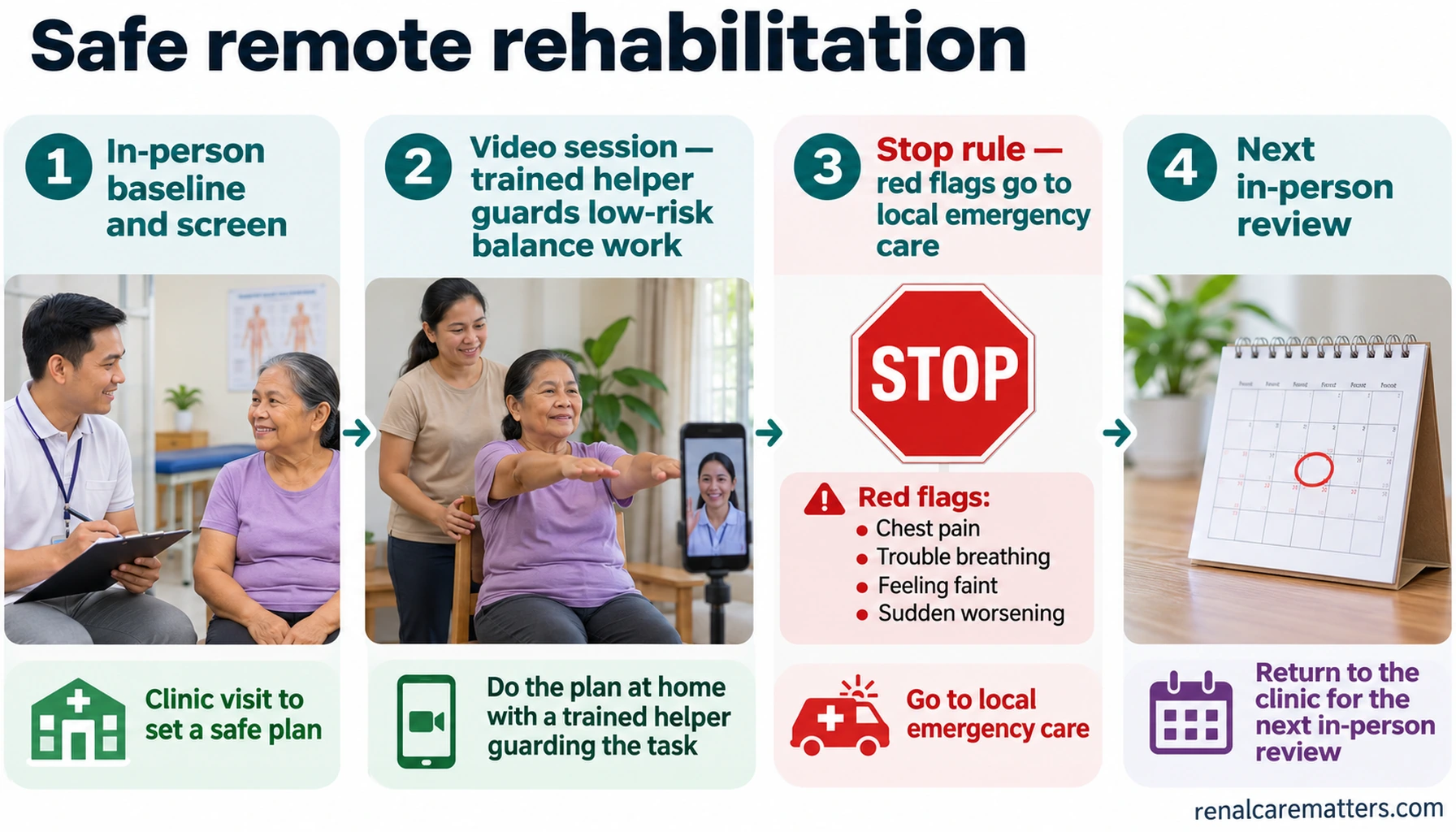
Figure 2. Safe remote rehabilitation. Built on an in-person baseline, guarded at home, with a stop rule and a next in-person visit.
Video or phone sessions can review a home program, coach progression, watch a task in the person’s own home, and keep motivation going between in-person visits. They cannot replace hands-on assessment, close guarding for balance work, or emergency response.
Figure 3 · Safe remote rehabilitation
BeforeAn in-person baseline and screen; a home set-up check; a named local contact (family member, barangay health worker); consent including privacy.
DuringConfirm identity and location; screen as in Module 3; keep exercises within what was tested in person; a family member present for any standing balance work.
Stop ruleIf the person reports red-flag symptoms, stop and direct them to local emergency help; you cannot see their pressure or reach them in time.
AfterDocument as for any session; schedule the next in-person review.
Protect privacy: use your institution’s approved platform, not personal messaging, for clinical information, and keep records in the clinical record.
RememberRemote care extends a plan that was built in person. It does not replace the in-person screen or guarding.
On the floor
Real situations: problems and solutions
These are fictional but typical. For each one, cover the answer, decide what you would do, then compare. Where a step depends on local rules, your unit’s procedure and your supervisor’s direction come first.
Banned from PE
What you see
A teacher bars a child on PD from physical education.
What is likely going on
A cautious misunderstanding.
What to do
With consent, send a letter on what the child can do and protect.
Why it matters
Exclusion harms development and friendships.
Bad signal
What you see
A video session keeps freezing during balance exercises.
What is likely going on
Unsafe remote supervision.
What to do
Stop balance work; switch to seated exercises or reschedule.
Why it matters
You cannot guard what you cannot see.
Only nearby patients
What you see
Your program’s attendees all live within 5 kilometers.
What is likely going on
An access gap.
What to do
Measure referral and attendance by distance; plan hybrid care.
Why it matters
Fairness must be measured to be improved.
Field notes
Involve pediatric specialists for children.
Do the first screen in person.
Use approved platforms for remote care.
Translate materials into the patient’s language.
Case review
Back to the case: Two patients far from the gym
Jomar. He needs participation: adapted physical education, a sport his PD team approves with catheter protection, and help reconnecting with friends. Bea involves the pediatric nephrology team and a pediatric therapist, writes a consented letter to the school explaining what he can do and what to protect, and screens for low mood. Basketball is a question for his PD team (contact, catheter, exit site); if approved, a protective belt and catheter security are part of the plan.
Mrs. Flores. A hybrid plan: her established home program reviewed by video or phone every two weeks when the signal allows, her daughter trained to guard balance work, a barangay health worker as local contact, and in-person review at the provincial hospital timed with her dialysis or other visits. Red-flag symptoms go to local emergency care.
Equity barriers. Distance and connectivity for Mrs. Flores; school attitudes and age-appropriate services for Jomar; cost and language for both.
Skills lab · with your preceptor
Skills checklist: Pediatric orientation, equity and remote care
Plan a school letter for a simulated child and run a simulated remote session for an adult. Your preceptor rates each step as satisfactory, needs practice, or not observed. Steps marked Critical must all be satisfactory before sign-off. This checklist supports supervised learning; your unit’s own procedure and competency form are the authority. A printable version of every checklist is on the trainer page.
CriticalInvolves the pediatric nephrology team and pediatric therapists for a child.
Writes a consented, plain-language school letter focused on participation.
Identifies at least three equity barriers for a patient and proposes responses.
CriticalCompletes an in-person baseline and screen before any remote program.
CriticalRuns a remote session with identity, location, screen and stop rule.
Uses an approved platform and keeps records in the clinical record.
Placement activity. Audit your caseload for one month: who was referred, who attended and who completed, by distance from the hospital.
Self-assessment
Check your understanding
Each visit draws 5 questions at random from this module’s 10-question bank. Choose the single best answer for each, then select Check answers; an explanation appears under the best answer. Select New set of questions for a different mix. A good target is 4 of 5 on two different sets. Nothing you select is sent anywhere; scoring happens in your browser.
Kidney Disease: Improving Global Outcomes (KDIGO) CKD Work Group. (2024). KDIGO 2024 clinical practice guideline for the evaluation and management of chronic kidney disease. Kidney International, 105(4S), S117–S314. https://doi.org/10.1016/j.kint.2023.10.018
Educational material for licensed occupational and physical therapists. Completing it is an Academy learning record only. It is not a PRC, DOH, PhilHealth or PSN credential, not CPD units, and not a workplace privilege. Your license, your referral or prescription, your employer’s privileges and the renal team’s plan govern what you may do.